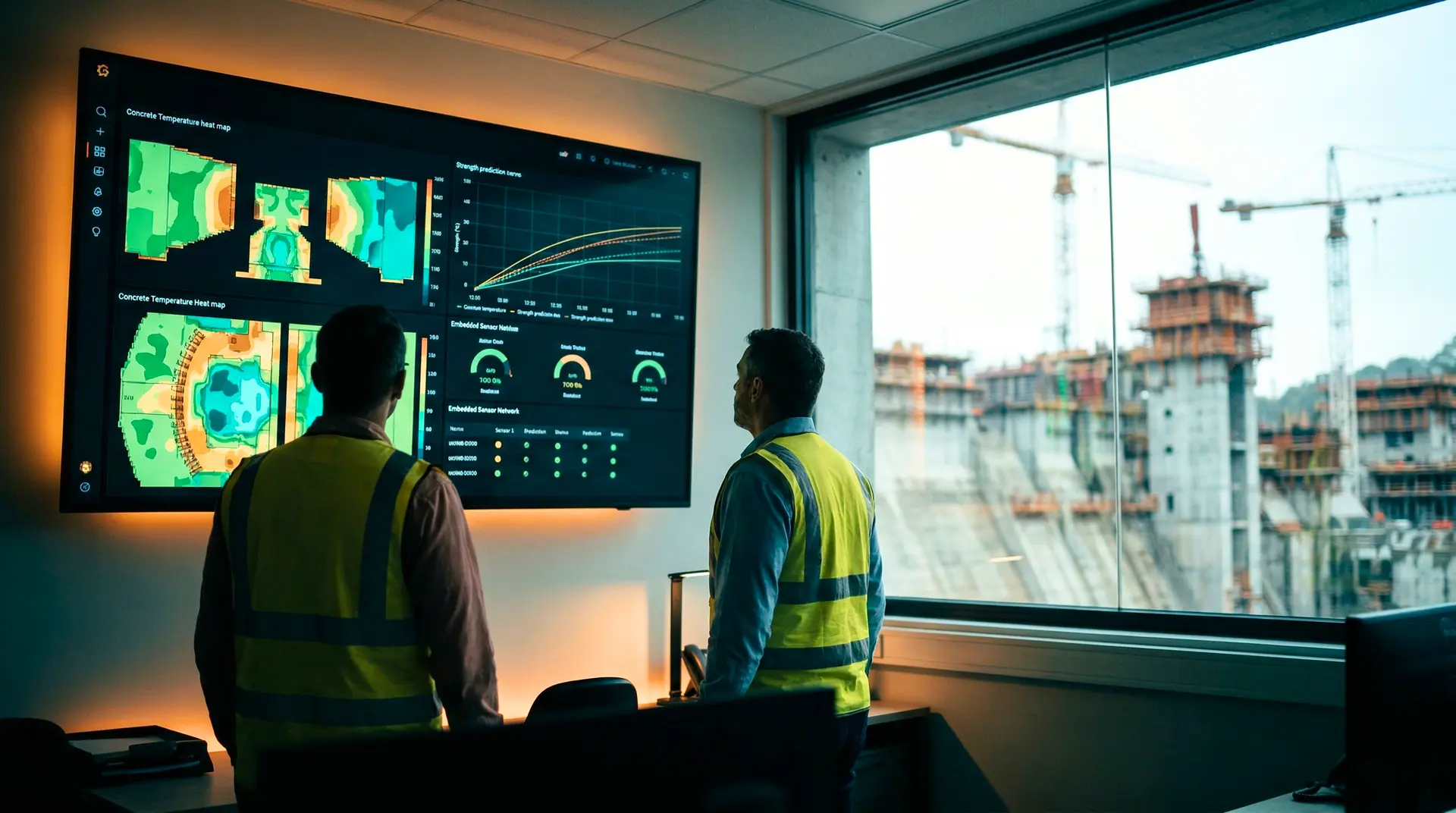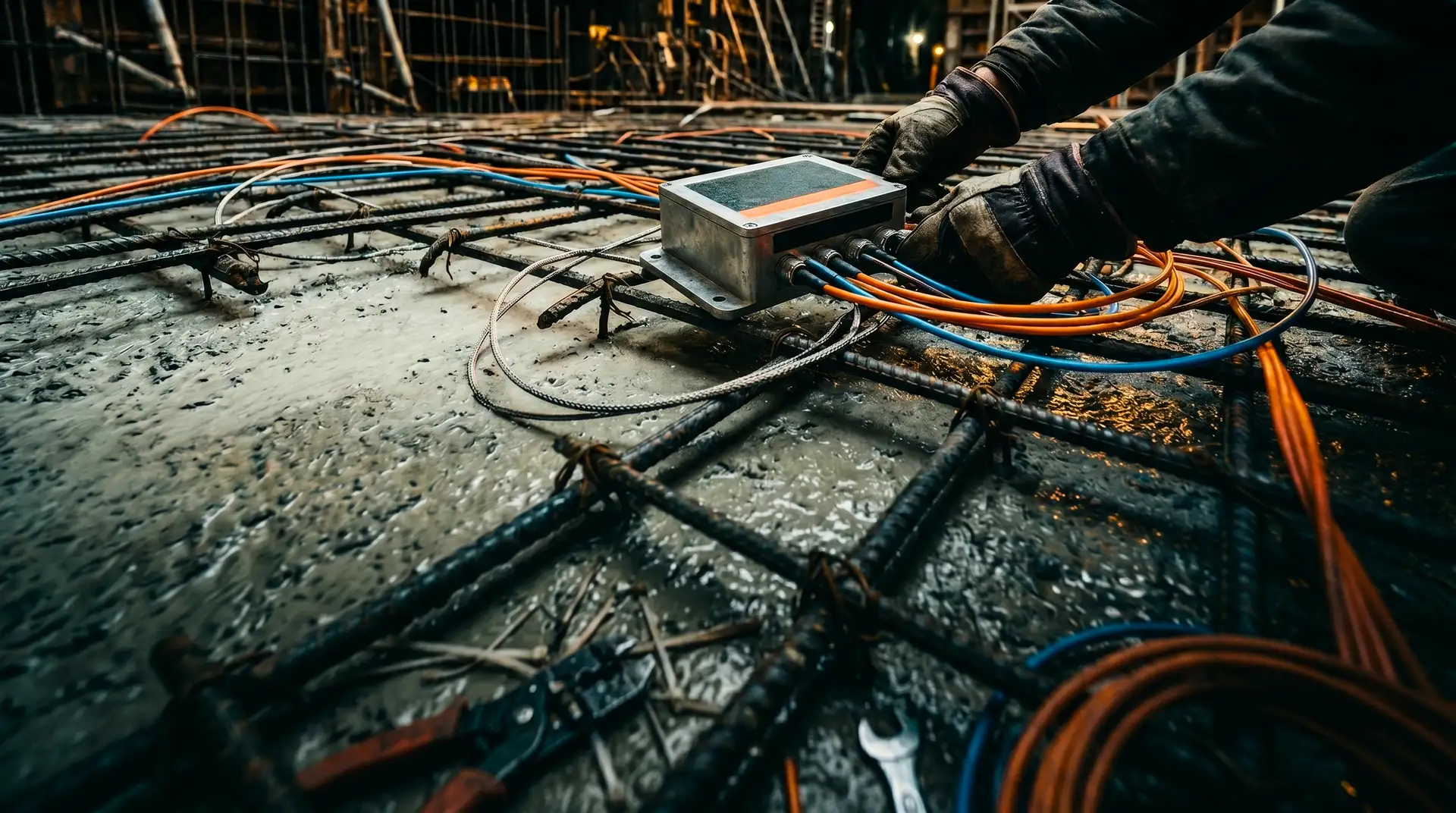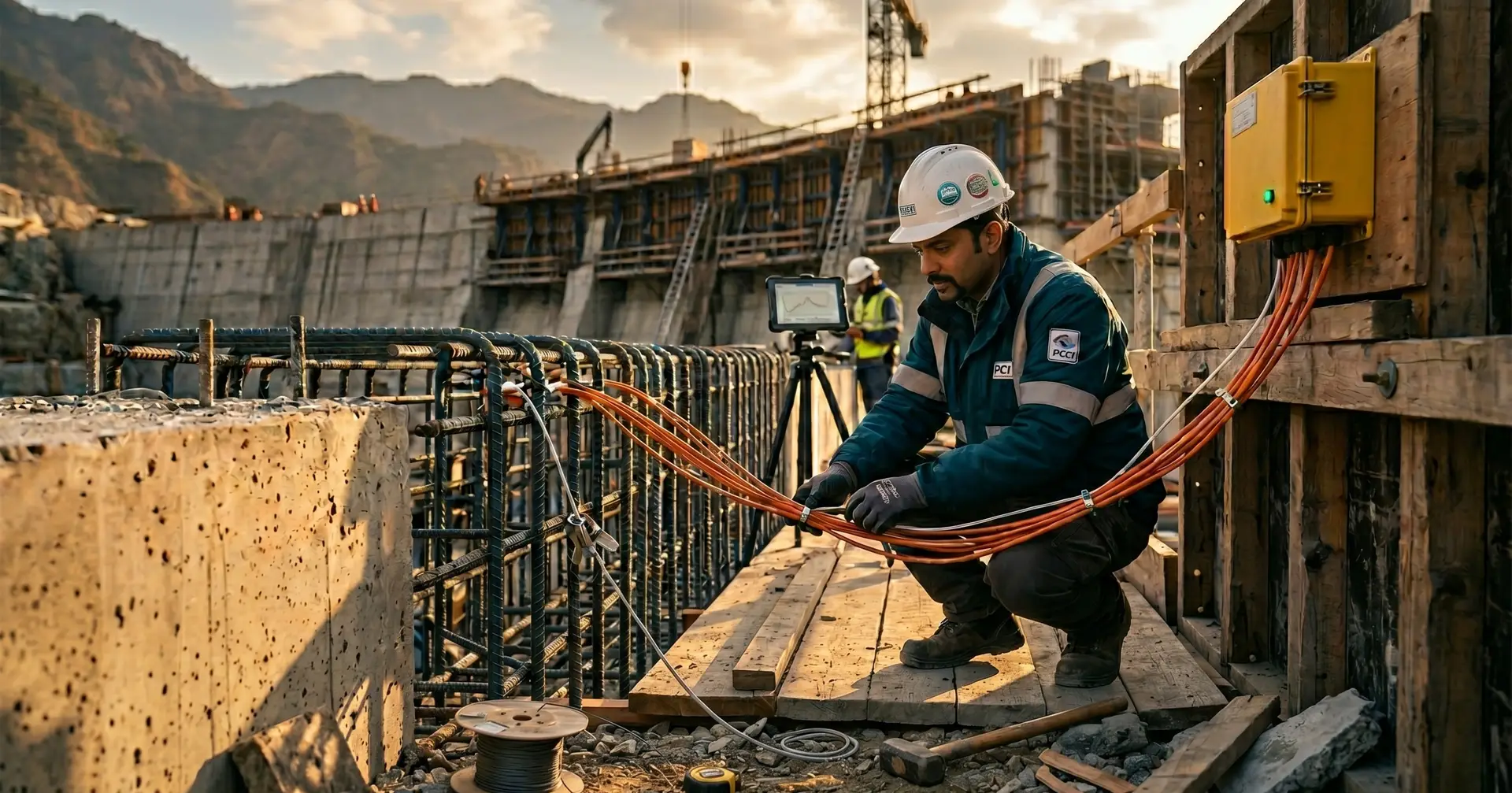
The thermal monitoring system on a typical Indian dam construction project consists of vibrating wire thermocouples embedded during placement, wired to junction boxes at the dam face, connected by cable runs to a data logger in the site laboratory. An instrument technician reads the logger, manually enters data into a spreadsheet, and compares temperatures against IS 457 or ACI 207 limits. If a reading exceeds the threshold, the information travels up the chain of command until someone authorises a change to the cooling system or placement schedule. The delay between the concrete reaching a critical temperature and the engineer learning about it can be hours. On a night shift, it can be until morning.
IoT sensor networks promise to compress this loop to minutes. The question for dam engineers is not whether faster data is better (it obviously is), but whether the specific sensor products, communication protocols, and analytical methods available today are ready for the demands of mass concrete construction on remote hydroelectric sites.
The Sensor Landscape: What Is Available
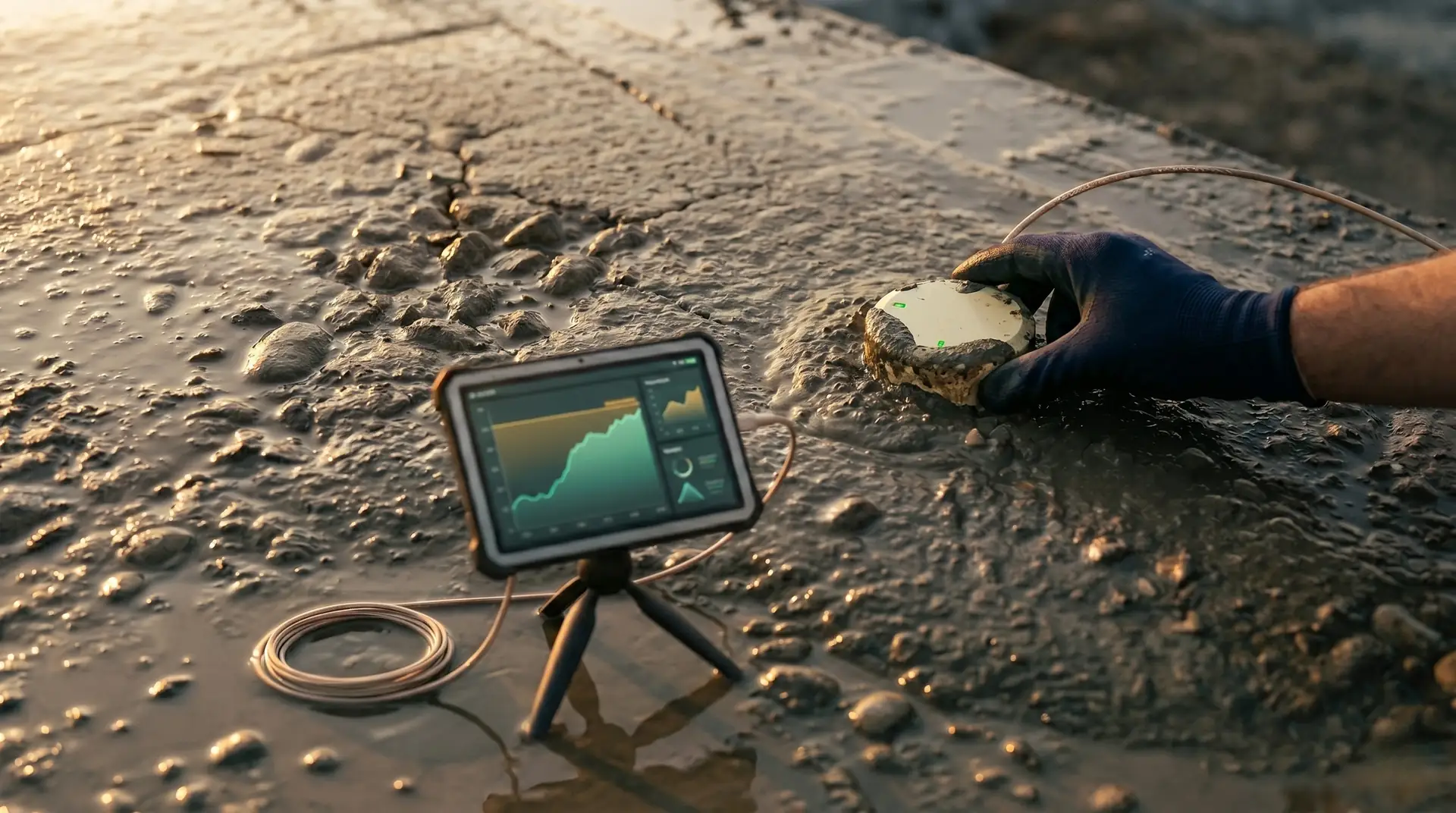
Wireless Embedded Sensors
The commercial market for wireless concrete sensors has matured significantly since 2020, driven primarily by building construction applications (post-tensioned slabs, precast elements, cold-weather concreting).
| Sensor | Temp Accuracy | Battery Life | Range (in concrete) | Cost |
|---|---|---|---|---|
| Giatec SmartRock | ASTM C1074-19 compliant | 4-5 months | 12 m (300 m with Long Range) | ~USD 85 |
| Converge Signal | +/- 0.2 deg C | 2 yr shelf + 2 yr active | 8 m at 100 mm depth | Quote-based |
| Maturix Nova | Configurable | 90-150 days | 50 m open air; 5-10 cm concrete | Quote-based |
| Vedantrik (India) | +/- 1 deg C | Battery operated | 100+ m wire length | Quote-based |
All of these use Bluetooth Low Energy (BLE) as the primary communication protocol. BLE range through concrete is the critical constraint: 8 to 15 metres through 50 to 100 mm of concrete cover. This works well for building slabs. It does not work for the centre of a mass concrete lift where the sensor may be 1 to 3 metres from the nearest accessible surface.
A 2025 study tested UHF (ultra-high frequency) sensors in large-scale concrete cubes and demonstrated reliable operation at depths up to 500 mm with 20-metre communication distance. This is a meaningful improvement over BLE, but 500 mm is still insufficient to reach the core of a standard mass concrete placement from the surface.
Fiber Optic Distributed Temperature Sensing
Fiber optic DTS takes a fundamentally different approach. Instead of discrete point sensors, a single optical fiber embedded in concrete provides continuous temperature measurement along its entire length.
Raman-based DTS responds exclusively to temperature, achieving accuracy of approximately +/- 0.1 degrees C with continuous spatial profiling. Three RCC dams (Wala and Mujib in Jordan, Schimenzhi arch dam in China) were monitored using Raman DTS between 2000 and 2002, detecting cooling effects of dam galleries and thermal gradients that conventional point sensors missed entirely.
Brillouin-based DTS (BOTDR/BOTDA) measures both temperature and strain simultaneously via the Brillouin frequency shift, enabling dual-parameter monitoring from a single fiber. Spatial resolution is approximately 1 metre with temperature accuracy of approximately +/- 0.3 degrees C.
For dam concrete, fiber optic DTS offers three advantages over wireless sensors: no battery limitations, continuous spatial coverage rather than point measurements, and no signal attenuation issues through thick concrete. The disadvantages are fragility during placement (fibers can be damaged by vibrators, pump lines, and construction traffic), the need for specialised interrogation equipment, and higher installation complexity.
The range problem in mass concrete
No commercial wireless sensor can reliably transmit through the full depth of a typical mass concrete placement (1.5 to 3 m lift heights). BLE penetrates approximately 100 mm. UHF reaches 500 mm. For dam applications, wireless sensors must be deployed with relay nodes at each lift surface or supplemented by fiber optic or wired systems for core temperature measurement.
The Maturity Method: Promise and Limitations for Dam Concrete
Most IoT concrete sensors use the ASTM C1074 maturity method to estimate in-place strength from temperature history. The method correlates cumulative time-temperature exposure (either Nurse-Saul maturity index or Arrhenius equivalent age) with compressive strength development based on a calibration curve developed from laboratory testing of the project mix.
For building construction, IoT sensor implementations achieve prediction accuracy within 1 to 2 MPa of measured compressive strength. This has made wireless maturity sensors standard practice on many commercial projects, reducing the need for early-age cylinder breaks to guide formwork stripping and post-tensioning schedules.
Why Mass Concrete Is Different
The US Army Corps of Engineers ERDC Technical Report SL-96-16 tested the maturity method at Red River Lock and Dam 4 and found a critical limitation: strength predictions were reasonably accurate in the first few days but diverged widely from core-measured strengths after that period.
The reason is fundamental. Mass concrete sustains high internal temperatures (50 to 70 degrees C or higher) for weeks or months due to the heat of hydration in thick sections. The maturity method assumes a monotonic relationship between temperature history and strength development. In reality, prolonged exposure to elevated temperatures can accelerate early strength gain while reducing ultimate strength (the crossover effect), and the maturity function’s temperature sensitivity (activation energy) may not be constant across the full temperature range experienced in mass concrete.
For dam QA/QC, this means the maturity method can serve as a real-time indicator of curing progress and thermal history but cannot replace cylinder break tests for acceptance. ACI 318-25 (Building Code Requirements for Structural Concrete) defines concrete acceptance based on field-cured and lab-cured cylinder tests, not maturity estimates. No Indian standard recognises maturity-based strength estimation for acceptance purposes.
What the Maturity Method Is Good For on Dam Sites
Despite its limitations for strength acceptance, the maturity method provides genuine value on dam projects in three ways:
Early thermal alarm. The temperature data itself (independent of the strength estimate) provides early warning of approaching thermal limits. A sensor reading 45 degrees C and rising at 2 degrees C per hour at the core of a fresh placement is actionable information, regardless of the maturity-derived strength estimate.
Comparative curing assessment. Comparing maturity indices across different placements of the same mix identifies placements that are curing differently, flagging potential issues (cold joints, inadequate insulation, cooling system malfunction) before they manifest as strength deficiencies in cylinder tests.
Formwork stripping decisions. For formed surfaces on dam faces, piers, and abutments, maturity data can support earlier formwork removal when the data confirms adequate early strength, accelerating the construction schedule without additional cylinder testing.
Connectivity for Remote Dam Sites
A sensor that cannot transmit its data to the engineer is an expensive thermocouple. Connectivity is the infrastructure layer that makes IoT monitoring viable, and remote hydroelectric dam sites present severe connectivity challenges.
LoRaWAN: The Leading Option
LoRaWAN (Long Range Wide Area Network) provides 10+ km line-of-sight range from a single gateway, connecting hundreds of sensors on sub-GHz frequencies. The low power consumption enables years of battery life on gateway-connected sensors. For remote dam sites without internet backhaul, LoRaWAN Gateway Mesh protocol relays data through intermediate gateways to a border gateway with network connectivity.
The architecture for a dam site: embedded sensors communicate via BLE or UHF to local receivers at the dam face. These receivers relay data via LoRaWAN to a site gateway. The gateway connects to cloud platforms via satellite (Starlink, Iridium) or cellular backhaul where available.
NB-IoT: Where Cellular Exists
NB-IoT (Narrowband IoT) operates on licensed cellular spectrum with better interference protection and deep penetration. Each cell supports up to 100,000 devices. For dam sites within range of a cellular tower, NB-IoT provides a simpler architecture than LoRaWAN mesh.
The Reality Check
Neither LoRaWAN nor NB-IoT has been documented in published case studies for dam concrete sensor networks specifically. The technology is proven for water level monitoring, environmental sensing, and structural health monitoring at dams, but the specific application of relaying embedded concrete sensor data from active construction zones has not been validated in published literature.
Practical Deployment on a Dam Site
What Works Today
Hybrid instrumentation. Use conventional thermocouples at all code-required locations for compliance documentation. These satisfy CWC and IS 457:1957 (Code of Practice for Plain and Reinforced Concrete for Dams) requirements and provide the long-term reliability (20+ year service life) needed for operational monitoring. Supplement with wireless IoT sensors in critical zones where higher temporal resolution or additional spatial coverage adds value: mass concrete cores during peak hydration, cooling pipe inlet and outlet zones, lift interfaces during early age, and locations where the thermal control plan identifies elevated cracking risk.
Fiber optic DTS for spatial mapping. For projects where comprehensive thermal mapping across entire dam sections is required (arch dams, high-head gravity dams, or dams with complex cooling systems), fiber optic DTS provides coverage that no discrete sensor network can match. Install fiber loops in planned patterns during placement, with interrogation points accessible from galleries or the dam crest.
Wired data loggers with wireless backhaul. A pragmatic middle ground: conventional wired thermocouples connected to modern data loggers with wireless (LoRaWAN or cellular) backhaul to a site server. This preserves the reliability of wired sensors while enabling real-time data access and automated alerting. Encardio-Rite has deployed this approach on 70 dams under DRIP across India.
What Does Not Work Yet
Wireless-only monitoring for mass concrete cores. Signal attenuation through thick concrete sections makes wireless-only systems unreliable for core temperature measurement. Until sensor technology overcomes the 500 mm depth limitation, wired or fiber optic sensors remain necessary for the most critical measurement locations.
Maturity-based acceptance. Neither ACI 318 nor any Indian standard accepts maturity-estimated strength as a substitute for cylinder break tests. IoT sensor maturity data is supplementary information, not acceptance documentation.
Autonomous curing control. Research systems that integrate IoT sensors with automated water spray valves for curing exist in laboratory settings, but have not been validated on dam construction sites where scale, access constraints, and environmental conditions (wind, temperature extremes, sediment exposure) create practical challenges that laboratory systems do not address.
Sensor Density and Placement Strategy
Indian dam instrumentation practice typically places temperature probes every 15 to 20 metres along the cross-section and every 10 metres along elevation. For IoT-enhanced monitoring, additional sensors at the following locations provide the highest incremental value:
- Centroid of each monitored placement (2 sensors minimum per ACI 207)
- 50 mm inside each formed face closest to the centroid (2 sensors per ACI 207)
- Cooling pipe inlet and outlet locations to monitor cooling system effectiveness
- Lift interfaces during the first 72 hours to detect cold joint formation risk
- Gallery and opening surrounds where geometric discontinuities concentrate thermal stresses
The Indian Standards Gap
No BIS standard addresses IoT sensor-based concrete monitoring, wireless temperature sensing, or maturity method data for acceptance. IS 456 and IS 14959 cover conventional thermocouple-based monitoring. CWC Guidelines for Instrumentation of Large Dams specify monitoring parameters and frequencies but do not reference wireless or IoT systems.
This gap has a practical consequence: IoT sensor data on Indian dam projects operates as supplementary information. All compliance documentation must rely on conventional instrumentation satisfying CWC and IS code requirements. Engineers who deploy IoT sensors must maintain parallel conventional systems, adding cost rather than replacing it.
The Dam Safety Act 2021 and DRIP Phase II provisions for automated data collection create an implicit pathway for IoT adoption. As DRIP-funded deployments demonstrate the value of automated monitoring (Encardio-Rite’s 70-dam programme is generating significant operational data), future CWC guideline revisions will likely accommodate IoT-based systems.
Emerging technology: passive RFID
Passive RFID sensors offer a batteryless alternative for long-term concrete monitoring. Radio frequency energy from the reader activates the tag via backscattering, eliminating battery life constraints entirely. Testing has validated both HF (13.56 MHz) and UHF RFID tags embedded in concrete for monitoring temperature, humidity, and corrosion indicators. For dam structures requiring decades of monitoring, passive RFID may eventually replace battery-dependent wireless sensors.
Cost Considerations
A realistic cost comparison must account for total installed cost, not just sensor price:
| System | Sensor Cost | Infrastructure Cost | Labour | Data Access |
|---|---|---|---|---|
| Conventional thermocouples + wired logger | Low (~USD 1/ft wire) | Data loggers, conduit, junction boxes | High (wiring, manual reads) | Manual or semi-automated |
| IoT wireless sensors | ~USD 85/sensor | Gateways, backhaul | Lower (no wiring) | Real-time automated |
| Fiber optic DTS | ~USD 1-10/m cable | Interrogation unit (USD 20-50K) | Moderate (careful installation) | Real-time continuous |
| Hybrid (thermocouple + IoT supplement) | Combined | Combined | Moderate | Mixed |
For a large hydroelectric project, the incremental cost of adding IoT sensors to a conventional monitoring programme is modest relative to total concrete costs. The value comes from faster response to thermal exceedances, reduced manual data collection labour, and enhanced spatial resolution in critical zones.
ACI-published research reports that machine learning applied to IoT sensor data improves concrete performance prediction accuracy by 31.6% compared to conventional methods, suggesting that the data quality improvement from continuous automated monitoring compounds into better engineering decisions.
Recommendations
For Indian dam projects planning instrumentation programmes, PCCI’s QA/QC consulting practice recommends:
-
Design the conventional monitoring system first. Meet all CWC and IS code requirements with proven thermocouple-based instrumentation. This is non-negotiable.
-
Identify high-value IoT supplement zones. Select 3 to 5 critical locations per dam section where higher temporal or spatial resolution provides actionable information: peak hydration zones in the first 72 hours, cooling system performance verification points, and lift interfaces during early curing.
-
Specify wireless sensors with adequate range for the application. BLE sensors work for dam face and gallery-adjacent placements. UHF or wired sensors are required for mass concrete core locations. Do not specify BLE sensors for locations deeper than 100 mm from an accessible surface.
-
Plan the connectivity architecture before construction. LoRaWAN gateway placement, backhaul connectivity (satellite or cellular), and data platform architecture should be designed during the pre-construction phase, not retrofitted after sensors are embedded.
-
Use maturity data as supplementary, not acceptance. Document maturity-estimated strength alongside cylinder break results for trend analysis and early warning, but do not use maturity data for contractual acceptance decisions.
-
Feed IoT data into the digital twin when ready. The real-time sensor network is the input layer for predictive thermal modelling. Design the sensor network with this future integration in mind, even if the digital twin is not deployed from day one.
For instrumentation planning and QA/QC system design on hydroelectric dam projects, contact PCCI’s consulting team.