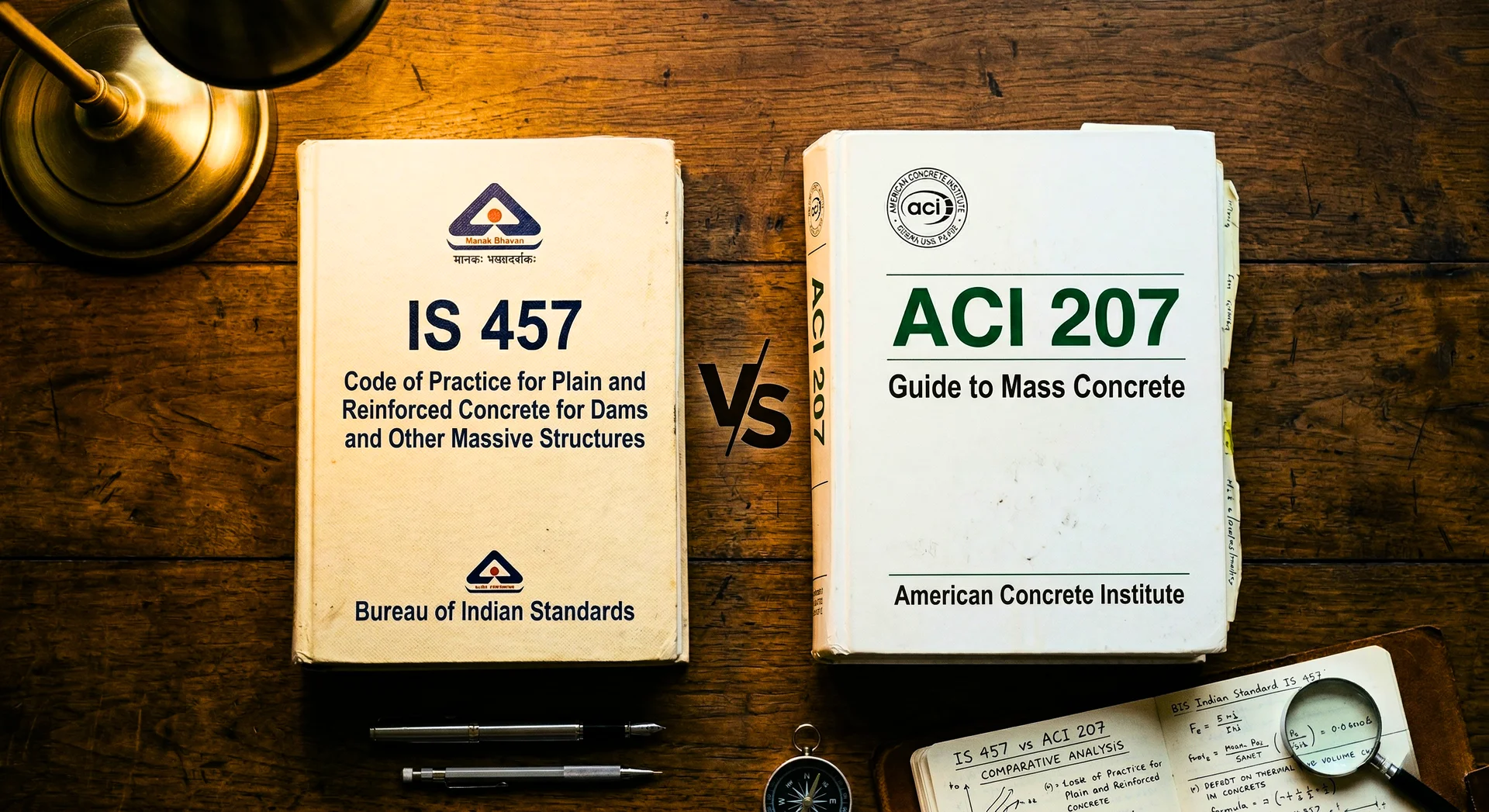
There is a 64-year gap between India’s primary mass concrete standard and its American counterpart.
IS 457, “Code of Practice for General Construction of Plain and Reinforced Concrete for Dams and Other Massive Structures,” was published by the Bureau of Indian Standards in 1957. It has not been revised since. The world it was written for had no finite element analysis, no supplementary cementitious materials beyond basic pozzolans, no roller compacted concrete, and no understanding of alkali-aggregate reaction as we know it today.
ACI 207, by contrast, is a family of six documents that have been updated multiple times, most recently in 2021. They cover mass concrete properties, thermal and volume change effects, evaluation practices, cooling systems, RCC, and placement methods.
For Indian dam engineers, the practical consequence is this: you are contractually bound to IS 457 and IS 14591, but the actual engineering decisions on your project are guided by ACI 207 and ICOLD bulletins. This creates a dual-standard reality that affects everything from bid document preparation to site-level quality control.
Here is how the two standards compare, where IS 457 falls short, and what Indian dam engineers actually do in practice.
The Documents
IS 457:1957
A single document covering general construction practice for plain and reinforced concrete in dams and massive structures. Published 1957. Supplemented by IS 14591:1999 (Temperature Control of Mass Concrete for Dams and Other Massive Structures).
ACI 207 Series
A family of six committee reports:
| Document | Title | Latest Edition |
|---|---|---|
| ACI 207.1R | Guide to Mass Concrete | 2005 (reapproved 2012) |
| ACI 207.2R | Report on Thermal and Volume Change Effects on Cracking | 2007 (reapproved 2021) |
| ACI 207.3R | Practices for Evaluation of Concrete in Existing Massive Structures | 2013 |
| ACI 207.4R | Cooling and Insulating Systems for Mass Concrete | 2005 (reapproved 2012) |
| ACI 207.5R | Guide for Roller-Compacted Mass Concrete | 2011 |
| ACI 207.6R | Report on Mass Concrete for Dams | 2017 |
The difference is not just age. ACI 207 is a living system of documents that reflects 60+ years of accumulated research, field data, and evolving construction practice. IS 457 is a snapshot of 1957 knowledge.
Material Specifications
Cement and Cementitious Materials
IS 457: References cement types available in 1957. Does not address blended cements, fly ash replacement limits, GGBS, silica fume, or modern supplementary cementitious materials in any meaningful way. SCM provisions must be sourced from IS 456:2000 (Amendment No. 6, 2024) and project-specific specifications.
ACI 207.1R: Comprehensive treatment of cementitious materials including Portland cement types, fly ash (Class F and Class C), GGBS, silica fume, and natural pozzolans. Discusses optimal SCM replacement rates for mass concrete (typically 25-50% for fly ash, higher for GGBS), heat generation characteristics of different binder systems, and the relationship between SCM content and long-term strength development.
What Indian engineers actually do: Reference ACI 207.1R and ICOLD Bulletin 126 for cementitious material selection, while ensuring compliance with IS 456:2000 SCM limits (fly ash up to 35%, GGBS at approximately double the fly ash replacement ratio).
Aggregates
IS 457: General aggregate requirements based on 1957 knowledge. Does not address alkali-aggregate reactivity (AAR) testing or prevention, which was not well understood when the standard was written.
ACI 207.1R: Detailed treatment of aggregate properties for mass concrete, including thermal properties, elastic modulus, specific heat, and conductivity. Addresses AAR prevention through ASTM C1260 and C1293 testing protocols.
The gap matters: AAR has affected multiple Indian dams (Rihand, Hirakud, Nagarjuna Sagar) precisely because the governing Indian standard predates modern understanding of the problem. Project teams must reference ACI, ASTM, and ICOLD guidance for AAR prevention.
Thermal Control
This is where the gap is most consequential for dam engineers.
Temperature Limits
IS 457/IS 14591: Provides general guidance on controlling temperature rise in mass concrete. IS 14591 addresses thermal control more specifically but does not provide the quantitative thermal modelling framework that modern practice requires. Temperature differential limits are not specified with the precision of ACI 207.2R.
ACI 207.2R: Provides a comprehensive framework for predicting temperature rise, calculating thermal gradients, and determining cracking risk. The commonly referenced limit of 20 degrees C maximum differential between peak concrete temperature and the mean annual ambient temperature originates from this document. Includes methods for calculating adiabatic temperature rise, accounting for heat dissipation, and determining the timing and magnitude of thermal stresses.
Pre-Cooling and Post-Cooling
IS 457: References the concept of cooling but does not provide detailed design guidance for pre-cooling systems (chilled water, ice flaking, aggregate cooling) or post-cooling systems (embedded pipe cooling).
ACI 207.4R: Dedicated entirely to cooling and insulating systems. Covers pre-cooling methods, embedded pipe cooling design (pipe spacing, flow rates, cooling water temperatures, duration), insulation for cold weather protection, and integration of cooling systems with placement schedules.
What this means on site: When an Indian dam project needs to design its cooling system, IS 457 provides almost no guidance. The engineering team references ACI 207.4R for embedded pipe design, project-specific thermal modelling (typically using finite element software), and experience from previous projects.
Thermal Modelling
IS 457: Predates computational thermal modelling entirely. No provisions for finite element analysis of thermal stresses.
ACI 207.2R: Provides the theoretical framework and input parameters for thermal analysis, including adiabatic temperature rise curves for different cementitious material systems, thermal properties of concrete (conductivity, diffusivity, specific heat), and methods for predicting thermal cracking.
In practice, every major Indian dam project now uses finite element thermal modelling. The input parameters and methodology come from ACI 207 and fib Model Code, not IS 457.
Placement and Construction
Lift Height and Placement Intervals
IS 457: Specifies general guidance on lift heights (typically 1.5 metres for conventional concrete) and placement intervals. The provisions reflect construction capabilities and practices of the 1950s.
ACI 207.6R: Provides detailed guidance on placement methods, lift heights (including the rationale for different heights based on thermal analysis), placement intervals based on maturity methods, and integration with cooling systems. Addresses both conventional placement and modern high-production-rate methods.
Roller Compacted Concrete
IS 457: No provisions. RCC was not developed until the 1970s-80s.
ACI 207.5R: A complete guide to RCC mass concrete, covering mix design, production, placement, compaction, lift joint treatment, curing, and quality control. This is the primary international reference for RCC dam construction.
IS 456:2025 draft: For the first time, includes an RCC chapter under the Indian standards framework, partially addressing this 40+ year gap.
Durability and Service Life
Exposure Classification
IS 457: Exposure classifications based on 1957 understanding. Does not address modern durability concepts such as service-life design, performance-based durability, or quantitative deterioration modelling.
ACI 207.3R: Specifically addresses evaluation of concrete in existing massive structures, including methods for assessing deterioration, testing protocols for aged concrete, and criteria for determining whether concrete meets current performance requirements.
AAR Prevention
IS 457: Silent on alkali-aggregate reaction.
ACI 207.1R/ASTM: Comprehensive AAR prevention through aggregate testing (ASTM C1260, C1293), cement alkali limits, and SCM strategies for mitigating reactive aggregates.
This is not an academic concern. Indian cement historically contains 1.2-1.8% equivalent alkalis, significantly higher than the 0.6% limit recommended by ACI for AAR prevention. Without explicit AAR provisions in IS 457, the onus falls entirely on the concrete technology consultant to specify appropriate testing and prevention measures.
Quality Control
IS 457: Basic QC provisions reflecting 1957 testing capabilities.
ACI 207 series: Modern QC frameworks including maturity methods for strength assessment, non-destructive testing protocols, in-situ temperature monitoring requirements, and statistical acceptance criteria.
The Practical Reality on Indian Dam Sites
The dual-standard reality on Indian dam projects typically works like this:
- Contract documents reference IS 457 and IS 14591 as governing standards
- Project specifications supplement with ACI 207 series provisions for thermal control, cooling design, and RCC (if applicable)
- ICOLD bulletins are referenced for dam-specific guidance not covered by either standard
- The concrete technology consultant bridges the gap, translating international best practice into specifications that satisfy Indian contractual requirements while meeting modern engineering standards
This arrangement works, but it depends entirely on the consultant’s expertise. There is no standardized framework that maps IS 457 provisions to modern equivalents or identifies which areas require supplementation from international standards.
What Needs to Change
In the Short Term
The IS 456:2025 revision addresses some gaps by including RCC and HPC chapters, performance-based durability provisions, and alignment with fib Model Code 2020. This is significant progress, but IS 456 is primarily a structural concrete standard, not a mass concrete construction standard.
In the Medium Term
IS 457 itself needs revision. A 67-year-old construction code cannot govern 21st-century dam construction. The revision should:
- Incorporate thermal modelling requirements and temperature differential limits
- Address SCM provisions specifically for mass concrete
- Include AAR prevention requirements
- Provide RCC placement and quality control provisions
- Address pre-cooling and post-cooling system design
- Align with IS 14591 and the IS 456:2025 revision
- Reference modern testing standards (IS 516 series, IS 13311 series)
In the Immediate Term
Dam engineers should document which ACI 207 provisions they reference on each project and why IS 457 does not cover those areas. This creates the evidence base for advocating a revision and ensures project specifications are defensible if challenged.
Quick Reference: IS 457 vs ACI 207
| Topic | IS 457:1957 | ACI 207 Series | Gap |
|---|---|---|---|
| Last updated | 1957 | 2005-2021 | 64 years |
| Thermal modelling | Not addressed | Comprehensive (207.2R) | Critical |
| Temperature limits | General guidance | Quantitative framework | Critical |
| Pre/post-cooling design | Mentioned | Dedicated document (207.4R) | Significant |
| RCC | Not addressed | Comprehensive (207.5R) | Critical |
| AAR prevention | Not addressed | Addressed (207.1R + ASTM) | Critical |
| SCM provisions | Minimal | Detailed (207.1R) | Significant |
| Placement methods | 1957 practice | Modern methods (207.6R) | Significant |
| Evaluation of existing concrete | Not addressed | Dedicated document (207.3R) | Significant |
| Quality control | Basic | Modern statistical methods | Moderate |
| Service-life design | Not addressed | Performance-based approach | Significant |
The concrete code that governs India’s dam construction is older than most of the engineers using it. Until IS 457 is revised, the bridge between 1957 provisions and 2026 practice is the concrete technology consultant.