
The physics problem at the heart of every dam
Cement hydration is an exothermic reaction. When Ordinary Portland Cement (OPC) reacts with water, it generates approximately 280 kJ/kg of heat within the first 7 days, and up to 321 kJ/kg by 28 days. In a 300mm slab, this heat dissipates to the environment within hours. In a 3-metre dam lift, it has nowhere to go.
The interior of a mass concrete placement can reach 70-80°C within 48 hours of casting. The surface, exposed to ambient air or cooling water, may be at 15-25°C. This temperature differential generates tensile stress in the surface zone, and concrete is weak in tension.
The critical threshold
[ACI 301](https://www.concrete.org) limits the maximum temperature differential between the core and surface of mass concrete to 19-20°C (35°F). Beyond this limit, the tensile strain induced by differential thermal contraction exceeds the tensile strain capacity of young concrete, causing cracks.
When a dam cracks due to thermal stress, the consequences cascade: seepage paths form through the structure, internal erosion begins, reinforcement corrodes, and the structure’s watertightness, its primary functional requirement, is compromised.
How heat of hydration varies by cement type
Not all cements generate equal heat. The composition of clinker minerals, particularly the proportions of tricalcium silicate (C₃S) and tricalcium aluminate (C₃A), determines the rate and magnitude of heat evolution.
| Cement Type | 7-Day Heat (kJ/kg) | Relative Heat |
|---|---|---|
| OPC (Grade 43) | ~280 | Baseline |
| Portland Pozzolana Cement (PPC) | ~190-225 | 30% lower |
| Low-Heat Portland Cement (PLH) | ≤272 | 10-15% lower |
| OPC + 50% GGBS | ~140-170 | 40-50% lower |
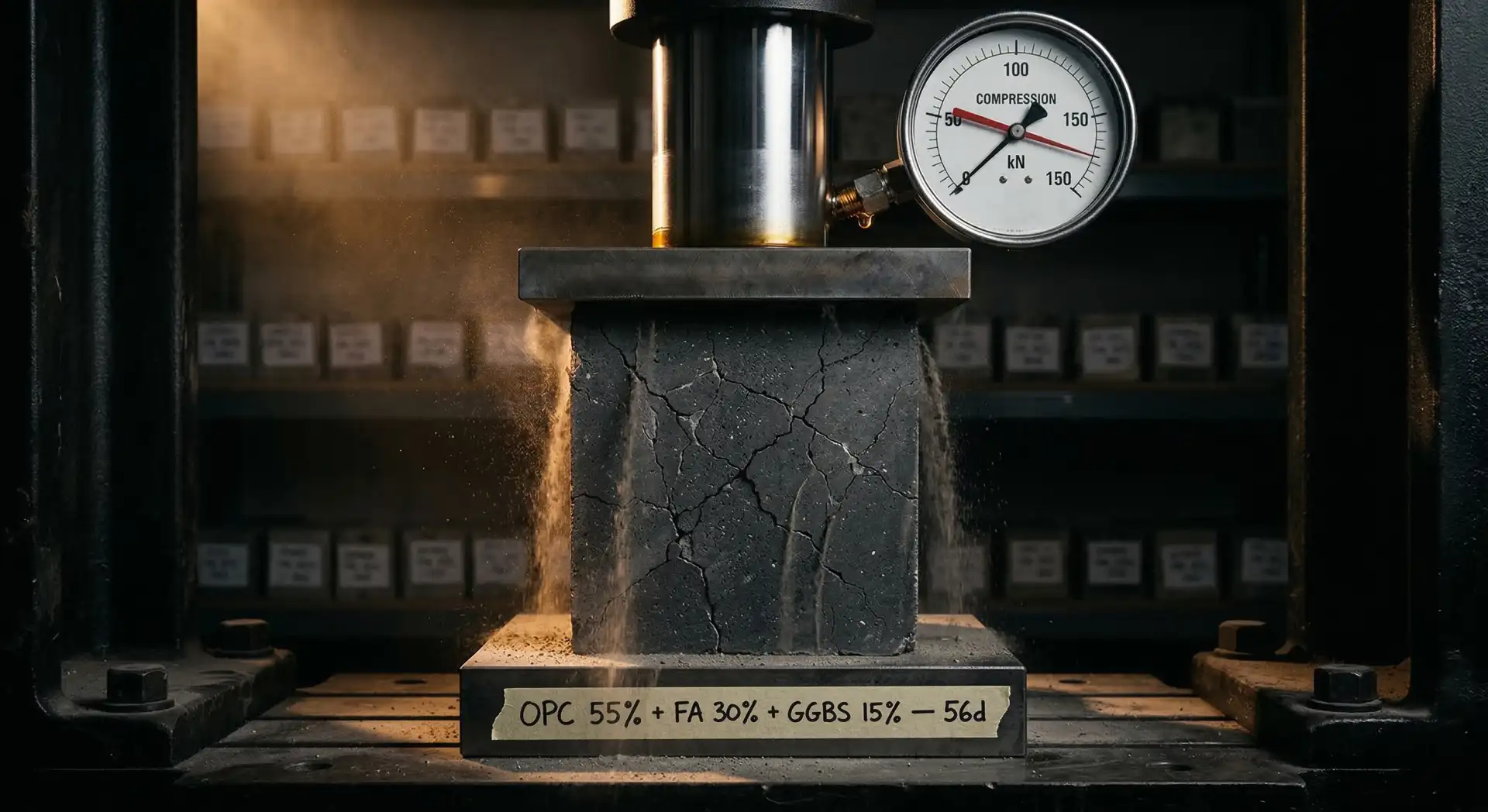
The choice of cement, or more precisely the cementitious system, is the first and most impactful thermal control decision. On PCCI’s engagement at the Tanahu Hydropower Project in Nepal, high fly ash content with low cement was specified specifically to achieve thermal and durability objectives simultaneously: lower peak temperatures, reduced thermal differentials, and enhanced resistance to alkali-aggregate reaction (AAR).
Pre-cooling: reducing the starting temperature
The peak temperature inside a mass concrete pour is the sum of the placement temperature plus the temperature rise from hydration. If you cannot fully control the temperature rise (which depends on cement content and type), you must control the placement temperature.
Common pre-cooling methods on dam projects:
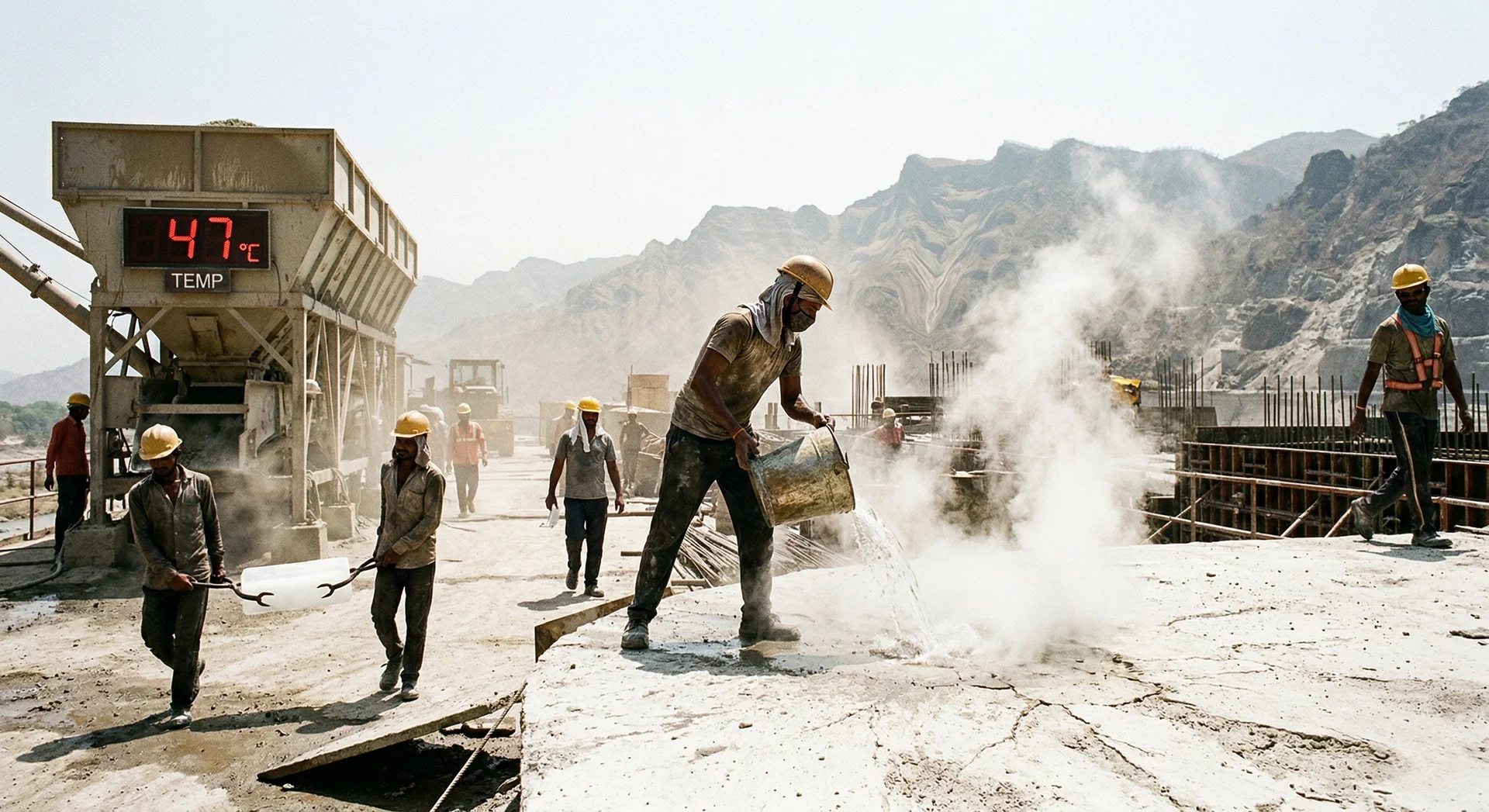
- Chilled mix water: Refrigeration plants cool batching water to 2-5°C. Since water represents ~180 kg/m³ of the mix and has a high specific heat capacity, this is effective and economical.
- Flake ice or crushed ice substitution: Replacing 50-75% of mix water with ice provides additional cooling through the latent heat of fusion (334 kJ/kg). This can reduce mix temperature by 5-8°C beyond chilled water alone.
- Aggregate cooling: Coarse and fine aggregates comprise 70-80% of concrete by mass. Cooling them through shaded stockpiles, cold-air blasting, or immersion cooling has the largest thermal impact by volume.
- Liquid nitrogen injection: For rapid, precise temperature reduction at the point of mixing. More expensive but allows real-time adjustment.
- Night placements: Scheduling pours during cooler ambient periods reduces both the placement temperature and early-age heat gain from solar radiation.
On major dam projects, PCCI recommends targeting a placement temperature of 10-15°C in tropical climates. This requires a combination of methods; no single technique is sufficient in summer conditions where ambient temperatures can exceed 40°C.
Post-cooling: managing heat after placement
Even with optimal pre-cooling and low-heat cementitious systems, large dam pours will develop significant internal temperatures. Post-cooling systems extract this heat before damaging differentials develop.
Embedded cooling pipes are the industry standard for mass concrete dams. Thin-walled steel or HDPE pipes (typically 25-50mm diameter) are laid in serpentine patterns within each lift before concrete placement. Chilled water is circulated through these pipes during and after curing.
Key Takeaway
Post-cooling is not a substitute for proper mix design and pre-cooling. It is a complementary system. A well-designed thermal control program addresses heat at every stage: reduce cement content (mix design), lower starting temperature (pre-cooling), extract residual heat (post-cooling), and protect surfaces (insulation).
Critical parameters for post-cooling systems:
- Pipe spacing: typically 1.0-1.5 metres horizontally and vertically
- Water inlet temperature: 5-10°C
- Flow rate: sufficient to maintain a temperature differential of ≤20°C between inlet and outlet
- Cooling duration: typically 10-21 days per lift, depending on ambient conditions and lift height
- Maximum cooling rate: 11°C per 12 hours to avoid thermal shock
Surface insulation and curing protection
The third line of defence against thermal cracking is surface protection. Even with low internal temperatures, rapid cooling of exposed surfaces, from cold winds, rain, or sudden temperature drops, can create dangerous differentials.
Surface protection strategies include:
- Insulating blankets over freshly placed concrete
- Curing compounds to prevent evaporative cooling
- Windbreaks around active placement areas
- Heated enclosures in cold-weather concreting
- Extended moist curing to maintain surface temperatures
In Bhutan, where PCCI’s leadership has delivered thermal control programs on projects including Tala (1,020 MW) and Mangdechhu (720 MW), high-altitude conditions present unique challenges: strong solar radiation during the day creates surface heating, followed by rapid radiative cooling at night. The diurnal temperature swing can exceed 25°C, requiring surface protection even in summer months.
The role of thermal modelling
Modern thermal control programs begin with computational thermal modelling, as recommended by ACI 207.2R, before any concrete is placed. Finite element analysis predicts the temperature distribution within each lift based on:
- Concrete thermal properties (specific heat, thermal conductivity, coefficient of thermal expansion)
- Cementitious system heat evolution curves (adiabatic temperature rise testing)
- Placement geometry and lift sequencing
- Ambient conditions (temperature, wind, solar radiation)
- Cooling system parameters
This modelling informs every downstream decision: cement content, SCM proportions, placement temperature targets, cooling pipe layout, lift heights, and placement intervals. Without it, thermal control becomes reactive rather than preventive, and by the time a crack appears, the damage is done.
Thermal control as a lifecycle investment
The cost of a comprehensive thermal control program, including mix design optimization, pre-cooling infrastructure, embedded cooling systems, thermal monitoring, and surface protection, typically represents 2-5% of the total concrete works budget on a dam project.
The cost of thermal cracking, including repair, grouting, structural assessment, schedule delays, and the ongoing maintenance burden of seepage management, can easily reach 15-30% of the concrete works budget. On projects where thermal cracking has been extensive, rehabilitation costs have exceeded the original construction cost of the affected structures.
The bottom line
Thermal control is not an overhead; it is a risk management investment. Every dollar spent on prevention saves five to ten dollars in repair, rehabilitation, and lifecycle maintenance. For dam developers, EPC contractors, and project owners, the question is not whether to invest in thermal control, but whether you can afford not to.
How PCCI approaches thermal control
PCCI’s Thermal Control & Placement Engineering service covers the full chain: pre-construction thermal modelling, cementitious system optimization, pre-cooling and post-cooling system design, thermal monitoring instrumentation, and construction-phase supervision.
With deep expertise across landmark hydroelectric projects totalling 4,000+ MW, PCCI brings field-tested knowledge to every engagement. Our approach is hands-on: we do not just write reports. We are on-site, at the batching plant, at the placement face, monitoring temperatures and making real-time adjustments.
Book a Technical Call → to discuss your project’s thermal control requirements.