
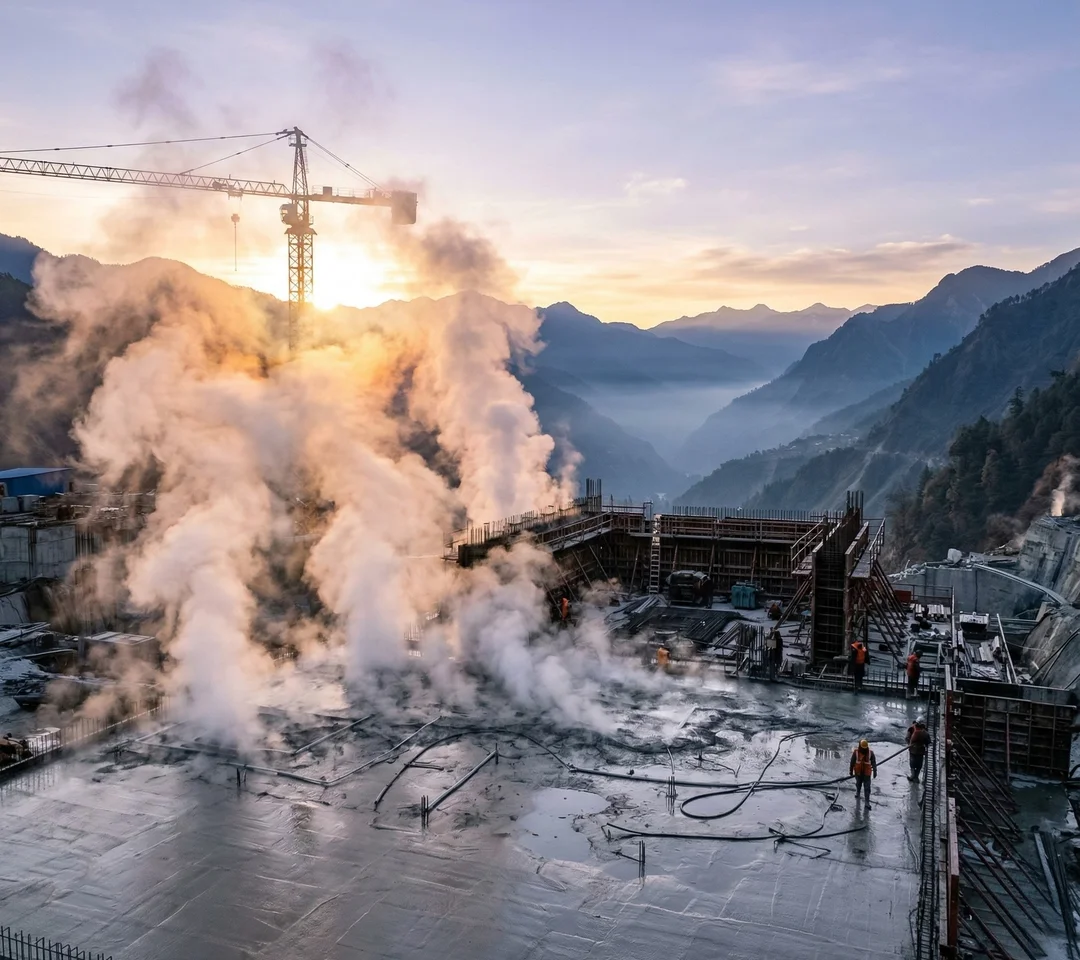
Services / Thermal Control
Mass concrete cracks are preventable. We prove it every project.
Pre-cooling, post-cooling, and thermal stress analysis to keep your mass pours crack-free, engineered for the specific volumes, conditions, and schedules of each project.
Why this matters
Thermal cracking isn't a surprise. It's a predictable failure that's entirely preventable.
Every cubic meter of mass concrete is an exothermic reactor. Cement hydration generates heat, and in large placements, that heat can't escape fast enough. The interior heats up while the surface cools, creating thermal gradients that produce tensile stresses. When those stresses exceed the concrete's tensile strength, cracks form.
In dam construction, the consequences are severe: cracks create seepage paths, reduce structural capacity, and can require costly grouting or repair programs that delay commissioning. On projects with concrete volumes exceeding hundreds of thousands of cubic meters, even small thermal management failures cascade into millions in additional cost.
The solution is engineering, not luck. With proper thermal analysis, strategic pre-cooling, embedded post-cooling systems, optimized lift schedules, and low-heat mix designs, peak temperatures can be kept below cracking thresholds on every pour. This is what PCCI delivers.
Our approach
End-to-end thermal engineering for mass concrete.
From thermal analysis before the first pour to cooling pipe removal after curing, every aspect of temperature management is engineered, monitored, and verified.
Thermal Stress Analysis
Finite element thermal modeling to predict temperature development, thermal gradients, and stress distribution in mass concrete placements. Identifies cracking risk before a single cubic meter is placed.
Pre-Cooling System Design
Engineering aggregate cooling (chilled water, liquid nitrogen, ice), mixing water chilling, and cement temperature management to achieve target placement temperatures in hot-climate construction.
Post-Cooling Engineering
Design of embedded cooling pipe systems: pipe layout, spacing, flow rates, coolant temperature, and cooling duration schedules to control peak temperatures within mass concrete after placement.
Lift Thickness Optimization
Determining optimal lift heights that balance construction speed with thermal control. Thinner lifts dissipate heat faster but slow progress. We find the sweet spot for every project.
Placement Temperature Planning
Comprehensive planning of placement schedules accounting for ambient temperature cycles, concrete delivery logistics, and cooling system capacity to ensure every pour meets temperature limits.
Curing Regime Engineering
Curing method selection, duration planning, and insulation requirements to manage temperature differentials during the critical first days after placement, when cracking risk is highest.
Project proof
Thermal control delivered on landmark projects.
Mangdechhu Hydroelectric Project
720 MW · Bhutan
Managed quality control from inception to commissioning, including thermal management of mass concrete placements across the dam and powerhouse structures in Bhutan's challenging mountain environment.
Punatsangchhu-1 Hydroelectric Project
1,200 MW · Bhutan
Comprehensive quality control programs including thermal monitoring and management for the 65m gravity dam's mass concrete placements, one of the largest concrete volumes in Bhutan.
Technical insights
Deep dives into thermal management for mass concrete.
Technical briefs on preventing thermal cracking and managing heat of hydration in dam and hydropower construction.

Thermal Control in Mass Concrete: Why It Matters and How We Manage It
Thermal modelling, pre-cooling, and placement scheduling to prevent cracking in mass concrete pours on hydroelectric projects.
Read article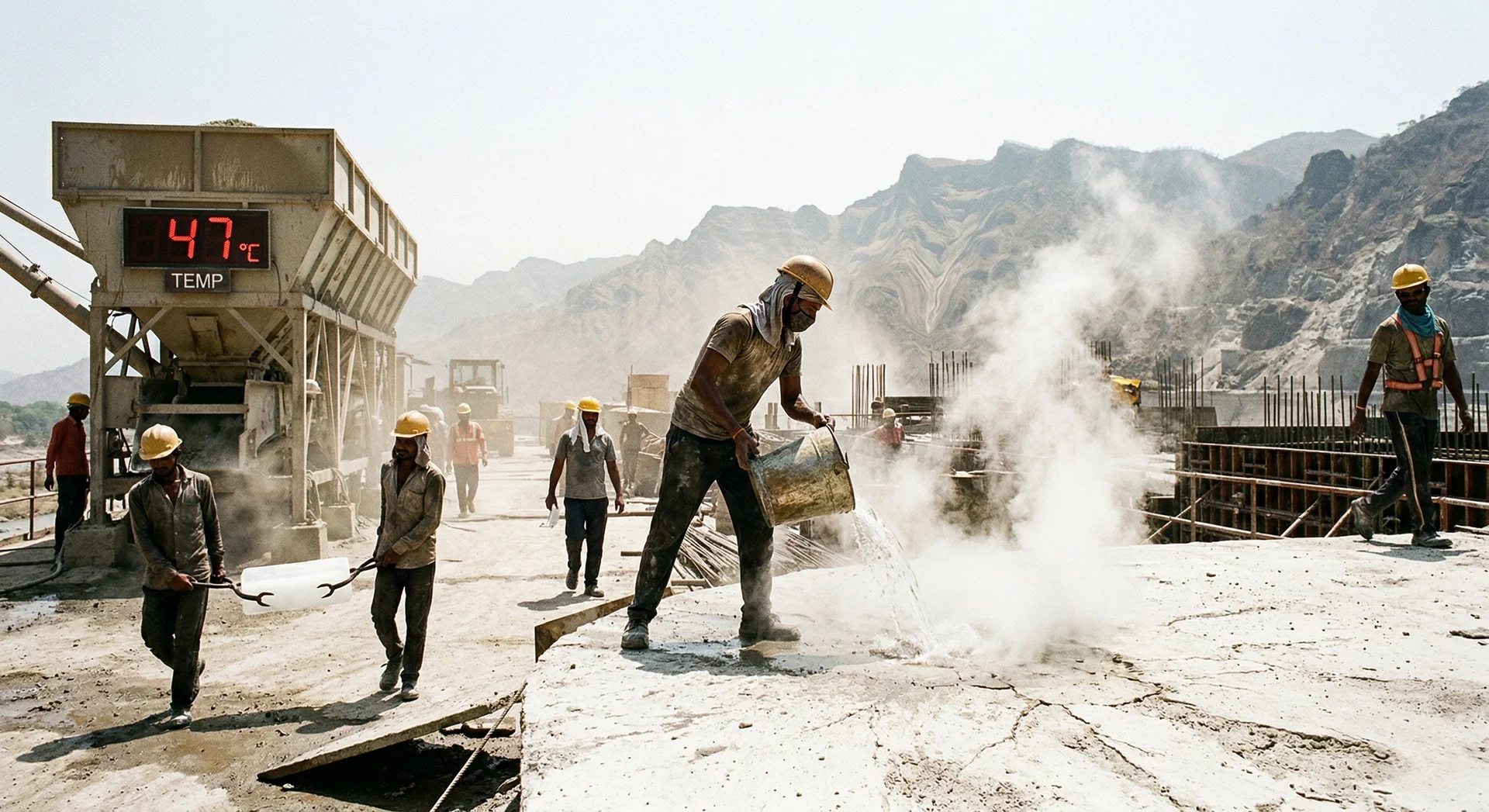
Hot Weather Concreting for Dams: Placement Strategies When Temperatures Exceed 40 Degrees C
Managing concrete placing temperature, accelerated setting, and thermal cracking risk during Indian summers on dam projects.
Read article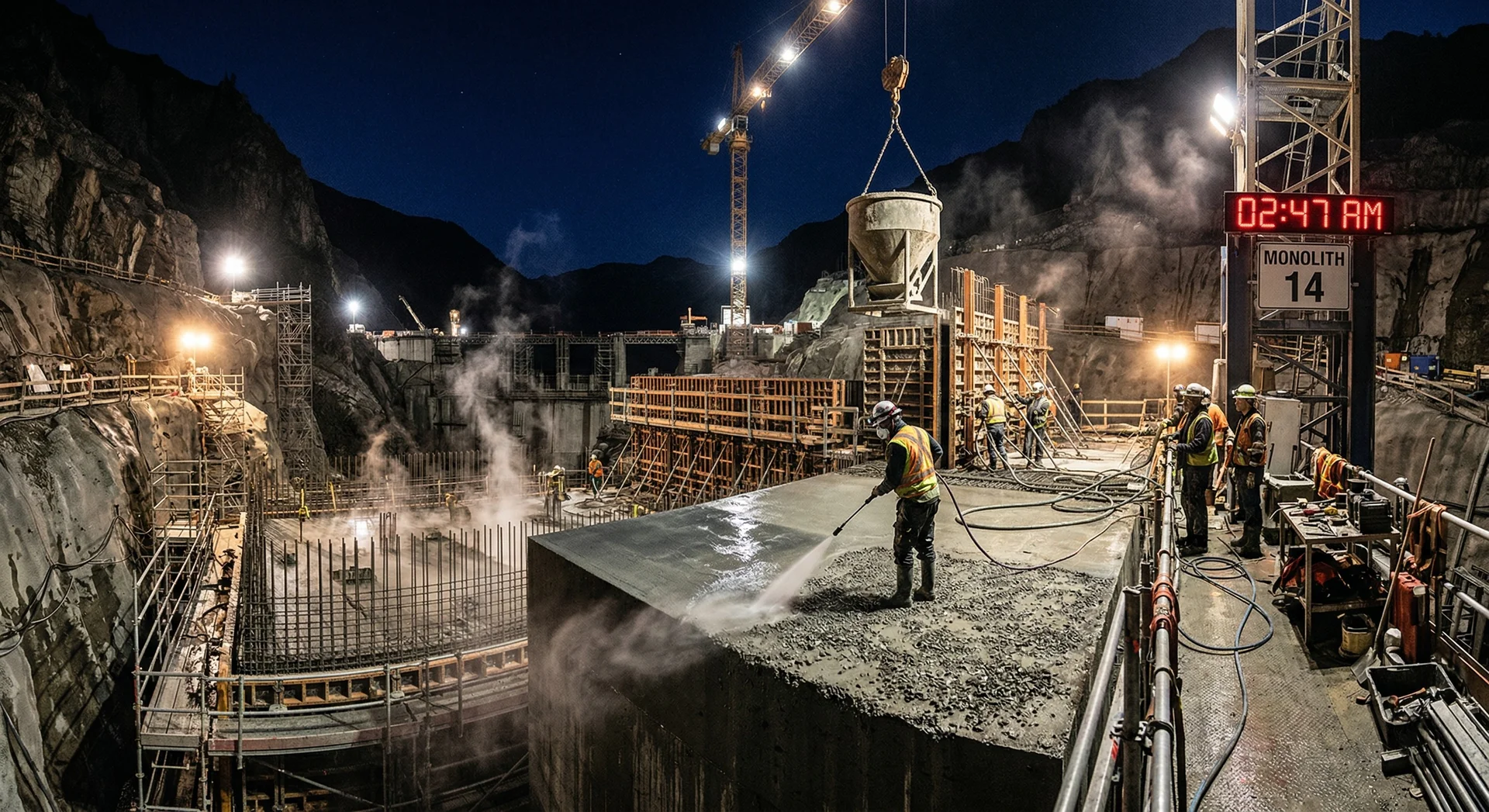
Cold Joint Prevention in Mass Concrete Dam Construction
Coordinating thermal control, placement scheduling, and surface preparation to prevent the most common quality defect in dam concrete.
Read articleFrequently asked questions
Thermal control questions, answered.
Why is thermal control critical in mass concrete dam construction?
Mass concrete generates significant heat during cement hydration. Without proper thermal control, the temperature differential between the interior and exterior of a concrete placement can cause thermal cracking, compromising structural integrity, durability, and watertightness. In dam construction, thermal cracks can lead to seepage, reduced service life, and costly repairs.
What thermal control methods does PCCI use for mass concrete?
PCCI provides comprehensive thermal control including pre-cooling of aggregates and mixing water, post-cooling using embedded pipe systems, placement temperature planning, lift thickness optimization, thermal stress analysis using finite element modeling, and curing regime engineering. The specific combination is tailored to each project's concrete volumes, ambient conditions, and structural requirements.
How does PCCI determine maximum allowable concrete placement temperatures?
PCCI determines placement temperature limits through thermal analysis that considers cement type and content, supplementary cementitious materials (which reduce heat generation), ambient temperature conditions, lift thickness and placement rate, cooling system capacity, and the thermal properties of the specific concrete mix. The goal is to keep peak temperatures below cracking thresholds throughout the curing process.
Newsletter
Concrete Pulse
Stay ahead on concrete technology. Subscribe to our weekly newsletter. Field-tested insights on mass concrete, dam engineering, and QA/QC, delivered straight to your inbox.
Free. No spam. Unsubscribe anytime.
Talk to a concrete specialist within 24 hours.
Whether you're at pre-tender feasibility or mid-construction troubleshooting. Whether your project is in India, Bhutan, Nepal, or beyond.