
About PCCI
Where concrete science meets infrastructure certainty.
PCCI is a specialist concrete technology consultancy built for the world's most demanding infrastructure. We bring deep technical leadership, proven methodologies, and a no-compromise commitment to quality to every engagement.

Our Story
Built on decades of field-proven expertise. Designed for the future.
PCCI (Precision Concrete Craft and Innovations Pvt. Ltd.) was established in 2024, but the expertise behind it was forged over decades on the most demanding dam sites in South Asia. Our technical leadership's experience spans landmark hydroelectric programs across India, Bhutan, Nepal, and Laos, from the research laboratory to the placement site.
That expertise was shaped by real challenges on real projects: different aggregates, different climates, different structural demands. Each one refined the methodology that PCCI now brings to every engagement: test rigorously, design precisely, and never accept a pour that doesn't meet the standard.
In 2024, Mr. A.K. Sthapak and Mr. Kushal Sthapak co-founded PCCI to formalize this deep knowledge into a dedicated consulting firm. The mission: make world-class concrete technology accessible to every hydroelectric and large-scale infrastructure project that needs it, from compact run-of-river installations to the world's largest gravity dams.
Today, PCCI is building a team of specialist professionals who share that same commitment to technical excellence. Backed by a network of accredited partner laboratories across India, PCCI can design and manage comprehensive testing programs for projects in any location: from trial mix development through 180-day strength evaluation, while maintaining full engineering oversight and quality control.
Serving hydroelectric and large-scale infrastructure projects across South Asia, with growing engagement in Southeast Asian markets, our vision is clear: become the consulting firm that the industry's most critical projects turn to when concrete performance is non-negotiable.
PCCI is the firm we wish existed when these projects started. Now it does.
1980s to 1990s
Roots in Research and Field
The technical expertise that underpins PCCI takes shape across dam construction sites and at the Central Soil and Materials Research Station (CSMRS), New Delhi. Deep knowledge is built at the intersection of concrete technology, rock mechanics, and field engineering.
1990s to 2000s
Pioneering Indian Firsts
Key involvement in India's first RCC dam at Ghatghar, Maharashtra. First mass-scale epoxy concrete application at Singur Dam. Pioneering use of GPR for masonry dam evaluation. Authorship of Indian Standard IS:14591 on thermal control of mass concrete.
2002 to 2012
Landmark Hydropower Programs
Concrete QC and optimization for Tala (1,020 MW) in Bhutan and Karchham Wangtoo (1,000 MW) in India. Cost-effective, high-performance mix designs developed spanning concrete, shotcrete, and grout. The methodologies proven here form the backbone of PCCI's approach today.
2012 to 2023
Multi-Country Track Record
End-to-end QC leadership at Mangdechhu (720 MW) and Punatsangchhu-1 (1,200 MW) in Bhutan. Engagements in Nepal (Tanahu, 140 MW) and Laos (Nam Long 2). Advanced work in durability, AAR mitigation, and eco-friendly high fly ash formulations.
2024
PCCI is Born
PCCI is co-founded by Mr. A.K. Sthapak and Mr. Kushal Sthapak, bringing together decades of proven expertise with a vision to build the specialist concrete technology consultancy the industry needs. Active consulting continues on the Tanahu Hydropower Project in Nepal.
Leadership
Led by experts who've shaped the industry.
PCCI's technical credibility begins with its leadership. Our technical lead has authored national standards, pioneered new concrete technologies, and delivered quality programs on some of the most critical hydroelectric projects in South Asia.
Photo coming soon
Mr. Arvind Kumar Sthapak
Managing Director
Mr. A.K. Sthapak holds an M.Tech in Rock Mechanics from IIT Delhi and a B.E. in Civil Engineering. He is one of South Asia's most experienced concrete technologists, with a career spanning government research, national standards development, and hands-on project leadership across four countries.
During two decades at the Central Soil and Materials Research Station (CSMRS), he played key roles in several Indian firsts: the country's first RCC dam at Ghatghar, the first mass-scale epoxy concrete application at Singur Dam, and the pioneering use of Ground Penetrating Radar for masonry dam evaluation. He authored IS:14591, India's national standard on thermal control of mass concrete, and contributed to the revision of IS 456:2000.
His project leadership spans landmark hydroelectric programs including Tala (1,020 MW) in Bhutan, Karchham Wangtoo (1,000 MW) in India, Mangdechhu (720 MW) and Punatsangchhu-1 (1,200 MW) in Bhutan, and engagements in Nepal and Laos. His specializations include mass concrete mix design, thermal control engineering, cement optimization, durability assessment, AAR mitigation, and QA/QC system design.
M.Tech, IIT Delhi
Rock Mechanics
Author, IS:14591
Thermal Control of Mass Concrete
48+ Publications
International technical papers
4 Countries
India, Bhutan, Nepal, Laos
Professional Affiliations
Rooted in the professional community.
ICI
Indian Concrete Institute
ACCE(I)
Association of Consulting Civil Engineers (India)
ISRMTT
Indian Society for Rock Mechanics & Tunnelling Technology
ISCMS
Indian Society for Construction Materials & Structures
Compliance expertise across international and Indian standards
Our Values
Principles that aren't negotiable.
No-Compromise Quality
Every mix design, every QC protocol, every advisory meets the same standard: the highest one. We don't cut corners because the concrete won't forgive us if we do.
Deep Field Expertise
Our experts bring decades of field experience to every engagement. Whether through on-site supervision or precise technical direction, we ensure every critical pour meets the standard.
Tailored Solutions
Every project gets a customized approach, never off-the-shelf answers. Different aggregates, different climates, different structural demands require different solutions.
Sustainability Through Science
We optimize cement content to reduce both cost and carbon simultaneously. The greenest concrete is the one you don't have to repair. We engineer for 100-year durability.
Knowledge Transfer
We don't hoard expertise. We build capacity. Through training programs, QC manuals, and technology transfer, we leave client teams stronger than we found them.
Full Lifecycle Partnership
From pre-tender material investigation through post-construction rehabilitation, we are with you for the entire journey. Your concrete is our responsibility, start to finish.
How We Work
Embedded expertise, not arm's-length advice.
PCCI integrates directly with your project team. We tailor our engagement to your specific needs, from focused advisory on a single challenge to full-lifecycle consulting.
Assessment & Planning
- Material investigation
- Feasibility studies
- Mix design strategy
- QC framework planning
Construction Support
- Mix design development
- On-site QA/QC
- Material testing
- Thermal control
Post-Construction
- NDT assessment
- Repair guidance
- Performance monitoring
- Life extension
Knowledge Transfer
- Team training
- QC manual preparation
- Technology transfer
- Capacity building
Frequently Asked Questions
About PCCI
Who founded PCCI and what is their background?
When was PCCI established?
What makes PCCI different from other concrete consultants?
What are Mr. A.K. Sthapak's qualifications and achievements?
Which professional bodies is PCCI affiliated with?
From the field
Concrete intelligence, not opinions. Lessons from inside dam sites.
Technical insights grounded in real project experience. Written by engineers, for engineers.
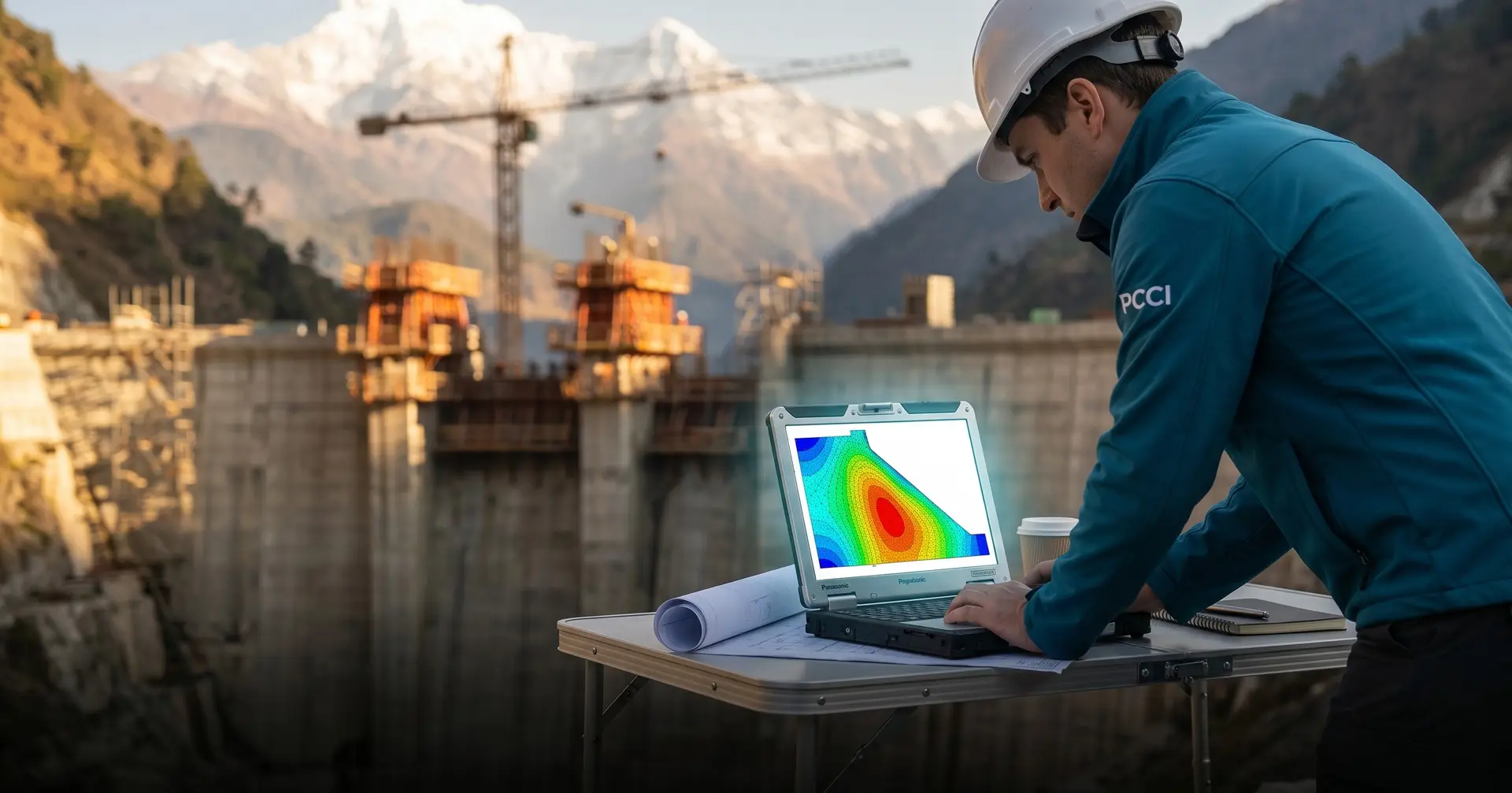
Thermal Modelling for Mass Concrete: FEM Analysis, Input Parameters, and Practical Application
Every thermal control plan for a mass concrete dam rests on a thermal model. The model predicts the temperature at every point inside the concrete, at every time step from placement through years of service. It determines whether the pre-cooling system is adequate, whether the placement schedule allows sufficient heat dissipation, whether the post-cooling pipes are correctly spaced, and whether the resulting thermal stresses will crack the concrete. A thermal model that is wrong does not just produce incorrect numbers. It produces a thermal control plan that either under-protects the concrete (leading to cracking) or over-protects it (wasting resources on unnecessary cooling). Getting the model right requires accurate input parameters, appropriate modelling assumptions, and validation against field measurements.
Read Article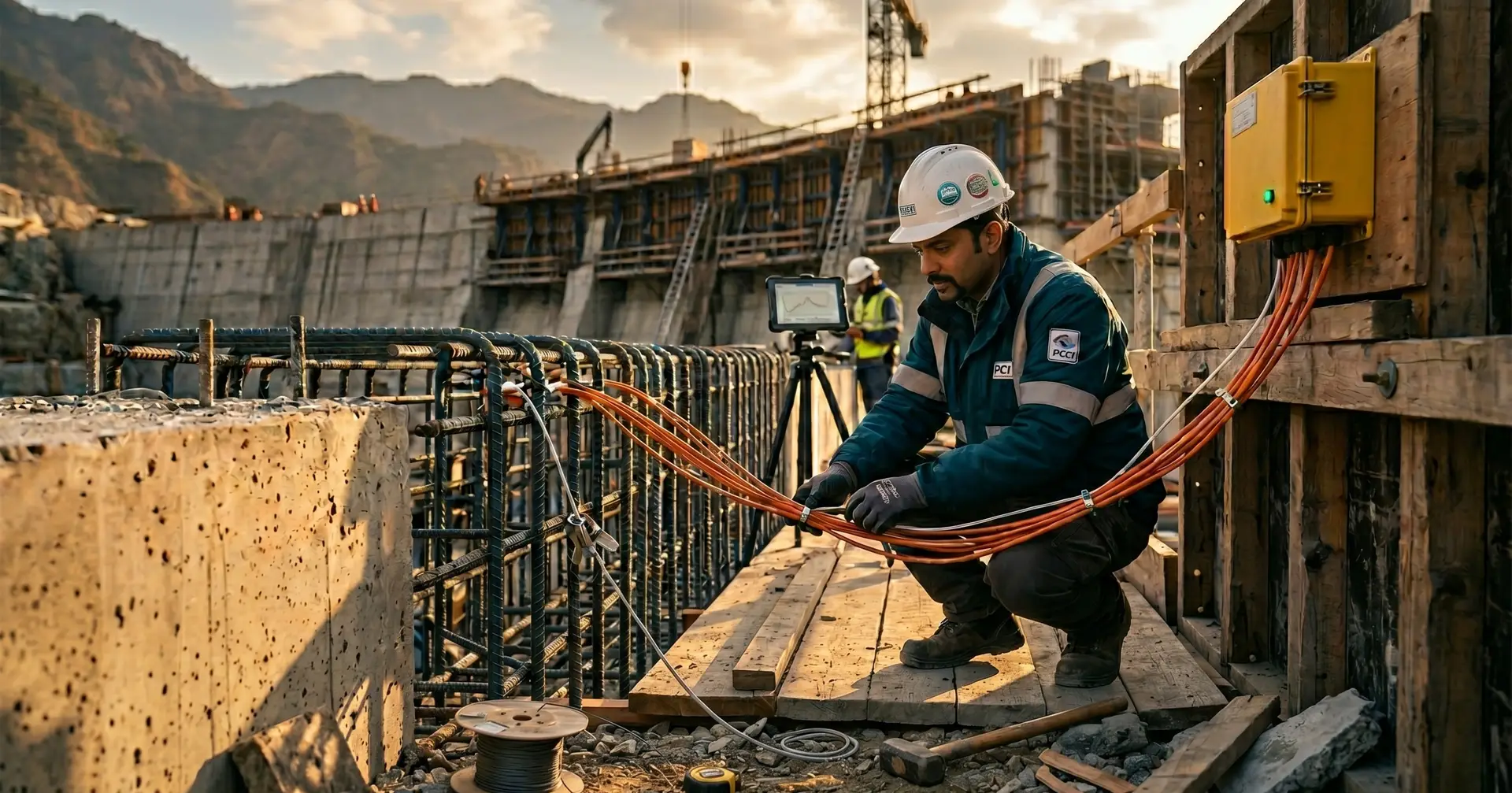
Thermal Instrumentation for Mass Concrete Dams: Sensors, Monitoring, and Real-Time Decision Making
A thermal control plan without instrumentation is a document without feedback. You can model the expected temperature rise, design the pre-cooling system, specify the placement schedule, and calculate the maximum thermal gradients. But unless you measure what actually happens inside the concrete after placement, you have no way of knowing whether the plan is working until a crack appears on the surface. Thermal instrumentation closes this loop: embedded sensors provide real-time temperature data that allows the construction team to verify predictions, adjust cooling operations, and intervene before thermal stresses exceed the concrete's capacity.
Read Article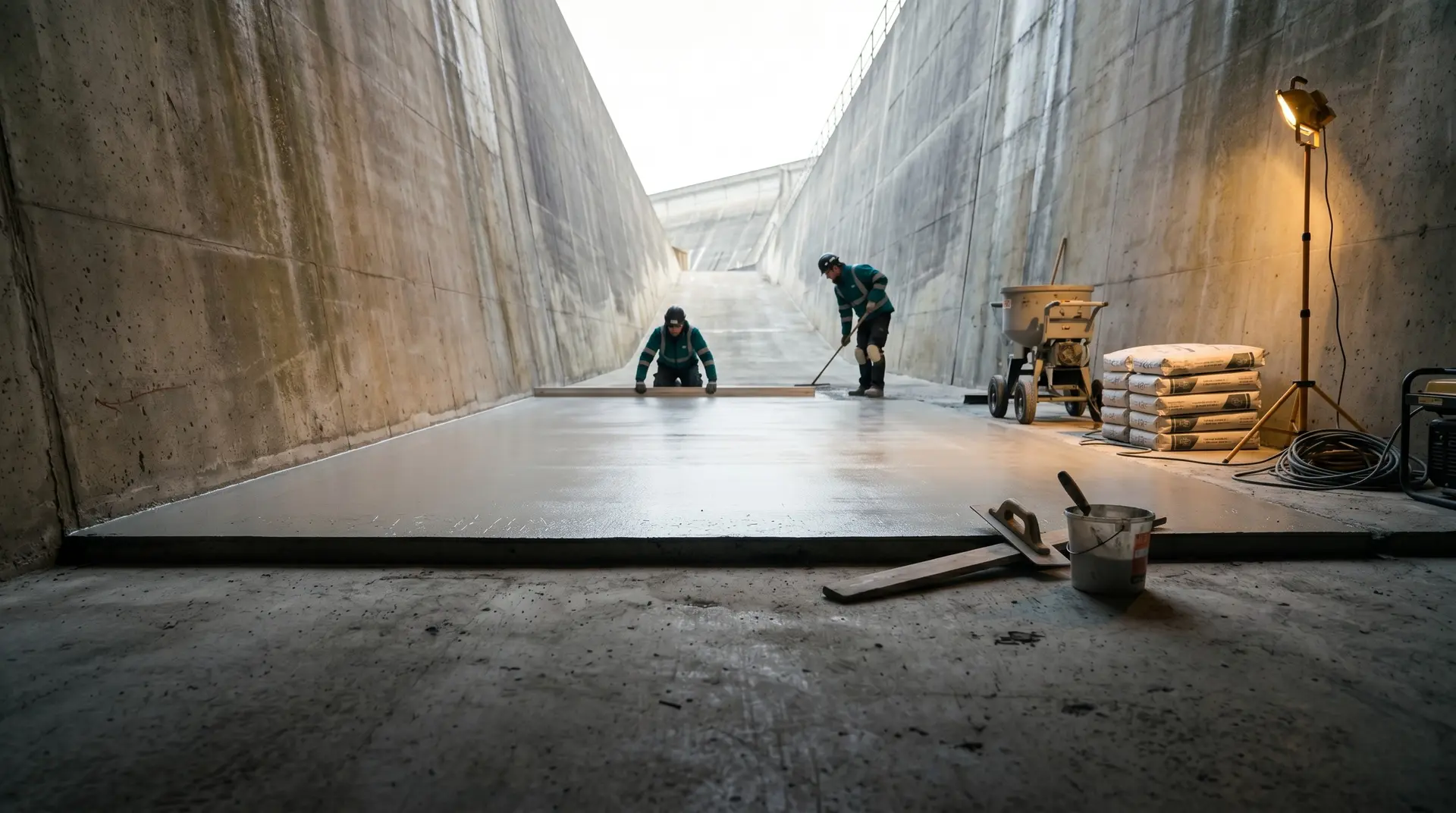
UHPC for Hydroelectric Infrastructure: Where Ultra-High Performance Concrete Fits in Dam Engineering
Ultra-high performance concrete (UHPC) has transformed bridge deck rehabilitation across North America, with more than 20 state departments of transportation using UHPC overlays as thin as 25 mm to extend bridge service lives by decades. The material's compressive strength exceeding 150 MPa, near-zero permeability, and abrasion resistance roughly double that of conventional concrete make it a compelling technology. For dam engineers, the question is specific: where in a hydroelectric project does UHPC's exceptional performance justify its cost, which runs 5 to 10 times higher than conventional concrete per cubic metre? The answer is not everywhere; it is in targeted applications where thin sections, extreme abrasion, cavitation exposure, or permanent submersion demand a material that conventional HPC cannot match. This technical brief examines UHPC's material properties through the lens of dam engineering requirements, identifies the specific applications where it adds genuine value, addresses the cost and constructability challenges, and provides a practical decision framework for dam owners and consulting engineers.
Read Article
Machine Learning for Concrete Mix Design: From BOxCrete to Dam-Specific Optimization
In March 2026, Meta released BOxCrete, an open-source Bayesian Optimization model for concrete mix design, under an MIT license. The model, developed with the University of Illinois and cement producer Amrize, reduces the carbon footprint of concrete by up to 40% while maintaining strength, with some formulations replacing upwards of 70% of cement with fly ash and slag combinations. For dam engineers, this raises an immediate question. Mass concrete for hydroelectric projects already uses high SCM dosages, low cement contents, and extended curing ages that fall outside the training data of most ML models. Can these tools actually help with dam-specific mix design, or are they solving a different industry's problem? This technical brief examines the current state of ML-driven mix design optimization, assesses its relevance to mass concrete for dams and RCC, and outlines a practical framework for integrating ML tools into the trial mix process without abandoning the engineering judgment that keeps dams standing.
Read Article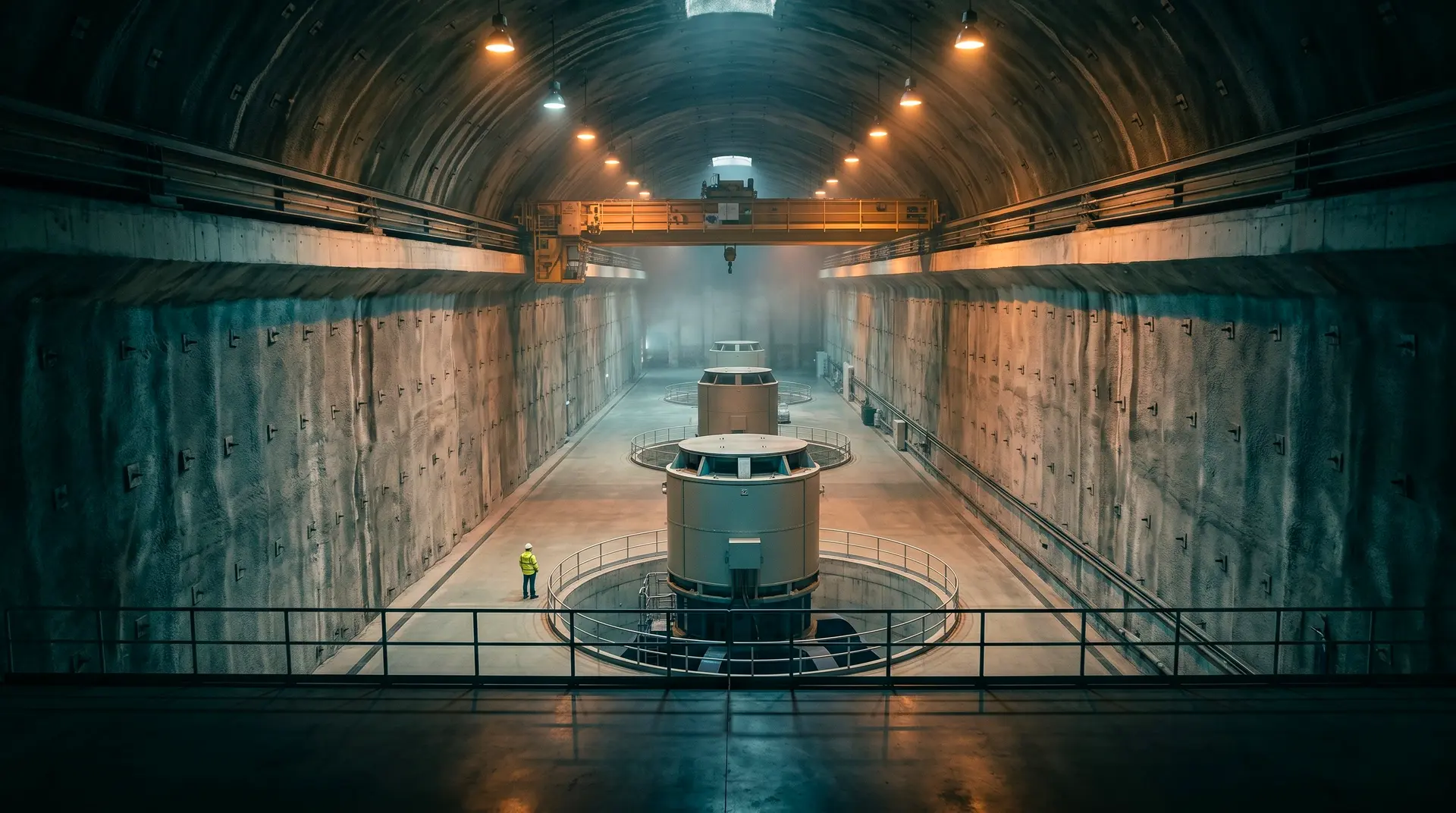
Pumped Storage vs Conventional Hydropower: How Concrete Requirements Differ
A conventional hydropower dam fills its reservoir once and maintains a relatively stable water level for decades. A pumped storage reservoir cycles its water level by tens of metres every single day. This fundamental operational difference transforms every concrete engineering decision: the dam must resist cyclic loading that conventional dams never experience, the waterways must withstand reversible high-velocity flow, and the project must build two reservoirs instead of one, often in remote terrain. Engineers who approach pumped storage concrete with conventional hydropower assumptions will underdesign for the conditions these structures actually face.
Read Article
Understanding ICOLD Bulletins: A Practitioner's Guide for Dam Engineers
The International Commission on Large Dams publishes the most authoritative technical guidance on dam engineering in the world. Over 180 bulletins cover every aspect of dam design, construction, safety, and operation. For concrete technology specialists, a handful of these bulletins are essential references that fill gaps left by Indian and American standards. But navigating the ICOLD library is challenging: bulletins are numbered sequentially, not thematically, some are decades old, and not all are freely accessible. This guide identifies the ICOLD bulletins most relevant to concrete technology, explains what each covers, and shows how they integrate with IS and ACI standards in Indian practice.
Read Article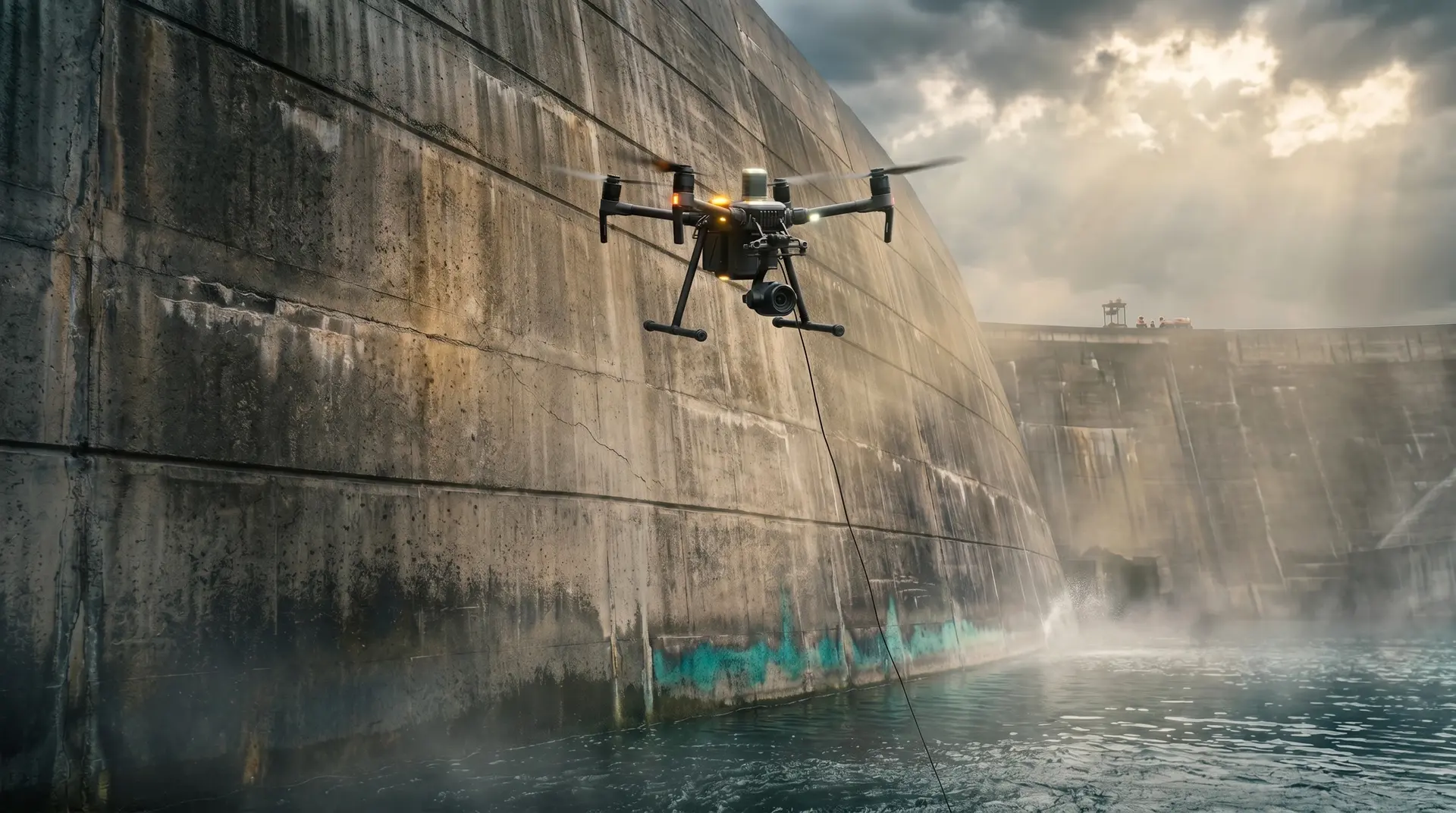
Computer Vision and Drone Inspection for Concrete Dams: A Practical Guide
At the Storfinnforsen Hydroelectric Power Station in Sweden, an autonomous drone system captured over 300,000 location-tagged images of the dam's concrete surfaces in 52 flight hours, completing the inspection 50% faster than manual methods and saving an estimated 40 workdays. No scaffolding, no rope access, no personnel working at height. This is not a research prototype. Drone-based inspection with AI-powered defect detection is commercially deployed and delivering measurable results on operational hydroelectric dams. Deep learning models now detect sub-millimetre cracks on concrete surfaces with precision exceeding 90%, while ROVs extend the same capability to submerged dam faces. For dam owners and engineers responsible for concrete condition assessment, the question has shifted from "does this technology work?" to "how do we integrate it into our inspection programme?" This technical brief examines the available systems, their proven capabilities, their limitations, and a practical deployment framework for hydroelectric projects.
Read Article
RCC Dam Seepage: Causes, Prevention, and Remediation
Seepage through RCC dams is not a defect. It is a design consideration. The low-paste, zero-slump nature of roller compacted concrete means that lift joints will never be as impermeable as monolithic conventional concrete. The question is not whether seepage will occur, but whether it is controlled within acceptable limits. When it is not, the consequences range from aesthetic staining to structural instability. This article examines why RCC dams seep, how upstream facing systems and internal drainage control it, and what to do when seepage exceeds design assumptions.
Read ArticleNewsletter
Concrete Pulse
Stay ahead on concrete technology. Subscribe to our weekly newsletter. Field-tested insights on mass concrete, dam engineering, and QA/QC, delivered straight to your inbox.
Free. No spam. Unsubscribe anytime.
Talk to a concrete specialist within 24 hours.
Whether you're at pre-tender feasibility or mid-construction troubleshooting. Whether your project is in India, Bhutan, Nepal, or beyond.