Ultra-high performance concrete occupies a specific position in the materials hierarchy for dam engineering. It is not a replacement for mass concrete in the dam body, where millions of cubic metres of M15 to M30 concrete provide gravity resistance at low cost. It is not a substitute for conventional high-performance concrete in spillway wearing layers, where M50 to M70 grades with silica fume and fly ash blends deliver proven abrasion resistance. UHPC is the material for applications where nothing else is thin enough, hard enough, or durable enough to solve the problem.
ACI 239R-18 defines UHPC as concrete with a minimum specified compressive strength of 150 MPa, specified durability, tensile ductility, and toughness requirements, with steel fibers generally included at approximately 2% by volume. The FHWA released its Structural Design Guide for UHPC in 2024, marking the transition from emerging technology to engineered material with documented design procedures.
For dam engineers in South Asia, where aging dams face rehabilitation under DRIP and where new hydroelectric projects demand longer service lives from hydraulic surfaces, UHPC deserves serious evaluation for specific applications. This brief examines where it fits, where it does not, and what the practical constraints are.
Material Properties Through a Dam Engineer’s Lens
Compressive Strength: 150 to 220 MPa
UHPC’s compressive strength is 2 to 4 times higher than conventional HPC used on dam projects. This is achieved through optimised particle packing (eliminating coarse aggregate entirely), very low water-to-cementitious ratios (0.15 to 0.25), and high silica fume content (typically 20 to 25% by weight of cement).
For dam applications, the high compressive strength matters less for structural load-bearing (mass concrete handles this) and more for abrasion and impact resistance, which correlate directly with compressive strength and paste density.
Tensile Ductility: 8 to 15 MPa
This is UHPC’s most distinctive property. Conventional concrete has negligible tensile capacity and fails in a brittle manner. UHPC with 2% steel fiber by volume achieves tensile strengths of 8 to 15 MPa and exhibits strain-hardening behaviour: it continues to carry load after initial cracking as fibers bridge the crack faces. Research shows fiber addition can enhance tensile strength by up to 200% compared to unreinforced UHPC.
For dam applications, tensile ductility is valuable in thin overlays on spillway surfaces, where thermal and shrinkage stresses would crack conventional thin-section repairs. The fiber reinforcement holds the overlay together through stress cycles that would delaminate a conventional patch.
Abrasion Resistance: Approximately 2x Conventional
UHPC demonstrates wear depth typically one-third to one-half that of conventional concrete under standardised abrasion testing. This is a direct consequence of the dense, hard matrix and the absence of the paste-aggregate interface (the weakest link in conventional concrete’s abrasion resistance).
For spillway chutes and stilling basins carrying sediment-laden Himalayan river water, this represents a step-change in wearing surface durability.
Permeability: Near Zero
UHPC’s discontinuous pore structure reduces liquid ingress to near zero. Chloride penetration, sulphate attack, carbonation, and freeze-thaw damage are effectively eliminated as deterioration mechanisms. This makes UHPC exceptionally suited for permanently submerged repairs where conventional concrete’s porosity allows long-term degradation.
AAR Resistance: Inherent
The high silica fume content, absence of coarse aggregate, low w/cm ratio, and dense pore structure combine to make alkali-aggregate reaction essentially a non-issue in properly formulated UHPC. For dam repairs in regions with reactive aggregates, this is a significant advantage.
Where UHPC Adds Value on a Dam
1. Spillway Wearing Layer Overlays
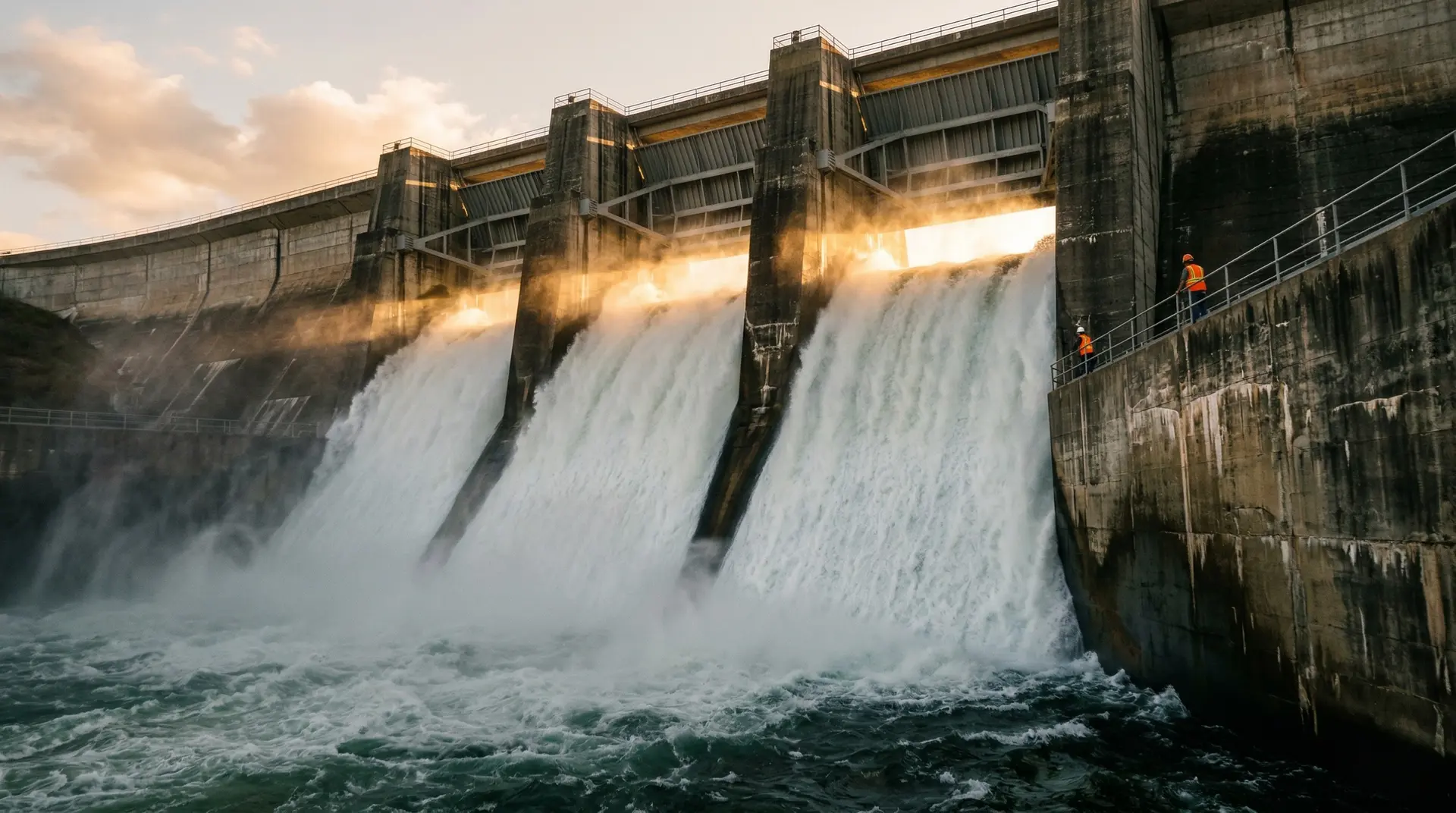
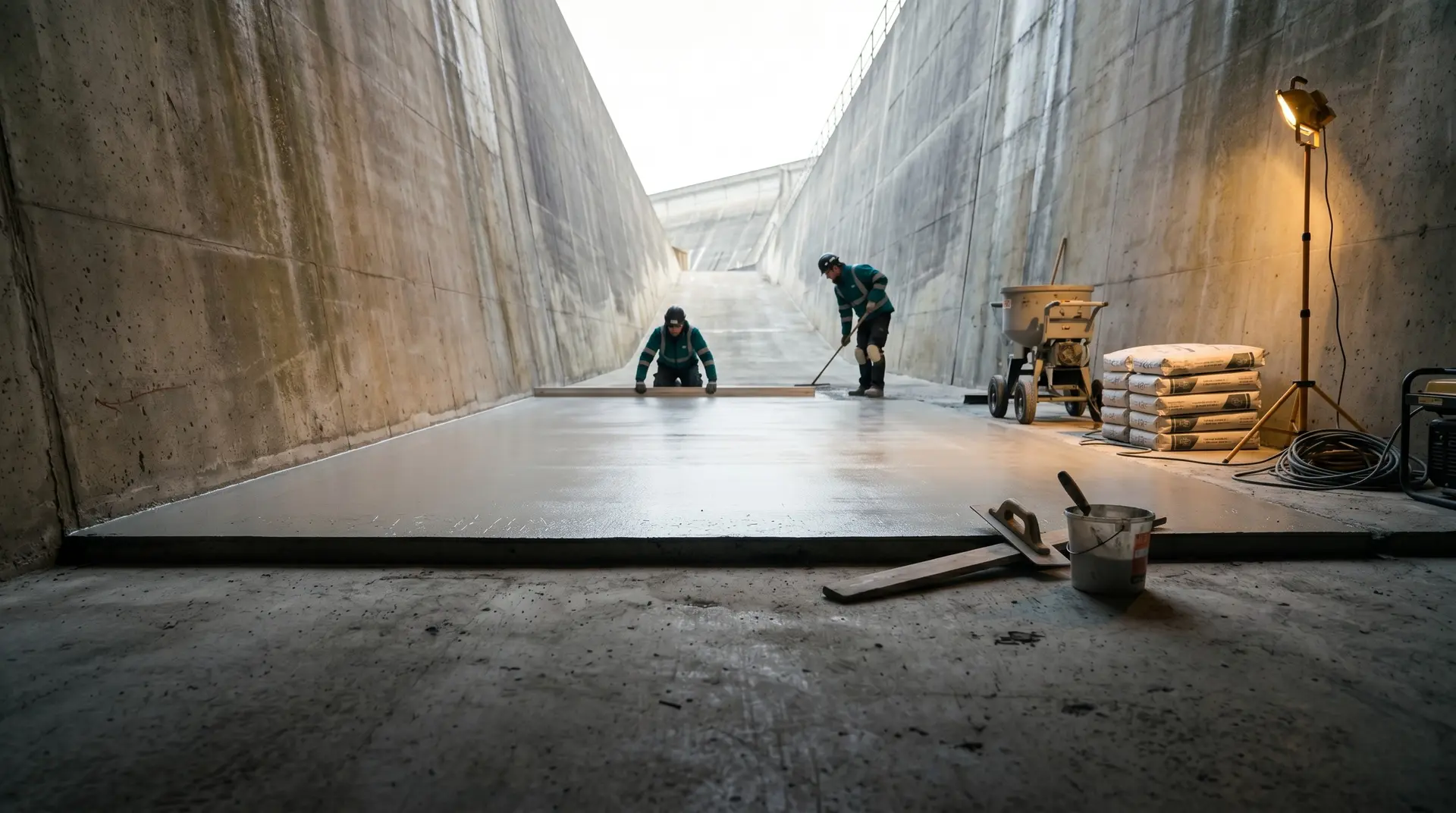
The most compelling dam application. A 25 to 50 mm UHPC overlay on a spillway chute surface provides roughly double the abrasion resistance of conventional M50 to M70 HPC, in a layer thin enough to install without significantly altering the hydraulic profile of the spillway. The fiber reinforcement prevents the overlay from cracking and delaminating under thermal cycling and the mechanical stresses of high-velocity flow.
This application addresses a common rehabilitation challenge: spillway surfaces that have eroded beyond serviceability but where a thick conventional repair would alter gate clearances or hydraulic performance. UHPC’s ability to perform in sections as thin as 25 mm is unmatched by any conventional concrete.
2. Stilling Basin Repair
Stilling basins endure the most severe combination of abrasion, cavitation, and impact on any dam. At Kinzua Dam on the Allegheny River (Pennsylvania), the stilling basin suffered severe abrasion and erosion damage after being put into operation in 1967. USBR’s Folsom Dam studies documented how non-uniform gate operation caused recirculating currents that transported loose rocks into the basin, compounding abrasion damage.
UHPC repairs in stilling basins offer extended service life between repair cycles, which is particularly valuable because stilling basin repair typically requires reservoir drawdown or temporary cofferdams, making each repair event expensive regardless of material cost.
3. Gate Structures and Slot Liners
Radial gate slots, guide rails, and sill beams require dimensional stability, tight tolerances, and resistance to abrasion from gate contact and debris impact. UHPC’s dimensional stability (minimal shrinkage and creep) and hardness make it well-suited for these precision applications where conventional concrete repairs wear unevenly and require frequent maintenance.
4. Thin-Section Dam Face Repairs
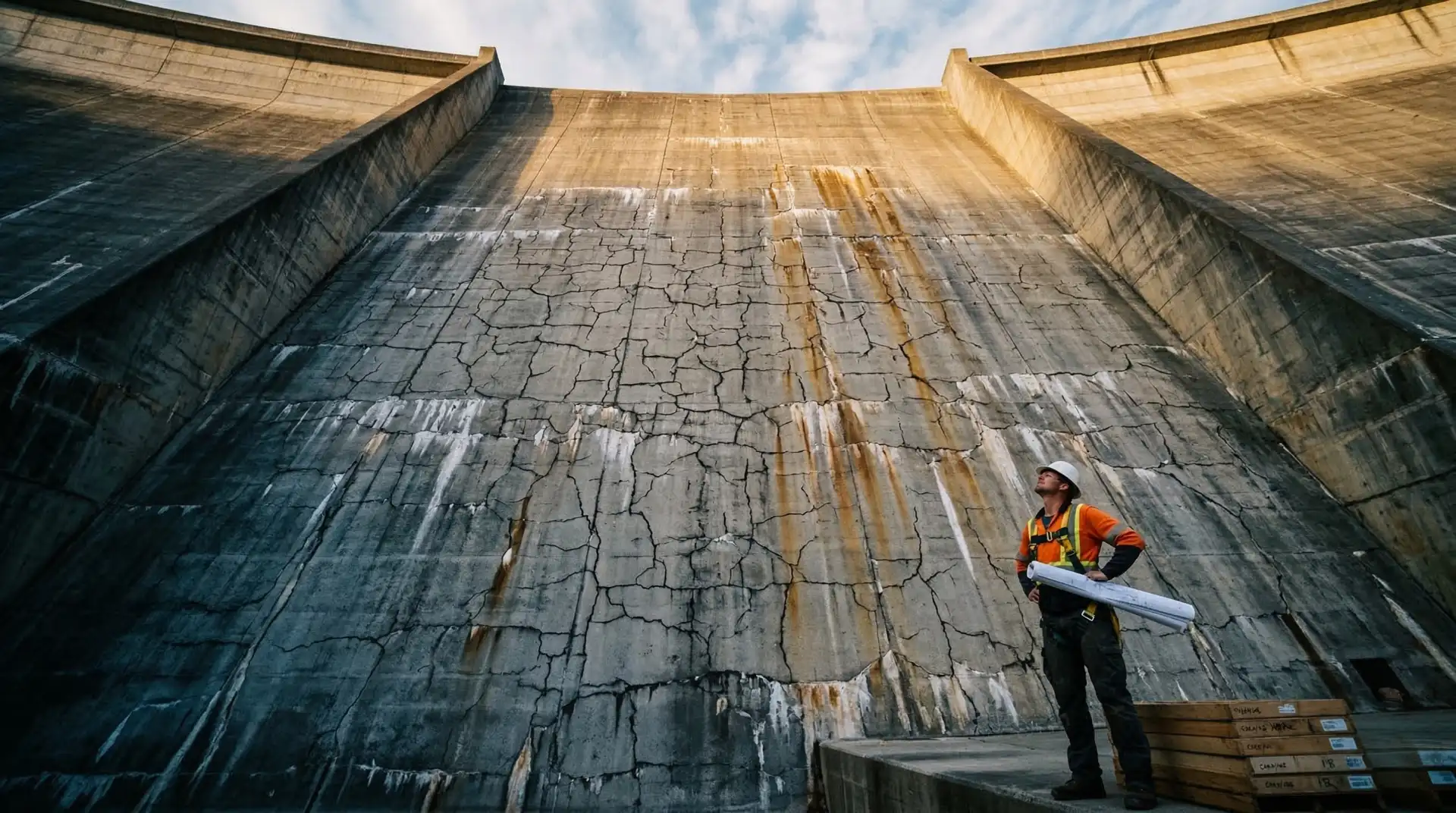
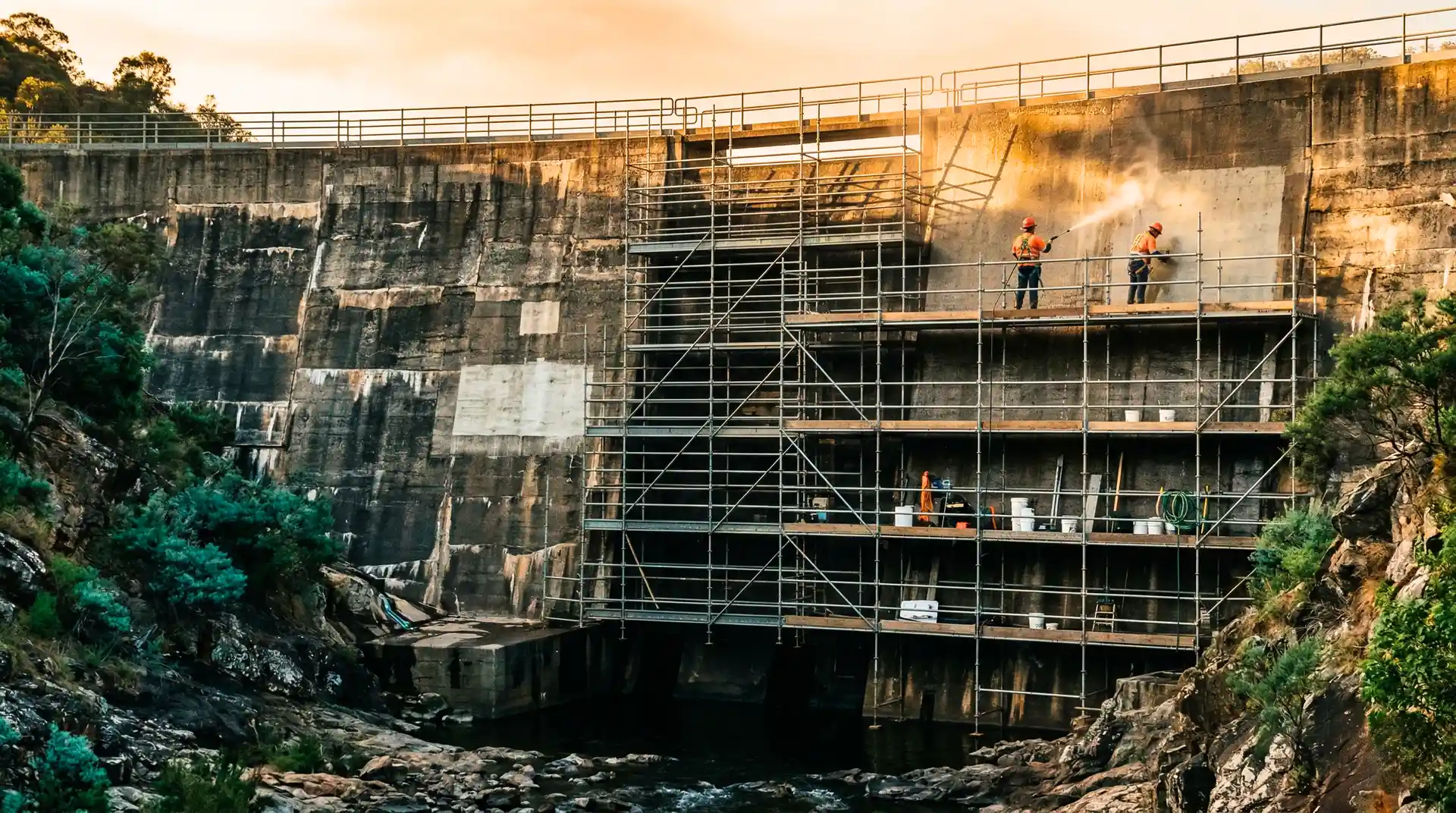
Conventional concrete repairs on dam faces, piers, and abutments require a minimum thickness of 75 to 100 mm to achieve adequate bond and avoid edge curling. When deterioration is shallow (less than 50 mm), the conventional approach requires removing sound concrete to achieve minimum repair thickness, destroying good material to accommodate the repair material’s limitations.
UHPC can be placed in overlays as thin as 25 mm with reliable bond to the substrate, eliminating the need to over-excavate. For dam faces where aesthetic and hydraulic profile considerations limit repair thickness, this capability is decisive.
5. Underwater Repair in Critical Zones
Where underwater repair is required in structurally critical or hydraulically exposed locations (gate sills, energy dissipation surfaces, intake structures), UHPC’s superior bond strength, impermeability, and abrasion resistance justify the cost premium over conventional underwater repair materials.
Where UHPC Does Not Belong
Mass concrete placement: UHPC has no role in the dam body, foundations, or any application requiring large volumes. The cost (USD 800 to 2,500 per cubic metre versus USD 100 to 200 for conventional concrete) and the material’s elimination of coarse aggregate make it fundamentally unsuited for mass concrete.
General spillway wearing layers on new construction: For new spillway construction where adequate section thickness is available, conventional M50 to M70 HPC with ternary SCM blends provides excellent abrasion resistance at a fraction of the cost. UHPC should be reserved for repairs and overlays where thin sections are required.
Applications where thermal control is the primary concern: UHPC’s high cementitious content generates significant heat of hydration. For any application where thermal management drives the design, conventional mass concrete with high SCM dosages is the appropriate choice.
Cost Reality
The material cost differential must be evaluated honestly:
| Material | Cost per m3 (USD) | Typical Thickness | Cost per m2 |
|---|---|---|---|
| Conventional concrete (M30) | 100 to 200 | 200 mm repair | 20 to 40 |
| High-performance concrete (M60) | 200 to 400 | 150 mm repair | 30 to 60 |
| UHPC | 800 to 2,500 | 35 mm overlay | 28 to 88 |
When compared on a per-square-metre basis for overlay applications, the cost gap narrows substantially. The lifecycle cost analysis often favours UHPC when repair frequency, mobilisation costs (especially for underwater or high-access work), and downtime costs are included.
For Indian dam projects, where mobilisation to remote Himalayan sites adds significant cost to every repair event, extending the interval between repairs from 10 years to 25+ years through a UHPC overlay can be economically rational even at the higher material cost.
Practical cost reduction
Non-proprietary UHPC formulations using locally available materials can reduce costs toward the USD 600 per cubic metre range. Research programmes at multiple universities are actively working to bring UHPC costs down through cement replacement with [SCMs](/insights/scm-strategies-dam-concrete) and optimisation of fiber dosage. For dam owners planning rehabilitation 2 to 3 years out, the cost trajectory favours waiting for these developments to mature.
Constructability Challenges at Dam Sites
Mixing Equipment
UHPC requires high-shear mixing to properly disperse the fine particles and achieve homogeneous fiber distribution. Standard drum mixers are inadequate. Pan mixers or high-intensity turbine mixers are required, which may not be available at remote dam sites without specific procurement.
Quality Control
The tolerances for UHPC proportioning are tighter than for conventional concrete. Small variations in water content have outsized effects on workability and strength because of the very low w/cm ratio. Site QC teams accustomed to conventional concrete acceptance criteria will need specific training on UHPC testing per ASTM C1856.
Curing
UHPC benefits significantly from thermal curing (steam or hot water at 60 to 90°C for 48 hours) to achieve full strength development. On a dam site, thermal curing may be impractical for large surface areas. Ambient-cured UHPC achieves lower strengths (typically 120 to 150 MPa versus 180 to 220 MPa with thermal curing), which must be accounted for in the specification.
Fiber Handling
Steel micro-fibers must be added uniformly during mixing and can cause balling if introduced too quickly. Handling fiber-reinforced UHPC requires different placement techniques than conventional concrete: it cannot be vibrated conventionally and relies on its self-compacting properties to fill formwork.
Standards and Specification Gaps
The standards landscape for UHPC in dam applications has significant gaps. ACI 239R-18 is a technology report, not a specification. ASTM C1856 addresses testing but not design. The FHWA’s 2024 Structural Design Guide covers bridges but not hydraulic structures. ICOLD has not published a bulletin on UHPC for dams. BIS has no Indian standard for UHPC.
This means every dam application of UHPC currently requires project-specific specifications developed by the consulting engineer, referencing available standards and supplemented by project-specific testing. This is not unusual for emerging materials in dam engineering, but it places greater responsibility on the specifying engineer to define acceptance criteria, testing protocols, and quality control requirements that are appropriate for the application.
Recommendation
UHPC is not a material that dam engineers should adopt broadly or immediately. It is a material they should understand deeply and deploy precisely, in the specific applications where its properties solve problems that conventional materials cannot. Spillway overlays, stilling basin repairs, gate structures, and thin-section rehabilitation are the applications where UHPC delivers measurable value. Everything else is conventional concrete territory.
PCCI’s mix design and durability consulting practice evaluates materials against the specific demands of each project. For dam owners considering UHPC for a rehabilitation or new construction application, the starting point is a rigorous assessment of whether the application genuinely requires UHPC’s properties, or whether a well-designed conventional HPC achieves the required performance at lower cost and complexity.
For expert evaluation of UHPC applicability on your hydroelectric project, contact PCCI’s consulting team.