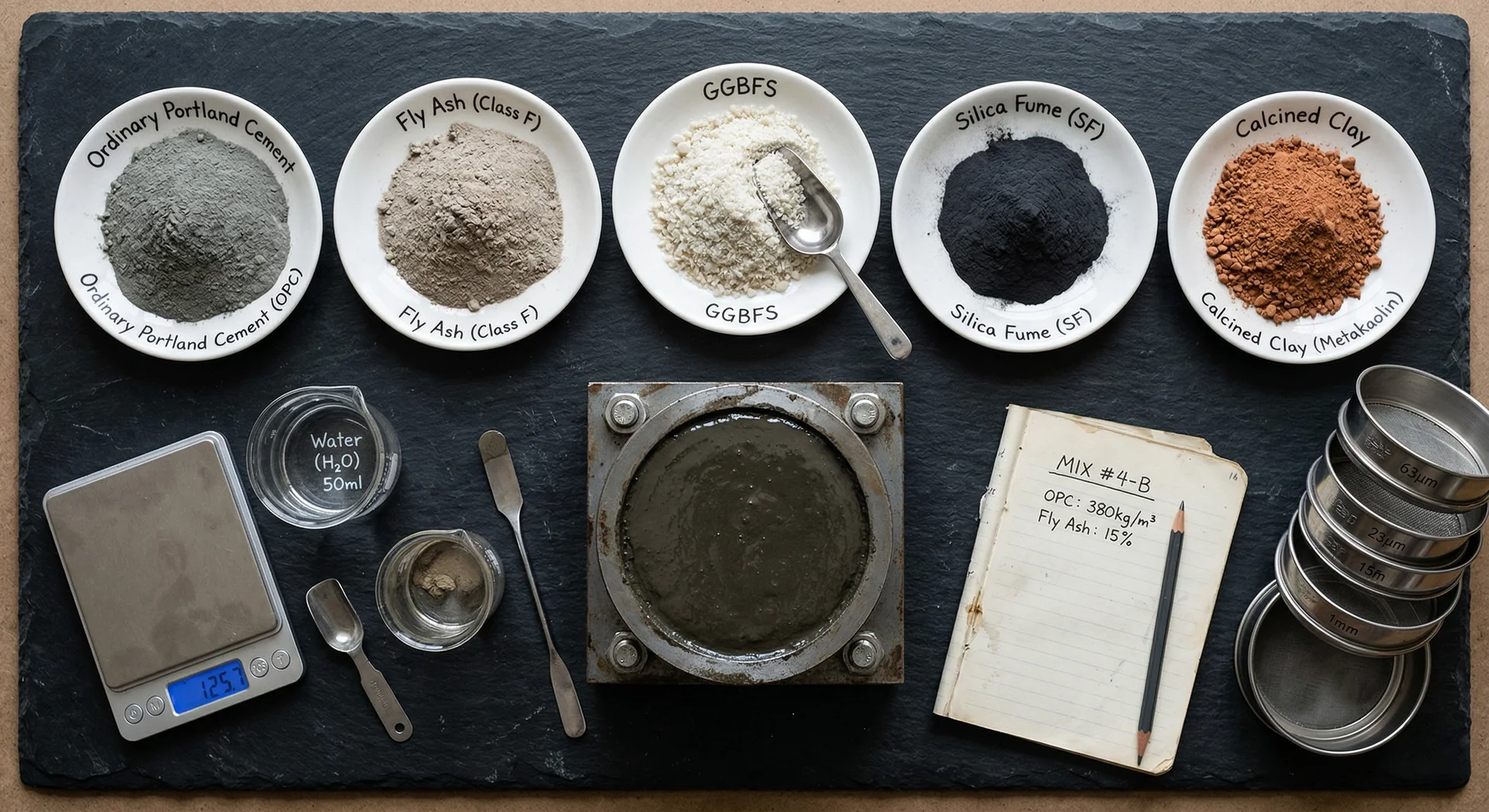
No modern dam is built with Portland cement alone.
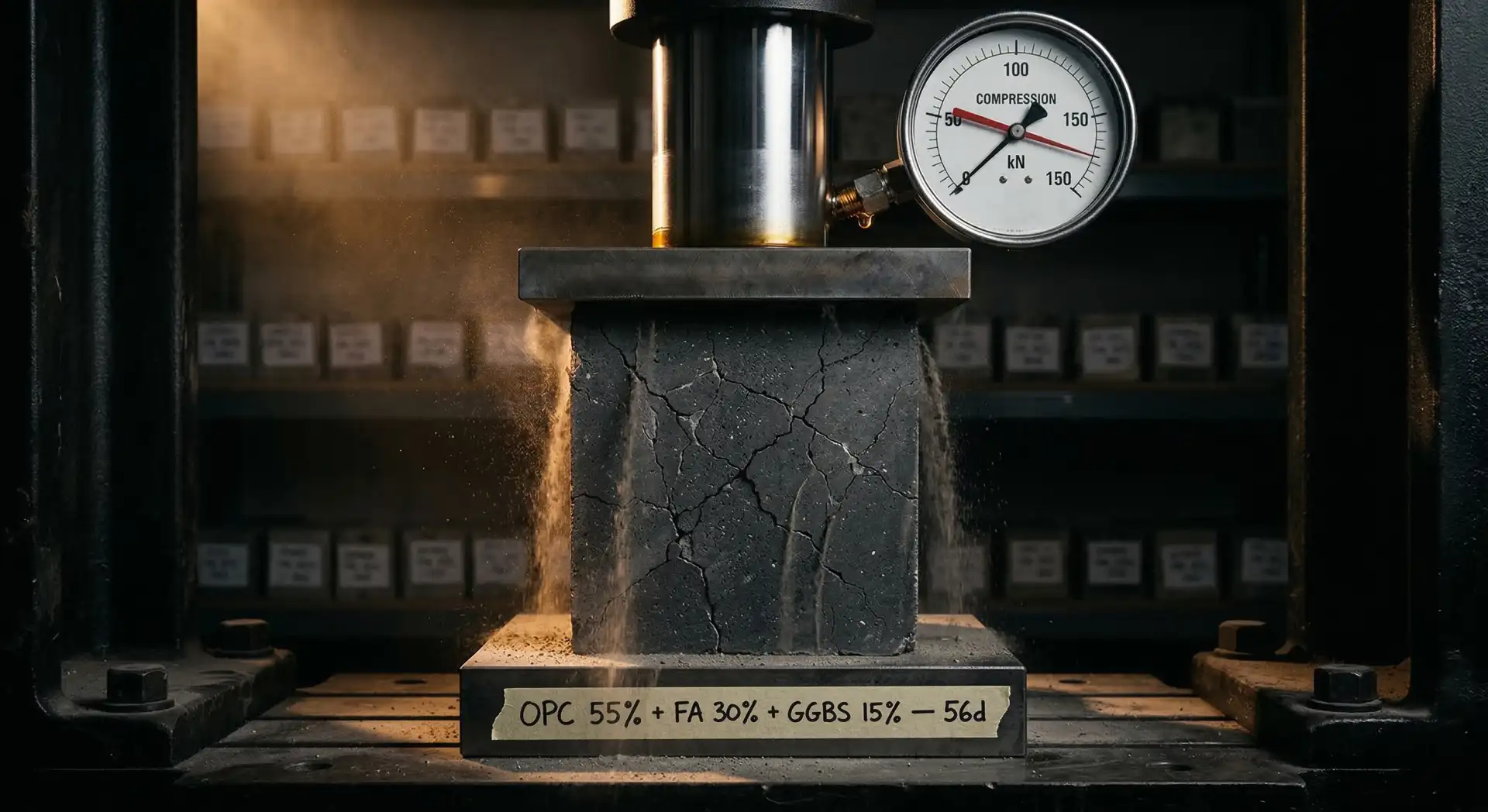
Every major dam project uses supplementary cementitious materials: fly ash, ground granulated blast-furnace slag (GGBS), silica fume, or increasingly, calcined clay. The reasons are both technical and economic. SCMs reduce the heat of hydration that causes thermal cracking, a key concern in thermal control planning. They improve long-term durability by reducing permeability and refining pore structure. They mitigate alkali-aggregate reaction. And they reduce cement consumption, cutting both cost and carbon footprint.
On a dam requiring 500,000 cubic metres of concrete, replacing 35% of the cement with fly ash saves approximately 35,000-50,000 tonnes of clinker. At current cement prices, that is Rs 15-25 crore in direct material savings. The CO2 reduction: approximately 30,000-40,000 tonnes.
But SCMs are not interchangeable. Each one has a distinct reaction mechanism, a different effect on heat generation, a different strength development profile, and different implications for construction logistics. Choosing the wrong SCM, or the wrong replacement rate, can solve one problem while creating another.
The Four SCMs for Dam Concrete
Fly Ash (Pulverised Fuel Ash)
What it is: A byproduct of coal combustion in thermal power plants. Classified as Class F (low calcium, primarily pozzolanic) or Class C (high calcium, with some hydraulic properties). Indian fly ash is predominantly Class F, conforming to IS 3812.
Why it dominates dam concrete: Fly ash is the most widely used SCM in Indian dam construction for three reasons: it is abundant (India produces over 200 million tonnes annually from coal-fired power plants), it is the most effective SCM for reducing heat of hydration, and it is the least expensive.
Performance profile:
| Property | Effect at 30-40% Replacement |
|---|---|
| Heat of hydration | Reduced 15-20 degrees C peak |
| Early strength (7-day) | 20-40% lower than OPC |
| Late strength (90-365 day) | Equal to or exceeding OPC |
| Permeability | Significantly reduced at 90+ days |
| AAR mitigation | Effective at 25%+ replacement |
| Sulphate resistance | Improved (Class F) |
| Workability | Improved (ball-bearing effect) |
Replacement rates in dam concrete:
- Conventional mass concrete: 25-40% (IS 456 limit: 35%)
- RCC: 40-60% (lower strength requirements allow higher replacement)
- High-performance concrete (spillways, stilling basins): 20-30% (early strength requirements limit replacement)
Limitations:
- Slow early strength development limits structural form removal and construction loading schedules
- Quality variability between power plants and between batches from the same plant (carbon content, fineness, LOI)
- Cold weather performance is poor: pozzolanic reaction is highly temperature-dependent and slows dramatically below 10 degrees C
- Supply reliability at remote dam sites: transport logistics for bulk fly ash from power plants
GGBS (Ground Granulated Blast-Furnace Slag)
What it is: A byproduct of iron production in blast furnaces. The molten slag is rapidly quenched with water to produce a glassy granulate, then ground to a fine powder. Conforms to IS 12089.
Why it is used in dam concrete: GGBS provides a balance between heat reduction and early strength that fly ash cannot match. It is hydraulic (reacts with water independently) as well as pozzolanic (reacts with calcium hydroxide), so it contributes to strength development earlier than fly ash.
Performance profile:
| Property | Effect at 50-65% Replacement |
|---|---|
| Heat of hydration | Reduced 10-15 degrees C peak |
| Early strength (7-day) | 10-20% lower than OPC |
| Late strength (90-365 day) | Equal to or exceeding OPC |
| Permeability | Significantly reduced |
| AAR mitigation | Effective at 50%+ replacement |
| Sulphate resistance | Excellent |
| Chloride resistance | Excellent |
Where it fits in dam construction:
- Spillway structures and stilling basins where moderate early strength is needed
- Submerged elements requiring excellent sulphate and chloride resistance
- Elements where consistent quality is critical (GGBS quality is more uniform than fly ash)
Limitations:
- More expensive than fly ash (typically 1.5-2x the cost per tonne)
- Availability limited to areas near steel plants (Jamshedpur, Rourkela, Bhilai, Visakhapatnam)
- At high replacement rates (above 65%), setting may be excessively delayed
- Less effective than fly ash for heat reduction at equivalent replacement rates
Silica Fume (Microsilica)
What it is: An ultra-fine byproduct of silicon and ferrosilicon production. Particle size is approximately 100 times finer than cement (0.1-0.3 microns vs. 10-30 microns for cement). Conforms to IS 15388.
Why it is used in dam concrete: Silica fume is not a bulk cement replacement material. It is a specialty addition used at 5-10% of cementitious content to achieve specific performance objectives: extremely low permeability, high early strength, and resistance to chemical attack.
Performance profile:
| Property | Effect at 5-10% Addition |
|---|---|
| Heat of hydration | Slightly increased (rapid early reaction) |
| Early strength (7-day) | 10-20% higher than OPC |
| Permeability | Dramatically reduced (100-1000x lower water permeability) |
| AAR mitigation | Highly effective even at 5-8% |
| Abrasion resistance | Significantly improved |
| Cohesion/bleeding | Reduced bleeding, improved cohesion |
Where it fits in dam construction:
- Spillway ogee crests and energy dissipation structures (abrasion resistance)
- Underwater concrete (anti-washout, cohesion)
- Repair and rehabilitation concrete (high early strength, low permeability)
- Impermeable zones requiring minimal water penetration
Limitations:
- Expensive (5-10x the cost of fly ash per tonne)
- Increases water demand (requires superplasticizer)
- Increases heat generation (the opposite of what mass concrete needs)
- Difficult to handle and dispense (ultra-fine, dusty, electrostatic)
- Not appropriate as a bulk replacement for heat control
Calcined Clay (Metakaolin) and LC3
What it is: Calcined clay is produced by heating kaolinite clay to 650-800 degrees C, transforming it into metakaolin, a highly reactive pozzolanic material. LC3 (Limestone Calcined Clay Cement) combines calcined clay with limestone and clinker to produce a cement with 30-40% lower CO2 emissions.
Why it matters for dam concrete: Calcined clay is not dependent on coal combustion (unlike fly ash) or steel production (unlike GGBS). It can be produced from locally available clay deposits, making it potentially available at remote dam sites where fly ash and GGBS supply is uncertain.
Performance profile:
| Property | Effect |
|---|---|
| Heat of hydration | Moderate reduction (less than fly ash, more than GGBS) |
| Early strength | Comparable to OPC (faster than fly ash) |
| Permeability | Significantly reduced |
| AAR mitigation | Effective |
| Chloride resistance | Excellent |
| Sulphate resistance | Good |
| CO2 reduction | 30-40% versus OPC |
Current status in India: IS 456:2000 Amendment No. 6 (2024) recognizes Portland Calcined Clay Limestone Cement (LC3) but restricts its use in underground structures and elements in contact with groundwater where temperatures are predominantly below 15 degrees C for six months. Holcim is targeting 1 million tonnes of LC3 production by 2026.
Where it could fit in dam construction:
- Above-ground structural elements (piers, abutments, parapet walls)
- Non-submerged portions of dam body
- Remote sites where fly ash and GGBS are not available
- Projects targeting low-carbon concrete
Limitations:
- Restricted from underground and certain submerged applications per current IS 456 amendment
- Limited production capacity in India as of 2026
- Performance data specific to mass concrete and dam applications is still limited
- Quality depends on the kaolinite content and mineralogy of the source clay
Selecting SCMs for Different Dam Elements
The key insight is that no single SCM is optimal for all elements of a dam. Each structural element has different performance requirements:
| Dam Element | Primary Requirement | Recommended SCM | Typical Replacement |
|---|---|---|---|
| Interior mass (gravity section) | Low heat, economy | Fly ash | 35-50% |
| RCC body | Low heat, workability, economy | Fly ash | 40-60% |
| Upstream face (CVC) | Impermeability, durability | Fly ash + silica fume | 25-30% FA + 5-8% SF |
| Spillway crest/ogee | Abrasion resistance, early strength | GGBS or fly ash + silica fume | 30-40% GGBS or 20% FA + 8% SF |
| Stilling basin | Abrasion, cavitation resistance | GGBS + silica fume | 30-40% GGBS + 5-8% SF |
| Galleries | Moderate strength, workability | Fly ash | 25-35% |
| Foundation treatment | Early strength, pumpability | GGBS | 30-50% |
| Repair/rehabilitation | Early strength, low permeability | Silica fume | 8-10% |
The Availability Problem
The most technically optimal SCM means nothing if it cannot be delivered to the dam site reliably and in sufficient quantity.
Fly ash: Abundant nationally (200+ million tonnes/year) but not uniformly distributed. Dam sites in the Himalayas, Northeast India, and parts of the Western Ghats may be hundreds of kilometres from the nearest thermal power plant. Transport cost for bulk fly ash to remote sites can exceed the material cost.
GGBS: Production concentrated near integrated steel plants. Transport to non-industrial areas is expensive. Supply disruptions from steel plant shutdowns can affect dam construction schedules.
Silica fume: Very limited production in India. Most is imported. Availability and cost are volatile.
Calcined clay: Potentially the most locally available option, since suitable clay deposits exist in many regions. But processing infrastructure is still developing.
For remote dam sites, the SCM strategy must start with a supply chain assessment, not a materials science optimisation. The best SCM is the one you can get reliably, in quality, at the site, for the duration of the project.
Quality Control for SCMs
SCM quality variability is a persistent challenge on Indian dam projects, and robust QA/QC systems are essential to manage it:
Fly ash: Carbon content (Loss on Ignition) can vary from 1% to 12% between sources and between batches. High carbon content reduces air-entraining admixture effectiveness and can affect colour and fineness. IS 3812 limits LOI to 5%, but enforcement varies.
Testing frequency: For dam concrete, fly ash should be tested per delivery (not per month) for fineness (Blaine), LOI, moisture content, and pozzolanic activity. Any change in source requires a full requalification.
GGBS: More consistent than fly ash but glass content (which determines reactivity) can vary between batches. Activity index testing per IS 12089 should be conducted regularly.
Silica fume: Quality is generally consistent from established sources but SiO2 content, carbon content, and particle size distribution should be verified per shipment.
Ternary and Quaternary Blends
Modern dam concrete increasingly uses combinations of SCMs rather than a single replacement:
Fly ash + silica fume: The most common binary blend for dam concrete. Fly ash provides bulk heat reduction and economy. Silica fume provides impermeability and early strength compensation. Typical: 25-30% fly ash + 5-8% silica fume.
Fly ash + GGBS: Used where both materials are available and different elements require different performance profiles. Fly ash for the interior mass, GGBS for structural elements.
Fly ash + calcined clay: An emerging combination that could serve remote sites where fly ash supply is limited. Calcined clay supplements the fly ash with faster pozzolanic reaction.
The key principle: each SCM in a ternary or quaternary blend should serve a specific performance function. Adding SCMs for the sake of complexity or to demonstrate innovation is counterproductive if it complicates quality control without measurable benefit.
The Economic and Carbon Case
For a dam requiring 500,000 cubic metres of concrete at 250 kg/m3 total cementitious content:
| SCM Strategy | Cement Saved (tonnes) | Approximate Cost Saving | CO2 Reduction (tonnes) |
|---|---|---|---|
| 35% fly ash | 43,750 | Rs 15-20 crore | 35,000-40,000 |
| 50% fly ash (RCC) | 62,500 | Rs 22-28 crore | 50,000-56,000 |
| 30% FA + 5% SF | 43,750 | Rs 10-15 crore (SF cost offsets) | 35,000-40,000 |
| 50% GGBS | 62,500 | Rs 12-18 crore (GGBS more expensive) | 50,000-56,000 |
The carbon reduction alone, at projected carbon pricing of $20-50/tonne CO2 by 2030, has a potential economic value of Rs 6-25 crore for a single dam project.
Key Takeaways
-
Match the SCM to the element. No single SCM is optimal for every part of a dam. Design the SCM strategy element by element.
-
Start with supply, not science. The most technically perfect SCM that cannot be delivered reliably is worthless. Assess supply chain before finalizing the mix design.
-
Test more than the standard requires. IS 3812 testing frequencies are minimums for general construction. Dam concrete demands testing per delivery.
-
Design for 90/365-day strength. SCM-rich mixes develop strength slowly. The structural design must specify the design age accordingly. Demanding 28-day strength from a 40% fly ash mix defeats the purpose of using fly ash.
-
Monitor thermal performance, not just strength. The primary reason for using SCMs in mass concrete is heat reduction. Verify that the actual heat generation matches the thermal modelling assumptions.
-
Watch for LC3. Calcined clay cement is the most significant development in cementitious materials since fly ash. As production capacity grows and codification advances, it will become a mainstream option for dam concrete, particularly at sites far from thermal power plants and steel mills.
The days of single-SCM, single-replacement-rate dam concrete are over. Modern dam projects use differentiated cementitious systems tailored to each structural element, each exposure condition, and each performance requirement. The mix design is no longer one document. It is a family of mixes, each optimised for its specific role in a structure designed to last a century.