
The scale problem: why RCC cement content matters more than you think
Global cement production accounts for roughly 8% of anthropogenic CO2 emissions, according to the Global Cement and Concrete Association. Every tonne of ordinary Portland cement (OPC) produced releases approximately 900 kg of CO2, split between the chemical decomposition of limestone (about 60%) and fuel combustion in the kiln (about 40%).
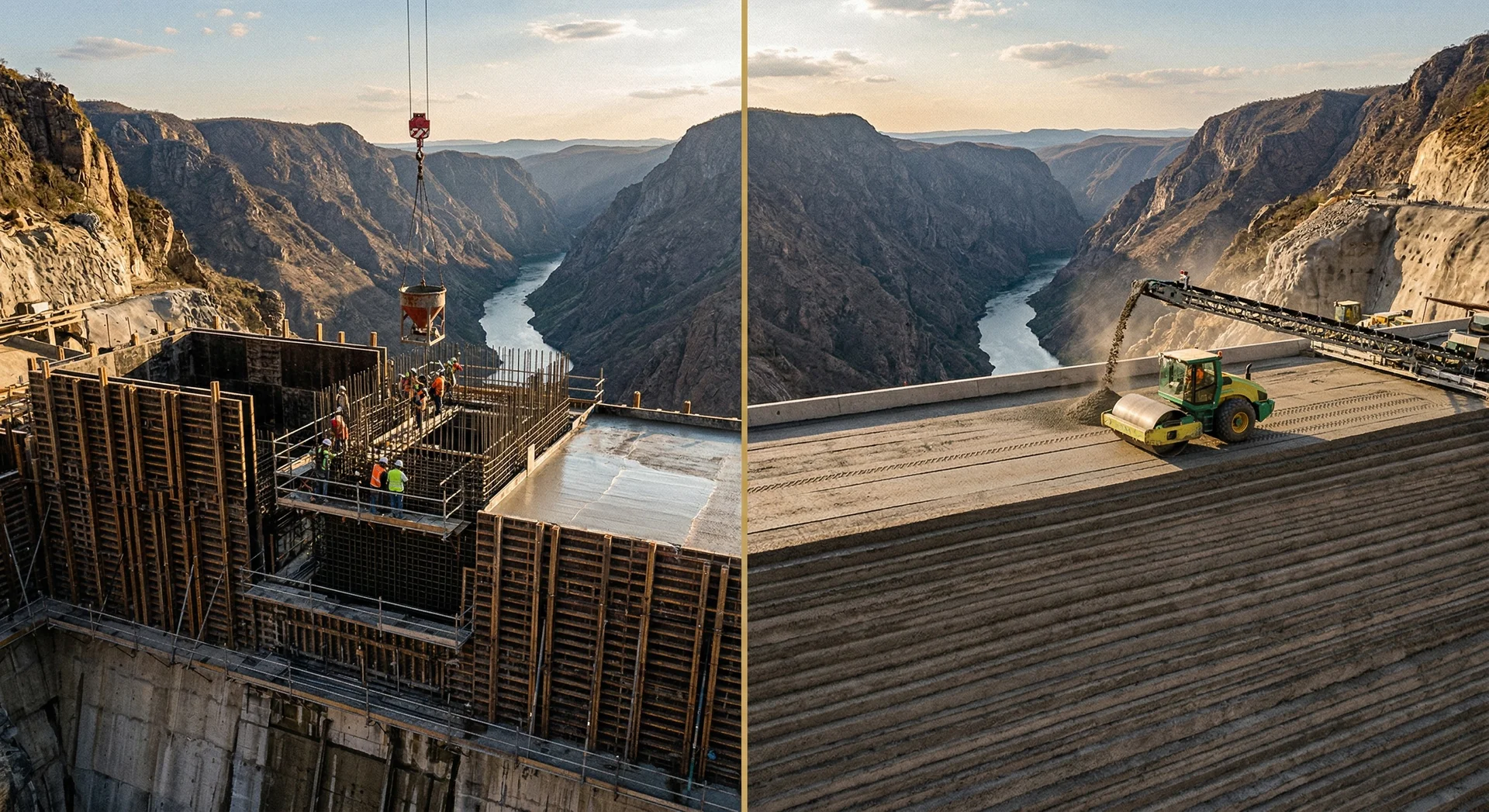
Now consider the scale of an RCC dam. A single large gravity dam can consume one to three million cubic metres of concrete. Even at RCC’s relatively lean cementitious contents of 100-250 kg/m3, that translates to tens of thousands of tonnes of cementitious material per project.
At this scale, percentage reductions compound into enormous absolute savings. Reducing cement content by just 20 kg/m3 across a 1.5 million m3 dam eliminates 30,000 tonnes of cementitious material and roughly 27,000 tonnes of CO2. That is equivalent to taking approximately 5,800 cars off the road for a year.
RCC vs. conventional: the carbon starting point
RCC already operates with lower cementitious contents than conventional mass concrete. Where conventional gravity dams typically specify 200-350 kg/m3 of cementitious material, RCC ranges from 100-250 kg/m3. This is not a compromise. It is a function of RCC's unique compaction mechanism: vibratory rollers achieve density through mechanical compaction, reducing the paste volume needed for workability.
But “lower than conventional” is not low enough. The question is how much further cement content can be reduced in RCC, and what that means for performance.
How SCMs reduce carbon in RCC
Supplementary cementitious materials (SCMs) are the primary lever for reducing cement content in RCC. These materials, including fly ash, ground granulated blast furnace slag (GGBS), natural pozzolans, and calcined clay, replace a portion of Portland cement while contributing to long-term strength and durability through pozzolanic or latent hydraulic reactions.
In conventional mass concrete, SCM replacement rates of 25-50% are well established. In RCC, the picture is even more favourable. The inherent characteristics of RCC placement allow, and often encourage, higher replacement rates.
Why RCC tolerates higher SCM content
Three factors make RCC uniquely suited to high-volume SCM mixes:
-
Low paste volume. RCC mixes are intentionally lean, with paste contents just sufficient to coat aggregates and fill voids under roller compaction. This means less total cementitious material is needed, and the SCM proportion within that smaller total can be higher.
-
Extended strength timelines. RCC dams are loaded gradually. The reservoir does not impound until the dam reaches its design height, which may take two to five years of construction. Specifying 90-day or 365-day design strength rather than 28-day strength allows the slower pozzolanic contribution of fly ash and GGBS to be fully utilised.
-
Thermal benefits. High SCM content directly reduces heat of hydration, which is the primary cause of thermal cracking in RCC dams. Since RCC cannot use embedded cooling pipes, reducing heat generation through mix design is not just a sustainability benefit. It is a structural necessity.
Common SCMs in RCC dam construction
| SCM | Typical replacement rate in RCC | CO2 per tonne (approx.) | Key benefits |
|---|---|---|---|
| Fly ash (Class F) | 40-70% | 10-30 kg | Reduces heat, improves workability, excellent AAR resistance |
| GGBS | 30-60% | 40-80 kg | High long-term strength, sulfate resistance, refined pore structure |
| Natural pozzolans | 20-50% | 30-60 kg | Locally available, no industrial supply chain dependency |
| Calcined clay | 15-35% | 200-300 kg | Globally abundant feedstock, core component of LC3 |
| OPC (reference) | 0% (baseline) | ~900 kg | Baseline cementitious material |
Fly ash remains the most widely used SCM in RCC dams worldwide, with replacement rates of 40-60% being routine and 70% documented on several projects. The combination of low cost, low heat, and proven long-term performance makes it the default choice where supply is reliable.
The CO2 arithmetic: a comparison
The carbon impact of SCM substitution becomes clear when applied to a representative RCC dam project.
Consider a dam requiring 1 million m3 of RCC with a total cementitious content of 150 kg/m3. The table below compares three scenarios:
| Parameter | Scenario A: 100% OPC | Scenario B: 50% fly ash | Scenario C: 65% fly ash |
|---|---|---|---|
| Total cementitious (kg/m3) | 150 | 150 | 150 |
| OPC content (kg/m3) | 150 | 75 | 52.5 |
| Fly ash content (kg/m3) | 0 | 75 | 97.5 |
| CO2 from OPC (kg/m3) | 135 | 67.5 | 47.3 |
| CO2 from fly ash (kg/m3) | 0 | 1.5 | 2.0 |
| Total CO2 (kg/m3) | 135 | 69 | 49.3 |
| Total CO2 for 1M m3 dam | 135,000 t | 69,000 t | 49,300 t |
| CO2 savings vs. Scenario A | Baseline | 66,000 t (49%) | 85,700 t (63%) |
Scenario C, which represents an aggressive but achievable fly ash replacement for RCC, eliminates over 85,000 tonnes of CO2 from a single dam. The savings are even larger when compared against conventional concrete dams, which use 300-400 kg/m3 of cementitious material with lower SCM ratios.
Key takeaway: Moving from a conventional concrete dam to a high-fly-ash RCC dam can reduce cement-related CO2 emissions by 75-85% per cubic metre. At the scale of a large dam, this translates to hundreds of thousands of tonnes of avoided emissions per project.
Why 28-day strength is the wrong specification for RCC
A persistent barrier to higher SCM content in dam concrete is the habit of specifying 28-day compressive strength. This convention, inherited from structural building concrete, is poorly suited to mass concrete in dams.
The logic is straightforward. A building column must carry its design load the moment formwork is removed, often within weeks. A dam is different. The full hydrostatic load does not apply until the reservoir fills, which cannot happen until the dam reaches its design height. For a large RCC dam, this process takes years.
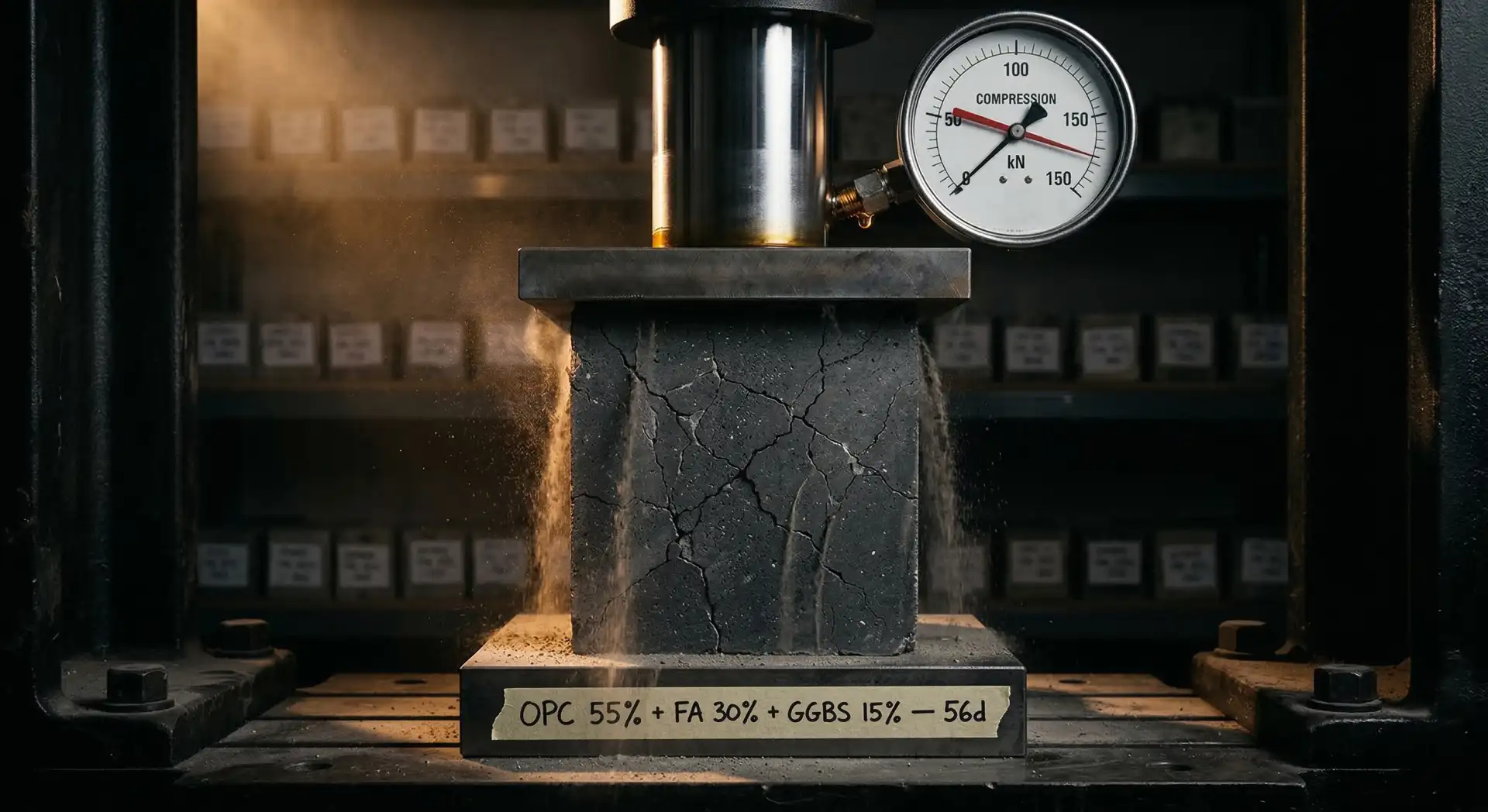
During those years, fly ash and GGBS continue reacting. The pozzolanic contribution, which is minimal at 28 days, becomes substantial at 90 days and dominant at 365 days. An RCC mix that shows only 15 MPa at 28 days may reach 25 MPa at 90 days and 30+ MPa at one year.
Specifying 90-day or 365-day design ages, as recommended by ACI guidance for mass concrete, removes the artificial ceiling on SCM content. It allows mix designers to optimise for the actual performance timeline rather than an arbitrary early-age benchmark.
This is not theoretical. It is standard practice on well-engineered RCC dams worldwide. The challenge is ensuring that project specifications reflect the actual structural requirement rather than defaulting to building-code conventions.
LC3: the next generation of low-carbon RCC binders
Limestone Calcined Clay Cement, known as LC3, represents the most significant development in low-carbon cementitious technology since the adoption of fly ash. Developed through research coordinated between EPFL and multiple international partners, LC3 replaces up to 50% of clinker with a combination of calcined clay (typically kaolinite heated to 700-800 degrees Celsius) and limestone.
The carbon reduction is substantial: 30-40% lower CO2 per tonne compared to OPC. The performance profile is comparable to OPC-fly ash blends at similar replacement levels, with adequate long-term strength development and good durability characteristics.
For RCC applications, LC3 offers a specific strategic advantage. Fly ash supply is declining in many regions as coal-fired power plants close. GGBS is geographically concentrated near steel production facilities. LC3’s raw materials, clay and limestone, are abundant globally. This makes it a viable binder technology for RCC projects in locations where traditional SCMs are scarce or expensive to transport.
Early pilot applications of LC3 in RCC are showing promising results for workability retention, compactability, and long-term strength development. While field experience is still limited compared to fly ash, LC3 is increasingly recognised by bodies such as ASTM International and regional standards organisations as a credible path forward.
Durability benefits of high-SCM RCC mixes
Reducing cement content in RCC is often framed purely as a sustainability measure. In practice, it improves several durability parameters simultaneously.
Alkali-aggregate reaction resistance
Alkali-aggregate reaction (AAR) is one of the most damaging deterioration mechanisms in dam concrete. High fly ash content (above 40%) is one of the most effective mitigation strategies, reducing pore solution alkalinity and consuming calcium hydroxide through the pozzolanic reaction. In RCC dams, where aggregate volumes are large and full-scale petrographic assessment of every source is impractical, high SCM content provides an essential safety margin.
Reduced permeability
The pozzolanic reaction produces calcium silicate hydrate (C-S-H) gel that fills capillary pores, refining the pore structure over time. High-SCM RCC mixes typically show significantly lower permeability at 90 and 365 days compared to OPC-only mixes, improving resistance to water ingress, sulfate attack, and chloride penetration.
Lower thermal cracking risk
Less cement means less heat. For RCC dams that cannot use cooling pipes, this thermal benefit is inseparable from the durability benefit. Every thermal crack avoided is a potential seepage path eliminated, which directly extends service life.
Durability is sustainability
As we explored in The Greenest Concrete Is the One You Don't Have to Repair, the largest carbon cost in concrete infrastructure comes not from the initial pour but from premature failure. High-SCM RCC mixes reduce carbon at placement and extend service life, delivering a double sustainability dividend.
Real-world performance: what the data shows
Multiple RCC dam projects worldwide have demonstrated that 50-70% cement replacement is achievable with proper mix design and quality control.
The performance evidence is consistent across these projects:
- 28-day strength ranges from 8-15 MPa at high SCM ratios. This is intentionally low and acceptable for RCC dams.
- 90-day strength typically reaches 15-25 MPa, meeting most design requirements.
- 365-day strength often exceeds 25 MPa, providing comfortable margins above the design specification.
- Permeability at 90+ days is consistently lower than OPC-only control mixes.
- AAR expansion in accelerated mortar bar and concrete prism tests meets ASTM C1567 and ASTM C1293 limits with adequate margins.
The data supports a clear conclusion: high-SCM RCC does not trade durability for sustainability. When designed correctly, it delivers both.
The QA/QC dimension: making low-carbon RCC work in the field
Specifying a high-SCM mix on paper is only half the challenge. Delivering it consistently across hundreds of thousands of cubic metres requires a QA/QC programme calibrated to the specific behaviour of high-SCM RCC.
Key considerations include:
- Variability management. Fly ash and GGBS properties vary between sources and batches. Carbon content in fly ash (measured as loss on ignition) directly affects air entrainment and workability. Regular testing and source qualification are essential.
- Maturity-based strength assessment. Since 28-day strength is not the design criterion, the QA/QC programme must track strength development at 90 and 365 days. Maturity methods allow estimation of in-situ strength from temperature history, reducing reliance on early-age cube tests.
- Lift joint quality. High SCM content can extend the time to initial set, which affects lift joint maturity and bond quality. Placement schedules and inter-lift intervals must account for the slower strength gain.
- Placement temperature control. The thermal benefits of high SCM content can be negated if placement temperatures are not controlled. Maximum fresh concrete temperatures of 20-25 degrees Celsius remain critical targets.
How PCCI approaches low-carbon RCC mix design
PCCI’s approach to low-carbon RCC is grounded in a principle: cement reduction must be performance-validated, not assumption-driven. Every project receives a site-specific mix design programme that accounts for local materials, climate conditions, and structural requirements.
The process typically includes:
-
Material characterisation. Detailed testing of available SCMs (fly ash, GGBS, natural pozzolans) for chemical composition, fineness, and pozzolanic activity. Not all fly ash is equal, and the mix design must reflect the actual material, not textbook averages.
-
Trial mix programme. Systematic evaluation of multiple SCM combinations and replacement levels, testing for compressive strength at 7, 28, 90, and 365 days, plus durability parameters including permeability, AAR potential, and sulfate resistance.
-
Thermal modelling integration. Mix design is not conducted in isolation. Heat generation characteristics of each candidate mix feed directly into thermal models that predict temperature evolution in the dam body, ensuring the selected mix meets both strength and thermal constraints.
-
Specification development. Translating the trial mix results into project specifications with 90-day or 365-day design ages, appropriate SCM replacement ranges, and QA/QC acceptance criteria calibrated to high-SCM RCC behaviour.
-
Construction support. On-site technical guidance during production to manage the inherent variability of SCM-rich mixes, ensuring that laboratory-proven performance translates to field-placed concrete.
With deep expertise across multiple landmark hydroelectric projects and 48+ technical papers published globally, PCCI’s technical team has the field-proven capability to develop low-carbon RCC mixes that satisfy both engineering requirements and environmental targets.
As ICOLD and the broader dam engineering community push toward net-zero construction practices, the demand for optimised low-carbon RCC will only grow. The technical solutions exist. The challenge is implementing them rigorously, project by project.
Ready to reduce cement content in your RCC dam project? PCCI provides end-to-end mix design consulting for low-carbon RCC, from material characterisation through construction support. Talk to our team about your project requirements.