The carbon cost of concrete failure
Cement production generates approximately 7-8% of global CO₂ emissions, around 2.4 billion tonnes annually, as reported by the Global Cement and Concrete Association. The industry knows this. The response has been to reduce clinker content: more fly ash, more GGBS, more limestone filler, more alternative binders.
This is necessary work. But it addresses only the first pour.
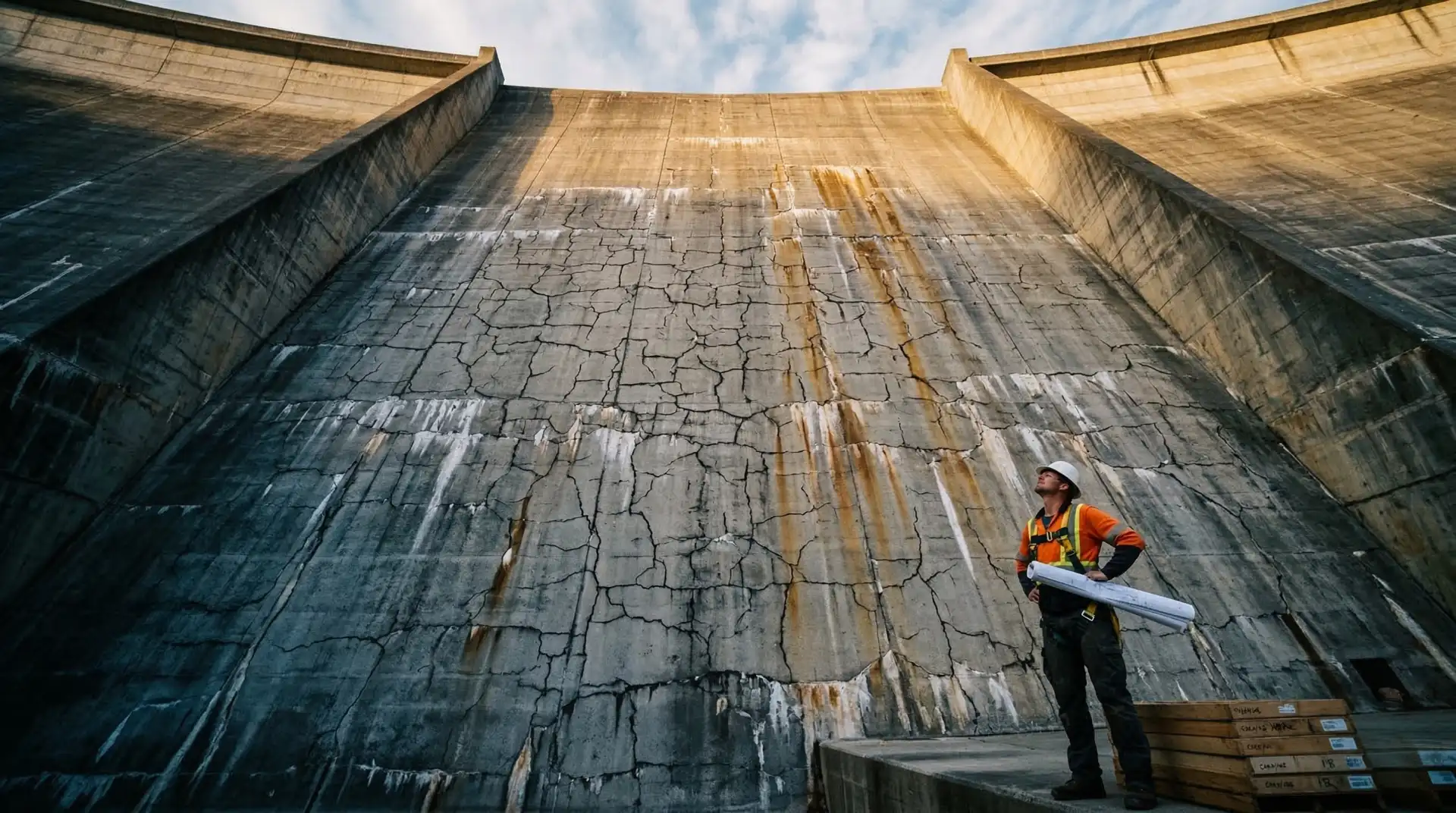
What happens when that concrete fails prematurely? When a dam develops thermal cracks at 15 years, requiring grouting and repair? When alkali-aggregate reaction causes expansion and structural distress at 25 years? When carbonation reaches the reinforcement, triggering corrosion-driven spalling at 30 years?
Each repair cycle demands new cement, new materials, new energy. Demolition of failed concrete creates waste. Reconstruction repeats the entire carbon burden of the original placement, often with additional complexity and cost.
The lifecycle perspective
A dam designed and built for a 100-year service life has roughly one-third the annualized carbon footprint of a dam that requires major rehabilitation at 30 years, even if both used the same initial materials. The most effective carbon reduction strategy in concrete is not just using less cement per cubic metre, but ensuring each cubic metre lasts as long as possible.
Where durability begins: the mix design
Durability is not a property you add to concrete after it hardens. It is an outcome of decisions made before the first aggregate is weighed.
The durability chain begins with material selection:
-
Aggregates: The source, mineralogy, and reactivity of aggregates determine vulnerability to alkali-aggregate reaction (AAR). Proper petrographic analysis and accelerated morite bar testing before construction identify reactive minerals that could cause expansive cracking decades after placement.
-
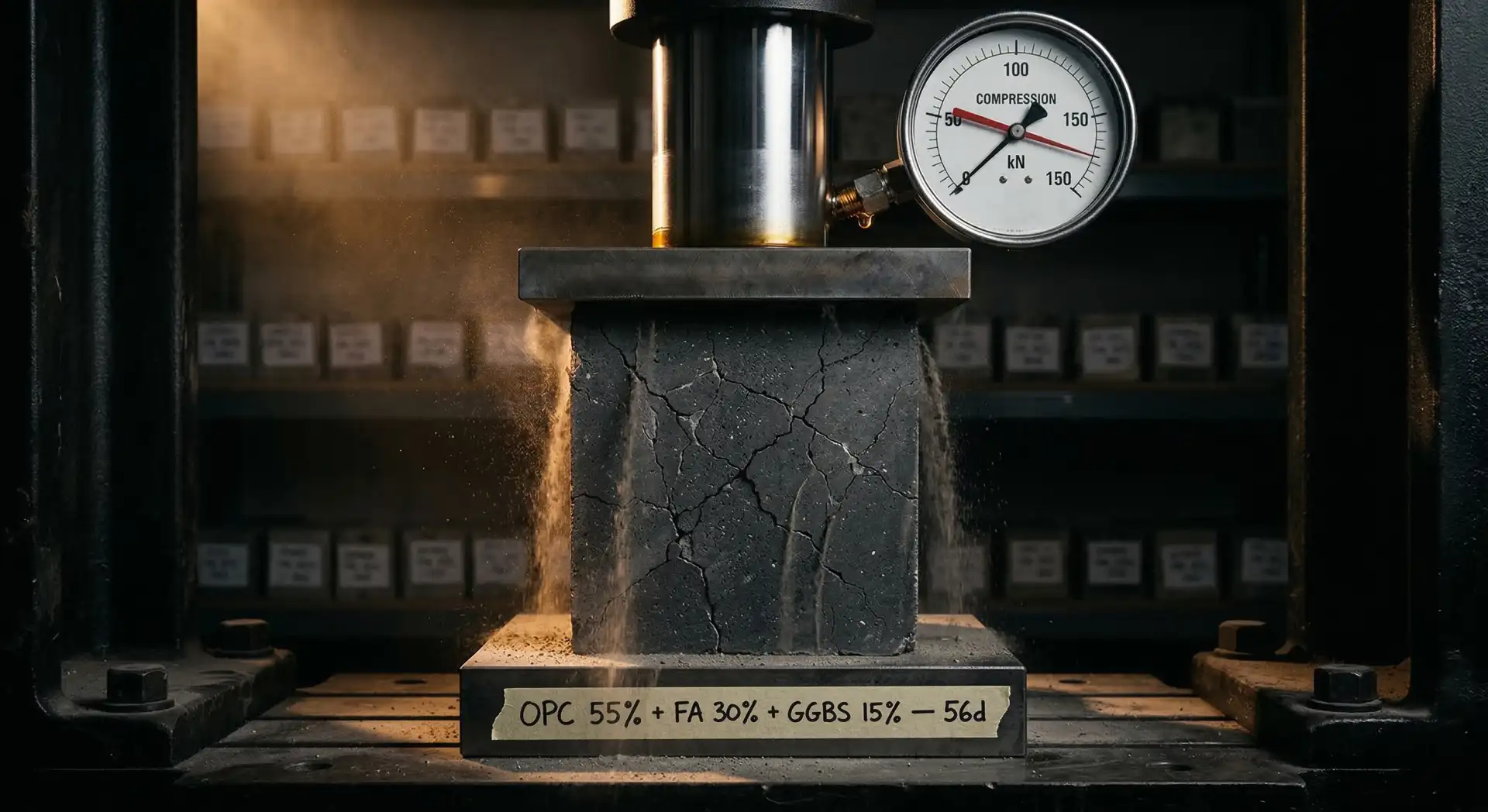
Cementitious system: The combination of Portland cement, fly ash, GGBS, silica fume, and other supplementary cementitious materials (SCMs) defines the concrete’s permeability, chemical resistance, and long-term strength development. Higher SCM content generally improves durability by reducing permeability and mitigating AAR.
-
Water-cementitious ratio: The single strongest predictor of concrete durability. Lower w/cm ratios produce denser, less permeable concrete that resists chloride ingress, carbonation, sulfate attack, and freeze-thaw damage.
-
Admixtures: Air-entraining agents for freeze-thaw resistance. Water reducers for workability without excess water. Corrosion inhibitors for reinforced elements.
At the Tanahu Hydropower Project in Nepal, PCCI specified high fly ash content with low cement specifically to achieve durability against alkali-aggregate reaction. The aggregates available near the site contained reactive minerals that would have caused long-term damage without proper mitigation. The mix design simultaneously addressed thermal control, economy, and 100-year durability.
The five durability threats to dam concrete
Each deterioration mechanism has a prevention strategy. The key is addressing them during design and construction, not after they manifest.
1. Thermal cracking
The most immediate threat. Inadequate thermal control during construction creates cracks that become permanent seepage paths. Prevention: optimized cementitious system, pre-cooling, post-cooling, surface insulation, and thermal monitoring.
2. Alkali-aggregate reaction (AAR)
A slow chemical reaction between alkalis in cement and reactive silica or carbonate minerals in aggregates. It causes expansion, map cracking, and structural distress, often not visible until 10-20 years after construction. Prevention: aggregate testing, low-alkali cement, SCM substitution (fly ash is particularly effective), and lithium-based admixtures.
3. Sulfate attack
External sulfates (from groundwater or soil) or internal sulfates (from contaminated aggregates) react with cement hydration products, causing expansion and disintegration. Prevention: sulfate-resistant cement (Type V), low C₃A content, and SCM substitution.
4. Carbonation and reinforcement corrosion
Atmospheric CO₂ penetrates concrete and reduces its alkalinity. When the carbonation front reaches embedded reinforcement, the protective passive layer is destroyed and corrosion begins. Prevention: adequate cover depth, low permeability (low w/cm ratio), and SCM optimization.
5. Freeze-thaw damage
Water in concrete pores expands on freezing, causing progressive scaling and internal cracking. Critical for dams in high-altitude and cold-climate locations. Prevention: air entrainment (4-7% air content), adequate drainage, and low permeability.
Key Takeaway
Every one of these deterioration mechanisms is preventable through proper material selection, mix design, and construction quality control. Premature failure of dam concrete is not an engineering inevitability; it is a failure of planning, design, or quality assurance.
The economics of durability
Consider two dam projects, each using 500,000 m³ of concrete:
Project A invests 3-5% more in its concrete program: better aggregates, optimized cementitious system, comprehensive QA/QC, thermal monitoring, and durability testing. The concrete achieves a 100-year service life.
Project B cuts corners on material testing, uses higher cement content for early strength, minimizes QC staffing, and does not conduct durability assessments. The concrete develops thermal cracks at year 5, AAR-related distress at year 20, and requires major rehabilitation at year 30.
The rehabilitation of Project B, including grouting, crack repair, surface treatment, structural assessment, and partial reconstruction, costs 20-40% of the original concrete works. And it only buys another 20-30 years before the next intervention.
Over 100 years, Project A’s total concrete lifecycle cost is 40-60% lower than Project B’s, despite higher initial investment. And its cumulative carbon footprint is roughly one-third.
Durability assessment is not optional
For new construction, PCCI’s Durability & Service-Life Design service includes:
- Aggregate investigation: Petrographic analysis, accelerated mortar bar testing (ASTM C1260), concrete prism testing (ASTM C1293) for AAR potential
- Durability mix design: Permeability testing, chloride diffusion, sulfate resistance, carbonation resistance
- Service-life modelling: Predicting deterioration rates and maintenance intervals based on exposure conditions
- Specification review: Ensuring project specifications address all relevant deterioration mechanisms for the site conditions
For existing structures, PCCI provides non-destructive testing, condition assessment, remaining service-life estimation, and rehabilitation strategy development through our Construction Troubleshooting & RCA service.
The real sustainability equation
The concrete industry’s sustainability conversation needs to expand beyond clinker factor. Both matter, but they are not equal:
- Reducing cement content by 30% saves 30% of initial carbon per cubic metre
- Extending service life from 30 to 100 years saves 67% of lifecycle carbon for the entire structure
The most impactful sustainability strategy is not choosing between low-carbon mix design and durability engineering. It is doing both, because they are complementary. Lower cement content (through SCM substitution) simultaneously reduces carbon, reduces heat of hydration, and improves long-term durability.
PCCI's position
The greenest concrete is the one you never have to repair. Every decision in our consulting practice, from aggregate selection to thermal control to QA/QC systems, is oriented toward this principle. Durability is not an upgrade. It is the foundation of responsible infrastructure engineering.
Book a Technical Call → to discuss durability engineering for your project.