
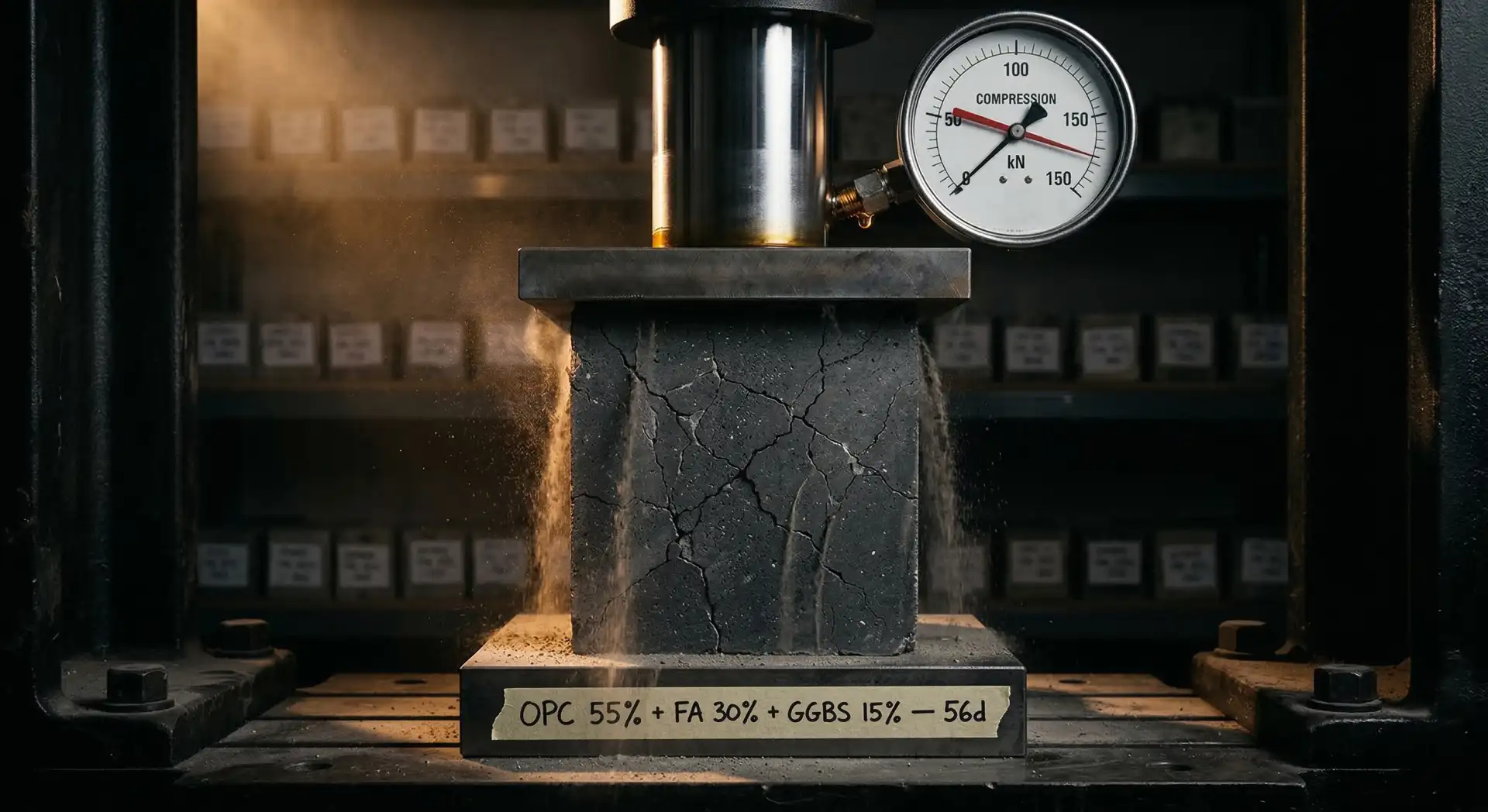
Why cement is over-specified in mass concrete
The default approach to concrete specification is conservative: specify a cement content high enough to guarantee the required compressive strength at 28 days with a comfortable margin. For structural concrete in buildings, this works reasonably well.
For mass concrete in dams, it creates three problems simultaneously:
-
Excess heat: More cement means more heat of hydration. OPC generates approximately 280 kJ/kg at 7 days. A mix with 350 kg/m³ of cement produces significantly more heat than one with 200 kg/m³, requiring more expensive thermal control measures or accepting higher cracking risk.
-
Excess cost: Cement is typically the most expensive component of concrete, accounting for 40-60% of material cost per cubic metre. On a 500,000 m³ dam pour, even a modest reduction in cement content represents substantial savings.
-
Excess carbon: Cement production accounts for approximately 7-8% of global CO₂ emissions, per the Global Cement and Concrete Association. Every kilogram of cement not used is roughly 0.9 kg of CO₂ not emitted.
The paradox of over-cementing
Using excess cement in mass concrete does not make it stronger or more durable; it makes it more vulnerable. Higher cement content increases the heat of hydration, which increases thermal cracking risk, which reduces watertightness and durability. The relationship is counterintuitive: in mass concrete, less cement often means better performance.
The SCM toolkit: fly ash, GGBS, and silica fume
Supplementary cementitious materials are not fillers. They are active participants in the hydration process. Each brings specific engineering benefits.
Fly ash (Class F)
A pozzolanic material from coal combustion that reacts with calcium hydroxide (a hydration by-product) to form additional calcium silicate hydrate, the binding phase of concrete.
Benefits in mass concrete:
- Reduces heat of hydration by 25-35% at typical replacement levels
- Improves long-term strength (56-day and 90-day strengths often exceed OPC-only mixes)
- Enhances sulfate resistance and AAR mitigation
- Improves workability, reducing water demand
- Achieves approximately 54% reduction in global warming potential vs. pure OPC
Typical replacement range: 25-50% by mass of total cementitious material
GGBS (Ground Granulated Blast Furnace Slag)
A latent hydraulic material from iron production that activates in the alkaline environment of Portland cement hydration.
Benefits in mass concrete:
- Reduces heat of hydration by 40-50% at high replacement levels
- Excellent long-term strength development
- Superior sulfate resistance
- Reduced permeability and chloride diffusion
- Achieves approximately 61% reduction in global warming potential vs. pure OPC
Typical replacement range: 50-70% by mass of total cementitious material
Silica fume
An ultra-fine pozzolanic material from silicon production, used primarily for high-performance and low-permeability applications.
Benefits:
- Dramatically reduces permeability
- Very high early pozzolanic reactivity
- Enhances interfacial transition zone between paste and aggregate
Typical use: 5-10% addition (used in combination with fly ash or GGBS, not as primary replacement)
Performance-based specification: the key to optimization
The critical shift that enables cement optimization is moving from prescriptive to performance-based specifications.
| Specification Approach | Example | Outcome |
|---|---|---|
| Prescriptive | ”Minimum 350 kg/m³ cement” | Over-cemented, high heat, unnecessary cost |
| Performance-based | ”Min. 25 MPa at 90 days, max permeability 1×10⁻¹² m/s” | Optimized for actual structural and durability requirements |
In mass concrete for dams, the structural loads develop gradually over months and years as the dam is built lift by lift. The 28-day strength that dominates building construction specifications is largely irrelevant. What matters is:
- 90-day or 365-day compressive strength: when the structure actually experiences design loads
- Heat of hydration: lower is better for crack prevention
- Permeability and durability: the true long-term performance indicators
PCCI advocates for 90-day strength specifications in mass concrete. This single change, extending the compliance window from 28 to 90 days, allows significantly higher SCM replacement levels, because the pozzolanic reaction of fly ash and the hydraulic reaction of GGBS continue developing strength well beyond 28 days.
Key Takeaway
Specifying 28-day strength for mass concrete is like judging a marathon runner by their 100-metre time. Mass concrete mix design should target the performance parameters that actually matter for the structure's 100-year service life, not an arbitrary early-age milestone.
The triple benefit: cost, heat, and carbon
When cement optimization is done correctly through performance-based mix design with SCMs, three objectives are achieved simultaneously:
Cost reduction:
- Fly ash costs 3-5 times less than Portland cement per tonne
- GGBS costs 40-60% of cement per tonne
- A 35% replacement of cement with fly ash in a 500,000 m³ dam pour can save significant material costs
Heat reduction:
- Portland Pozzolana Cement generates approximately 30% less heat than OPC
- OPC + 50% GGBS generates 40-50% less heat than OPC alone
- This directly reduces cooling infrastructure costs and thermal cracking risk
Carbon reduction:
- Each tonne of cement replaced with fly ash avoids approximately 0.9 tonnes of CO₂
- Fly ash concrete achieves roughly 54% lower global warming potential
- GGBS concrete achieves roughly 61% lower global warming potential
These are not theoretical projections. They are verified outcomes from projects where PCCI’s leadership has implemented cement optimization programs.
Field implementation: from lab to placement
Cement optimization in mass concrete requires more than adjusting proportions on paper. The field implementation chain includes:
1. Material characterisation
Before any mix design begins, PCCI conducts comprehensive testing of all available cementitious materials, aggregates, and admixtures. For SCMs, this includes chemical composition, fineness, reactivity index, and variability assessment. Source consistency is critical: a fly ash that performs well in trial mixes must maintain that performance through the entire construction period.
2. Trial mix programme
Extensive trial mixes establish the relationship between cementitious system composition, fresh concrete properties (workability, air content, setting time), and hardened properties (strength at 7, 28, 56, 90, and 365 days, heat evolution, permeability, durability indicators). This programme typically requires 3-6 months before construction begins.
3. Adiabatic temperature rise testing
For mass concrete thermal control, PCCI conducts adiabatic calorimetry on the optimized mix to measure the actual heat evolution curve. This data feeds directly into the thermal modelling programme that determines cooling requirements.
4. Quality control during production
Cement optimization makes QC more, not less, important. Variations in SCM quality, proportioning, and mixing must be monitored continuously. PCCI’s QA/QC systems include real-time monitoring of batch plant operations, fresh concrete testing at point of placement, and hardened concrete testing programmes calibrated to the specific cementitious system.
PCCI’s approach to cement optimization
On every project engagement, PCCI evaluates the available materials, project specifications, exposure conditions, and construction schedule to develop a cementitious system that delivers optimal performance at minimum cement content.
At the Karchham Wangtoo HEP (1,000 MW) in India, PCCI’s leadership developed cost-effective, high-performing mix designs for concrete, shotcrete, and grout: three distinct material applications, each with its own optimization strategy.
At the Tanahu Hydropower Project (140 MW) in Nepal, the optimization was particularly rigorous: high fly ash with low cement content was specified to simultaneously achieve economy, thermal control, and durability against alkali-aggregate reactions, all while adhering to ACI and ASTM standards required by the multilateral development bank financing the project.
At Dhaulasidh HEP (66 MW) in India, optimized mix designs with advanced materials testing consultancy ensured specification compliance at the lowest practicable cement content.
The bottom line
Cement optimization is not about cutting corners. It is about engineering precision: using exactly the right amount of each material to meet performance requirements, with no waste, no excess heat, and no unnecessary carbon. Every kilogram of cement that can be replaced with a well-characterized SCM makes the concrete better, cheaper, and greener.
Request a Proposal → to discuss cement optimization for your project’s concrete programme.