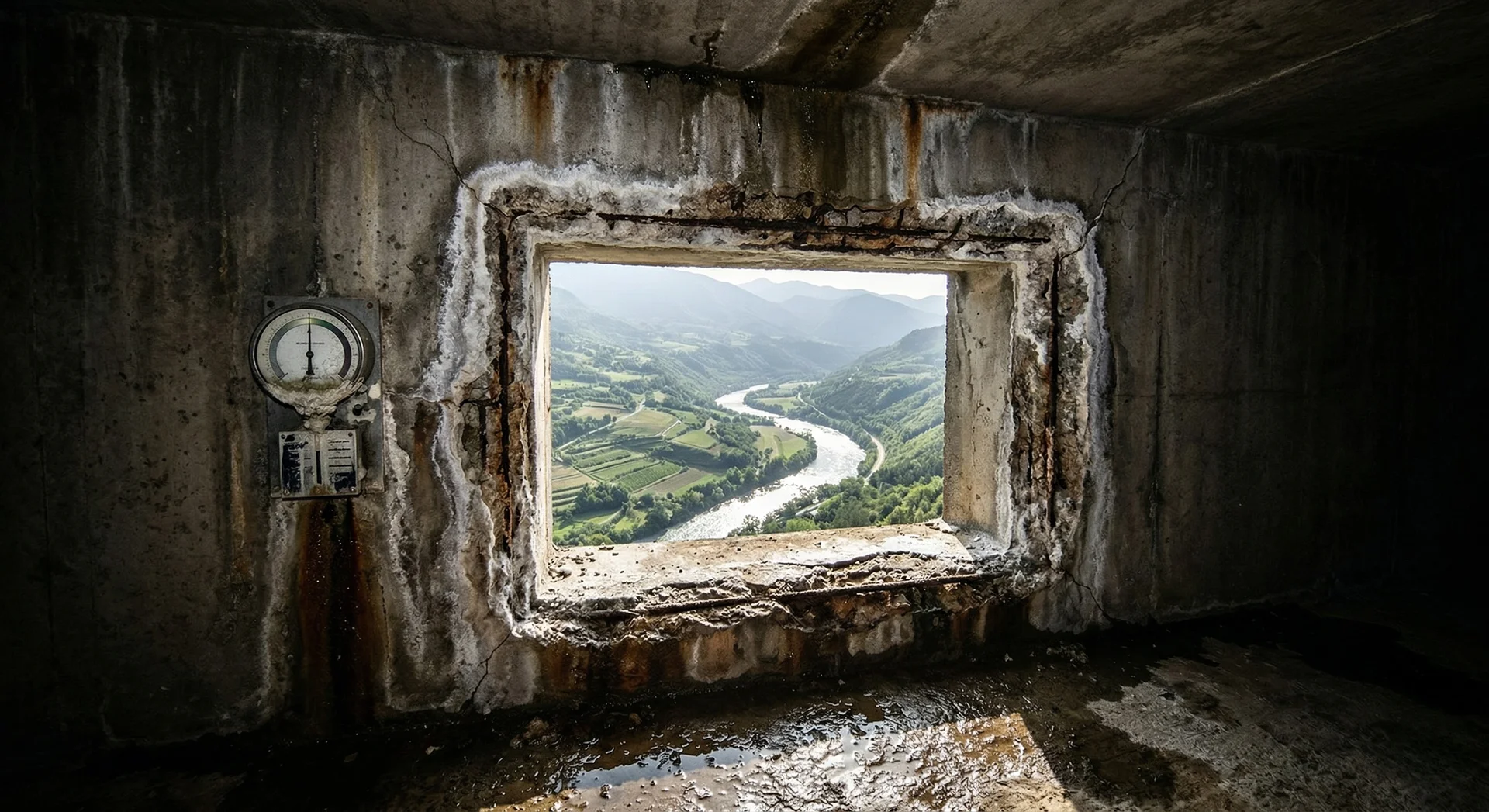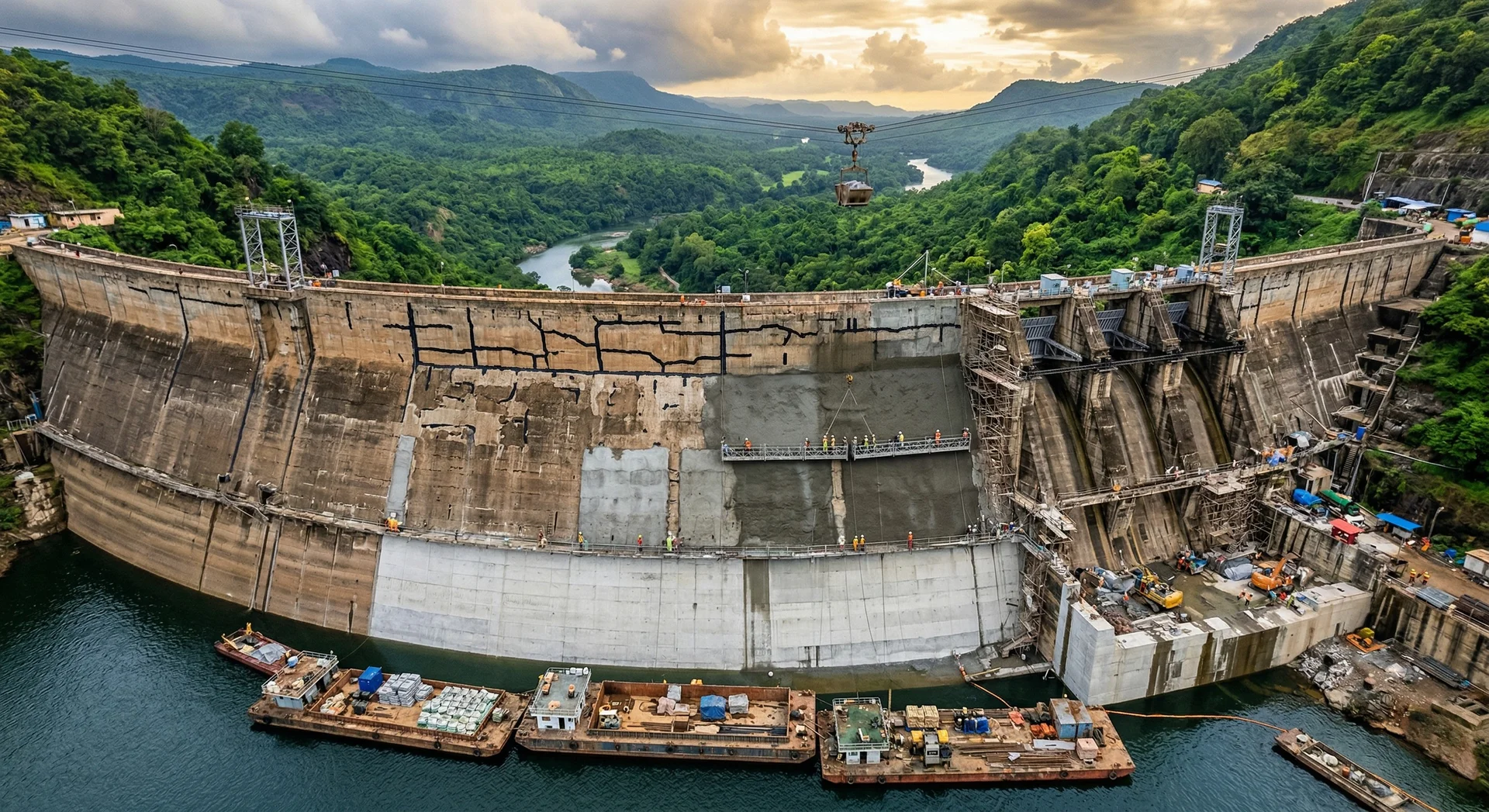
Dam concrete deteriorates. It is an engineering reality that every dam owner must confront. Carbonation advances into the cover zone. Alkali-aggregate reaction swells the concrete internally. Freeze-thaw cycling spalls the surface. Abrasion removes material from hydraulic surfaces. Leaching dissolves calcium compounds from the paste.
When deterioration reaches a threshold where the concrete no longer performs its intended function (structural load-bearing, waterproofing, hydraulic surface protection, or cover to reinforcement and embedded metalwork), repair becomes necessary.
The challenge is selecting the right repair material. The dam repair materials market offers dozens of products, from epoxy resins to polymer-modified mortars to fibre-reinforced overlays. Each has specific properties, application methods, limitations, and costs. Choosing the wrong material results in premature repair failure, requiring re-repair that costs more and disrupts operations again.
This guide provides a structured approach to repair material selection for dam concrete, organised by repair type and application environment. Engineers responsible for construction troubleshooting and root cause analysis on dam projects will find this a practical reference for specifying materials that match the deterioration mechanism and exposure conditions.
Repair Material Categories
Dam concrete repair materials fall into six principal categories, each addressing different damage types and repair geometries.
1. Crack Injection Materials
Cracks in dam concrete must be sealed for one or more reasons: to restore structural continuity, to stop water seepage, to prevent reinforcement corrosion, or to arrest further deterioration. The injection material must penetrate the crack, bond to the crack faces, and perform its sealing or structural function for the remaining service life.
Epoxy Injection Resins
Epoxy resins are the primary material for structural crack repair. When injected into a crack and cured, they form a rigid bond that is typically stronger than the concrete itself.
| Property | Typical Specification |
|---|---|
| Viscosity | 100-500 mPa.s (low viscosity for fine cracks) |
| Tensile strength | 30-60 MPa |
| Bond strength to concrete | 3-5 MPa (exceeds concrete tensile strength) |
| Elongation at break | 1-5% |
| Pot life (at 25°C) | 30-90 minutes |
| Temperature range for application | 10-35°C |
| Minimum crack width | 0.1 mm |
Epoxy injection is performed by sealing the crack surface with an epoxy paste, installing injection ports at intervals along the crack (typically 150-300 mm for fine cracks, wider spacing for larger cracks), and injecting resin through the ports sequentially from the lowest point upward, allowing each port to discharge until resin appears at the next port.
ASTM C881 classifies epoxy resins for concrete by grade, class, and type. For dam crack injection, Type IV (load-bearing) or Type V (non-load-bearing) in the appropriate viscosity grade are standard.
Polyurethane Injection Grouts
For cracks that are actively leaking, epoxy resins are unsuitable because they cannot cure in the presence of flowing water. Polyurethane grouts react with water to form an expanding foam or gel that seals the crack against flow.
| Property | Hydrophilic PU | Hydrophobic PU |
|---|---|---|
| Reaction with water | Absorbs and reacts | Reacts but repels |
| Expansion ratio | 5-20x volume | 2-5x volume |
| Flexibility after cure | High (gel-like) | Moderate to rigid |
| Reinjection if needed | Easier (can be flushed) | Difficult (rigid foam) |
| Best for | Active leaks, moving cracks | Moderate leaks, gap filling |
| Bond to concrete | Mechanical (foam expansion) | Mechanical + adhesive |
For dam galleries where seepage through cracks is common, hydrophilic polyurethane gels are the standard treatment. They remain flexible, accommodating thermal movement of the dam, and can be reinjected if the original seal deteriorates.
Cement-Based Injection Grouts
For wide cracks (greater than 1 mm) and voids in mass concrete, cement-based injection grout is often the most practical and economical material. The grout composition is similar to foundation grouting grout: Portland cement, water, and sometimes admixtures (bentonite for stability, superplasticiser for fluidity).
| Property | Typical Range |
|---|---|
| Water-cement ratio | 0.5-1.0 by weight |
| Injection pressure | 0.1-0.5 MPa (low, to avoid hydraulic fracturing) |
| Bleed | Less than 2% at 2 hours |
| Setting time | 4-8 hours |
| Compressive strength (28 days) | 20-40 MPa |
Cement grout does not bond to crack faces as strongly as epoxy, but for mass concrete cracks where the primary objective is to fill the void and restore waterproofing rather than tensile continuity, it is effective and durable.
2. Patch Repair Materials
Patch repairs address localised areas of concrete deterioration: spalled surfaces, corroded reinforcement zones, impact damage, and erosion cavities. The repair material must bond to the prepared concrete substrate, match the thermal expansion coefficient of the parent concrete, achieve adequate strength, and resist the specific deterioration mechanism that caused the original damage.
Polymer-Modified Cementitious Mortar
The workhorse of concrete patch repair. A blend of Portland cement, graded sand, and polymer admixture (styrene-butadiene or acrylic) produces a mortar with properties superior to plain cement mortar.
| Property | Plain Cement Mortar | Polymer-Modified Mortar |
|---|---|---|
| Bond strength (pull-off) | 0.5-1.0 MPa | 1.5-2.5 MPa |
| Compressive strength (28d) | 30-40 MPa | 40-60 MPa |
| Flexural strength (28d) | 4-6 MPa | 8-15 MPa |
| Water absorption | 6-10% | 2-5% |
| Abrasion resistance | Moderate | Good |
| Maximum layer thickness | Unlimited (with proper curing) | 30-40 mm per layer |
| Coefficient of thermal expansion | 10-12 x 10⁻⁶/°C | 10-14 x 10⁻⁶/°C |
Application procedure:
- Remove deteriorated concrete to a minimum depth of 20 mm beyond sound concrete
- Square the edges of the repair cavity (no feathered edges)
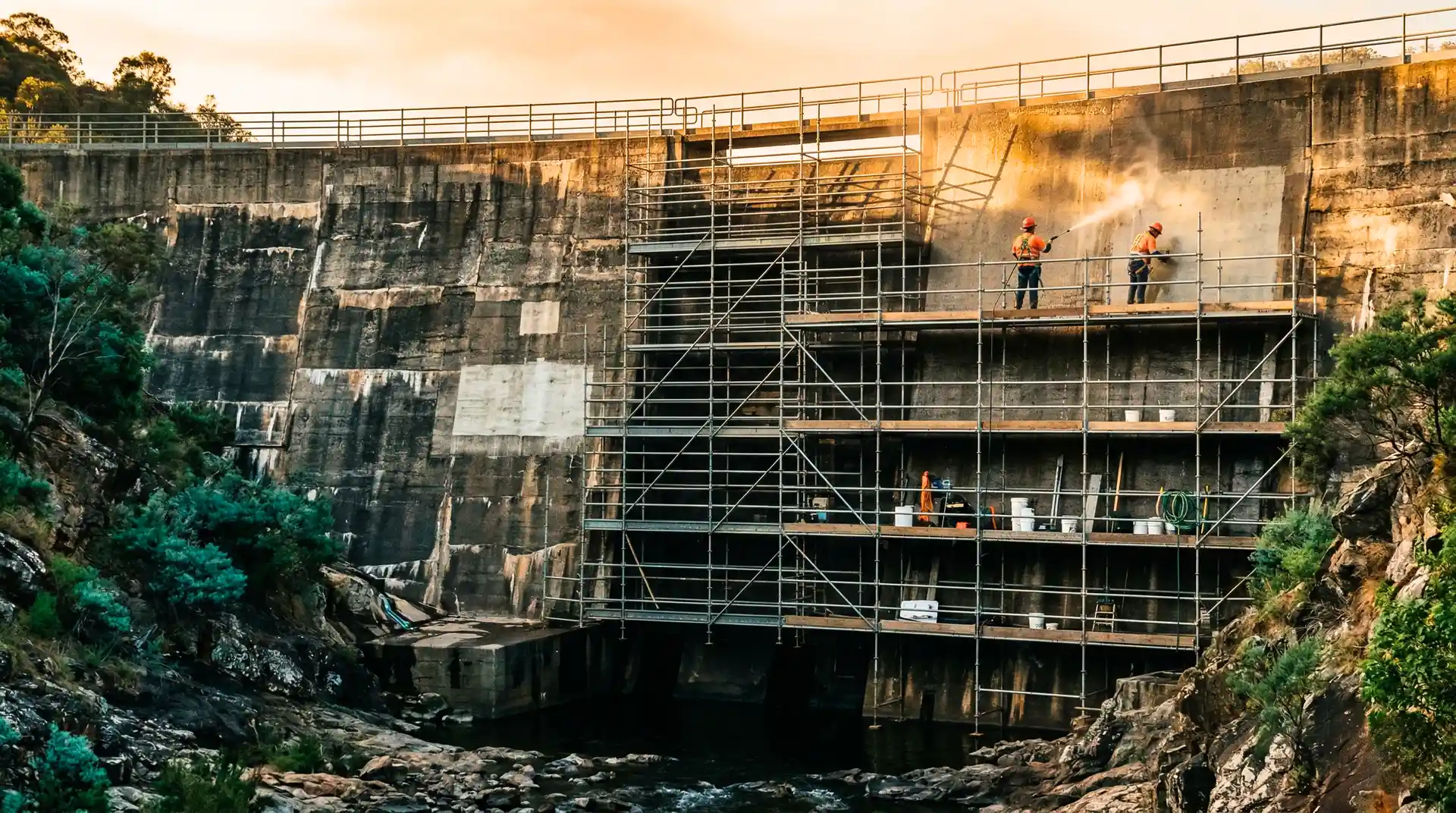
- Clean the substrate with high-pressure water (minimum 15 MPa)
- Saturate the substrate surface with water, then allow to reach saturated surface-dry condition
- Apply a bonding slurry (neat cement and polymer or proprietary bonding agent)
- Apply the polymer-modified mortar in layers not exceeding 30 to 40 mm
- Cure each layer with wet hessian and polyethylene for a minimum of 7 days
IS 15477:2019 provides guidance on polymer-modified cementitious mortar for repair of concrete structures.
Epoxy Mortar
For repairs requiring maximum bond strength, chemical resistance, and rapid strength gain, epoxy mortar (epoxy resin plus graded aggregate) provides the highest performance.
| Property | Typical Specification |
|---|---|
| Bond strength | 4-8 MPa (exceeds concrete tensile strength) |
| Compressive strength | 70-100 MPa |
| Chemical resistance | Excellent (acids, alkalis, solvents) |
| Maximum service temperature | 40-60°C (above this, epoxy softens) |
| Cost relative to polymer mortar | 3-5x higher |
| Maximum layer thickness | 30-50 mm (heat of reaction limits thicker pours) |
Epoxy mortar is used selectively on dams: for repairing gate seal seats where dimensional precision is critical, for repairing erosion damage on spillway surfaces, and for anchoring metalwork in repair zones. Its cost and temperature sensitivity limit broader use.
Pre-Bagged Repair Mortars
Proprietary pre-bagged repair mortars are increasingly used on dam rehabilitation projects because they provide consistent quality without site batching variability. These products are manufactured to comply with EN 1504 (the European standard for concrete repair products) and are classified by their structural and non-structural applications.
When specifying proprietary repair mortars for dam projects, the key performance requirements per ICOLD Bulletin 165 include:
- Bond strength exceeding 1.5 MPa at 28 days (pull-off test)
- Coefficient of thermal expansion within 20% of the parent concrete
- Compressive strength within the range of 80 to 120% of the parent concrete (over-strong repairs concentrate stress at the interface)
- Shrinkage less than 600 microstrain at 28 days
- Freeze-thaw resistance (if applicable) per ASTM C666
3. Concrete Overlays
When damage extends over a large area or when the entire surface requires upgrading, a concrete overlay is more practical than individual patch repairs.
High-Performance Concrete (HPC) Overlays
For spillway aprons, stilling basins, and other hydraulic surfaces, an HPC overlay of 75 to 150 mm thickness provides a new wearing surface with enhanced durability.
| Parameter | Typical Specification |
|---|---|
| Compressive strength | 50-60 MPa at 28 days |
| Water-cementitious ratio | 0.35-0.38 |
| Silica fume content | 5-8% of cementitious |
| Maximum aggregate size | 10-20 mm |
| Fibre reinforcement | Steel fibres 30-50 kg/m³ |
| Bonding to substrate | Epoxy bonding agent or hydrodemolished surface |
| Minimum thickness | 75 mm |
The critical requirement for overlays is bond to the substrate. The existing concrete surface must be prepared by hydrodemolition (high-pressure water jetting at 80 to 150 MPa) to remove the deteriorated surface and expose a rough, clean substrate. Mechanical scarification (milling) is less effective because it creates micro-cracks in the substrate surface that weaken the bond.
ACI 546R provides comprehensive guidance on concrete repair, including overlay design and substrate preparation.
Shotcrete Overlays
For vertical and overhead surfaces where formed overlays are impractical, shotcrete provides an alternative application method. Modern wet-mix shotcrete can achieve properties comparable to placed concrete, with compressive strengths of 40 to 60 MPa.
| Parameter | Wet-Mix Shotcrete |
|---|---|
| Compressive strength | 40-60 MPa |
| Bond strength | 1.5-2.5 MPa |
| Fibre reinforcement | Steel fibres 30-60 kg/m³ |
| Rebound (material waste) | 10-20% on vertical, 20-35% overhead |
| Typical thickness per pass | 25-75 mm (vertical), 25-50 mm (overhead) |
| Maximum total thickness | 200 mm+ (in multiple passes) |
For dam face repairs, shotcrete applied by an experienced nozzleman on a properly prepared substrate achieves bond strengths and durability comparable to formed concrete. The keys are adequate substrate preparation, correct mix design (including accelerator dosage), proper application technique, and thorough curing.
ACI 506R is the primary reference for shotcrete application in repair and rehabilitation.
4. Fibre-Reinforced Repair Materials
Adding fibres to repair materials improves their resistance to cracking, impact, and the dynamic loading conditions found in dam hydraulic structures.
Steel Fibre-Reinforced Concrete (SFRC)
| Fibre Dosage (kg/m³) | Effect on Repair Performance |
|---|---|
| 20-30 | Crack control, reduced shrinkage cracking |
| 30-50 | Improved impact resistance, moderate toughness |
| 50-80 | High toughness, suitable for high-velocity flow zones |
| 80+ | Ultra-high performance, used in extreme conditions |
Steel fibres for dam repair should be hooked-end or crimped, with a length-to-diameter ratio (aspect ratio) of 60 to 80 and a length of 30 to 50 mm. Longer fibres provide better crack bridging but can cause workability problems in thin repair sections.
Synthetic Macro-Fibres
Polypropylene or polyolefin macro-fibres at dosages of 4 to 10 kg/m³ provide crack control and moderate toughness improvement without the corrosion risk associated with steel fibres. They are particularly useful for repairs in zones where the concrete is exposed to chlorides or where rust staining from corroding steel fibres would be unacceptable.
5. Protective Coatings and Sealers
Coatings and sealers provide a barrier or surface treatment that protects the underlying concrete from the deterioration mechanism without adding significant thickness.
| Coating Type | Application | Advantages | Limitations |
|---|---|---|---|
| Acrylic emulsion | Brush or spray, 100-200 micron DFT | Breathable, UV-resistant, economical | Limited abrasion resistance |
| Epoxy | Brush, roller, or spray, 200-500 micron DFT | Excellent chemical and abrasion resistance | Not breathable, may blister on damp concrete |
| Polyurethane | Brush, roller, or spray, 200-400 micron DFT | Flexible, UV-resistant, abrasion-resistant | Higher cost, moisture-sensitive during application |
| Silane/siloxane penetrating sealer | Spray or flood coat | Breathable, invisible, protects against water and chlorides | No crack-bridging capability, no abrasion resistance |
| Crystalline waterproofing | Brush or spray, single coat | Self-sealing (reactivates with water), permanent | Limited to cementitious substrates, slow activation |
| Polyurea | Spray (specialised equipment) | Extremely tough, flexible, fast curing | Expensive, requires specialised application equipment |
For dam applications, the coating must be compatible with damp or saturated substrates. Epoxy coatings, while excellent in dry conditions, can blister and delaminate on concrete that has moisture migrating from within. Acrylic and crystalline systems tolerate damp conditions better.
6. Grouting Materials for Void Filling
Voids behind linings, beneath slab panels, and around embedded metalwork require filling with grout to restore structural support and prevent water pathways.
| Grout Type | Application | Key Properties |
|---|---|---|
| Cement grout (neat) | Filling large voids, contact grouting | Economical, durable, limited penetration into fine cracks |
| Cement-bentonite grout | Filling irregular voids with varying widths | Good stability, reduced bleed, penetrates finer spaces |
| Microfine cement grout | Penetrating fine cracks and tight spaces | Particle size less than 15 micron, high penetration |
| Polyurethane foam grout | Filling voids behind linings where water is present | Expands to fill irregularities, waterproof |
| Epoxy grout | Structural void filling, metalwork encasement | High strength, excellent bond, high cost |
Material Selection Framework
Selecting the appropriate repair material requires systematic evaluation of several factors. The decision framework below provides a structured approach.
Step 1: Identify the Deterioration Mechanism
The repair material must address the cause, not just the symptoms. Applying a surface coating over concrete that is deteriorating from internal alkali-aggregate reaction will not stop the reaction. The coating may even trap moisture and accelerate the damage.
| Deterioration Mechanism | Primary Repair Strategy | Secondary Strategy |
|---|---|---|
| Carbonation-induced corrosion | Remove damaged concrete, protect rebar, patch with polymer mortar, coat | Cathodic protection for extensive corrosion |
| Chloride-induced corrosion | Remove chloride-contaminated concrete, patch, apply chloride barrier | Electrochemical chloride extraction |
| Alkali-aggregate reaction | Monitor, seal cracks, apply flexible coating if active | Slot cutting to relieve expansion stress |
| Freeze-thaw damage | Remove damaged concrete, replace with air-entrained HPC | Apply penetrating sealer for prevention |
| Sulphate attack | Remove damaged concrete, patch with sulphate-resistant material | Apply barrier coating on exposure face |
| Abrasion/erosion | Overlay with abrasion-resistant HPC or SFRC | Apply steel plate or ceramic lining |
| Cavitation | Correct surface geometry, overlay with HPC, aerate flow | Install aerator slots upstream |
| Leaching/dissolution | Seal cracks, coat with crystalline or epoxy system | Reduce hydraulic gradient if possible |
Step 2: Assess the Repair Environment
The conditions during application and in service affect material selection.
| Factor | Impact on Material Selection |
|---|---|
| Substrate moisture | Eliminates moisture-sensitive materials (many epoxies) |
| Temperature during application | Limits epoxy and polyurethane in cold conditions (below 10°C) |
| Access constraints | Favours shotcrete over formed concrete for vertical/overhead |
| Downtime available | Rapid-setting materials if shutdown window is short |
| Hydraulic exposure | Requires abrasion and cavitation resistance |
| Submerged or tidal zone | Requires underwater-curing materials |
| Future accessibility | Durable materials to minimise re-repair frequency |
Step 3: Verify Compatibility
The repair material must be compatible with the parent concrete in three respects:
Thermal compatibility. The coefficients of thermal expansion of the repair material and the parent concrete must be within 20% of each other. A repair material that expands or contracts significantly more than the surrounding concrete will debond or crack at the interface. This is particularly critical on dams with large seasonal temperature variations.
Elastic compatibility. A repair material that is much stiffer (higher modulus of elasticity) than the parent concrete will attract stress concentration at the repair boundary, leading to cracking. Conversely, a material that is too flexible will not carry load. The general recommendation from ICOLD Bulletin 165 is that the repair material modulus should be 50 to 150% of the parent concrete modulus.
Chemical compatibility. The repair material must not introduce chemicals that are harmful to the parent concrete or to embedded metalwork. For example, some accelerators used in shotcrete contain alkalis that can exacerbate AAR in the parent concrete. Metallic expanding agents in non-shrink grouts can corrode and stain if exposed to water.
Quality Control for Repair Works
Repair material quality control is at least as important as new concrete quality control, yet it receives less attention on many projects.
Pre-Application Testing
- Bond strength testing. Perform pull-off tests (per ASTM C1583) on test patches before proceeding with full repairs. Minimum bond strength: 1.0 MPa for non-structural repairs, 1.5 MPa for structural repairs.
- Compatibility testing. Prepare test specimens of the repair material bonded to cores of the parent concrete. Subject to thermal cycling (20 cycles from minus 10 to plus 50 degrees Celsius) and test bond strength. Any bond loss exceeding 20% indicates incompatibility.
- Mock-up repairs. For large repair programmes, prepare a full-scale mock-up of a typical repair on a concrete surface similar to the dam concrete. Evaluate workability, bond, finish quality, and curing.
During Application
- Surface preparation verification. The prepared substrate must be inspected and approved before repair material application. Surface cleanliness, roughness, moisture condition, and soundness of the exposed concrete must all be verified.
- Batch testing. For site-batched repair materials, verify proportions, mixing time, and consistency for each batch. For pre-bagged materials, verify compliance with manufacturer’s mixing instructions.
- Environmental monitoring. Record air temperature, concrete surface temperature, relative humidity, and wind speed. Each of these affects the curing behaviour and bond development of the repair material.
Post-Application Testing
- Hammer sounding. Tap the repair surface with a hammer to detect hollow-sounding areas indicating debonding. Non-destructive testing methods such as this help identify debonded zones for remediation.
- Pull-off bond testing. Per ASTM C1583, test bond strength at representative locations. The failure should occur in the parent concrete, not at the interface or within the repair material.
- Core testing. For large overlay repairs, extract cores that span the interface to verify bond integrity and repair material strength.
Conclusion
Dam concrete repair is not a one-material solution. The range of deterioration mechanisms, exposure conditions, and repair geometries encountered on a single dam rehabilitation project may require five or more different repair materials, each specified, tested, applied, and cured according to its own requirements.
The common thread is rigour. Surface preparation determines whether the repair bonds or debonds. Material selection determines whether the repair survives the environment. Application technique determines whether the repair achieves its design properties. And quality control determines whether anyone knows the difference.
Under India’s DRIP programme, 736 dams will undergo rehabilitation. Each one presents a unique combination of concrete deterioration, exposure conditions, and repair challenges. The engineers specifying and supervising these repairs need a working knowledge of the full repair materials palette, not just familiarity with one or two products. The cost of getting repair material selection wrong is not just the cost of re-repair. It is the continued deterioration of a safety-critical structure during the interval between a failed repair and its replacement.