
On 30 December 2026, a clock runs out.
That is the deadline by which every specified dam in India must undergo its first comprehensive safety evaluation under the Dam Safety Act 2021. The Act covers 6,628 dams. As of November 2025, the National Dam Safety Authority (NDSA) has audited only 1,853, roughly 28% of the total.
For concrete engineers, this is not just a regulatory story. It is a generational shift in how India maintains its dam infrastructure, and it creates the largest sustained demand for concrete assessment and rehabilitation expertise the country has ever seen.
The Scale of the Problem
India has 6,628 specified dams in its National Register, making it the third-largest dam-owning nation after China and the United States. Of these, 1,681 are over 50 years old. By 2050, that number will exceed 4,250.
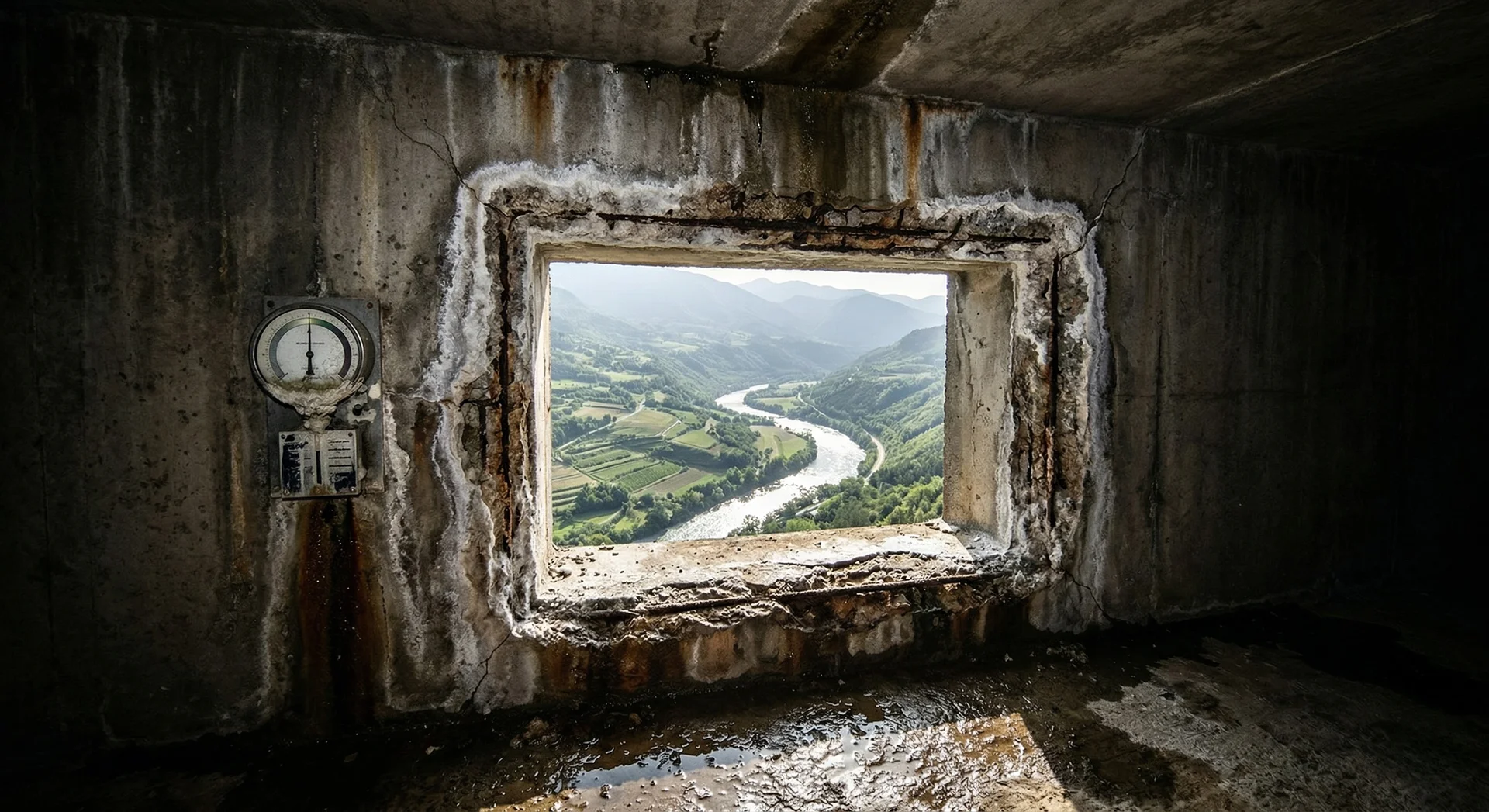
These are not abstract statistics. Consider what 50+ years of service means for dam concrete:
-
Alkali-aggregate reaction has had decades to propagate through reactive aggregates. Rihand Dam in Uttar Pradesh experienced severe AAR spalling that rendered its powerhouse inoperable for years. Hirakud Dam in Odisha developed AAR after approximately 30 years of service, with spillway ogee crest cracks measuring 25 mm wide and 100 mm deep.
-
Seepage paths have developed through monolith joints, construction joints, and deteriorated concrete. At Barna Dam in Madhya Pradesh, a masonry gravity dam built in 1978, blocked drains have led to excessive seepage requiring intervention under DRIP.
-
Carbonation fronts have advanced through cover concrete, potentially reaching reinforcement in structures designed to earlier, less stringent durability standards.
-
Freeze-thaw cycles at Himalayan dam sites have progressively damaged concrete surfaces over decades of seasonal temperature extremes.
Approximately one-third of India’s large dams are concrete and masonry structures. Several hundred require concrete rehabilitation work.
What the Act Requires
The Dam Safety Act 2021, enacted on 14 December 2021 and operational from 30 December 2021, establishes a four-tier institutional framework:
-
National Committee on Dam Safety (NCDS): Formulates policies, recommends regulations, advises on technical standards. Chaired by the Central Water Commissioner.
-
National Dam Safety Authority (NDSA): Implements policies, resolves disputes, specifies inspection regulations, and accredits agencies for dam construction and design.
-
State Committee on Dam Safety (SCDS): Supervises state-level rehabilitation programmes.
-
State Dam Safety Organisation (SDSO): Conducts surveillance, inspection, and monitoring of dam operations and maintenance.
All 28 states and 3 union territories owning specified dams have established their respective bodies.
Dam Owner Obligations
The Act places direct responsibility on dam owners for:
- Providing a dam safety unit at each dam
- Conducting pre-monsoon and post-monsoon inspections every year
- Inspecting during and after any calamity or sign of distress
- Maintaining sufficient funds and trained manpower for safety measures
- Installing emergency flood warning systems
- Carrying out risk assessments at regular intervals
- Ensuring mandatory presence of engineers during floods and emergencies
The Comprehensive Evaluation Mandate
Section 38 is the provision that matters most for concrete engineers. It requires the first comprehensive evaluation of each specified dam within five years of the Act coming into force, with subsequent evaluations at regular intervals based on vulnerability and hazard classification.
A comprehensive evaluation must include:
- Review and analysis of data on design, construction, operation, maintenance, and performance of the structure
- Assessment of hydrologic and hydraulic conditions with mandatory review of design floods
- Assessment of seismic safety with mandatory site-specific seismic parameters
- Evaluation of operation, maintenance, and inspection procedures
- Evaluation of any other conditions constituting a hazard to structural integrity
Section 39 adds that a compulsory evaluation is triggered by any major modification to the original structure or discovery of an unusual condition at the dam.
Penalties
The Act includes enforcement provisions that previous dam safety guidelines lacked:
- Up to one year imprisonment, fine, or both for obstruction or non-compliance
- Up to two years imprisonment if non-compliance results in loss of life or imminent danger
- Head of department deemed personally guilty for departmental offences unless due diligence is proven
This is not advisory guidance. In February 2023, the Sikkim High Court ordered a hydropower company to pay Rs 70 lakh to two families for non-compliance with the Act, establishing early legal precedent.
What “Comprehensive Evaluation” Means for Concrete
The Act defines “inspection” broadly: on-site examination of any component of a dam and its appurtenant structures, including laboratory testing, in-situ testing, geological exploration, model testing, and mathematical simulation.
For concrete and masonry dams, a comprehensive evaluation translates into:
Visual Assessment
Systematic documentation of visible deterioration: cracking patterns, spalling, efflorescence, seepage staining, joint deterioration, surface erosion, and drain condition.
Non-Destructive Testing
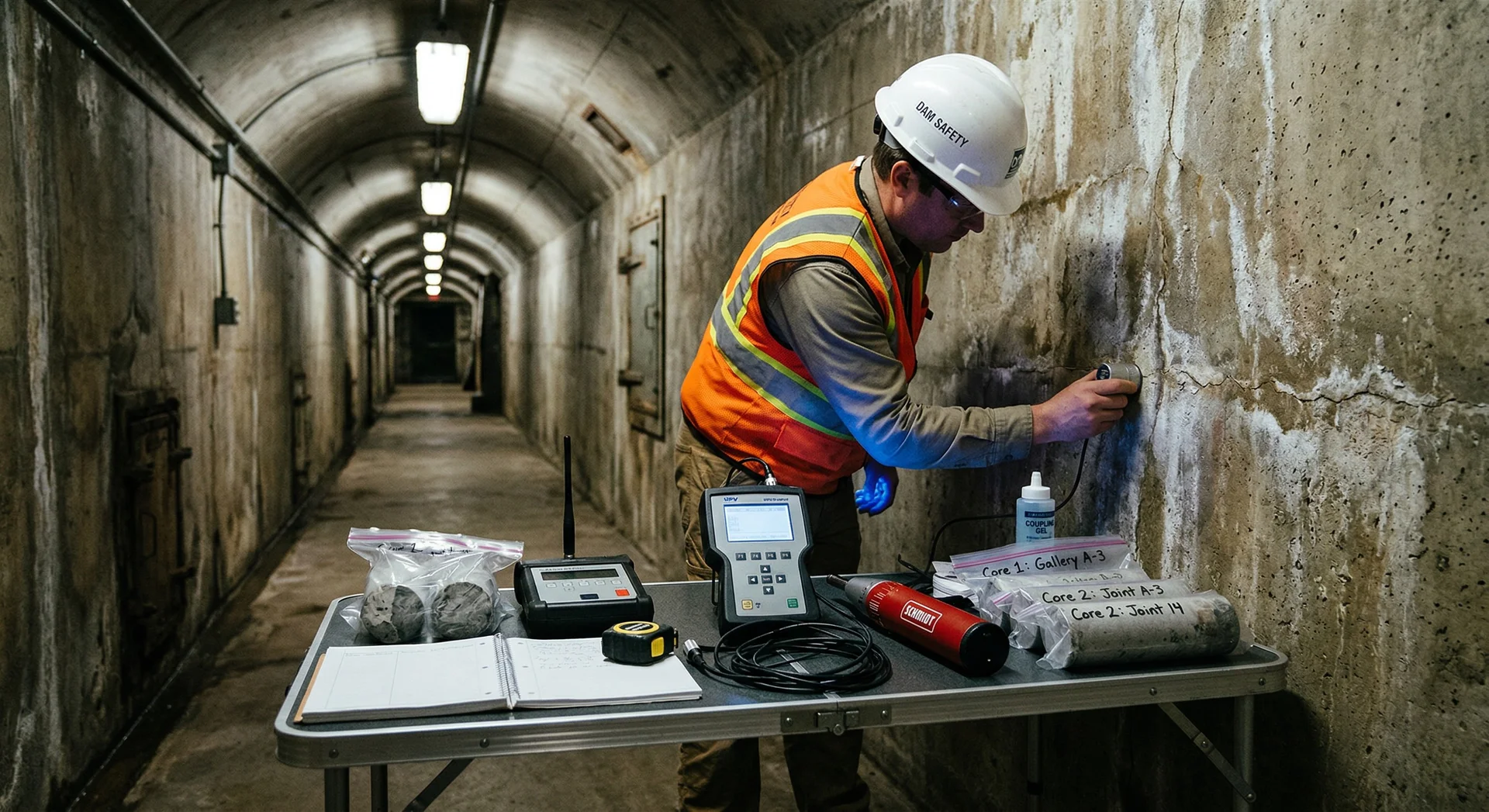
The standard NDT toolkit for Indian dam concrete includes:
- Rebound hammer testing (per IS 13311 Part 2) for surface hardness and estimated compressive strength (see our NDT guide for dam owners for detailed method selection)
- Ultrasonic pulse velocity (per IS 13311 Part 1) for in-situ compressive strength and internal defect detection
- Impact echo testing for concrete thickness measurement and delamination detection
- Ground penetrating radar for void detection below concrete surfaces, particularly relevant for spillway assessments
- Concrete core extraction for laboratory testing of compressive strength, elastic properties, and petrographic examination
- Scanning electron microscopy for identifying reactive aggregates and diagnosing AAR
Structural Analysis
For dams showing unusual behaviour or approaching design life, finite element method (FEM) analysis provides structural assessment that goes beyond visual and NDT inspection. FEM studies have been conducted at Idukki Arch Dam in Kerala and Bhakra Dam for age-related deflection analysis.
Assessment Outcomes
Evaluation results must include recommendations for emergency measures (if required), remedial measures related to design and construction, additional detailed studies, and improvements in routine maintenance. An independent review consultant can provide the objective assessment these evaluations require. Dam owners are required to provide adequate funds for recommended remedial measures.
DRIP: Rs 17,878 Crore for Rehabilitation
The Dam Rehabilitation and Improvement Project represents the world’s largest dam rehabilitation programme. Supported by the World Bank and the Asian Infrastructure Investment Bank (AIIB), DRIP provides the funding mechanism for the assessment and repair work that the Dam Safety Act mandates.
Phase I (Completed: 2012-2021)
- 223 dams rehabilitated across 7 states
- Budget: Rs 2,567 crore
- All dams comprehensively audited and rehabilitated
Phase II and III (Active: 2021-2031)
- 736 dams across 19 states and 3 central agencies
- Combined budget: Rs 10,211 crore
- External funding: Rs 7,000 crore (World Bank: $250 million + AIIB: $250 million)
- Expected to generate approximately 10 lakh person-days for unskilled workers and 2.5 lakh person-days for professionals
What Rehabilitation Looks Like in Practice
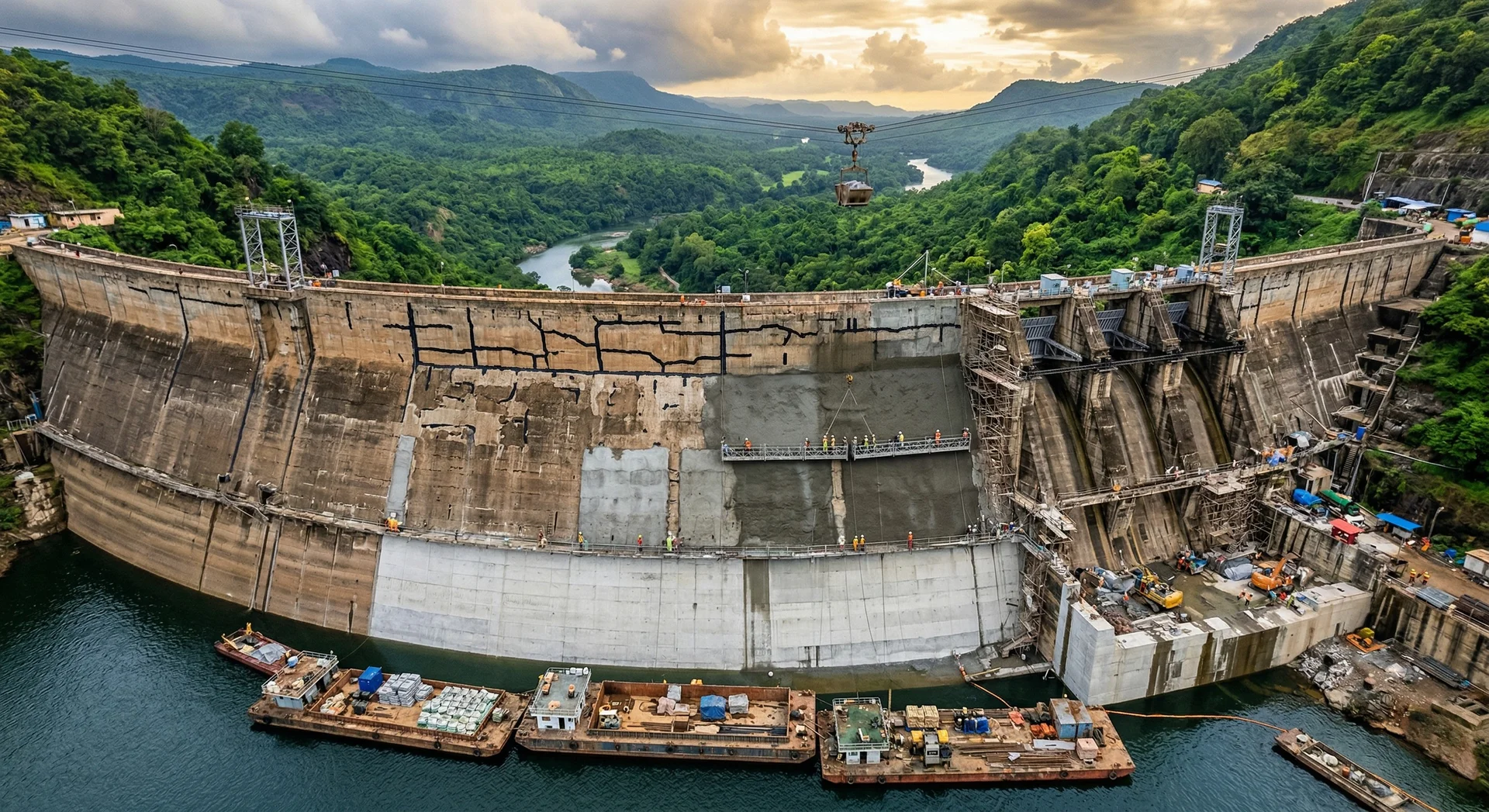
DRIP-funded concrete rehabilitation across Indian dams includes:
Seepage control: Cement grouting and chemical grouting through dam bodies and foundations. Polyurethane joint injection for monolith joint sealing (used at Almatti Dam in Karnataka). Cementitious grout mix design for dams like Warna and Bhatsa in Maharashtra.
Structural repair: Crack sealing with low-viscosity cementitious and chemical grouts. HPC lining with steel fibres, polymers, and silica fume for severely damaged surfaces (used at Rihand Dam). Micro-concrete jacketing and fibre wrapping for cracked concrete columns.
Surface protection: UV-resistant epoxy repair materials for exposed surfaces. High abrasion-resistant coatings for spillway surfaces. Upstream dam face treatment and waterproofing.
Investigation: 3D hydraulic model studies (conducted at Hirakud Dam). Concrete core extraction for strength and elastic property testing. Petrographic and SEM examination for AAR diagnosis.
DRIP won the Award for Excellence in Dam Safety at the World Water Awards 2024-25 (by The Water Digest and UNESCO).
NETRA: AI Enters Dam Safety
The NDSA has launched NETRA (NDSA Engine for Tracking and Review using Artificial Intelligence), an AI-powered platform developed in collaboration with WESEE, a research laboratory of the Indian Navy.
NETRA processes natural language inspection records from over 13,000 annual dam inspection reports, identifies trends and flags anomalies, generates risk indicators, and helps authorities prioritize follow-up action across India’s dam inventory.
The platform integrates with DHARMA (Dam Health and Rehabilitation Monitoring Application), the national repository covering 6,600+ dams. Companion platforms include RBSD (Rashtriya Bandh Suraksha Darpan) for dam break analysis visualization and DAMCHAT, a real-time regulatory knowledge AI developed by IIT Roorkee.
Additionally, CWC signed a Memorandum of Agreement with IISc Bengaluru in March 2024 for establishing the International Centre of Excellence for Dams (ICED) under DRIP Phase II, focusing on advanced construction materials, material testing, and multi-hazard risk assessment.
The Compliance Gap
The numbers reveal the scale of the challenge:
- 6,628 specified dams require comprehensive evaluation
- 1,853 audited as of November 2025 (28%)
- 4,775 dams remaining before the December 2026 deadline
- Over 13,000 inspection reports generated annually
- 348 large dams with suspect structural strength have not been inspected for over a decade
The gap between where India is and where it needs to be by December 2026 is significant. This compression creates sustained demand for concrete assessment expertise: NDT testing, petrographic analysis, structural evaluation, and rehabilitation design.
What This Means for Project Teams
For Dam Owners and PSUs
The December 2026 deadline is less than nine months away. If your dams have not undergone comprehensive evaluation, the window for compliance is closing. The Act’s penalty provisions, including personal liability for department heads, make this a governance risk as well as a technical one.
Start with a prioritization exercise: identify dams over 50 years old, dams with known seepage or cracking issues, and dams in high-hazard zones. These need evaluation first. A durability assessment provides the technical foundation for prioritization.
For Concrete Engineers and Consultants
The combination of regulatory mandate, DRIP funding, and aging infrastructure creates the largest sustained market for concrete assessment and rehabilitation services in Indian dam history. The skills required are specific: NDT interpretation, AAR diagnosis, rehabilitation material selection, grouting design, and structural FEM analysis. Knowing how to select a concrete technology consultant for these assessments is critical.
For Construction and Rehabilitation Contractors
DRIP Phase II and III represent Rs 10,211 crore of funded work across 736 dams. Rehabilitation contracts require demonstrated capability in concrete repair materials (HPC, polymer-modified systems, grouting), quality control during rehabilitation works, and compliance with CWC and NDSA guidelines.
The Bigger Picture
The Dam Safety Act 2021 arrives at a time when India’s dam infrastructure is aging at scale. With 1,681 dams already over 50 years old and that number growing every year, the question is not whether rehabilitation will happen but whether it will happen proactively or in response to failures.
The Tungabhadra Dam crest gate failure in August 2024, after 70+ years of service, and the Mullaperiyar Dam controversy, with 3.5 million people at risk downstream of a 100+ year old structure, illustrate what happens when aging concrete infrastructure is not assessed and maintained systematically.
The Act provides the legal framework. DRIP provides the funding. NETRA provides the data infrastructure. What remains is the engineering expertise to assess, diagnose, and rehabilitate the concrete that holds these structures together.
The deadline is 30 December 2026. The clock is running.