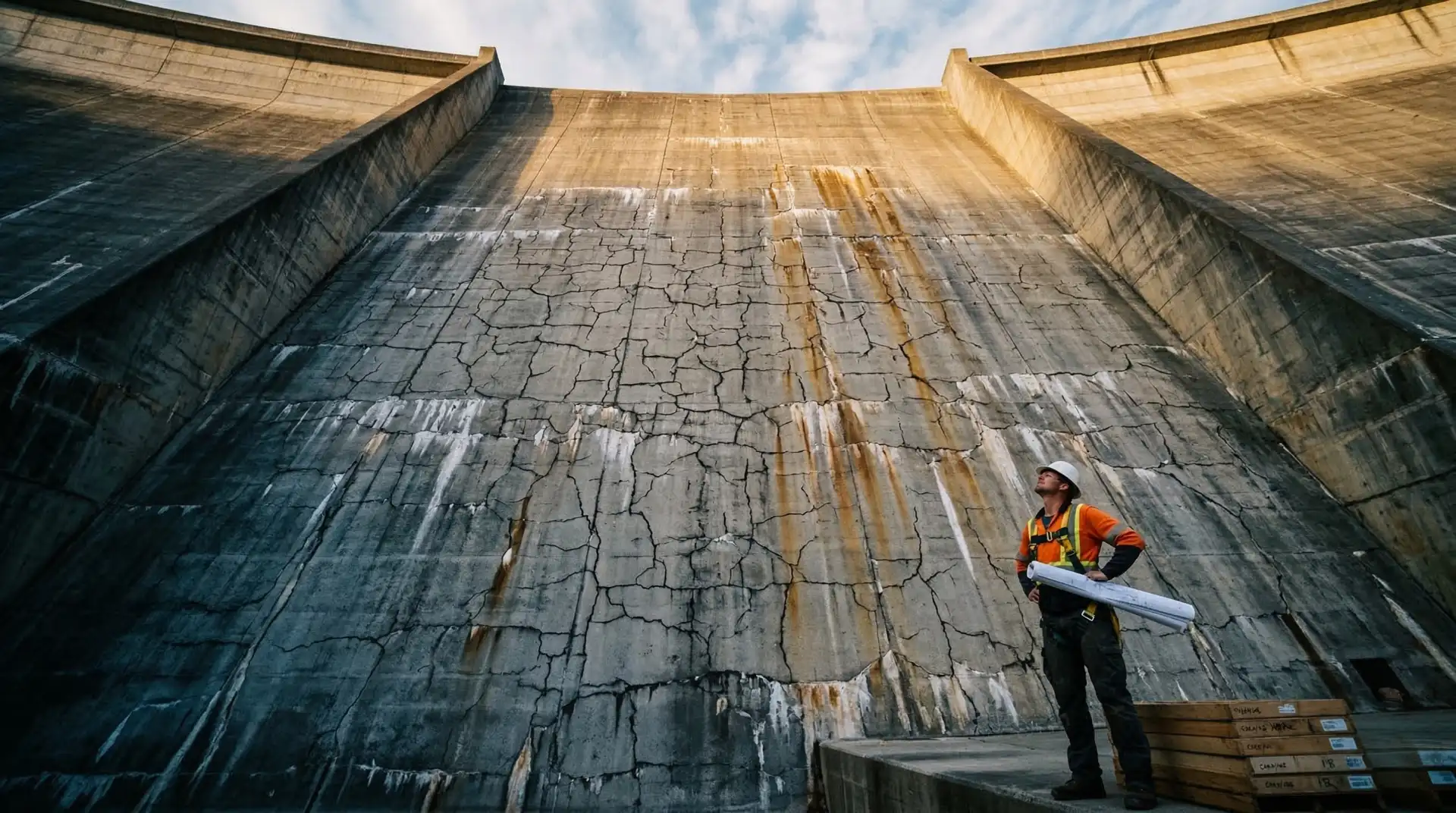
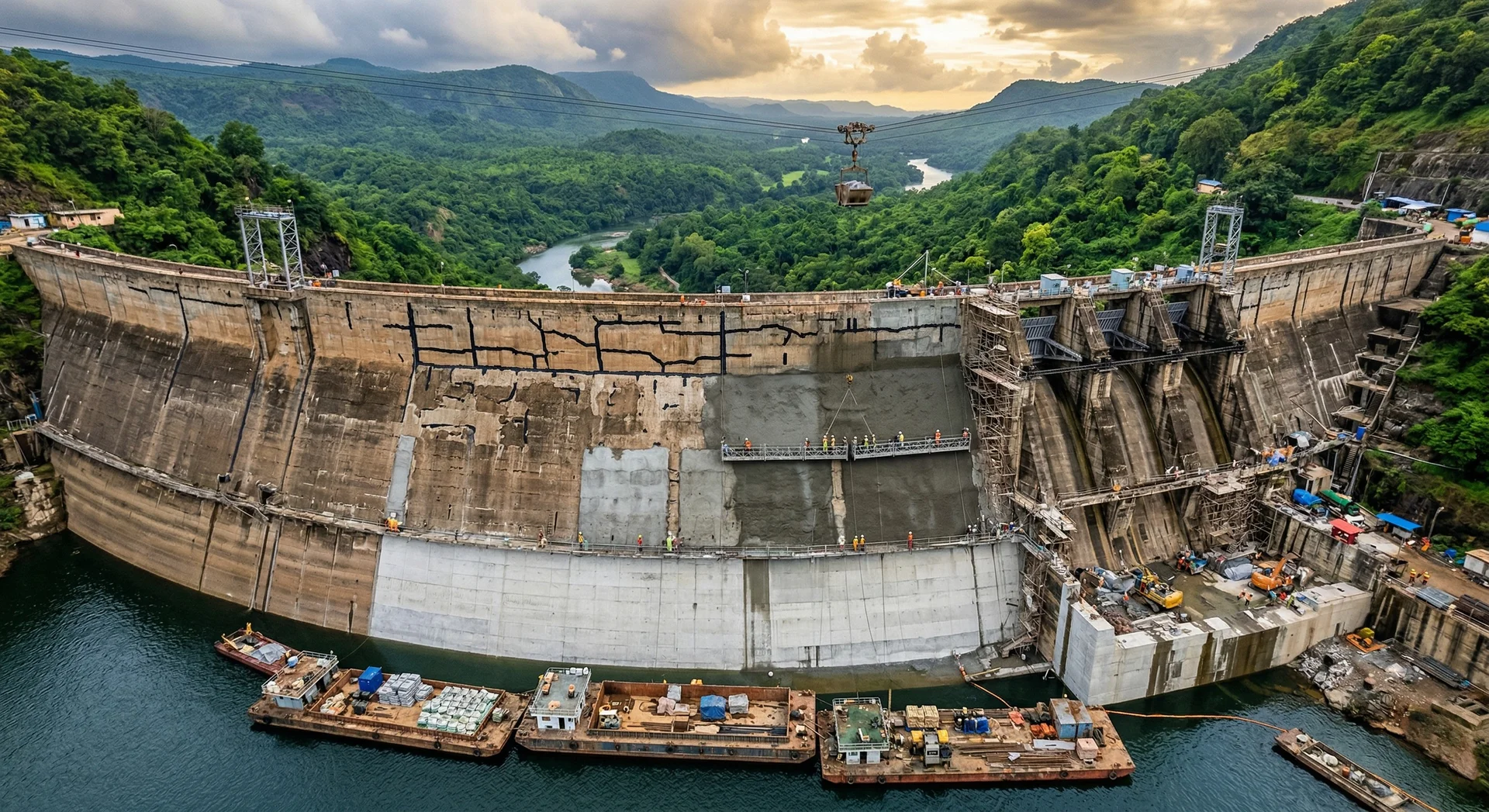
Between 2021 and 2031, the Government of India will spend Rs 10,211 crore rehabilitating 736 dams across 19 states.
This is DRIP: the Dam Rehabilitation and Improvement Project. Funded by the World Bank ($250 million) and the Asian Infrastructure Investment Bank ($250 million), with domestic co-funding from implementing agencies, DRIP is the world’s largest dam rehabilitation programme. It won the Award for Excellence in Dam Safety at the World Water Awards 2024-25.
For concrete engineers, DRIP is not just a policy initiative. It is a decade-long, funded pipeline of assessment, diagnostic, and rehabilitation work on aging infrastructure. Understanding how the programme works, what it funds, and what technical capabilities are required is essential for anyone working in dam concrete.
The Programme Structure
Phase I (Completed: 2012-2021)
- Scope: 223 dams across 7 states (Jharkhand/DVC, Karnataka, Kerala, Madhya Pradesh, Odisha, Tamil Nadu, Uttarakhand)
- Budget: Rs 2,567 crore
- World Bank loan: $350 million original + $137 million additional financing
- Outcome: All 223 dams comprehensively audited and rehabilitated
- Key learning: Established the institutional framework, procurement systems, and technical standards for dam rehabilitation at scale
Phase II and III (Active: 2021-2031)
- Approved: October 2020 by Cabinet Committee on Economic Affairs
- Operational: Phase II became active on 12 October 2021
- Duration: 10 years, with two phases of 6 years each and a 2-year overlap
- Scope: 736 dams across 19 states and 3 central agencies
- Budget: Rs 10,211 crore (Phase II: Rs 5,107 crore; Phase III: Rs 5,104 crore)
- External funding: Rs 7,000 crore (World Bank: $250 million + AIIB: $250 million)
- Employment generation: Approximately 10 lakh person-days for unskilled workers and 2.5 lakh person-days for professionals
Funding Pattern
The cost-sharing formula varies by category:
| Category | Central Share | State/Agency Share |
|---|---|---|
| Special Category States | 80% | 20% |
| General Category States | 70% | 30% |
| Central Agencies | 50% | 50% |
This structure ensures that even resource-constrained states can participate in the rehabilitation programme.
What DRIP Rehabilitates
The rehabilitation scope under DRIP covers every aspect of dam infrastructure:
Structural Rehabilitation
- Crack sealing with low-viscosity cementitious and chemical grouts
- Backing concrete and re-sectioning of deteriorated dam sections
- HPC lining with steel fibres, polymers, and silica fume for severely damaged surfaces
- Micro-concrete jacketing for structural strengthening
- Fibre wrapping for cracked concrete columns and piers
Seepage Control
- Cement grouting through dam body and foundation
- Chemical grouting for fine cracks and joints
- Polyurethane joint injection for monolith and contraction joints (used at Almatti Dam)
- Upstream dam face treatment and waterproofing
Spillway and Appurtenant Works
- Surface rehabilitation of spillway ogee crests and stilling basins
- High abrasion-resistant coatings for flow surfaces
- UV-resistant epoxy repair for exposed concrete
- Gate mechanism rehabilitation
- Drain clearing and rehabilitation
Investigation and Analysis
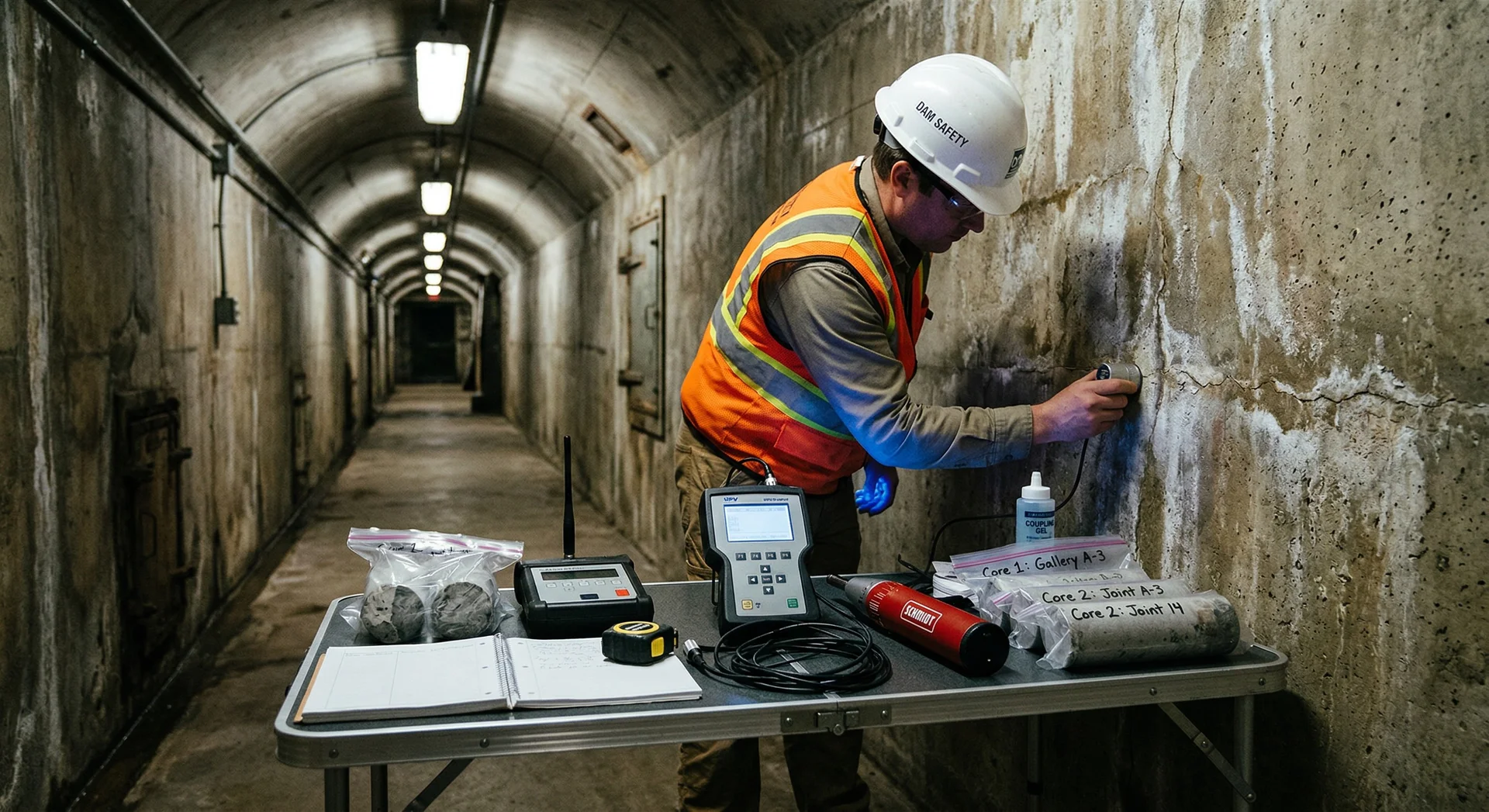
- Non-destructive testing programmes (rebound hammer, UPV, GPR, impact echo)
- Core extraction and laboratory analysis
- 3D hydraulic model studies (conducted at Hirakud Dam under DRIP)
- Finite element analysis for structural assessment
- Petrographic examination for deterioration mechanism identification
Documentation and Systems
- Operation and Maintenance manuals for each dam
- Emergency Action Plans with inundation mapping
- Dam Break Analyses using RBSD (Rashtriya Bandh Suraksha Darpan) platform
- Instrumentation installation and monitoring systems
- DHARMA database population for dam health records
Case Studies from DRIP
Rihand Dam, Uttar Pradesh
Problem: Severe alkali-aggregate reaction caused spalling so extensive that the powerhouse was inoperable for years. In one penstock gallery column, 9 of 10 rebar were found snapped due to AAR expansion.
DRIP response: Crack sealing with cementitious and chemical grouts. HPC lining with steel fibres, polymers, and silica fume for the most severely affected surfaces. Comprehensive petrographic investigation to confirm the AAR mechanism and assess remaining structure.
Hirakud Dam, Odisha
Problem: AAR developed after approximately 30 years of service. Spillway ogee crest showed cracks measuring 25 mm wide and 100 mm deep.
DRIP response: 3D hydraulic model studies. Concrete core extraction for strength and elastic property testing. Rehabilitation design based on investigation findings.
Almatti Dam, Karnataka
Problem: Spillway pier and ogee deterioration from age and hydraulic action.
DRIP response: Polyurethane joint injection materials for joint sealing. High abrasion-resistant coating for spillway surface repair.
Idukki Arch Dam, Kerala
Problem: Unusual structural behaviour detected through monitoring instrumentation.
DRIP response: Finite element method analysis. Detailed site and laboratory investigation. Rehabilitation design based on structural assessment.
These case studies illustrate the range of expertise required: from petrographic diagnosis of AAR to 3D hydraulic modelling to structural FEM analysis. DRIP projects are not simple repair jobs. They are investigative engineering programmes that require concrete science, structural analysis, and rehabilitation design capability.
The Market Opportunity
Scale
- 736 dams across 19 states over 10 years
- Rs 10,211 crore total budget
- Each dam requires assessment, design, construction, and quality assurance
- Approximately one-third of India’s large dams are concrete and masonry structures
Professional Services Demand
Each dam rehabilitation typically requires:
- Comprehensive safety assessment (6-12 months): visual inspection, NDT, core extraction, laboratory testing, structural analysis, hydrology review, seismic assessment
- Rehabilitation design (3-6 months): diagnosis of deterioration mechanisms, selection of repair methods, specification development, cost estimation
- Construction supervision (12-24 months): quality assurance during rehabilitation works, testing and verification, as-built documentation
- Institutional support: Training of dam owner personnel, O&M manual preparation, instrumentation commissioning
Types of Firms Needed
| Role | Capability Required |
|---|---|
| Assessment consultant | NDT expertise, laboratory testing, structural FEM, petrographic analysis |
| Design consultant | Concrete rehabilitation design, grouting design, material specification |
| QA consultant | Construction quality assurance, testing programme management |
| Specialist consultant | AAR diagnosis, seismic assessment, hydraulic analysis |
| Rehabilitation contractor | Concrete repair, grouting, surface coating, instrumentation |
| Material supplier | Repair mortars, grouting materials, coatings, admixtures |
Procurement
DRIP follows World Bank procurement guidelines, which require:
- Qualification-based selection for consulting services
- International competitive bidding for large works packages
- National competitive bidding for smaller packages
- Quality and cost-based selection (QCBS) for consultant contracts
Beyond DRIP: The Broader Market
DRIP covers 736 dams, but India has 6,628 specified dams under the Dam Safety Act. The remaining 5,892 dams will eventually require similar assessment and rehabilitation, funded through state budgets, central assistance, or future phases of DRIP. The market for dam concrete rehabilitation in India is not a 10-year programme. It is a generational shift in how the country maintains its water infrastructure.
The International Centre of Excellence for Dams
In March 2024, CWC signed a Memorandum of Agreement with IISc Bengaluru for establishing the International Centre of Excellence for Dams (ICED) under DRIP Phase II.
ICED’s research areas include:
- Advanced construction and rehabilitation materials and material testing for dams
- Comprehensive multi-hazard risk assessment of dams
- Development of Indian-specific rehabilitation protocols
This institutional development signals a long-term commitment to building domestic expertise in dam rehabilitation, moving from reliance on international consultants and standards to developing Indian knowledge and capability.
What Concrete Engineers Should Know
The Compliance Driver
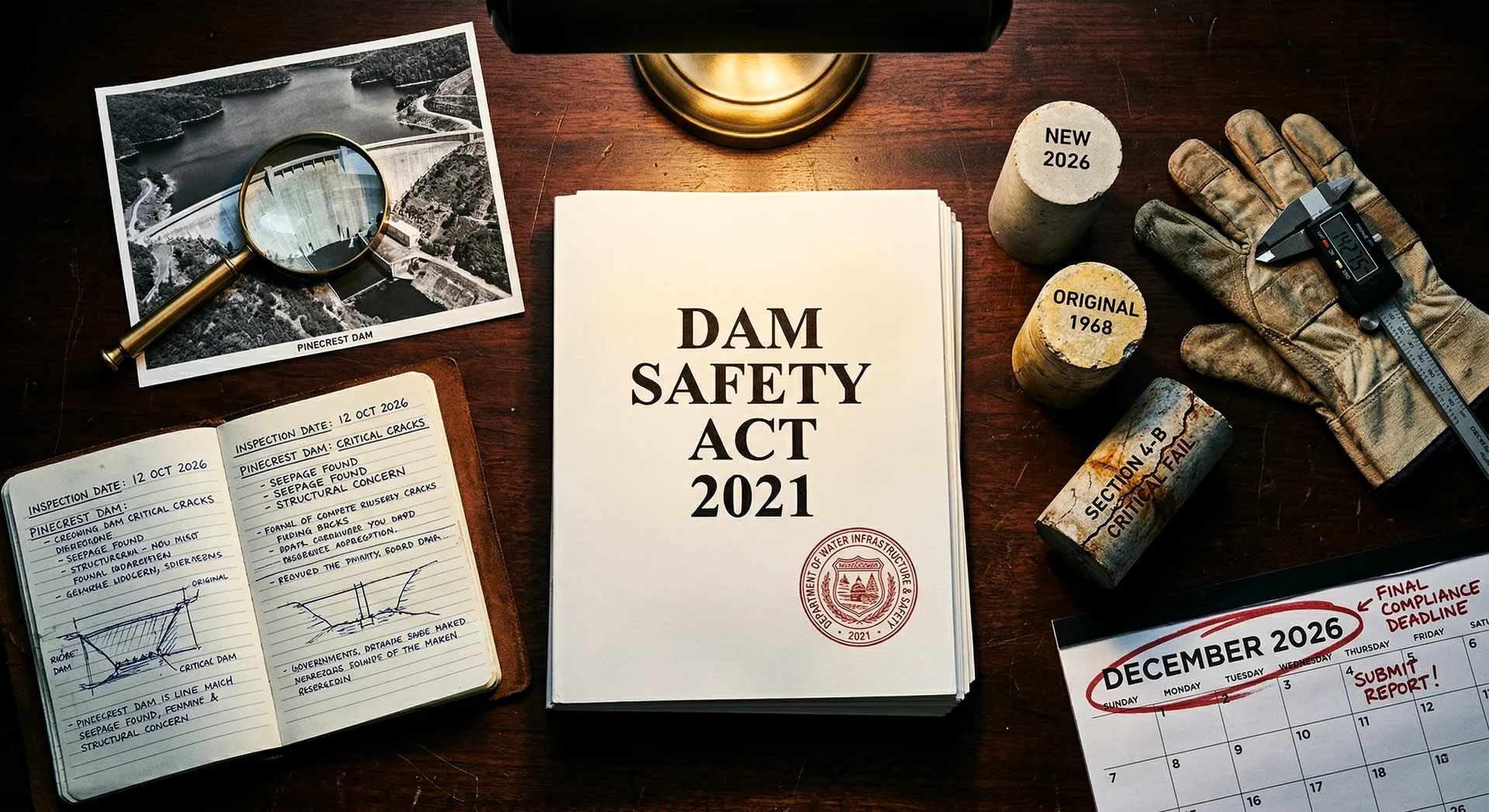
The Dam Safety Act 2021 mandates comprehensive evaluation of all specified dams by December 2026. DRIP provides the funding mechanism. Together, they create both the legal obligation and the financial means for unprecedented rehabilitation activity.
The Technical Gap
India has deep expertise in building new concrete dams. It has limited institutional experience in assessing and rehabilitating aging concrete dams. This gap creates demand for:
- NDT specialists who can interpret results in the context of dam structures
- Petrographers who can diagnose AAR, sulphate attack, and other deterioration mechanisms from core samples
- Structural engineers who can assess residual capacity and design strengthening solutions
- Grouting specialists who can design and execute cement and chemical grouting programmes
- Material scientists who can specify rehabilitation materials (repair mortars, coatings, injection systems)
The Timeline
- Phase II: Active now through 2027
- Phase III: 2025-2031
- Dam Safety Act deadline: December 2026
- Peak activity: 2026-2029, when the Act’s compliance deadline and DRIP’s construction phase converge
The next 3-5 years represent the highest concentration of dam rehabilitation activity in Indian history. The firms and professionals who build capability now will define the industry’s future.