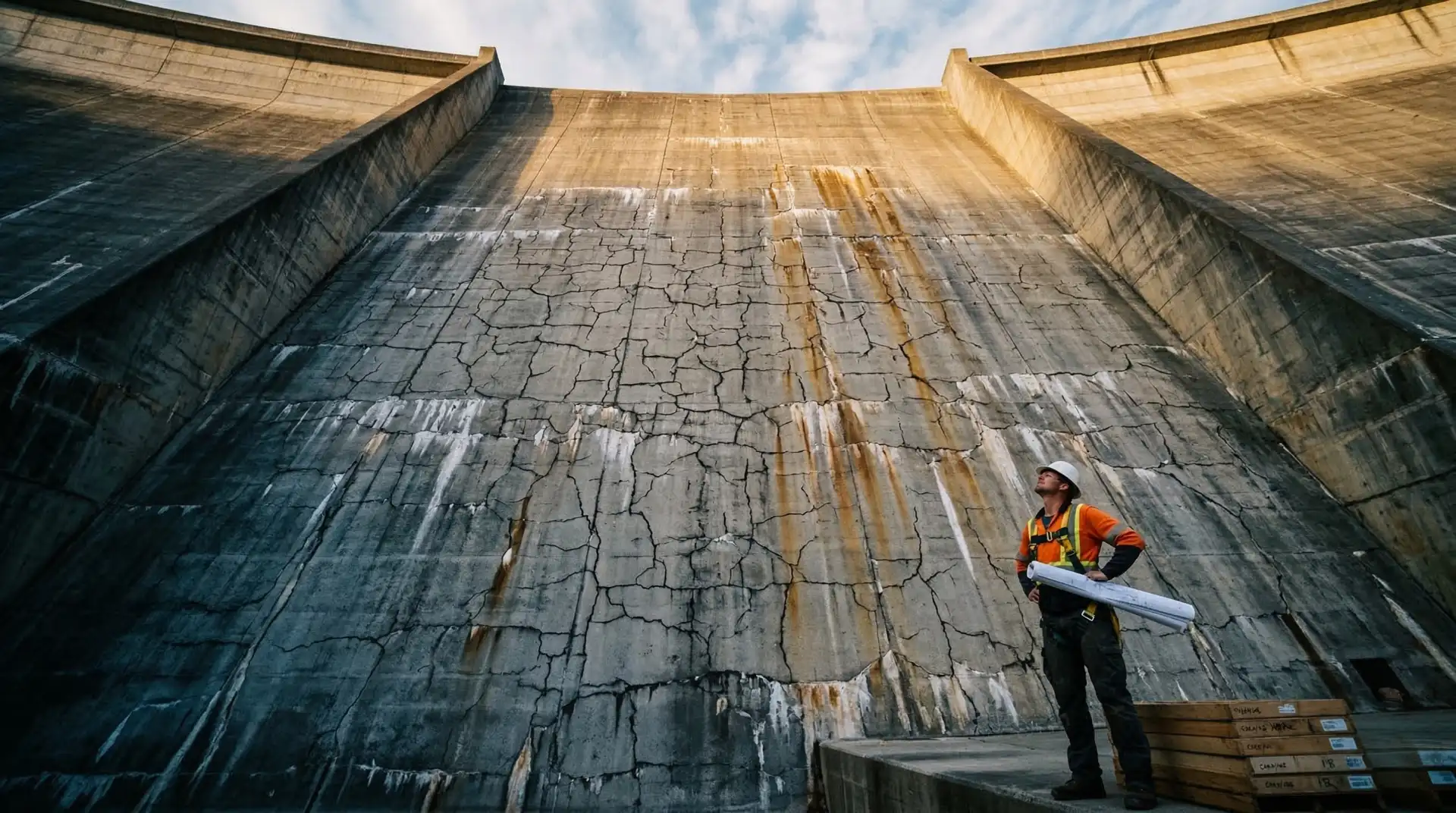
In August 2024, a crest gate at Tungabhadra Dam in Karnataka failed and was swept away. The dam, built in 1953, had been in service for over 70 years. The gate failure was attributed to age-related deterioration of the concrete and mechanical components.
Tungabhadra is not unique. It is representative. India’s dam infrastructure is aging at a rate that exceeds the capacity of its maintenance and rehabilitation systems. The warning signs are visible at dams across the country, but recognising them, and understanding what they mean, requires specific knowledge that many dam owners and their maintenance teams do not have.
This article documents the primary concrete deterioration mechanisms observed in Indian dams, the visible warning signs for each, and the progression from early signs to structural concern.
The Indian Dam Aging Problem in Numbers
| Statistic | Value | Source |
|---|---|---|
| Specified dams in National Register | 6,628 | NRSD 2025 |
| Dams over 50 years old | 1,681 | NRSD 2025 |
| Dams over 100 years old | 224 | Jal Shakti Ministry, Dec 2024 |
| Dams with suspect structural strength, uninspected for 10+ years | 348 | NDSA |
| Concrete and masonry dams (approximate) | ~2,000 | CWC estimate (~1/3 of total) |
| Dams projected to be 50+ years old by 2050 | 4,250+ | UNU study |
The age distribution tells a stark story: the majority of India’s large dams were built between the 1950s and 1980s, during the first wave of dam construction for irrigation and hydropower. These structures are now 40-75 years old, approaching or exceeding the half-life of their 100-year design period.
Deterioration Mechanism 1: Alkali-Aggregate Reaction (AAR)
The Mechanism
Alkalis (sodium and potassium oxides) in the cement react with reactive forms of silica in the aggregate. The reaction produces an expansive gel that absorbs water from the pore solution, swells, and generates internal pressure that cracks the concrete from within.
Why It Is Prevalent in Indian Dams
Two factors specific to Indian practice create conditions favourable for AAR:
High-alkali cement: Indian cement historically contains 1.2-1.8% equivalent alkalis (Na2Oe). ACI recommends limiting alkali content to 0.6% for concrete with potentially reactive aggregates. The IS 456 framework has not historically required low-alkali cement for dam construction.
Reactive local aggregates: Indian dam sites commonly use river-bed aggregates sourced near the construction site. Many Indian river systems carry sediment from geological formations containing reactive quartz, chalcedony, chert, or feldspar. Without ASTM C1260 (accelerated mortar bar) or ASTM C1293 (concrete prism) testing, these reactive aggregates entered the concrete mix.
Indian Dams Affected
- Rihand Dam, Uttar Pradesh: Severe AAR spalling rendered the powerhouse inoperable for years. In one penstock gallery column, 9 of 10 reinforcement bars were found snapped due to AAR expansion.
- Hirakud Dam, Odisha: AAR developed after approximately 30 years of service. Spillway ogee crest cracks measured 25 mm wide and 100 mm deep.
- Nagarjuna Sagar Dam, Andhra Pradesh: AAR deterioration documented, requiring crack sealing and HPC lining.
- Dams in Bundelkhand region (Sukuwa, Dukuwa, Kamala Sagar, Saprar): AAR from reactive quartz and feldspar in local aggregates.
Warning Signs (in order of progression)
Early (5-15 years):
- Fine map cracking on exposed surfaces, often initially mistaken for drying shrinkage
- Dark staining around crack intersections (moisture entering through cracks)
Intermediate (15-30 years):
- Crack widths increasing, becoming visible without close inspection
- White gel deposits at crack surfaces (AAR gel exuding to the surface)
- Surface pop-outs where aggregate particles are pushed out by expanding gel
- Misalignment at monolith joints as the concrete mass expands differentially
Advanced (30+ years):
- Severe spalling with large concrete pieces detaching
- Structural deformation visible to the naked eye
- Reinforcement exposure and corrosion (in reinforced sections)
- Operational problems: gates binding, shafts misaligning, penstocks stressing
- At Rihand: complete operational failure of structural elements
What to Do
AAR cannot be reversed. Management options:
- Reduce moisture access (improved drainage, surface sealing)
- Monitor expansion with crack gauges and survey monuments
- Structural assessment to determine remaining capacity
- Rehabilitation with HPC lining, crack grouting, and surface protection
- In severe cases: partial demolition and reconstruction with non-reactive aggregate
Deterioration Mechanism 2: Seepage and Leaching
The Mechanism
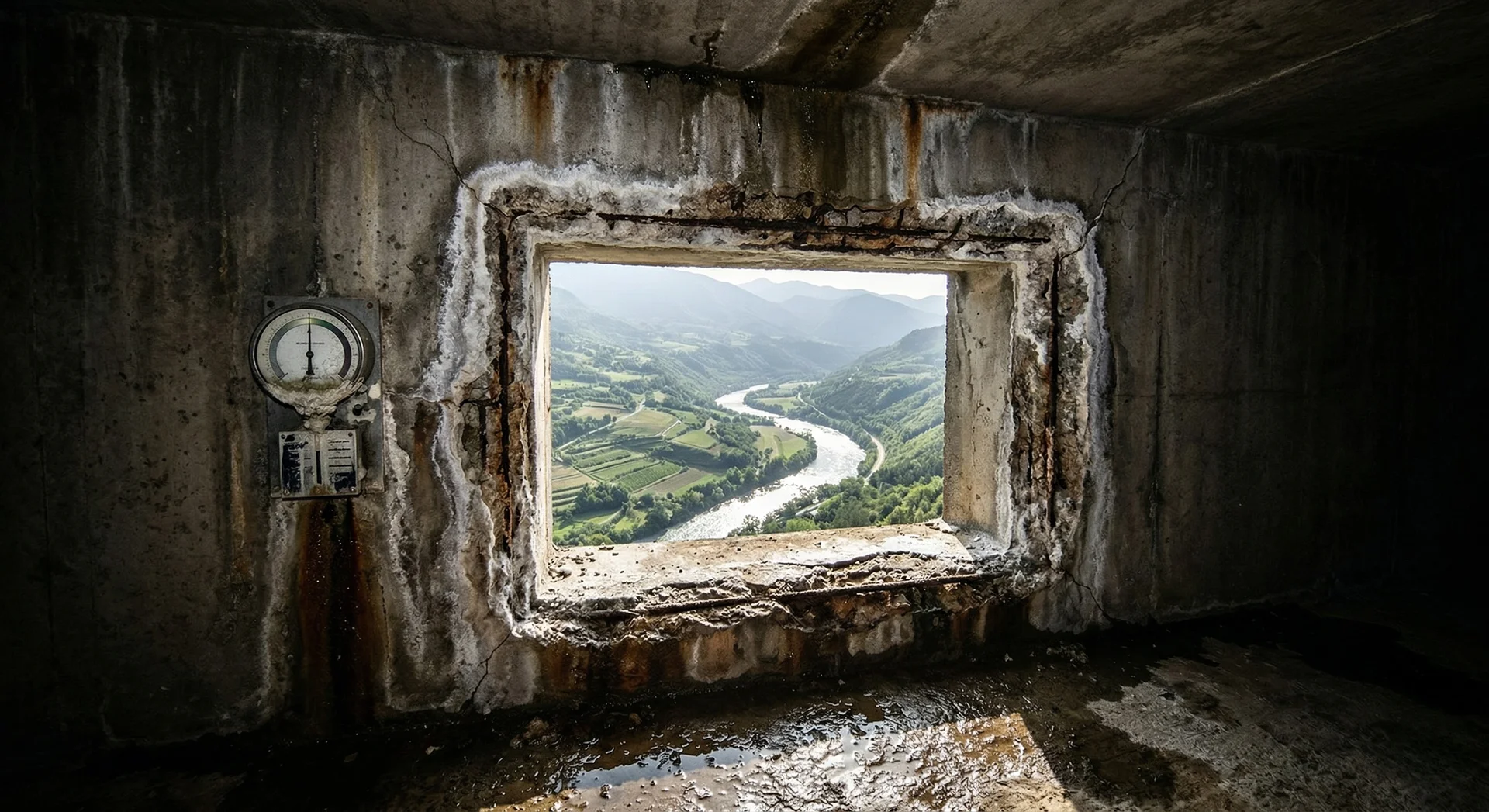
Water passing through concrete dissolves calcium hydroxide (Ca(OH)2) from the cement paste. Over decades, this leaching progressively increases porosity, reduces strength, and creates visible white calcium carbonate deposits (efflorescence) at seepage exit points.
Warning Signs
Early:
- Damp patches on the downstream face that appear and disappear with reservoir level changes
- White efflorescence deposits at the base of the dam or around gallery drainage outlets
- Weir measurements showing seepage volumes proportional to reservoir level
Concerning:
- Seepage volume increasing over time at the same reservoir level
- Seepage emerging at new locations not previously observed
- Efflorescence deposits becoming thicker and more widespread (indicating more calcium being dissolved from more concrete)
- Stalactite formation in galleries (dramatic visual indicator of sustained leaching)
Critical:
- Turbid seepage carrying visible particles (internal erosion)
- Seepage concentrated at a single point with increasing flow
- Piezometric pressures rising above design assumptions
- Gallery drainage system unable to handle the flow volume
Indian Dams Affected
- Barna Dam, Madhya Pradesh: Blocked drains leading to excessive seepage, under DRIP rehabilitation
- Warna Dam, Maharashtra: Seepage through dam body requiring grouting
- Bhatsa Dam, Maharashtra: Seepage through dam body requiring cementitious grout treatment
- Multiple DRIP dams: Seepage through masonry and concrete is the most common rehabilitation trigger across the programme
Deterioration Mechanism 3: Surface Erosion and Cavitation
The Mechanism
High-velocity water flow erodes concrete surfaces through two mechanisms: abrasion (physical wearing by suspended sediment) and cavitation (collapse of vapour bubbles in low-pressure zones creating shock waves that pit the surface).
Where It Occurs
- Spillway ogee crests and chute slabs
- Stilling basin floors and end sills
- Energy dissipation structures
- Gate slots and sill beams
- Tunnel and penstock linings at bends and transitions
Warning Signs
Early:
- Smooth, polished appearance on spillway surfaces (fine aggregate matrix worn away, exposing coarse aggregate)
- Shallow pitting in high-velocity zones
Progressing:
- Coarse aggregate exposed and standing in relief (the mortar matrix has been removed around them)
- Deepening cavities in cavitation-prone zones (downstream of steps, transitions, and surface irregularities)
- Aggregate dislodgement from the surface
Severe:
- Deep channels cut into the spillway surface
- Reinforcement exposure in eroded zones
- Structural thinning of spillway slabs
- Risk of progressive undermining if erosion penetrates to foundation
Indian Dams Affected
- Tungabhadra Dam, Karnataka: 70+ years of spillway operation leading to the 2024 crest gate failure
- Almatti Dam, Karnataka: Spillway pier and ogee deterioration
- Hirakud Dam, Odisha: Spillway erosion in addition to AAR
Rehabilitation
- High abrasion-resistant coatings (polyurethane, epoxy-based)
- HPC resurfacing with silica fume and low water-cementitious ratio
- Fibre-reinforced overlays for impact and abrasion resistance
- Stainless steel or specialty alloy armour plates in severe cases
Deterioration Mechanism 4: Thermal and Structural Cracking
The Mechanism
Thermal cracking originates from the heat of hydration during original construction. Structural cracking develops from foundation settlement, load redistribution, seismic events, or restraint stresses.
Warning Signs
Construction-origin thermal cracks:
- Typically found in the interior of the dam, visible in galleries
- Pattern: horizontal or sub-horizontal cracks parallel to lift surfaces, or vertical cracks perpendicular to the upstream face
- Width typically 0.1-1.0 mm when first formed, may widen over decades if the driving mechanism continues
Structural cracks:
- Located at points of geometric change (gallery corners, spillway notches, changes in dam section)
- Pattern related to the structural cause (vertical for thermal/shrinkage, diagonal for shear, horizontal for flexure)
- May propagate over time under sustained load
The Diagnostic Challenge
Distinguishing between construction-origin cracks (which may be stable and require only sealing) and structurally-caused cracks (which may indicate an ongoing problem requiring structural intervention) requires:
- Crack monitoring over time (widening indicates active mechanism)
- Structural analysis to determine if the crack pattern is consistent with a structural deficiency
- Finite element modelling in complex cases
Deterioration Mechanism 5: Drain Clogging
The Mechanism
Internal drainage systems in concrete dams collect seepage through drilled holes in the dam body and foundation. Over decades, these drains clog with calcium carbonate deposits (from the same leaching process that causes efflorescence), biological growth (algae, bacteria), or silt infiltration.
Warning Signs
- Reduced drainage flow at weir measurements despite constant reservoir level
- Rising piezometric pressures within the dam body
- New seepage appearing on the downstream face (water finding alternative paths because the designed drainage path is blocked)
- Visible calcification in drain outlets
Why It Matters
Blocked drains do not reduce total seepage. They redirect it. Instead of being collected and measured in the gallery, the seepage builds pore pressure within the dam body. High pore pressure reduces the effective weight of the dam, which reduces the factor of safety against sliding. A dam that was stable with a functioning drainage system may become marginal with blocked drains.
Drain maintenance (periodic flushing, reaming, or replacement) is one of the simplest and most effective dam safety measures. Yet it is frequently neglected because the drains are underground, difficult to access, and their deterioration is invisible until the consequences appear.
The Inspection Framework
Recognising these warning signs requires a systematic inspection approach:
Annual Visual Inspection (Pre- and Post-Monsoon)
Per the Dam Safety Act 2021:
- Document all visible cracking, seepage, spalling, efflorescence, and surface erosion
- Photograph each defect with a scale reference
- Record seepage weir measurements
- Check gallery drainage function
- Inspect gates, sills, and mechanical components
- Compare with previous inspection records to identify changes
Periodic Detailed Assessment (Every 5-10 Years)
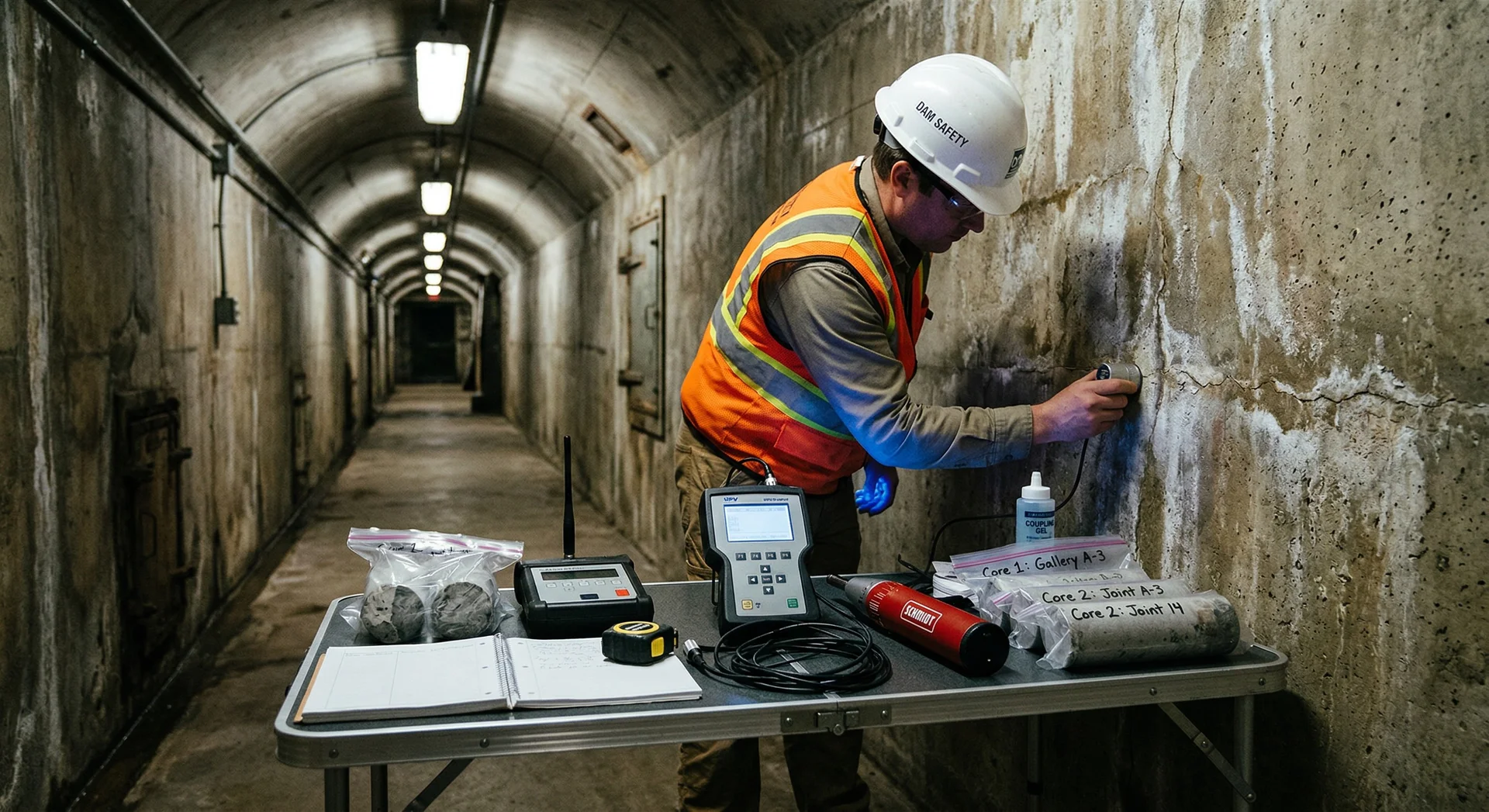
- NDT programme: rebound hammer, UPV, impact echo, GPR as appropriate
- Core extraction from representative locations and areas of concern
- Petrographic examination for AAR diagnosis
- Compressive strength testing of cores
- Structural FEM analysis if warranted by inspection findings
Continuous Monitoring
- Piezometers: read at defined frequency (weekly to monthly)
- Seepage weirs: read daily
- Crack gauges: read at defined frequency
- Survey monuments: read quarterly (for overall dam movement and deformation)
The Bottom Line
Concrete deterioration in dams is not sudden. It is progressive. Every mechanism described in this article, from AAR to leaching to erosion, takes years to decades to advance from early warning signs to structural concern.
This is both the danger and the opportunity. The danger: because deterioration is slow, it is easy to normalise. The dam looked the same last year. The seepage has always been there. The cracks have been there since the gallery was inspected in 2005. The danger is complacency.
The opportunity: because deterioration is slow, it is detectable. Every mechanism has visible warning signs that precede structural failure by years or decades. The dam that is inspected systematically, with consistent documentation and trending of observations over time, will reveal its problems before they become emergencies.
The Dam Safety Act 2021 exists because too many Indian dams were not being inspected systematically. The December 2026 deadline for comprehensive evaluation is approaching. For dam owners with concrete structures showing any of the warning signs described here, the time to investigate is now, not after the next monsoon.