A site engineer on a dam project receives a 28-day compressive strength report. The result: 19.2 MPa. The specification requires M20 concrete with a characteristic strength of 20 MPa.
Does this concrete pass or fail?
The answer depends on which acceptance criterion applies. Is it an individual test result (which must not fall below fck minus 3 MPa = 17 MPa, so 19.2 MPa passes this criterion)? Or is it part of a group average (which must exceed fck plus a margin, depending on the number of results and the statistical method)?
This is not a hypothetical exercise. On a dam project placing 500-1,000 cubic metres per day, the QC laboratory generates dozens of test results weekly. Borderline results are not exceptional. They are routine. The acceptance criteria define the boundary between concrete that stays in the dam and concrete that must be investigated, repaired, or removed. Getting these criteria right, and applying them consistently, is the foundation of the entire QA/QC programme.
The Acceptance Framework
What the Specification Must Define
A complete concrete acceptance specification for a dam project must address:
- Compressive strength (the primary acceptance parameter)
- Placing temperature (thermal control compliance)
- Density (particularly for RCC)
- Air content (for freeze-thaw zones)
- Slump/workability (production consistency)
- Water-cementitious ratio (durability parameter)
- Lift joint quality (bond strength, surface preparation)
- Surface finish (for spillway, formed surfaces)
For each parameter, the specification must state:
- The target value (what we are designing for)
- The acceptance criterion (the minimum that will be accepted without investigation)
- The investigation trigger (the threshold below which additional testing or assessment is required)
- The rejection criterion (the threshold below which the concrete must be repaired or removed)
- The test method (which standard, which equipment, what frequency)
- The decision authority (who decides the disposition of non-conforming concrete)
The Statistical Reality
Concrete is not a manufactured product with tight tolerances. It is a site-mixed material produced from natural aggregates, variable cementitious materials, and water, in a batching plant exposed to ambient conditions. Variability is inherent.
IS 456:2000 recognises this through its statistical acceptance approach:
For groups of consecutive test results:
- Mean of any group of 4 consecutive results ≥ fck + 0.825 × established standard deviation
- Or: Mean ≥ fck + 3 MPa (for M15) / fck + 4 MPa (for M20 and above) when standard deviation is not established
For individual results:
- No individual result ≤ fck - 3 MPa
This framework allows individual results to fall below the characteristic strength, provided the group average compensates. It recognises that concrete variability is normal and that the characteristic strength (fck) is a statistical concept: the value below which not more than 5% of results are expected to fall.
A note on IS 456:2025: The Bureau of Indian Standards is currently finalising a comprehensive revision of IS 456. The draft IS 456:2025 introduces six limit states (up from two), codifies performance-based durability testing, and adds dedicated chapters for RCC and HPC. When published, it will significantly change the acceptance framework described in this article. Until the 2025 revision is officially published, IS 456:2000 remains the enforceable standard for concrete acceptance on all Indian projects.
Parameter 1: Compressive Strength
The Design Age Question
For general construction, the design age is 28 days. For mass concrete in dams, the design age is typically 90 days or 365 days.
Why? Dam concrete uses high SCM content (30-60% fly ash or GGBS). These pozzolanic materials react slowly, producing significant strength gain between 28 and 365 days. A mass concrete mix designed for M20 at 365 days might test at only M12-M15 at 28 days.
This creates a practical problem: the concrete is buried under subsequent lifts long before the design-age strength result is available. If the 365-day result ultimately fails, the failing concrete is metres below the current working surface.
The solution: Establish a correlation between early-age strength (7 or 28 days) and design-age strength (90 or 365 days) from the trial mix programme. Use the early-age result as an interim acceptance criterion: if the 28-day result meets the predicted interim value, the concrete is provisionally accepted pending the design-age confirmation.
If the design-age result subsequently fails, the engineer must decide whether the as-built strength, while below the specification, is adequate for the actual loading conditions at that location. This decision requires structural analysis and is the responsibility of the design engineer, not the site QC team.
Testing Frequency
IS 456 specifies a minimum of one sample per 50 cubic metres or per shift, whichever is more frequent. For dam concrete:
| Production Rate | Minimum Testing Frequency |
|---|---|
| Less than 100 m3/day | 1 set per 50 m3 |
| 100-500 m3/day | 1 set per 50-100 m3 |
| 500-2,000 m3/day | 1 set per 100-200 m3 |
| More than 2,000 m3/day (RCC) | 1 set per 200-500 m3 |
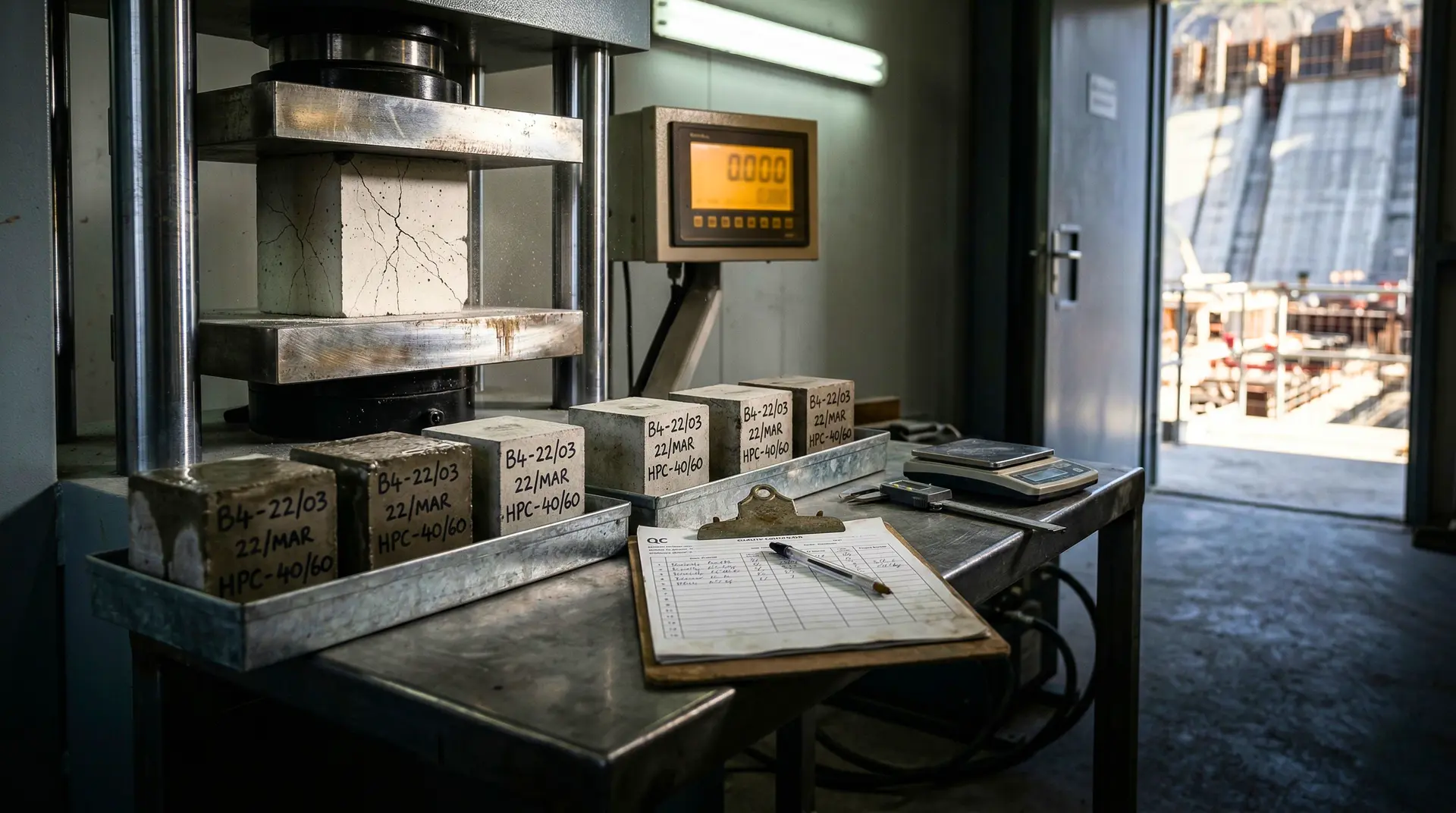
Each “set” typically consists of 3 cubes (150 mm) or cylinders (150 x 300 mm), tested at the design age. Additional specimens for 7-day and 28-day interim testing are standard on dam projects.
Parameter 2: Placing Temperature
The Criterion
The thermal control plan defines the maximum placing temperature, typically 15-25 degrees C depending on the section thickness, ambient conditions, and pre-cooling capability. This is a hard limit: exceeding it directly increases the peak temperature, the thermal gradient, and the cracking risk.
Verification
Temperature measurement at the point of placement (not at the batching plant discharge) using a calibrated thermometer or thermocouple inserted into the fresh concrete. Measurement frequency: every batch or every truck, with a minimum of one measurement per hour of continuous placement.
Non-Conformance Response
Concrete exceeding the placing temperature limit by more than the permitted tolerance (typically 1-2 degrees C, if any) should be rejected (not placed). Concrete that has already been placed at above-specification temperature requires:
- Notification to the thermal control engineer
- Review of the thermal instrumentation data to determine the actual temperature rise
- If the peak temperature or gradient exceeds the thermal model’s safe limits: additional cooling measures, extended curing, or structural assessment
Parameter 3: Density (RCC)
The Criterion
RCC density is verified against the Theoretical Maximum Density (TMD) established from trial compaction in the laboratory. The specification typically requires:
- Minimum in-situ wet density: 96-98% of TMD
- No individual reading below 94-96% of TMD
Verification
Nuclear density gauge testing on the compacted lift surface. Testing locations at a defined grid (typically every 100-500 m2) plus additional tests at edges, near formwork, and at compaction boundaries (where adjacent roller passes overlap).
Non-Conformance Response
Low-density readings indicate inadequate compaction. Response:
- Marginal (94-96% TMD): Additional roller passes may recover the density if the RCC has not yet reached initial set
- Significant (below 94% TMD): If the RCC has set, the low-density material cannot be recompacted. The area must be documented, and the structural engineer must assess whether the reduced density affects the section’s capacity or permeability
- Pattern failure (multiple consecutive low readings): Investigation of the cause, potentially including equipment check (roller vibration amplitude and frequency), RCC consistency check, and lift thickness verification
Parameter 4: Air Content
The Criterion
For dam concrete in freeze-thaw exposure zones (Himalayan sites above 1,500 metres), the specification requires entrained air content of 4-8% in the fresh concrete, with an air-void system spacing factor of less than 0.2 mm in the hardened concrete.
Verification
- Fresh concrete: Air content measured by pressure method (ASTM C231 or IS 1199) at the batching plant discharge and/or at the point of placement
- Hardened concrete: Air-void analysis (ASTM C457) on cores from the structure, verifying spacing factor and specific surface
Non-Conformance Response
Low air content in fresh concrete in the freeze-thaw zone is a rejection criterion: the concrete should not be placed because it will be vulnerable to freeze-thaw damage for the life of the structure. If already placed, the affected area must be identified in the project records and may require additional surface protection (sealer, coating) to reduce moisture ingress.
Parameter 5: Lift Joint Quality
The Criterion
For RCC dams, the specification defines:
- Joint classification system (hot, warm, cold) with treatment requirements for each
- Maximum time between lifts (based on maturity monitoring or elapsed time)
- Bond strength requirements (tested at 90 or 365 days on cored samples)
- Surface preparation requirements (cleaning, moisture conditioning, bedding mortar)
Verification
- Joint timing: Recorded for every lift. Maturity monitoring provides the most accurate classification.
- Surface preparation: Visual verification and photographic documentation before the next lift is placed.
- Bond strength: Core extraction through the joint at defined frequency (typically 1 per 500-1,000 m2 of joint area), tested in direct tension or direct shear at 90 or 365 days.
Non-Conformance Response
Joint bond strength below the specification requirement triggers:
- Review of the joint classification and treatment records for that location
- Structural assessment: is the reduced bond strength adequate for the actual loading at that elevation?
- If not adequate: remedial grouting through the joint or, in extreme cases, removal and replacement of lifts above the deficient joint
The Non-Conformance Report (NCR) System
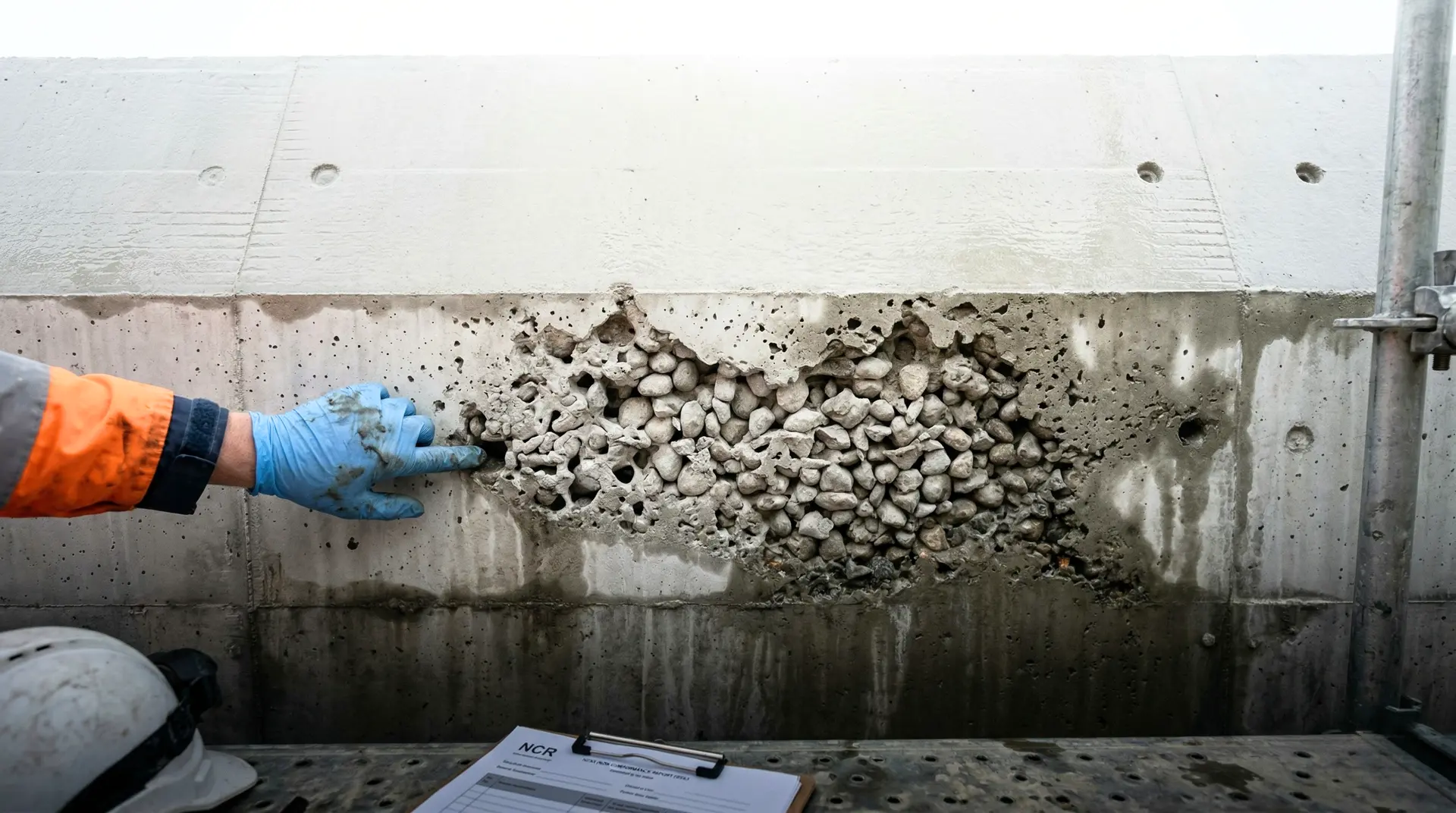
Every acceptance failure must be documented in a Non-Conformance Report:
- Description: What failed, where, when, and by how much
- Cause analysis: Why did it fail? (Equipment, material, procedure, human error, environmental)
- Extent: How much concrete is affected?
- Proposed disposition: Accept as-is (with technical justification), repair (with method), or remove and replace
- Technical assessment: Structural and durability impact of the non-conformance
- Decision: Approved disposition with signature of the authorised decision-maker
- Follow-up: Verification that the disposition was implemented, and corrective action to prevent recurrence
The NCR register is a critical project document. It provides a complete record of every quality deviation and its resolution. For dam safety assessments decades later, the NCR register reveals what happened during construction: where the concrete was below specification, what was done about it, and whether the disposition was technically sound.
The Grey Zone: Borderline Results
The most difficult decisions on dam projects are not clear pass or clear fail results. They are the borderline results that fall between the acceptance criterion and the rejection criterion:
- Strength at 97% of target: does it need investigation or acceptance?
- Placing temperature 0.5 degrees above the limit: reject the batch or accept with documentation?
- Density at 96.5% TMD in a non-critical zone: investigate or pass?
The specification should define these grey zones explicitly. Without clear guidance, different engineers will make different decisions on different shifts, creating inconsistency that undermines the entire QC programme.
Best practice: Define three zones for each parameter:
- Green (automatic acceptance): Meets or exceeds the specification requirement
- Yellow (investigate and decide): Below specification but above rejection threshold. Requires investigation, documentation, and an engineering disposition.
- Red (automatic rejection/removal): Below the rejection threshold. The concrete cannot be accepted regardless of circumstances.
The yellow zone is where the engineer earns their fee. The green and red zones are where the specification earns its clarity.
Key Principles
-
Write the specification before the first pour, not after the first failure. Acceptance criteria developed reactively (after a failure has occurred and pressure to accept is high) will be less rigorous than those developed proactively.
-
Statistical acceptance requires sufficient data. IS 456’s group average criterion works only when enough test results exist to form meaningful groups. In the first weeks of a dam project, individual result criteria may be the only applicable standard.
-
The design age must match the SCM strategy. Specifying 28-day acceptance for a 40% fly ash mix is setting the concrete up to fail. The acceptance age must reflect the actual strength development curve of the specific mix design.
-
Document everything in real time. An NCR written weeks after the non-conformance, from memory, is less valuable than one written on the day, with photographs, test data, and witness statements.
-
Consistency is more important than strictness. A moderately strict specification applied consistently across every batch is superior to a very strict specification applied inconsistently depending on who is on shift, how far behind schedule the project is, or how much pressure the contractor is applying.
The acceptance criteria for dam concrete are not arbitrary standards. They are the quantitative expression of the design intent: the minimum quality that the structure requires to perform for its 100-year design life. Every test result that meets the criteria adds confidence that the dam will perform. Every non-conformance that is properly investigated, documented, and resolved maintains that confidence. The QA/QC programme is the guardian of the dam’s future.