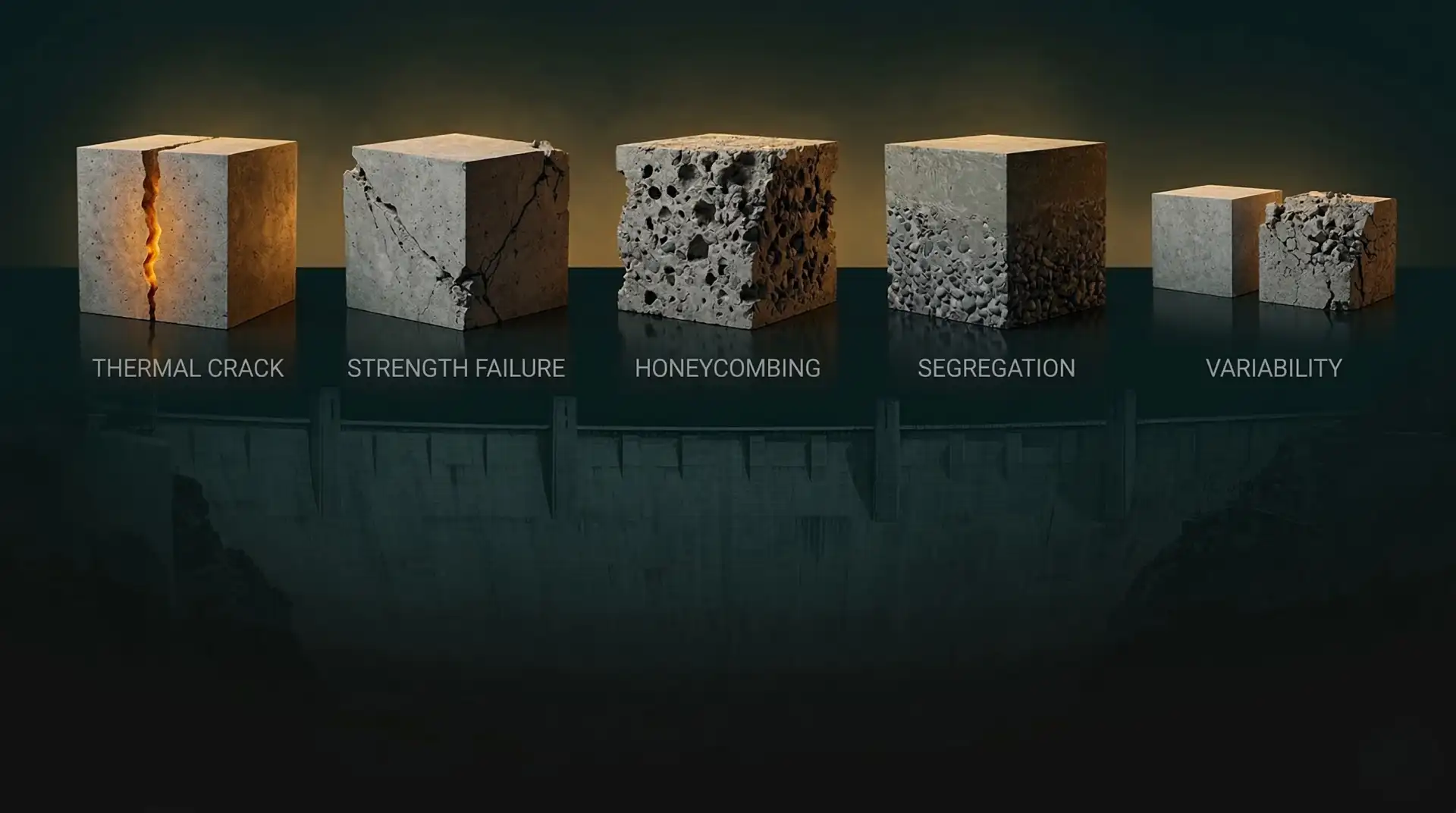
Every dam engineer has seen one. A horizontal line running across the dam face where two concrete lifts meet but did not bond. Water seeping from that line during the first reservoir filling. A core extracted across the joint that breaks cleanly in two, the surfaces showing no interlock, no paste continuity, no bond.
That is a cold joint. And in mass concrete dam construction, it is the most common preventable quality defect.
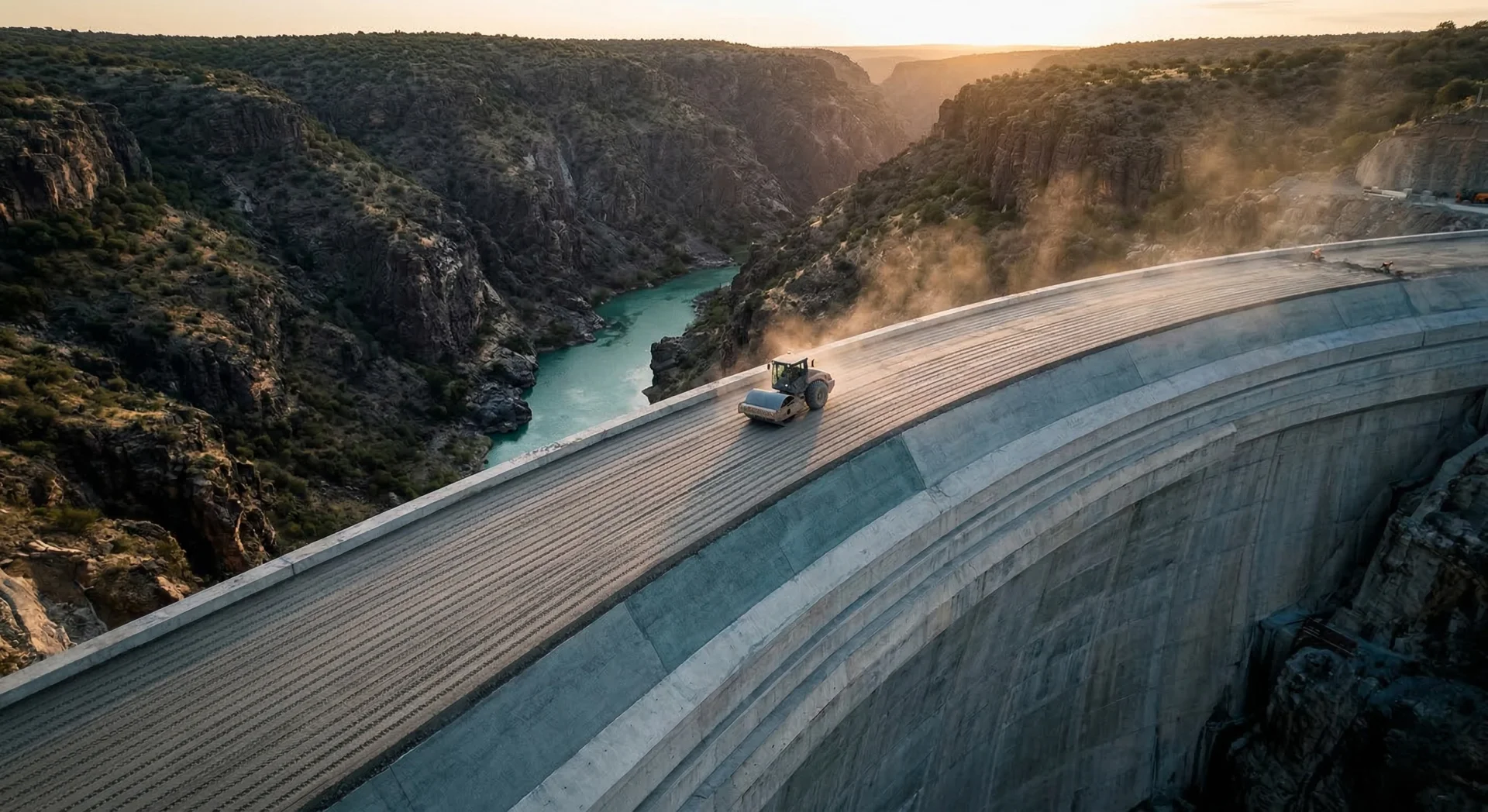
Cold joints matter because gravity dams depend on monolithic behaviour. The weight of the concrete resisting the water pressure works only if the dam acts as a single mass. Every cold joint is a plane of weakness where the dam is no longer monolithic. It is a seepage path, a shear resistance reduction, and a point where deterioration will concentrate over the structure’s 100-year service life.
The irony is that cold joints are entirely preventable. They form because of failures in planning, logistics, and site management, not because of concrete material limitations.
How Cold Joints Form
Fresh concrete bonds to a substrate through two mechanisms: mechanical interlock (aggregate particles embedding into the rough surface of the underlying concrete) and chemical bond (cement paste hydration products bridging the interface).
Both mechanisms require that the underlying surface has not completed initial setting when the fresh concrete arrives. Once initial set occurs, the surface forms a hardened skin. Fresh concrete placed on this skin cannot mechanically interlock with the substrate, and the cement paste cannot form chemical bonds across the boundary.
The result is two separate concrete masses in contact but not bonded. Under hydrostatic pressure, water finds and exploits this unbonded interface.
The Timeline
For typical dam concrete mixes (with 25-40% fly ash replacement), initial set occurs within approximately:
- 4-6 hours at ambient temperatures above 30 degrees C
- 6-10 hours at 20-30 degrees C
- 10-16 hours at 10-20 degrees C
- 16-24+ hours below 10 degrees C
These are general ranges. The actual setting time depends on the specific cement type, SCM content and reactivity, chemical admixtures (retarders can extend initial set by several hours), and the water-cementitious ratio.
The critical point: bond quality does not suddenly drop to zero at initial set. It deteriorates progressively from the moment the underlying concrete is placed. Even within the initial set window, a 6-hour-old surface will bond less effectively than a 2-hour-old surface.
Why Cold Joints Happen on Dam Sites
In theory, preventing cold joints is simple: place the next lift before the previous one sets. In practice, the forces conspiring to delay placement are numerous.
Equipment Failures
A batching plant breakdown, a transit mixer with a mechanical fault, a crane failure, or a conveyor belt rupture can halt concrete delivery for hours. On a dam site where the batching plant may be kilometres from the placement face, there is no backup. The concrete in the forms continues to set while the equipment is repaired.
Weather
Monsoon rainfall in the placement area. Extreme heat accelerating set (reducing the placement window). Extreme cold slowing production rates. Wind drying the exposed surface faster than expected.
Logistics and Supply Chain
Cement delivery delays. Aggregate stockpile depletion. Admixture supply interruption. Any break in the material supply chain stops production.
Thermal Control Restrictions
Mass concrete placement schedules are governed by thermal analysis. Lifts must be spaced to allow heat dissipation. If the thermal control plan requires a 72-hour interval between lifts but the surface preparation and fresh concrete placement cannot be completed within the setting time window, a cold joint is inevitable unless the surface is properly treated as a planned construction joint.
Shift Changes and Labour Availability
Placement crews changing at shift boundaries. Holiday periods. Labour disputes. Any disruption to the human element of the placement operation.
Poor Planning
The most common root cause. A placement schedule that does not account for the production capacity of the batching plant, the transport time from plant to placement face, the spreading and compaction time, and a contingency margin for delays.
Prevention: An Integrated System
Preventing cold joints requires coordinating multiple systems. No single measure is sufficient.
1. Placement Scheduling
Calculate the maximum placement interval based on trial mix initial setting times under site-specific conditions. Work backward from that limit to determine the required production rate, transport capacity, and placement crew size. Include a contingency margin of at least 30% on the time budget.
2. Surface Protection
If a delay is anticipated, protect the exposed surface from moisture loss (which accelerates surface setting). Fog spraying, curing membranes, or wet hessian covering buys additional time.
3. Retarding Admixtures
Chemical retarders can extend initial set by 2-6 hours depending on dosage and temperature. On dam projects, retarders are standard in mass concrete mixes, but the dosage should be adjusted based on ambient conditions. A retarder designed for 25 degrees C placement may not provide adequate delay at 35 degrees C.
4. Contingency Batching
Identify backup equipment and procedures. A standby batching capability, even at reduced capacity, prevents total production stoppage.
5. Real-Time Monitoring
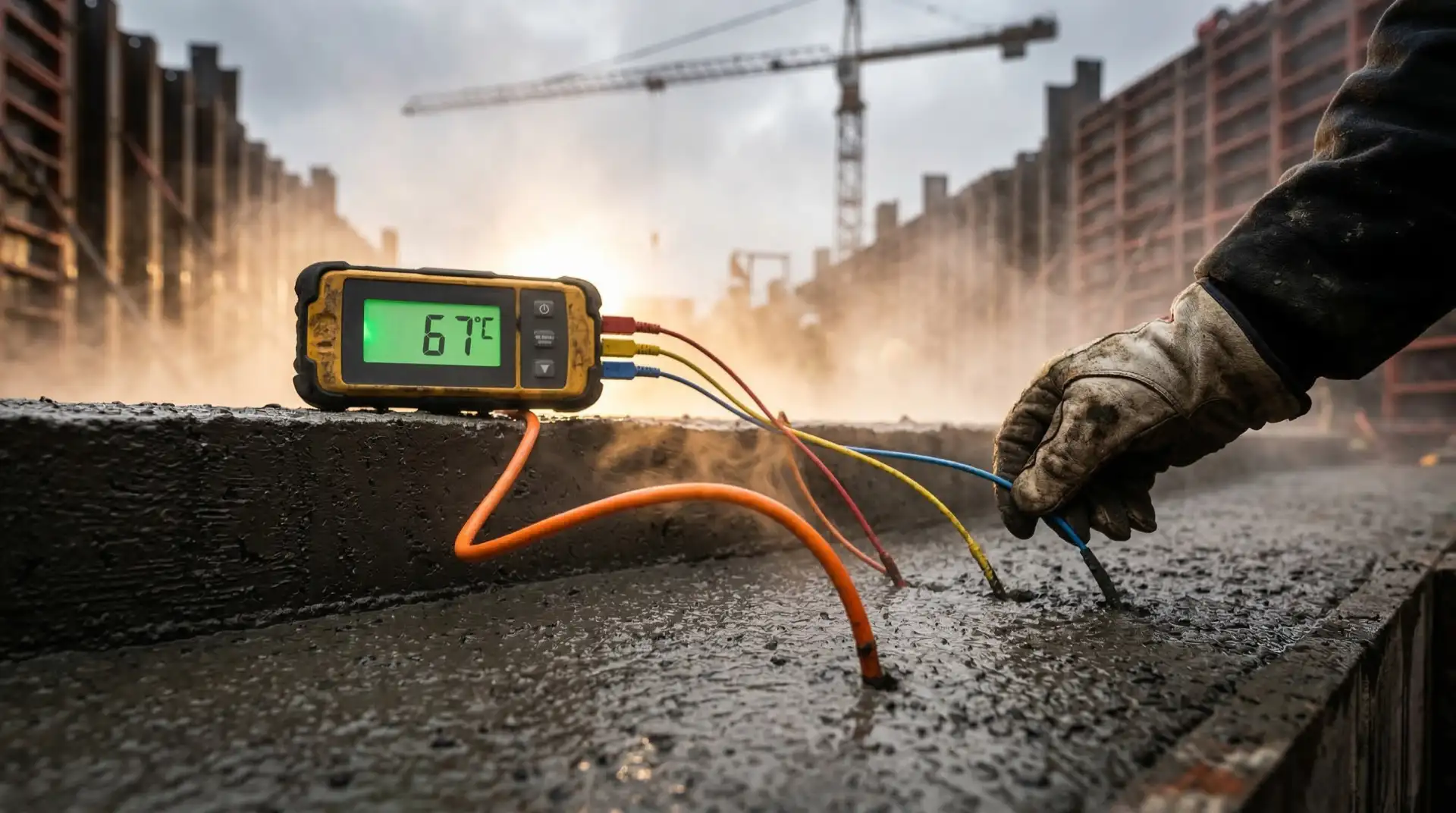
Maturity meters on the placed concrete surface provide real-time data on how much of the setting window remains. This replaces guesswork with measurement. When the maturity reading approaches the threshold, the crew knows exactly how much time they have.
6. Communication Protocol
A defined escalation procedure when delays occur. The site engineer, placement supervisor, and concrete technology specialist must be in direct communication. The decision to treat a surface as a planned construction joint (rather than risk a cold joint) should be made early, not after the setting window has passed.
When Prevention Fails: Planned Construction Joints
Despite best efforts, there will be situations where placement cannot resume within the setting window. The critical decision is to recognize this early and convert the unplanned interruption into a properly treated construction joint.
A planned construction joint differs from a cold joint in one essential way: the surface is prepared to maximize bond before the next lift is placed.
Surface Preparation
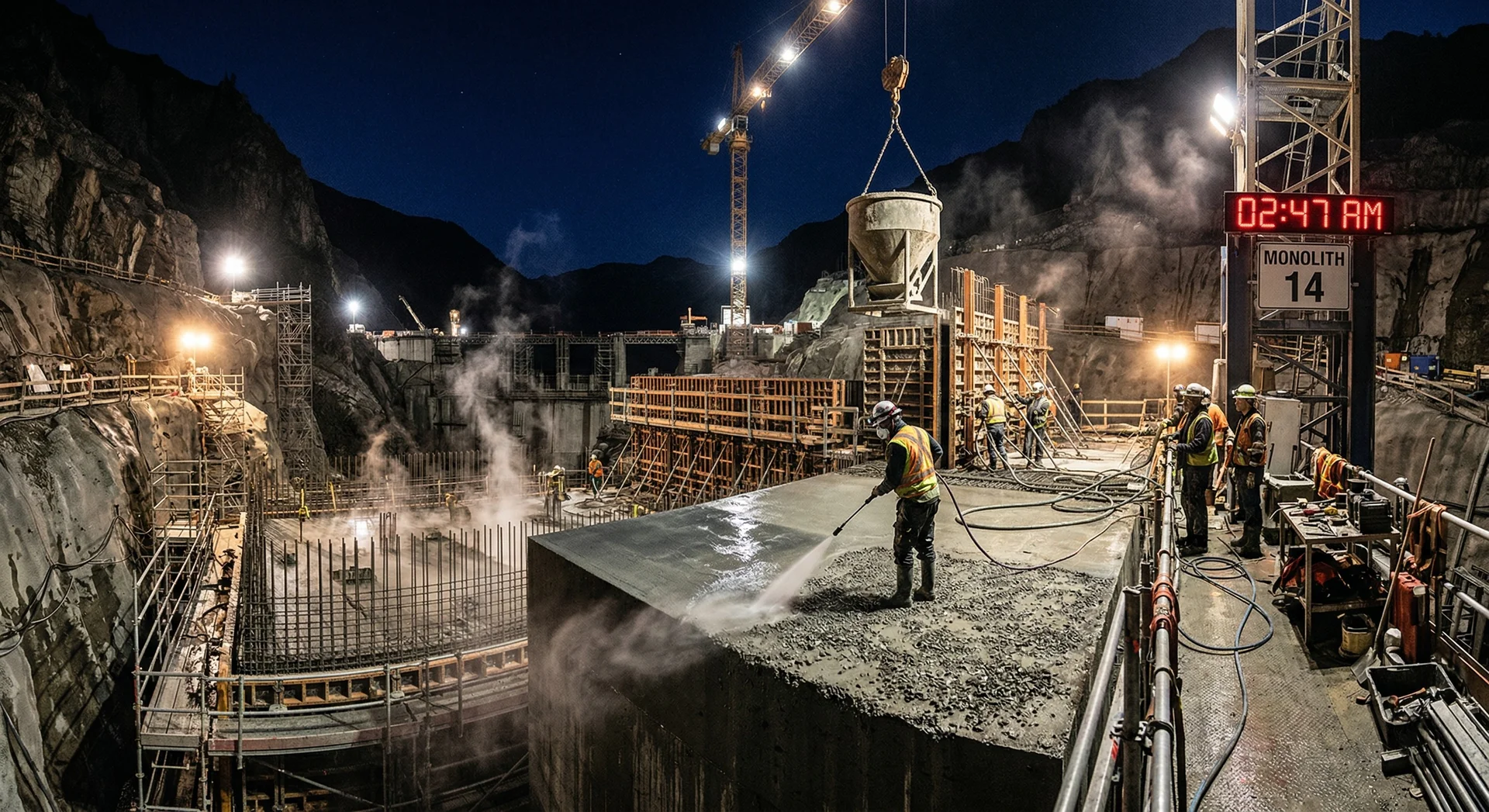
- Green cutting: Removing the laitance and weak morite layer from the surface using high-pressure water jets while the concrete is still green (6-24 hours after placement). This exposes coarse aggregate for mechanical interlock.
- Surface roughening: If the concrete has hardened beyond the green cutting window, mechanical methods (sandblasting, bush hammering, or high-pressure water blasting) remove the smooth surface layer.
- Cleaning: All loose material, standing water, and contamination removed before placing the next lift.
Bonding
- Bedding mortar: A thin layer of cement-sand mortar (typically 10-20 mm) applied to the prepared surface immediately before placing fresh concrete. The mortar fills surface irregularities and provides a paste-rich transition zone.
- Bonding agent: Epoxy-based bonding compounds applied to the prepared surface in specific situations.
Moisture Conditioning
The prepared surface must be in a saturated surface-dry (SSD) condition: damp throughout but without standing water. A dry surface absorbs water from the fresh concrete, weakening the interface. A wet surface dilutes the paste at the interface.
Repair of Existing Cold Joints
When cold joints are discovered in an existing dam, repair options depend on the severity and location:
Seepage Control
- Epoxy injection: Low-viscosity epoxy injected under pressure through drilled holes to seal the joint. Effective for joints showing moderate seepage.
- Polyurethane injection: Expanding polyurethane foam injected to seal joints with active water flow. Less structural than epoxy but better at stopping flowing water.
- Cement grouting: Portland cement grout injected through drilled holes along the joint plane. Effective for widespread joints where individual injection is impractical.
Structural Repair
For cold joints affecting the structural capacity of the dam (typically in the upper lifts where tensile stresses are highest), repair may require:
- Extensive drilling and grouting programmes to restore bond across the joint
- External post-tensioning to provide compressive stress across the joint (rare, for severe cases)
- In extreme cases, partial demolition and re-placement of the affected lifts
The Cost Equation
The cost of repairing a cold joint after the dam is built is typically 10 to 50 times the cost of preventing it during construction. For a cold joint that causes seepage requiring grouting, the cost may be tens of lakhs. For a cold joint that triggers a comprehensive structural assessment and remediation programme, the cost can run to crores.
Prevention is not just better engineering. It is better economics.
Lessons from the Field
What works:
- Trial placements that test the full production-to-placement cycle under realistic conditions, including deliberate delays to establish the actual cold joint formation timeline for the specific mix and climate
- Maturity monitoring integrated into the daily placement decision process
- A placement schedule that treats the setting time limit as a hard constraint, not a target to approach
- Empowering site engineers to stop placement and initiate construction joint treatment when delays exceed the safe window
What does not work:
- Assuming the concrete will “be fine” because the delay was “only” a few hours
- Relying on retarders as the sole cold joint prevention strategy without monitoring actual surface condition
- Placing fresh concrete on a surface that “looks wet” without proper surface preparation
- Deferring the cold joint decision to the next shift
Key Takeaway
Cold joints are a construction management failure, not a materials failure. The concrete does not care about your production schedule, your equipment maintenance status, or your labour availability. It sets according to its chemistry and the ambient conditions. Everything else is planning.
The dam engineer’s job is to ensure the planning matches the chemistry. When it does, cold joints do not form. When it does not, the dam carries the consequences for the next 100 years.