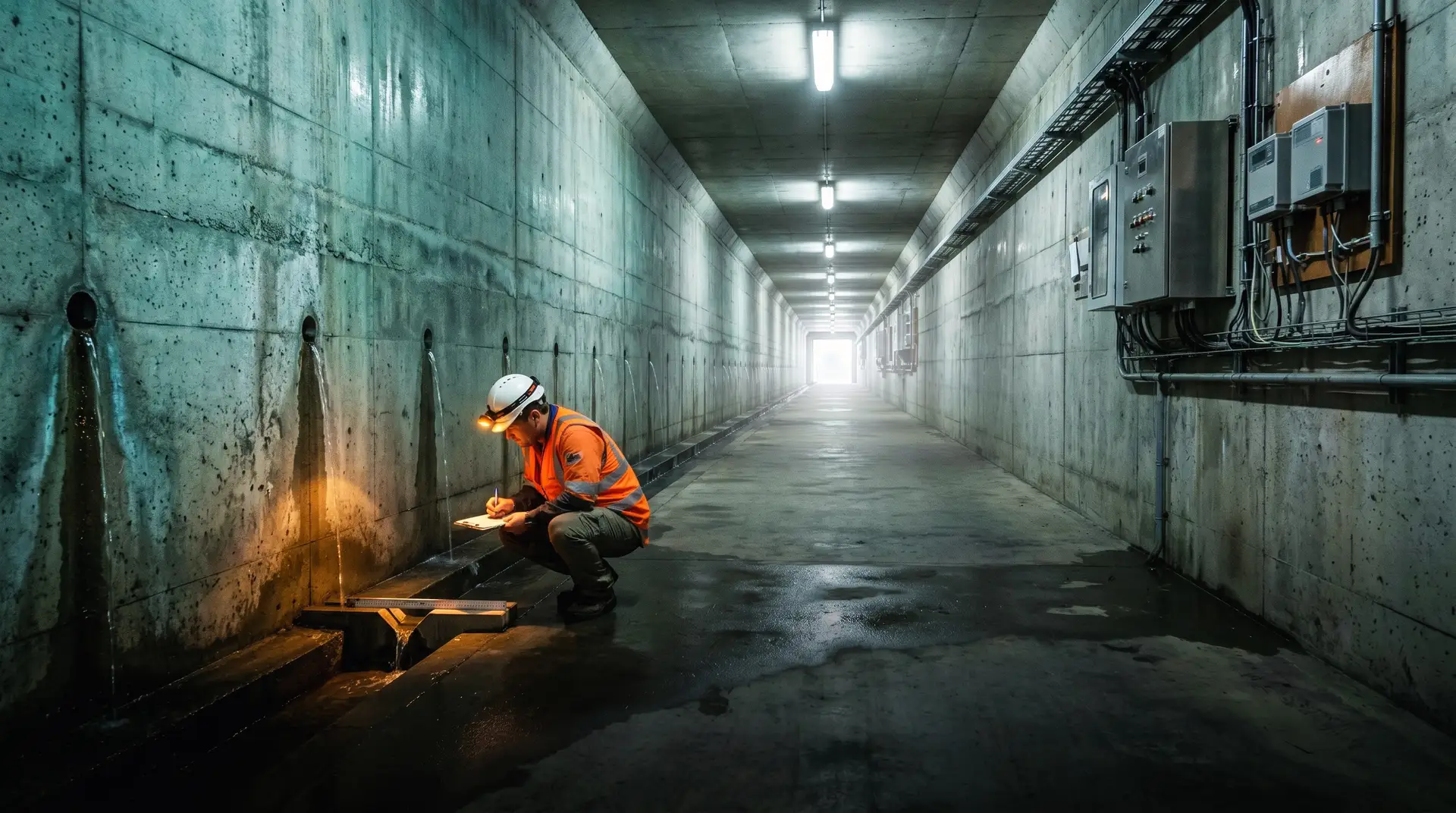
The first time reservoir water appears on the downstream face of a new RCC dam, it generates concern. Sometimes alarm.
It should not. Controlled seepage through an RCC dam is a design expectation, not a failure. For hydropower projects, managing this seepage is a core engineering challenge. The entire impermeability strategy for most RCC dams assumes that the RCC body itself is not watertight. Instead, impermeability is provided by an upstream facing system (conventional concrete, geomembrane, or grout-enriched RCC), and any seepage that passes through is collected by an internal drainage system that controls pore pressures within the dam body.
The problems begin when seepage exceeds the design assumptions. When the upstream facing has defects. When lift joints were not treated to specification. When the drainage system cannot handle the flow. When seepage that was stable for years begins to increase.
Understanding why RCC dams seep, how to control it during design and construction, and what to do when control fails is one of the most critical aspects of RCC dam engineering.
Why RCC Is Not Watertight
The impermeability of concrete depends on two factors: the density of the paste matrix and the continuity of that matrix across the full section. ICOLD Bulletin 126 on RCC dams identifies lift joint permeability as the single most important design consideration for water-tightness.
Conventional mass concrete, with its 200-350 kg/m3 cementitious content, has abundant paste to fill voids between aggregate particles and create a dense, continuous matrix. When properly placed and vibrated, a 1.5-metre CVC lift is essentially impermeable through its section.
RCC is fundamentally different. With 100-150 kg/m3 cementitious content and zero slump, the paste volume is barely sufficient to coat the aggregate particles and fill the inter-particle voids during compaction. The vibratory roller provides the compaction energy, but the thin 300 mm lifts and dry consistency mean that:
- Micro-voids persist at the interfaces between aggregate particles where paste was insufficient to fill completely
- Lift joint interfaces develop a thin zone of higher porosity where the fresh RCC meets the surface of the previous lift
- The number of potential seepage planes is enormous: A 60-metre-high RCC dam has approximately 200 lift joints, each running the full width and upstream-to-downstream depth of the dam
The result: an RCC dam body, taken as a whole without any facing system, has a permeability coefficient typically 10 to 100 times higher than equivalent CVC. The lift joints are the dominant seepage paths.
The Three Lines of Defence
RCC dam impermeability is engineered through a layered system, not through the RCC material itself.
Line 1: Upstream Facing
The upstream facing provides the primary impermeable barrier. Three systems are commonly used:
CVC (Conventional Concrete) Facing A 300-600 mm layer of conventional concrete placed simultaneously with the RCC on the upstream face. The CVC is slip-formed or placed against formwork as the RCC lifts progress.
Advantages:
- Highest reliability (proven technology, well-understood performance)
- Structural contribution (adds to the dam section)
- Durability (100+ year service life)
- No maintenance requirements if properly constructed
Limitations:
- Slows RCC placement (the CVC must be coordinated with each RCC lift)
- The interface between CVC and RCC must bond effectively (a construction quality challenge)
- More expensive than geomembrane
PVC Geomembrane A synthetic membrane (typically 2-3 mm PVC) anchored to the upstream face after the RCC is placed.
Advantages:
- Can be installed after the RCC body is complete (no interference with RCC placement speed)
- Factory-manufactured quality (uniform thickness, no field-mixed variability)
- Effective seepage barrier even over cracked or deteriorated concrete
Limitations:
- Vulnerable to mechanical damage during installation and service
- Limited service life (30-50 years, requiring eventual replacement)
- Poor performance in freeze-thaw environments (ice damage to membrane and anchors)
- Cannot be inspected without reservoir drawdown
GERCC (Grout-Enriched RCC) A zone of RCC enriched with cement-sand grout at the upstream portion of each lift. Grout is spread on the lift surface, and the fresh RCC is placed onto it. The roller compaction mixes the grout into the RCC, creating a paste-rich transition zone with lower permeability.
Advantages:
- Integrated into the RCC placement process (no separate operation)
- Fills the lift joint interface with paste (addresses the primary seepage path)
- No separate facing system to construct
Limitations:
- Quality depends on grout application consistency (a labour-intensive QC challenge)
- Less reliable than CVC facing for high-head dams
- Difficult to verify impermeability until the reservoir fills
Many dams use combinations: CVC facing below the maximum waterline where hydrostatic pressure is highest, and GERCC above the waterline where the pressure is lower.
Line 2: Internal Drainage
Even with a functioning upstream facing, some seepage will enter the dam body through defects in the facing, through the foundation, and through the abutments. The internal drainage system collects this seepage and routes it to measurement points before discharge.
A typical RCC dam drainage system includes:
- Drainage gallery at or near the dam base, running the full length
- Drain holes drilled from the gallery into the dam body and foundation
- Collection channels along the gallery floor
- Weirs for measuring seepage flow rate
- Pumps if gravity drainage is not possible
The drainage system serves two purposes:
- Controls pore pressure within the dam body (critical for stability: high pore pressures reduce the effective weight of the dam, reducing its resistance to sliding)
- Provides monitoring data (seepage flow rate correlated with reservoir level is the primary indicator of dam impermeability performance)
Line 3: RCC Body Quality
While the RCC body is not expected to be watertight, its permeability should be minimised through:
- Proper compaction to full density (density testing at every lift through rigorous QA/QC)
- Lift joint treatment to maximise bond and minimise joint permeability
- Mix design targeting the lowest practical void ratio
- Curing to ensure hydration continues and pore structure refines over time, consistent with durability-first design principles
The higher the base quality of the RCC body, the less stress on the upstream facing and drainage systems.
Seepage Patterns and What They Mean
Normal Seepage
- Distributed across the downstream face as damp patches or thin films
- Flow rate proportional to reservoir level (increases when reservoir is high, decreases when low)
- Stable over time at the same reservoir level
- Clear water with no visible particles
Warning Signs
- Increasing flow at constant reservoir level: indicates deterioration of the facing or internal drainage system
- Concentrated flow at a single point: indicates a localised defect (crack, unbonded joint, or facing failure)
- Turbid water or water carrying particles: indicates internal erosion (the most dangerous condition, as material is being removed from within the dam)
- New seepage locations that were not present during initial filling: indicates progressive deterioration
- Chemical deposits (white calcium carbonate) at seepage exit points: indicates water is dissolving calcium from the concrete (leaching), which gradually increases porosity
Critical Seepage
If seepage water carries visible particles, or if flow rate is accelerating at constant reservoir level, the dam is experiencing internal erosion. This requires:
- Immediate notification to the dam safety authority (SDSO and NDSA) under the Dam Safety Act 2021
- Increased monitoring frequency (hourly instead of daily)
- Assessment by a qualified dam safety engineer or independent reviewer
- Potential reservoir drawdown to reduce driving head
- Emergency grouting or other intervention
Remediation Options
When RCC dam seepage exceeds design limits, root cause analysis and troubleshooting become essential. The options depend on the severity and cause:
Grouting from Upstream
Cement grout or chemical grout injected through holes drilled from the upstream face into the RCC body. The grout fills voids along lift joints and reduces permeability.
Effectiveness: Moderate. Per ACI 207.5R, grouting can reduce seepage by 50-80% but is rarely permanent. The grout itself can deteriorate over time, and new seepage paths may develop adjacent to the grouted zone.
Cost: Rs 5-25 lakh per metre of dam length, depending on the number and depth of holes.
Chemical Grouting for Active Seepage
Polyurethane foam or acrylic gel injected into active seepage paths. These materials can seal joints with flowing water, which cement grout cannot.
Effectiveness: Good for specific, localised seepage paths. Not practical for distributed seepage across many lift joints.
Upstream Membrane Retrofit
Installing a geomembrane on the upstream face of a dam that was originally built without one, or where the original facing has failed.
Effectiveness: High. A new membrane provides a complete impermeable barrier.
Limitation: Requires reservoir drawdown, which may not be feasible for operational dams. Installation on a curved or irregular RCC surface requires careful surface preparation.
Drainage Enhancement
Drilling additional drain holes from the gallery to intercept seepage before it builds pore pressure. This does not reduce total seepage volume but reduces the structural impact.
Effectiveness: Addresses the stability consequence of seepage without addressing the cause.
The Cost Equation
Remediation of seepage in a completed RCC dam typically costs 5-20% of the original upstream facing cost. But the real cost is in the monitoring, investigation, and engineering time required to diagnose the problem and design the solution. Prevention during construction, through proper facing system design and execution, lift joint quality control, and drainage system installation, is always the more economical approach. This is the principle behind “the greenest concrete is the one you don’t have to repair.”
Monitoring: The Long-Term Commitment
Seepage monitoring is not a construction-phase activity. It is a lifetime commitment.
During First Filling
The first reservoir filling is the critical test of the impermeability system. Seepage monitoring should be:
- Continuous (weir readings every 4-8 hours)
- Correlated with reservoir level (plot seepage vs. level in real time)
- Compared with predictions from the design-stage seepage analysis
Any deviation from predicted behaviour during first filling should trigger investigation before the reservoir reaches full supply level.
During Operation
- Daily weir readings in the drainage gallery
- Weekly visual inspection of the downstream face
- Monthly piezometer readings
- Quarterly chemical analysis of seepage water
- Annual comprehensive seepage assessment as part of dam safety review, consistent with USBR dam safety guidelines
The seepage record, maintained over years and decades, is the most valuable performance indicator for an RCC dam. A gradual upward trend in seepage at constant reservoir level signals deterioration long before it becomes visible.
Key Principles
-
Design for seepage, not against it. An RCC dam that leaks within its design assumptions is performing correctly. An RCC dam that leaks beyond its design assumptions has a problem. The design must establish what “acceptable” seepage is, and the construction must deliver it.
-
The upstream facing is the dam’s most important waterproofing element. Its quality and continuity determine everything downstream. Invest the design effort and construction QC in the facing that the dam’s performance demands.
-
The drainage system is the safety net. When the facing underperforms (and all facings develop defects over time), the drainage system prevents pore pressures from reaching dangerous levels. A blocked or inadequate drainage system converts manageable seepage into a stability threat.
-
Monitor forever. Seepage behaviour changes over time. The dam that performs perfectly during first filling may develop problems after 10, 20, or 50 years of service. Only continuous monitoring reveals these changes before they become emergencies.
-
The cheapest seepage control is at the design stage. Every decision about facing type, GERCC extent, drainage capacity, and lift joint treatment protocol determines the seepage behaviour for the next 100 years. Getting it right at the design stage costs a fraction of remediation after the reservoir fills.