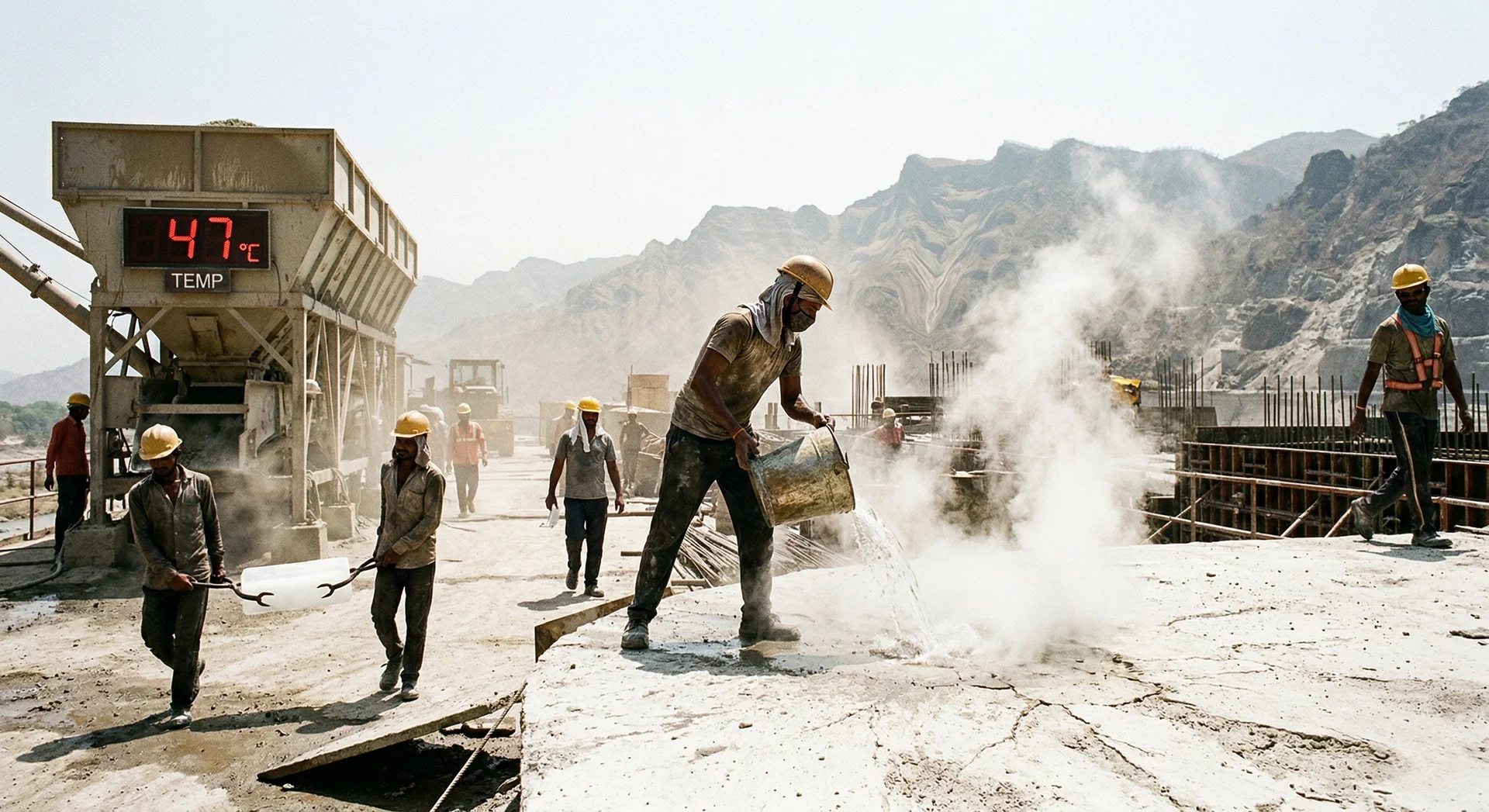
At 2 PM on a May afternoon at a dam site in central India, the ambient temperature reads 44 degrees C. The coarse aggregate stockpile, exposed to direct sunlight, measures 52 degrees C at the surface. The mixing water in the overhead tank is at 38 degrees C.
Without pre-cooling, the concrete leaving the batching plant would be at approximately 40-42 degrees C. The project specification requires a placing temperature not exceeding 25 degrees C. The gap between what the site produces naturally and what the specification demands is 15-17 degrees C. Closing that gap, lift after lift, day after day, for the 4-6 months of Indian summer, is one of the most demanding concrete engineering challenges in dam construction.
International guidelines, ACI 305R and ACI 207 series, were developed primarily from North American and European experience. Indian dam sites in Madhya Pradesh, Maharashtra, Andhra Pradesh, Rajasthan, and the plains of Uttarakhand regularly exceed the temperature ranges these documents were calibrated for.
This is not a niche problem. It is the default operating condition for a large proportion of India’s dam construction industry.
What Hot Weather Does to Mass Concrete
The effects compound. Each one individually is manageable. Together, they can overwhelm a thermal control plan that was designed for moderate conditions.
Accelerated Setting
Every 10 degrees C increase in concrete temperature approximately halves the setting time. A mass concrete mix designed for an initial set of 8 hours at 20 degrees C may set in under 4 hours at 40 degrees C. This directly reduces the placement window: the time available to transport, place, compact, and finish each lift before cold joint formation begins.
For dam construction, where placement intervals are already constrained by thermal control requirements, accelerated setting converts “comfortable” time windows into critical-path operations.
Higher Peak Temperatures
The placing temperature is the starting point for the thermal rise. If the concrete is placed at 25 degrees C and the adiabatic temperature rise from hydration is 30 degrees C, the peak temperature reaches approximately 55 degrees C (depending on boundary conditions and cooling). If the same concrete is placed at 35 degrees C, the peak rises to approximately 65 degrees C.
That 10 degrees C difference in placing temperature produces a 10 degrees C higher peak, which increases the thermal gradient between the interior and the surface, which increases the tensile stress at the surface, which increases the risk of thermal cracking. The thermal control plan and any post-cooling system must be designed for the worst-case placing temperature, not the average.
Rapid Moisture Loss
Low relative humidity combined with high temperature and wind accelerates surface moisture evaporation. When the evaporation rate exceeds the bleed rate (the rate at which water rises to the concrete surface from within), plastic shrinkage cracking occurs. On a dam placement face exposed to direct sun and wind, the evaporation rate can exceed 1.0 kg/m2/hour, well above the 0.5 kg/m2/hour threshold at which plastic shrinkage cracking becomes likely.
Increased Water Demand
Hot concrete requires more water for the same workability because water evaporates during mixing and transport, and higher temperatures accelerate the initial hydration reactions that stiffen the mix. The temptation to add water at the placement face is the most common hot weather quality failure: it increases the water-cementitious ratio, reduces strength, increases permeability, and amplifies drying shrinkage. Every litre of water added at site is a litre of durability lost.
Reduced Long-Term Strength
Concrete that hydrates rapidly at high temperature can develop high early strength but lower ultimate strength compared to the same mix cured at moderate temperature. The rapid early hydration creates a less ordered microstructure with higher porosity. For dam concrete designed on 90-day or 365-day strength (as most mass concrete mixes are), hot weather placement can reduce the long-term strength that the structural design depends on.
Pre-Cooling: The Engineering Response
Pre-cooling concrete ingredients before mixing is the primary strategy for controlling placing temperature. Each component of the mix contributes to the final temperature in proportion to its mass and specific heat.
Mixing Water and Ice
Water has the highest specific heat of any concrete ingredient, making it the most efficient cooling medium per kilogram.
Chilled water: Cooling mixing water from 30 degrees C to 5 degrees C reduces concrete temperature by approximately 3-5 degrees C, depending on the water content of the mix. Chilling plants with capacities of 50,000-200,000 litres per hour are standard on Indian dam projects.
Ice replacement: Replacing 50-75% of the mixing water with flaked or crushed ice provides additional cooling because the phase change from ice to water absorbs 334 kJ/kg (the latent heat of fusion). This is the most thermally efficient cooling method. A mix using 60% ice replacement can reduce concrete temperature by an additional 5-10 degrees C beyond what chilled water alone achieves. Ice flaking plants with capacities of 20-100 tonnes per day are commonly installed at Indian dam sites.
Combined effect: Chilled water + ice replacement can reduce concrete temperature by 8-15 degrees C compared to using ambient-temperature water.
Aggregate Cooling
Coarse aggregate typically constitutes 40-50% of the concrete mass. Because of its large proportion, even moderate aggregate cooling produces significant temperature reduction.
Chilled water sprays: Spraying coarse aggregate stockpiles with chilled water is the most common method on Indian dam sites. Cooling aggregate from 45 degrees C (sun-exposed stockpile) to 20 degrees C can reduce concrete temperature by 8-12 degrees C. The aggregate must drain to saturated surface-dry condition before batching.
Shading: Covering aggregate stockpiles with shade structures reduces solar heat gain by 10-15 degrees C. This is a low-cost supplement to active cooling.
Submerged cooling: Passing aggregate through a chilled water bath is more effective than spraying but requires more infrastructure.
Liquid Nitrogen
For situations requiring very low placing temperatures (below 15 degrees C), liquid nitrogen can be injected directly into the mixer. Each kilogram of liquid nitrogen absorbs approximately 198 kJ as it vaporizes and warms to concrete temperature. Liquid nitrogen is expensive and logistically complex (cryogenic storage, specialised injection equipment) but provides precise temperature control when other methods are insufficient.
On most Indian dam projects, the combination of chilled water, ice, and aggregate cooling is sufficient to achieve the 25 degrees C placing temperature target. Liquid nitrogen is reserved for exceptional requirements.
Placement Strategy for Indian Summers
Night Placement
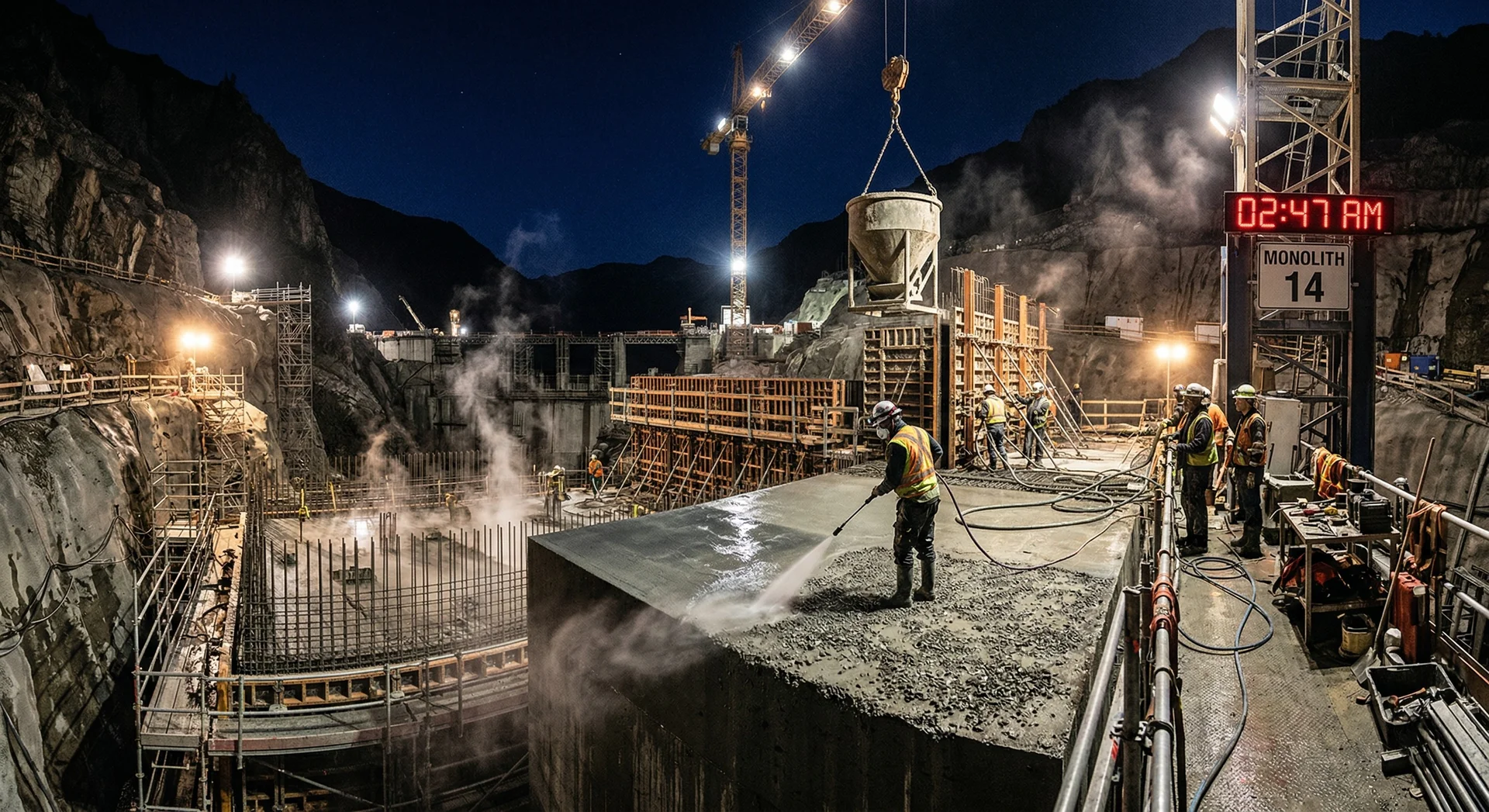
Ambient temperatures between 10 PM and 6 AM are typically 10-15 degrees C lower than peak daytime readings. Night placement reduces the pre-cooling burden significantly: achieving 25 degrees C placing temperature at 2 AM when the ambient is 28 degrees C is far easier than at 2 PM when the ambient is 44 degrees C.
Most Indian dam projects shift to predominantly night placement during April-June. This requires:
- Adequate lighting across the placement face
- Adjusted shift schedules (typically 10 PM to 6 AM primary placement shift)
- Safety protocols for night operations
- Quality control procedures adapted for reduced visibility
Reduced Lift Intervals
In hot weather, the time between lifts must be recalculated based on the actual (faster) setting time. A lift interval that was safe at 20 degrees C may produce cold joints at 40 degrees C. The placement schedule must be recalibrated for summer conditions, typically reducing the maximum allowable interval between lifts by 30-50%.
Retarder Dosage Adjustment
Chemical retarders extend initial setting time, providing a larger placement window. However, retarder performance is temperature-dependent: a dosage designed for 25 degrees C may provide only half the retardation at 40 degrees C. Retarder dosage must be increased in hot weather, with trial mixes conducted at actual site temperatures, not laboratory conditions.
Surface Protection
Exposed concrete surfaces must be protected from direct solar radiation and wind immediately after placement. Curing compounds, fog spraying, wet hessian, or shade covers prevent the rapid moisture loss that causes plastic shrinkage cracking.
Transport Time Minimisation
Every minute of transport time in hot weather adds heat to the concrete. Transit mixer drums absorb solar radiation and conduct ambient heat into the mix. Strategies include:
- Minimising haul distance from batching plant to placement face
- Insulating or painting transit mixer drums with reflective coatings
- Scheduling deliveries so concrete does not sit in drums waiting for placement
- Testing concrete temperature at the point of placement, not at the batching plant discharge
What the Standards Say
ACI 305R: Defines hot weather as any condition that can adversely affect concrete quality, including high ambient temperature, high concrete temperature, low humidity, and wind. Recommends limiting concrete temperature to a maximum specified in the project documents, with 35 degrees C as a common upper limit for general construction (mass concrete limits are lower).
IS 7861 Part 1: Indian Standard for hot weather concreting. Provides general recommendations for placement, curing, and temperature control. Relevant but not sufficient for mass concrete dam construction, where thermal control requirements under IS 14591 are more stringent.
IS 14591: Temperature Control of Mass Concrete for Dams. The governing Indian standard for thermal management in dam construction. Must be read alongside IS 7861 for hot weather conditions.
ACI 207.4R: Cooling and insulating systems for mass concrete. Provides detailed guidance on pre-cooling methods, including quantitative calculations for temperature reduction from each cooling component.
The Economic Case for Pre-Cooling
Pre-cooling infrastructure, including chilling plants, ice plants, aggregate cooling systems, and shade structures, represents a significant capital investment: typically Rs 5-20 crore depending on dam size and production rate.
The return on this investment is measured in what it prevents:
- Thermal cracks requiring epoxy injection or grouting: Rs 10-50 lakh per crack repair programme
- Cold joints from accelerated setting: Rs 25 lakh to crores for grouting and remediation
- Reduced long-term strength requiring structural reassessment: project delay and potential redesign
- Plastic shrinkage cracking on exposed surfaces: surface repair and durability concerns
A single thermal cracking event in a dam gallery or on the upstream face can cost more to repair than the entire pre-cooling installation. The pre-cooling plant pays for itself by preventing the first major defect.
Lessons for Indian Dam Engineers
-
Design for the worst month, not the average year. The thermal control plan must assume peak summer conditions as the baseline, not moderate weather. A plan that works in October will fail in May.
-
Calibrate everything to site temperature. Retarder dosages, setting times, placement intervals, and curing protocols developed at 25 degrees C laboratory conditions must be recalibrated for 40-45 degrees C field conditions. Trial mixes must be conducted at the temperatures you will actually place at.
-
Budget for pre-cooling from the beginning. Pre-cooling is not an optional extra. On any Indian dam project with summer placement, it is a structural requirement. Include it in the project estimate, not as a variation claim.
-
Monitor temperature at the point of placement. The temperature that matters is the concrete temperature when it enters the forms, not when it leaves the batching plant. A 3-5 degrees C rise during transport and waiting time can push a compliant batch out of specification.
-
Integrate hot weather into the QC programme. Additional temperature checks, adjusted retarder dosages, modified curing protocols, and accelerated setting time tests should be standard elements of the summer QC regime, triggered automatically when ambient temperature exceeds a defined threshold.
Indian dam engineers have been managing hot weather concreting for decades. The challenge is not that the problem is unsolvable. It is that every project must solve it from scratch because the institutional documentation of site-specific solutions, pre-cooling performance data, and summer placement protocols is sparse. Every dam site that systematically records and shares its hot weather experience makes the next project easier.