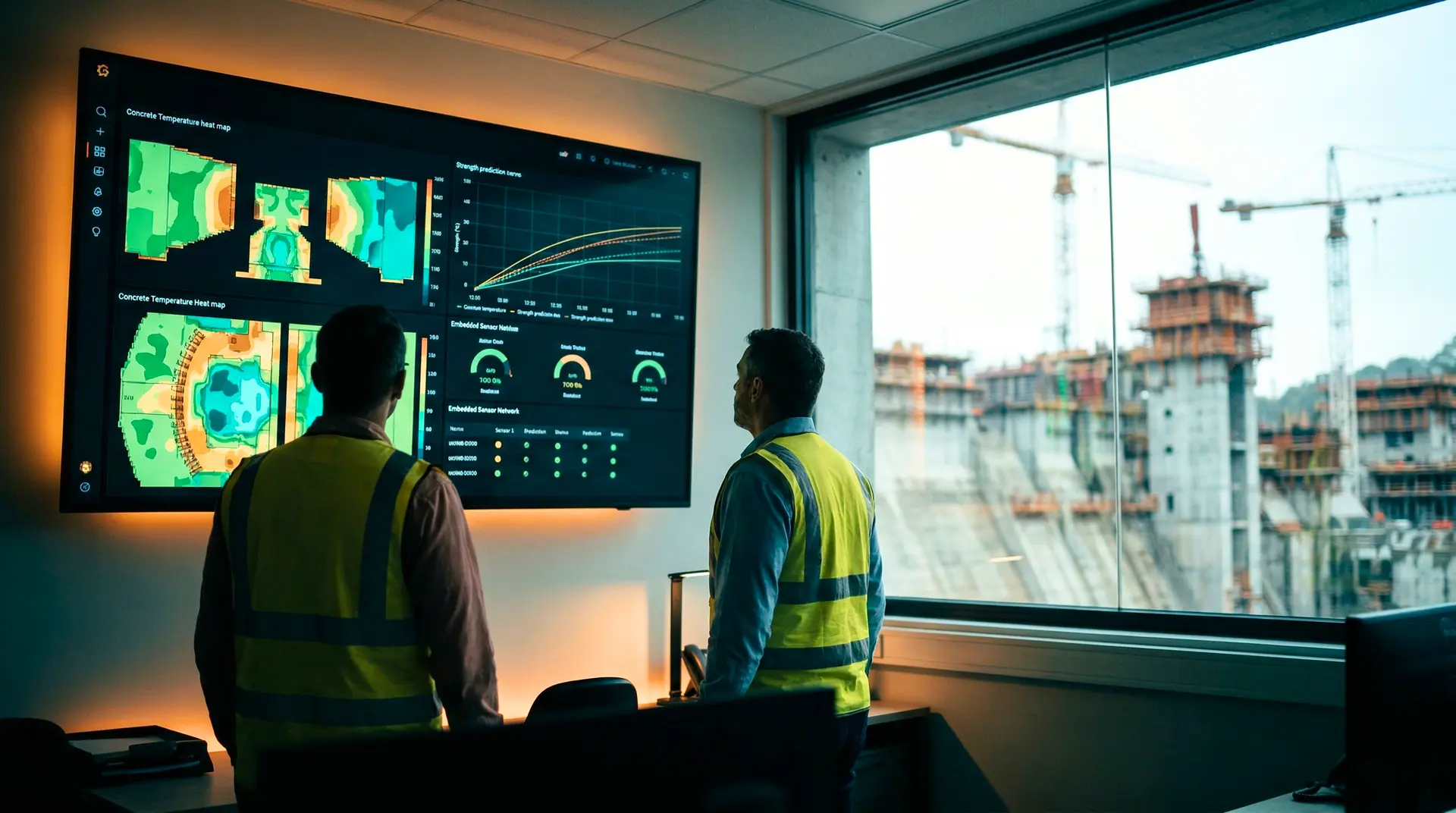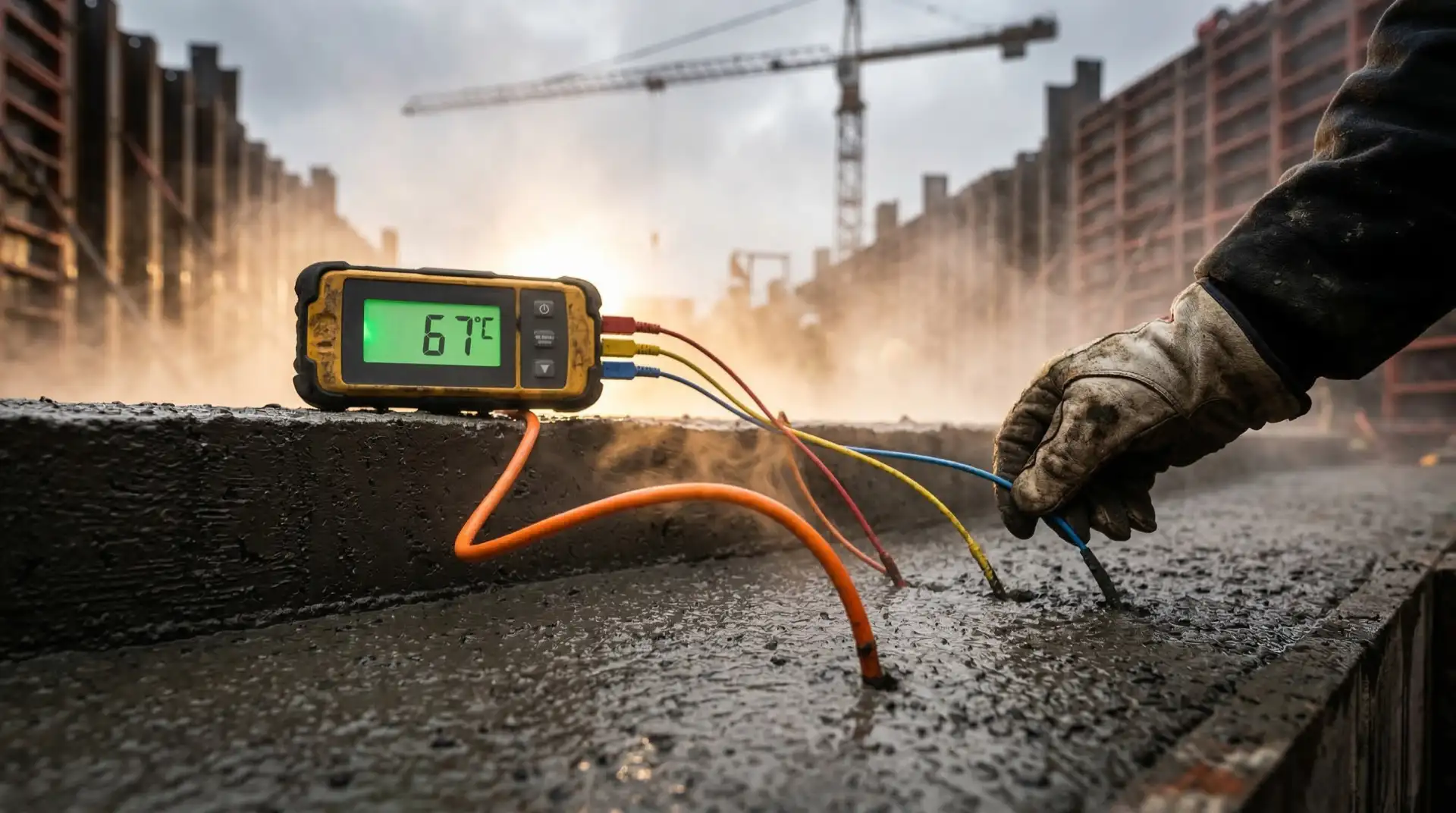
Thermal control in mass concrete dam construction is, at its core, a prediction problem. The engineer must anticipate how heat generated by cement hydration will distribute through a concrete lift, interact with ambient conditions and cooling systems, and create temperature differentials that either stay within safe limits or produce cracks. Traditional thermal control relies on pre-construction finite element modelling to set the thermal control plan, followed by thermocouple monitoring during construction to verify compliance with ACI 207 or IS 457 limits.
The gap between the pre-construction model and the as-built reality is where thermal cracking occurs. Material properties vary between batches. Ambient temperatures deviate from design assumptions. Cooling pipe flow rates fluctuate. Placement schedules shift. Every deviation introduces error into the original thermal prediction, and those errors compound across lifts. By the time a thermocouple registers a temperature exceedance, the opportunity for prevention has passed.
Digital twins close this gap by turning the thermal model from a static design tool into a living, continuously updated prediction system that learns from the concrete it monitors.
What a Digital Twin Actually Does for Thermal Monitoring
A digital twin for dam thermal monitoring integrates three layers:
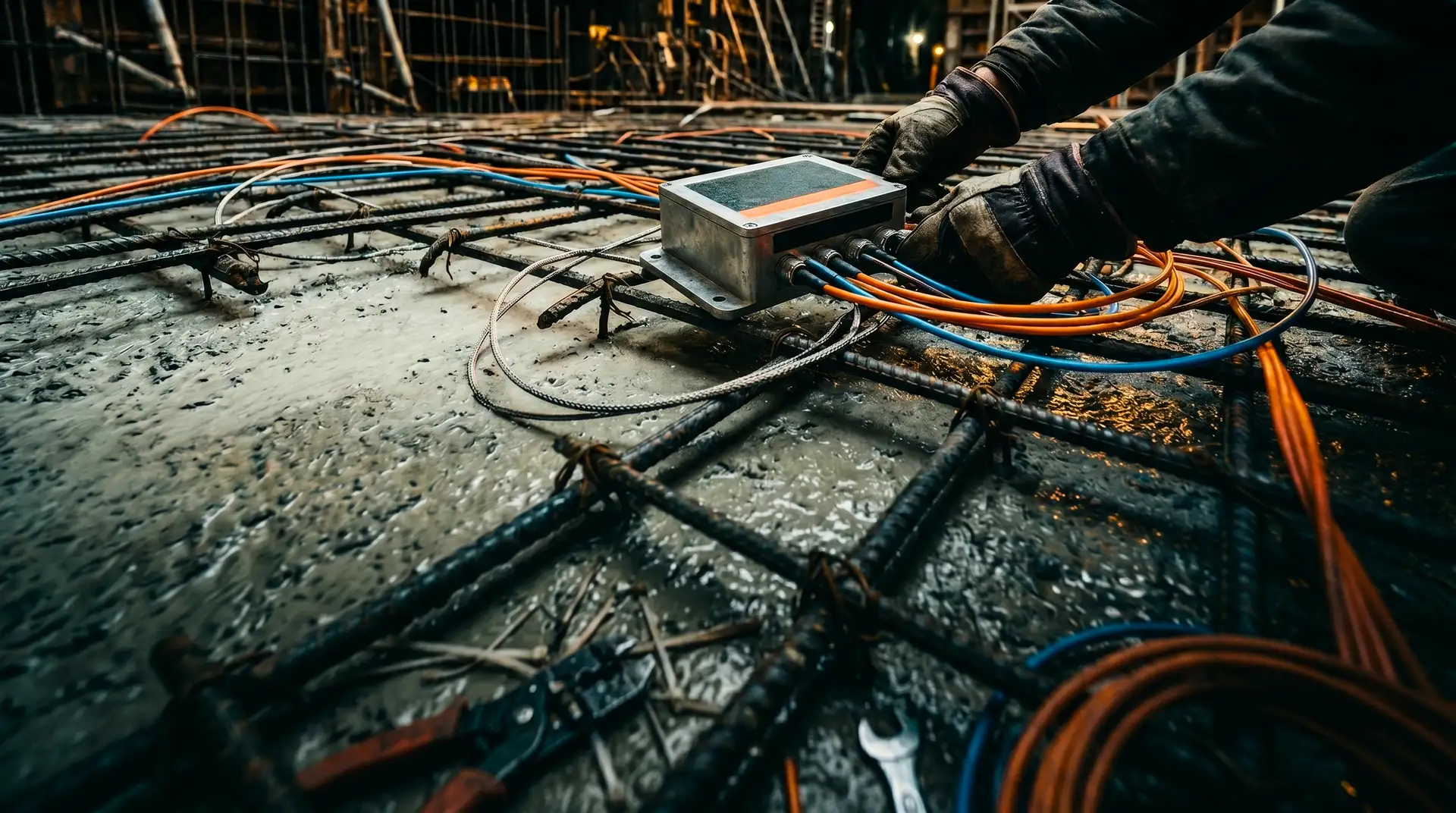
Layer 1: Sensor network. Embedded thermocouples, fiber optic distributed temperature sensors, and ambient weather stations stream real-time data from the concrete and its environment. At Baihetan Dam (16 GW, China), this layer comprised approximately 6,000 thermometers and 80 km of measuring optical fiber embedded throughout pouring blocks.
Layer 2: Physics-based model. A finite element model simulates heat generation (from cement hydration curves), heat transfer (conduction through concrete, convection at surfaces, heat extraction through cooling pipes), and boundary conditions (ambient temperature, solar radiation, formwork insulation). This is the same FEM thermal analysis used at the design stage, but running continuously with updated inputs.
Layer 3: Machine learning correction. An ML algorithm (typically LSTM, ANN, or ensemble methods) learns the systematic differences between the FEM predictions and actual sensor readings. It corrects for material variability, modelling simplifications, and unmeasured influences. Over time, the ML layer improves the digital twin’s forecast accuracy far beyond what the FEM alone achieves.
The output is a 3D temperature field updated in real time, with 24 to 72 hour forecasts, thermal gradient maps across every monitored block, and automated alerts when predicted conditions approach the cracking threshold, typically the 19.4 degrees C (35 degrees F) differential between core and surface specified in ACI 301.
Key distinction from conventional monitoring
Conventional thermocouple monitoring tells you what the temperature IS. A digital twin tells you what the temperature WILL BE in 24 to 72 hours, giving the thermal control team time to act before limits are reached.
Prediction Accuracy: What the Research Shows
The critical question for any engineer considering digital twin adoption is accuracy. Published research from instrumented dam projects provides concrete numbers.
Short-Term Temperature Forecasting
At Baihetan Dam, researchers developed an ANN-based temperature forecast model trained on over 80,000 monitoring samples. The model used two hidden layers to forecast concrete temperature at 1-day intervals, achieving an average RMSE of 0.15 degrees C. This ANN outperformed support vector machines (SVM), LSTM, and decision tree models for this short-term prediction task.
For context, an RMSE of 0.15 degrees C is well within the engineering tolerance for thermal control decisions, where the relevant thresholds are measured in degrees, not tenths of degrees.
Multi-Point Spatiotemporal Prediction
A more sophisticated approach integrates LSTM networks with Kalman filters, using K-means clustering to identify spatially correlated sensor groups and attention mechanisms to weight the most relevant inputs. Compared to standalone LSTM, this integrated approach achieved:
| Metric | Improvement over standalone LSTM |
|---|---|
| R-squared | 11.0% higher |
| RMSE | 47.1% lower |
| MAE | 45.8% lower |
These improvements are significant because standalone LSTM already performs well; the Kalman filter integration accounts for process noise and measurement uncertainty that LSTM alone cannot model.
Adiabatic Temperature Rise Prediction
Predicting the heat generation characteristics of a specific concrete mix is fundamental to thermal modelling. A bidirectional deep recurrent neural network (BD-RNN) achieved R-squared of 0.9245 for adiabatic temperature rise prediction, compared to 0.7616 for standard ANN and 0.8542 for standard RNN. This 21% improvement in R-squared over basic ANN translates directly into more accurate thermal control plans.
FEM-ML Hybrid Performance
The most compelling result for dam engineers comes from hybrid digital twin models that integrate deep transfer learning with FEM. On a 186-metre dam, this approach improved deformation prediction accuracy by 47.1% over traditional inversion-based FEM, with an average error of just 3.17% and simulation accuracy improving by 64.42%.
Sensor Infrastructure Requirements
The digital twin is only as good as its sensor inputs. The instrumentation strategy must balance coverage, resolution, and cost.
Minimum Sensor Placement (ACI 207 Baseline)
ACI 207 and ACI 301 specify minimum requirements for mass concrete temperature monitoring:
- Two sensors at the centroid of the placement
- Two sensors at 50 mm inside the nearest form face
- One ambient temperature sensor per monitored zone
- Maximum concrete temperature shall not exceed 71 degrees C (160 degrees F) during curing
- Maximum temperature differential (center to surface) shall not exceed 19.4 degrees C (35 degrees F)
- Concrete shall not cool more than 11 degrees C (20 degrees F) in 12 hours
These placements are adequate for compliance checking but insufficient for a digital twin, which requires spatial density to validate the FEM interpolation between sensor points.
Enhanced Sensor Options for Digital Twin Deployment
Embedded thermocouples (vibrating wire or resistance type): The proven baseline. Reliable, low-cost (USD 15 to 50 per sensor), long-lived (20+ years in concrete). Limitation: point measurements only, requiring interpolation between sensors.
Fiber optic distributed temperature sensing (DTS): Provides continuous temperature profiles along the entire fiber length. Brillouin-based systems (BOTDR/BOTDA) achieve spatial resolution of approximately 1 metre with temperature accuracy of approximately 0.3 degrees C. Raman-based DTS offers higher temperature resolution but shorter range. At Baihetan, 80 km of optical fiber provided unprecedented spatial coverage that detected thermal gradients between dam galleries that conventional thermocouples missed.
Fiber Bragg gratings (FBGs): Discrete high-accuracy measurements at predetermined locations along a fiber. Useful for monitoring specific critical points (cooling pipe outlets, lift interfaces, gallery surrounds) with multiplexing capability on a single fiber.
Wireless data transmission: LoRaWAN, NB-IoT, or mesh networks enable real-time data streaming from embedded sensors to the digital twin platform. Critical for remote dam sites where wired data collection infrastructure is impractical.
Ambient weather stations: Temperature, humidity, wind speed, and solar radiation data provide the boundary conditions that drive the FEM’s surface heat transfer calculations. Without accurate ambient data, the digital twin’s predictions degrade rapidly.
FEM vs. ML vs. Hybrid: Choosing the Right Approach
The engineering question is not whether to use FEM or ML, but how to combine them.
FEM Alone (Pre-Construction Thermal Analysis)
Strengths: Mechanistic, physics-based, interpretable. Can predict thermal behaviour before any concrete is placed. Essential for thermal control plan development.
Limitations: Requires accurate material properties (often assumed, not measured). Cannot account for as-built variability. Does not self-correct during construction. Computationally expensive for real-time updating.
ML Alone (Data-Driven Prediction)
Strengths: Learns from actual data. Self-corrects as patterns emerge. Computationally lightweight once trained.
Limitations: Cannot predict anything before data exists (useless for the first few lifts). No physical interpretability. May produce physically impossible predictions in extrapolation scenarios. Requires large training datasets (Baihetan used 80,000+ samples).
Hybrid FEM-ML (Digital Twin)
Strengths: Physics backbone prevents impossible predictions. ML layer corrects for model simplifications and material variability. Improves continuously. Research shows 47.1% improvement in prediction accuracy over FEM alone.
Limitations: More complex to implement. Requires both modelling expertise (for the FEM) and data science capability (for the ML). The FEM must be detailed enough to capture the relevant physics, which requires thermal modelling expertise.
For dam projects, the hybrid approach is the clear recommendation. The FEM provides the thermal control plan and the physics backbone; the ML learns from the inevitable deviations between plan and reality.
Deployment Framework for Indian Dam Projects
China’s Ministry of Water Resources launched 94 pioneering digital twin projects for dams and watersheds in 2022, including Three Gorges, Xiaolangdi, and Danjiangkou (which has been in trial operation since September 2023). India’s dam sector is earlier in this trajectory, but the institutional signals are clear.
Current Indian Context
DRIP Phase II (Rs 10,211 crore, 700+ dams under CWC and World Bank funding) includes provisions for automated data collection, processing, analysis, and interpretation. Encardio Rite has deployed structural health monitoring on 70 dams under DRIP, including Mettur, Krishnagiri, Vaigai, and Idukki dams.
NHPC showcased an AI-driven early warning system for dam safety at the AI Impact Summit in February 2026, focusing on operational efficiency and disaster preparedness. This signals institutional willingness to adopt AI-augmented monitoring.
The Dam Safety Act 2021 and CWC Guidelines for Instrumentation of Large Dams mandate temperature monitoring but do not prescribe specific technologies, leaving regulatory room for digital twin adoption.
Practical Implementation Path
Phase 1: Enhanced conventional instrumentation (Month 1 to 3) Deploy thermocouples and fiber optic DTS at higher density than minimum CWC/ACI requirements. Install wireless data loggers for real-time transmission. Set up ambient weather stations. This phase produces immediate value through conventional monitoring while building the data foundation.
Phase 2: FEM calibration (Month 3 to 6) Build and calibrate a finite element thermal model using actual material test data (heat of hydration curves, thermal conductivity, specific heat) and initial placement data. Compare FEM predictions against monitored temperatures. Document systematic deviations.
Phase 3: ML layer integration (Month 6 to 12) Once 3 to 6 months of sensor data have accumulated (several thousand data points per sensor), train ML models (start with ANN or LSTM) to predict the residual between FEM prediction and actual temperature. Validate on held-out data. Deploy as a decision support tool alongside conventional monitoring.
Phase 4: Operational digital twin (Month 12+) Integrate the calibrated FEM-ML hybrid into a real-time dashboard accessible to the QA/QC team, thermal control engineers, and project management. Automate alerts when predicted (not measured) temperatures approach thresholds. Generate automated shift reports with thermal risk assessments.
Standards compliance note
IS 457 and ACI 207 thermal limits remain the compliance benchmarks throughout. The digital twin enhances the ability to meet these limits proactively; it does not replace or modify the acceptance criteria. All thermal exceedances, whether detected by conventional sensors or predicted by the digital twin, must be documented and addressed per the project thermal control plan.
The Standards Gap
Neither ACI, ICOLD, nor BIS has published guidance specifically addressing digital twins for dam thermal monitoring. ACI 207 defines the performance-based temperature difference limit (PBTDL) approach and ACI 207.4R-20 covers cooling and insulating systems, but neither addresses real-time ML-augmented prediction. ICOLD Bulletin 158 covers dam surveillance but predates the digital twin paradigm.
This standards gap has two implications. First, dam engineers implementing digital twins must define project-specific protocols for how predictions are used in decision-making, what constitutes an actionable alert, and how digital twin outputs are documented in QC records. Second, there is an opportunity for early adopters to influence the eventual standards, much as the bridge sector’s FHWA guidance on UHPC was shaped by early practitioners.
For PCCI’s thermal control practice, this gap represents both a consulting opportunity and a technical responsibility. Projects adopting digital twin thermal monitoring need expert guidance on translating ML predictions into engineering decisions that comply with existing code requirements.
Limitations and Honest Assessment
Data dependency. Digital twins require months of sensor data before the ML layer adds meaningful predictive value. For the first lifts of a dam, conventional FEM-based thermal control remains the primary tool.
Sensor reliability. Embedded sensors in mass concrete must survive decades. Fiber optic sensors are more fragile than thermocouples and may suffer damage during concrete placement and compaction. Redundancy in the sensor network is essential.
Expertise requirement. Operating a digital twin requires both concrete thermal engineering expertise and data science capability. Most Indian dam projects currently have neither in-house. This must be addressed through consulting support or training.
Quantified outcomes are scarce. While prediction accuracy metrics (RMSE, R-squared) are well-documented, no published study quantifies the reduction in thermal cracks directly attributable to digital twin deployment. The technology is too new for long-term outcome data.
Cost. A basic digital twin deployment adds an estimated 15 to 25% to conventional instrumentation costs, plus ongoing data management and model maintenance. For mega-projects (1,000+ MW), this is negligible relative to total concrete costs. For smaller projects, the business case is less clear.
Where This Technology Is Heading
The trajectory is clear from the Chinese experience: digital twins will become standard practice for large dam construction within the next decade. The convergence of cheaper sensors (IoT), faster computation (cloud), and better algorithms (deep learning) makes this inevitable.
For Indian hydropower, the question is not whether to adopt digital twin thermal monitoring, but when and at what scale. DRIP Phase II provides the funding mechanism. The Dam Safety Act 2021 provides the regulatory impetus. NHPC’s public commitment to AI-driven safety systems provides the institutional signal.
The practical starting point for any dam project is better instrumentation. Every thermocouple installed today with wireless data logging capability becomes a training input for tomorrow’s digital twin. The cost of instrumenting well is low. The cost of instrumenting poorly, and then trying to build a digital twin on sparse data, is a prediction system that cannot predict.
For thermal control consulting that integrates advanced monitoring and predictive approaches with proven concrete engineering practice, contact PCCI’s thermal control team.