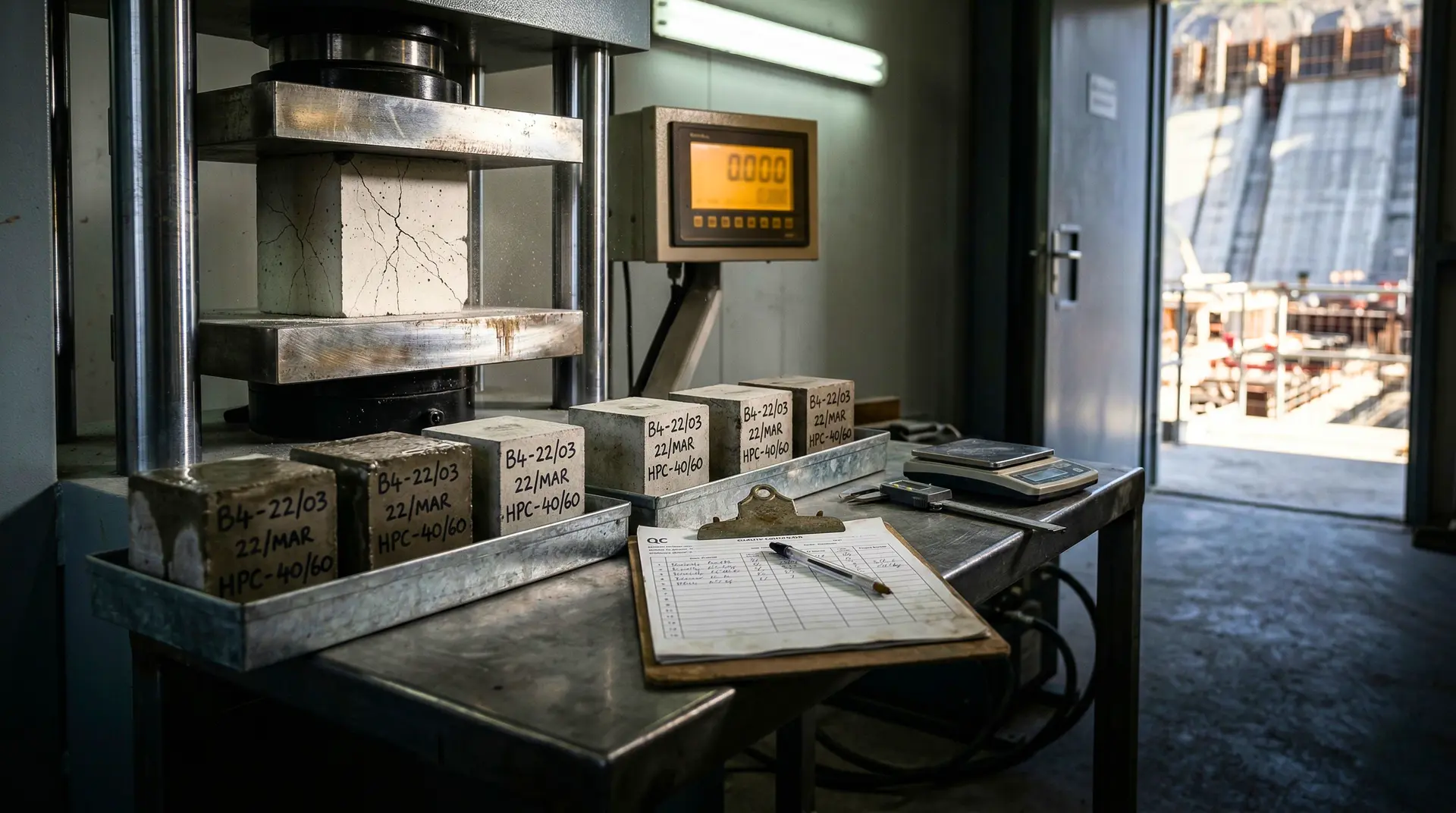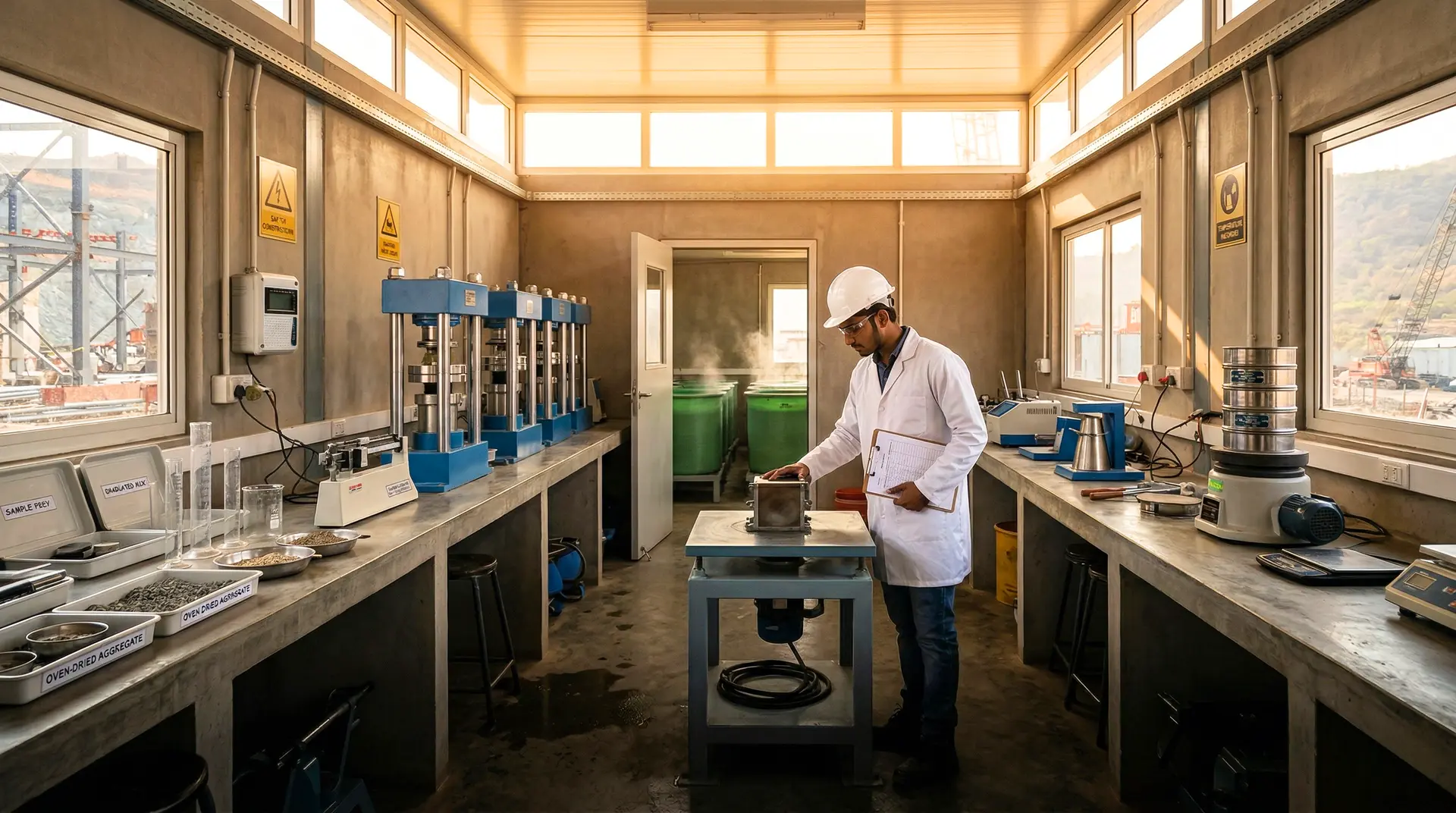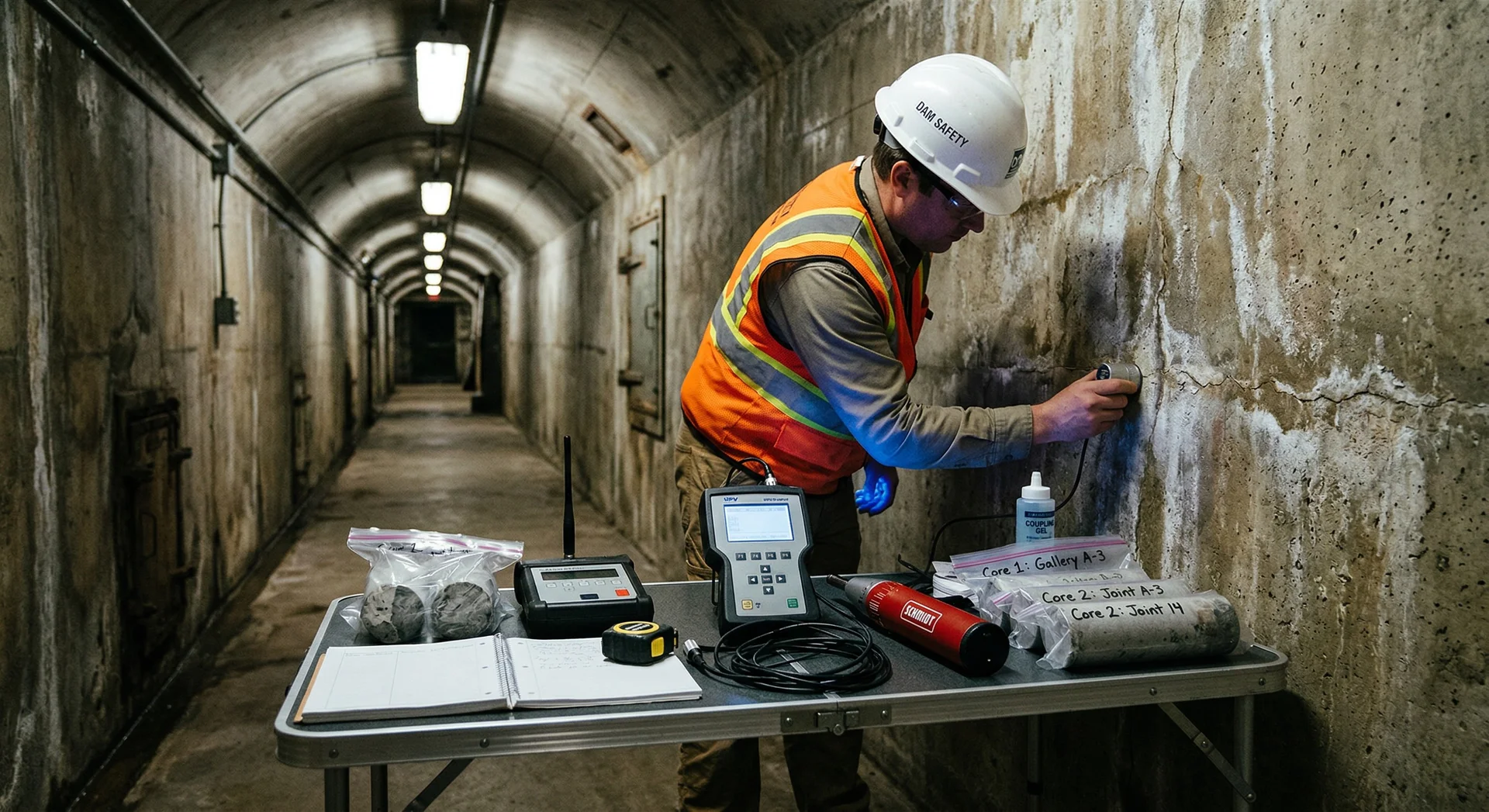
Concrete quality control on dam projects has relied on the same fundamental workflow for decades: design a mix in the lab, test cylinders at 7, 28, and sometimes 90 days, monitor placement temperatures with thermocouples, and inspect surfaces with the human eye. It works. Dams built under this system stand for a century.
But the tools available to execute that workflow are changing faster than at any point in the industry’s history. In March 2026, Meta released BOxCrete, an open-source AI model for concrete mix optimization, under an MIT license. Giatec’s SmartRock sensor platform has been deployed on over 7,500 construction projects across 45 countries, feeding millions of curing data points into machine learning algorithms. Autonomous drones now inspect dam faces in half the time of rope-access teams, while deep learning models detect cracks that human inspectors miss.
For engineers responsible for concrete quality on hydroelectric projects, the question is not whether these tools exist. It is which ones are ready for the dam site, which remain laboratory curiosities, and how to evaluate them without either dismissing genuine progress or falling for marketing hype.
Five Application Areas, Ranked by Readiness
Not all AI applications in concrete are at the same stage of maturity. The following assessment ranks five key areas by their readiness for deployment on hydroelectric dam projects, from most practical to most aspirational.
1. ML-Driven Mix Design Optimization: Ready for the Trial Mix Phase
Machine learning’s clearest near-term value in dam concrete is accelerating the mix design process. Traditional mix design for mass concrete involves testing 15 to 25 trial mixes to optimize across competing objectives: compressive strength at specified ages, workability for the placement method, heat of hydration limits, durability requirements (freeze-thaw, sulphate, AAR resistance), and increasingly, embodied carbon.
ML models can screen hundreds of candidate formulations computationally and identify the most promising combinations for physical testing. This does not eliminate trial mixing. It reduces the number of expensive physical iterations needed to reach an optimal design.
The data supports the approach. CatBoost models have achieved R² = 0.94 and RMSE = 2.7 MPa for compressive strength prediction across general concrete datasets. XGBoost models predict workability with R² = 0.98. For SCM-heavy mixes typical of dam concrete (30 to 50% fly ash, 7 to 10% silica fume), hybrid models combining XGBoost with metaheuristic optimization algorithms have reached R² = 0.995.
Meta’s BOxCrete brings an additional capability: multi-objective optimization that balances mechanical performance against embodied carbon. In a real-world deployment at a data center in Minnesota, the BOxCrete-optimized mix reached full structural strength 43% faster and reduced cracking risk by nearly 10%.
Practical limitation for dam engineers
BOxCrete's training dataset contains 123 mixtures, none of which are mass concrete with the high SCM dosages, large aggregate sizes (75 to 150 mm), or extended evaluation ages (90 to 365 days) used on dam projects. The model architecture is sound, but the training data needs to be supplemented with dam-specific formulations before the predictions are reliable for hydroelectric applications.
2. Computer Vision for Dam Surface Inspection: Production-Ready
This is arguably the most deployment-ready AI application for dam owners today. The combination of UAVs (drones) with deep learning defect detection has moved well past the research phase.
At a hydropower plant in northern Sweden, ScoutDI’s autonomous drone system completed a large-scale concrete dam inspection 50% faster than conventional methods, saving over 40 workdays. The system captured 300,000 location-tagged, high-resolution images and generated consistent 3D photogrammetry models for crack monitoring over time.
The AI component processes these images automatically. Deep learning architectures (YOLO-family object detectors, U-Net segmentation networks, EfficientNet classifiers) identify cracks, spalling, efflorescence, honeycombing, and other surface anomalies with measurable precision:
| Model | Application | Accuracy |
|---|---|---|
| EfficientNetB0 | Borehole crack classification | 91% |
| YOLOv8 + U-Net | Microscopic surface crack detection | Sub-millimetre |
| Custom CNN | Real-time crack/spalling detection (Seattle City Light) | 80M coordinates processed |
For dam operators, the value proposition is straightforward: faster, safer, more consistent, and more repeatable than rope-access visual inspection. The AI creates a quantitative baseline, not a subjective report. When the same drone flies the same path five years later, crack progression is measurable in millimetres, not dependent on whether the same inspector returns.
The limitation is equally clear: surface inspection only. Computer vision cannot assess embedded reinforcement condition, delamination depth, or internal cracking. It complements, rather than replaces, non-destructive testing methods like ultrasonic pulse velocity, impact echo, and ground-penetrating radar.
3. IoT and Real-Time Placement Monitoring: Commercially Available
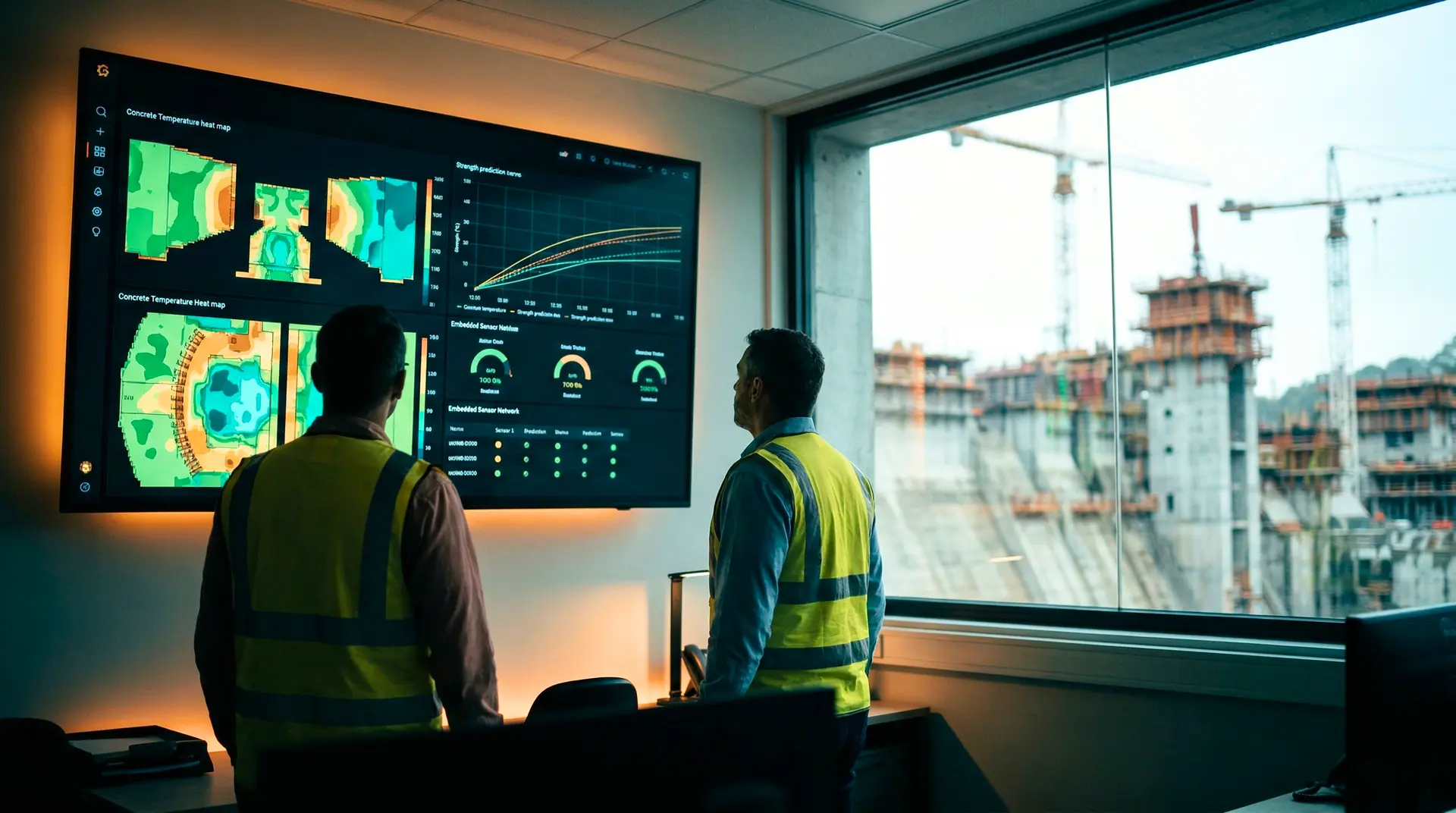
Real-time concrete monitoring using embedded sensors is commercially mature, though adoption on dam projects specifically remains limited. The technology addresses one of the most critical QA/QC challenges in mass concrete: thermal control during curing.
Giatec’s SmartRock wireless sensor, embedded directly into fresh concrete, transmits temperature and maturity data to a mobile app in real time. The platform’s AI algorithm, Roxi, draws on a dataset from over 7,500 projects to predict strength development based on the concrete’s thermal history, following the maturity method principles of ASTM C1074. In its first year, SmartMix (Giatec’s AI-driven mix management platform) helped reduce cement usage by an average of 22 pounds (approximately 10 kg) per mix across participating producers.
For thermal control in mass concrete, the combination of distributed sensors and ML-based prediction creates a powerful capability. Instead of reading thermocouples manually at fixed intervals, the system can predict whether a placement will exceed the allowable temperature differential (typically 19 to 20°C between core and surface) hours before it happens. This provides time to adjust cooling systems or modify the next lift placement schedule.
Fiber-optic distributed temperature sensing (DTS) takes this further. Raman-type distributed fiber-optic sensors offer continuous thermal mapping along the entire length of the fiber, detecting localized phenomena like cooling pipe effects and thermal gradients that point sensors miss.
The deployment challenge for dam sites is practical: remote locations in mountainous terrain often lack reliable cellular connectivity for cloud-based platforms. Edge computing solutions that process data locally are emerging but not yet standard.
4. Strength Prediction and Anomaly Detection: Promising but Unvalidated for Dams
ML models for compressive strength prediction have shown impressive accuracy in research settings. The question for dam engineers is whether these models can be trusted for the concrete types and conditions specific to hydroelectric construction.
The performance numbers are compelling in isolation. Research published in 2024 and 2025 shows:
- CatBoost achieving R² = 0.94 with RMSE = 2.7 MPa
- Ensemble models combining PCA, Random Forest, SVR, and CNN reaching R² = 0.95 with average error of 2.0 MPa
- SHAP analysis confirming that cement content, water content, and water reducer dosage are the dominant predictive features
However, these models are trained on datasets dominated by ordinary Portland cement concrete at standard dosages, tested at 28 days, with maximum aggregate sizes typical of building construction (20 to 25 mm). Dam concrete operates in a different parameter space entirely: high SCM replacement ratios, low cement content, large aggregate sizes, evaluation at 90 or 365 days, and strength requirements that prioritize long-term performance over early-age gain.
No published study has validated an ML strength prediction model against a dam-specific dataset with the rigour that IS 457 or ACI 207 demand for mass concrete design. Until that validation exists, ML predictions should inform engineering judgment, not replace standard acceptance testing.
5. Digital Twins for Dam Lifecycle Management: Early Stage but High Potential
A digital twin for a concrete dam integrates real-time sensor data (strain, temperature, seepage, displacement) with finite element models to create a continuously updated virtual replica of the structure. The AI component processes streaming data to predict behaviour and flag anomalies before they become visible.
The technology is advancing rapidly. A hybrid approach combining LSTM neural networks with Kalman filtering and k-means clustering has improved deformation prediction in concrete dams by 11% (R²) while reducing RMSE and MAE by approximately 45%. ICOLD’s 2024 meeting in New Delhi discussed digital twin integration into dam surveillance frameworks, and China’s Lancang River hydropower cascade has implemented elements of intelligent construction and operation management for RCC dams.
For dam owners, the promise is predictive maintenance: identifying structural concerns through data patterns months or years before they manifest as visible distress. This would fundamentally change the economics of dam safety assessment and rehabilitation planning.
The barriers are significant. Full digital twin implementation requires dense sensor networks installed during construction (retrofitting is expensive and limited), robust numerical models calibrated to the specific dam, continuous data infrastructure at remote sites, and engineers trained in both structural analysis and data science. Most dam operators globally are still in the early stages of digitizing their basic monitoring data, let alone building predictive models on top of it.
What This Means for Hydroelectric Projects in South Asia
The AI adoption landscape in Indian dam construction is notably behind the global frontier. Most projects follow IS/BIS standards with established QA/QC protocols built around manual data collection, paper-based reporting, and periodic physical testing. The Dam Safety Act 2021 creates a regulatory framework that could eventually incorporate digital monitoring requirements, but no specific provisions for AI-based QC currently exist.
This gap is both a challenge and an opportunity. The challenge is infrastructure: remote Himalayan dam sites often lack the connectivity, power supply, and technical workforce needed to deploy IoT-based monitoring at scale. The opportunity is that the next generation of Indian hydroelectric projects, particularly the pumped storage pipeline, can be designed from the outset with embedded sensor infrastructure and data-ready QC systems, rather than retrofitting them later.
Three practical steps make sense now:
- During mix design, use ML screening tools to explore a wider design space before committing to physical trial mixes. This is low-risk, low-cost, and immediately saves time.
- During construction, deploy wireless temperature sensors for real-time thermal monitoring of mass concrete placements. The technology is proven, affordable, and directly reduces the risk of thermal cracking.
- For periodic inspections, commission drone-based photogrammetry with AI defect detection to create quantitative, repeatable condition baselines.
The Principle That Should Guide Adoption
Every technology discussed in this article shares a common characteristic: it augments engineering judgment rather than replacing it. An AI model that predicts a concrete mix will achieve 45 MPa does not eliminate the need to break cylinders. A drone that detects a 0.3 mm crack does not determine whether that crack is structural. A digital twin that flags unusual displacement does not decide whether to draw down the reservoir.
The engineer remains the decision-maker. AI provides better data, faster analysis, and pattern recognition at scales humans cannot match. The firms and project owners that integrate these tools thoughtfully will build better dams. Those that either ignore them or adopt them uncritically will not.
PCCI’s approach is to evaluate each AI application against a straightforward test: does it improve a concrete quality outcome that matters on a hydroelectric project? If the answer is yes, and the tool can be validated against dam-specific conditions, it belongs in the workflow. Our QA/QC consulting practice is built on our founder’s 40+ years of field experience with mass concrete. AI does not replace that experience. It makes it more precise.
For a detailed discussion on how AI-augmented QA/QC systems can be integrated into your next hydroelectric project, contact PCCI’s consulting team.