On a hydroelectric dam project, the site laboratory is not a support function. It is a decision engine. Every batch of concrete placed in the dam body, every aggregate stockpile approved for use, every admixture dosage adjustment, and every formwork stripping decision depends on test results generated in that laboratory.
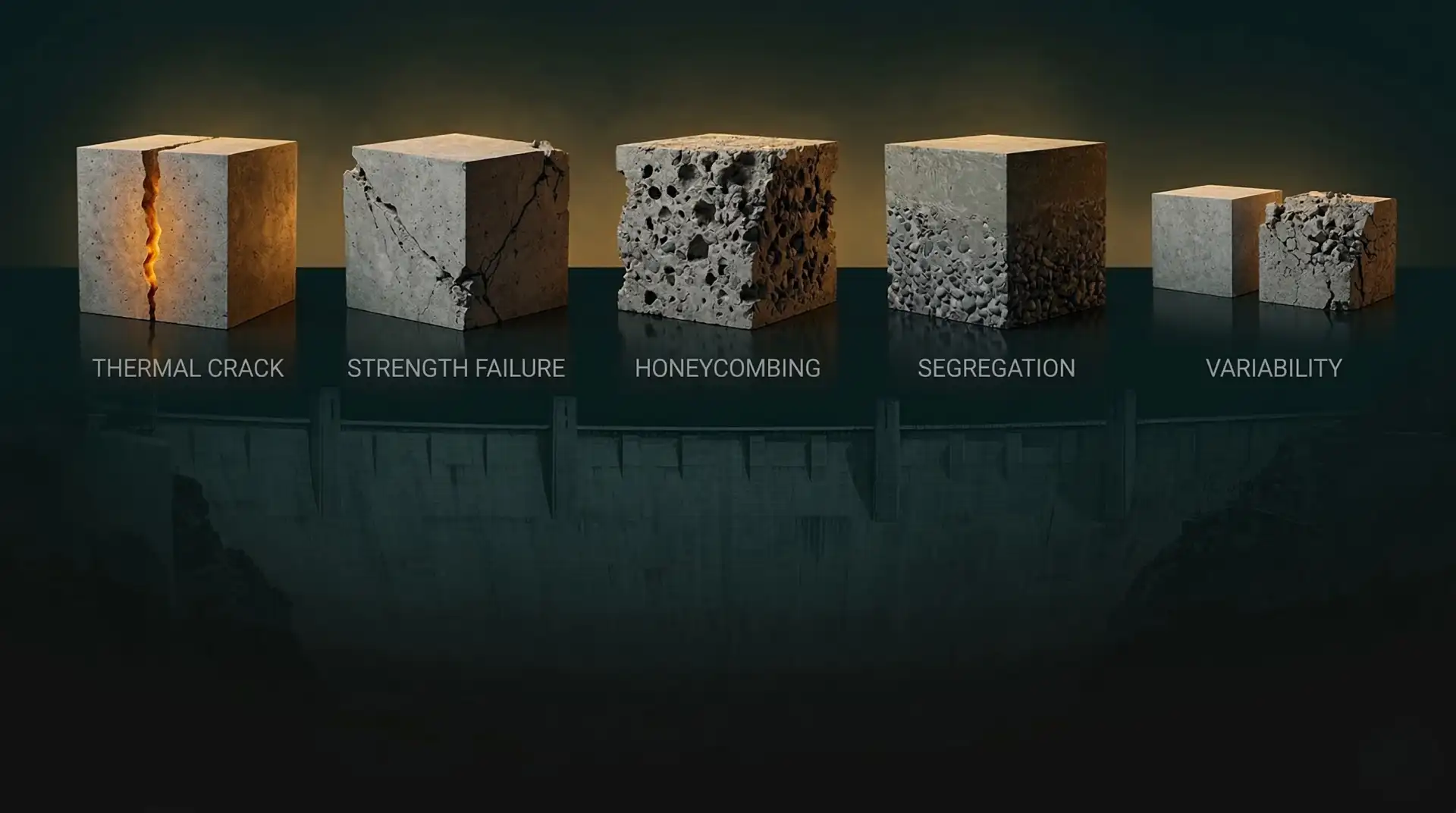
A poorly equipped or understaffed laboratory does not simply produce unreliable data. It produces decisions made in ignorance, approvals given on assumption, and problems discovered months after the concrete has hardened. On a project where a single monolith lift contains 500 to 2,000 cubic metres of concrete that must last 100 years, the cost of laboratory deficiency is measured in crores of rework, years of delay, and decades of maintenance.
This guide covers the complete laboratory setup required for a dam construction site: the equipment, the layout, the testing protocols, the staffing structure, and the calibration systems that separate a credible quality control programme from a paper exercise.
Why Dam Projects Need Dedicated Laboratories
Most building construction projects send specimens to commercial testing laboratories. Dam projects cannot follow this model for several reasons.
Volume and frequency. A dam project placing 300 cubic metres per day generates 30 to 60 cube specimens daily (one set per 50 cubic metres per IS 456:2000 sampling frequency). Commercial labs cannot process this volume with the turnaround time needed for placement decisions.
Multiple mix designs. A typical dam project uses 5 to 15 different concrete mixes: structural concrete for the dam body, mass concrete for the foundation, high-performance concrete for spillway surfaces, shotcrete for tunnel support, grout for foundation treatment, and specialised mixes for underwater placement. Each requires independent testing and approval.
Temperature sensitivity. Mass concrete temperature monitoring is time-critical. Peak temperature occurs 2 to 5 days after placement, and decisions about cooling pipe operation, lift thickness, and placement intervals depend on real-time temperature data that an off-site lab cannot provide.
Remote location. Hydroelectric dam sites are typically in mountainous terrain, hours from the nearest city. Transport of fresh concrete specimens to a distant lab would alter their properties and delay results beyond usefulness.
Laboratory Layout and Zoning
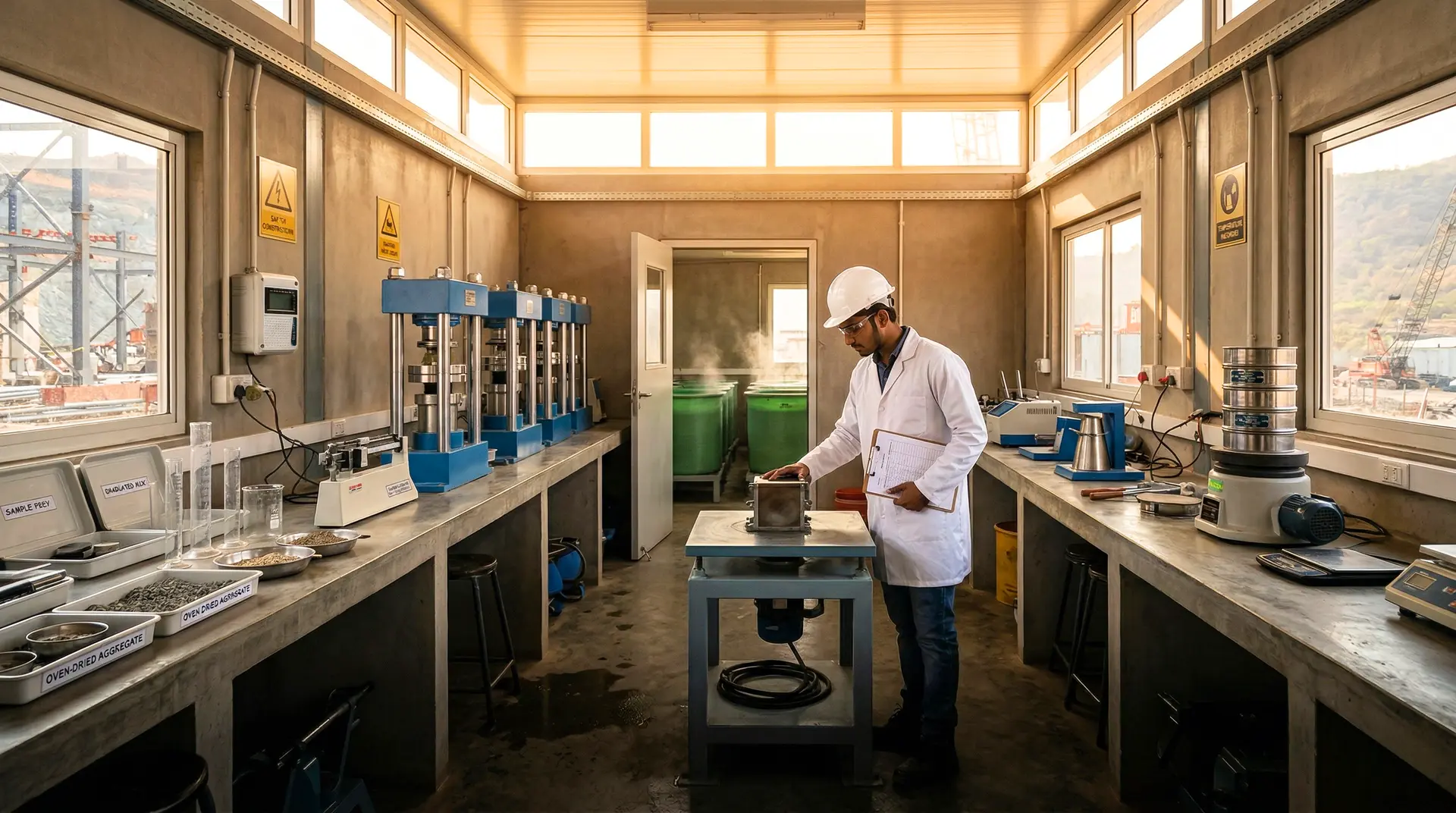
A well-designed site laboratory separates activities by function, contamination risk, and environmental requirements. The standard layout comprises six zones.
Zone 1: Fresh Concrete Testing Area (30-40 sq m)
This area handles all tests performed on concrete before it hardens. It should be located closest to the batching plant or the point where transit mixers arrive, minimising the time between sampling and testing.
Equipment required:
| Equipment | Standard | Purpose |
|---|---|---|
| Slump cone apparatus (set of 3) | IS 1199 / ASTM C143 | Workability measurement |
| Air content meter (pressure type) | IS 1199 Part 6 / ASTM C231 | Entrained air measurement |
| Unit weight container (7 litre and 15 litre) | IS 1199 / ASTM C138 | Fresh density determination |
| Concrete thermometer (digital, range -10 to 80°C) | IS 1199 | Placement temperature |
| Cube moulds (150 mm, minimum 60 nos.) | IS 516 | Specimen preparation |
| Cylinder moulds (150 x 300 mm, minimum 30 nos.) | ASTM C31 | Specimen preparation |
| Vibrating table (440 x 440 mm platform) | IS 516 | Specimen compaction |
| Tamping rods (16 mm dia, 600 mm length) | IS 516 | Manual compaction |
| Weighing balance (100 kg capacity, 10 g accuracy) | IS 1199 | Batch weight verification |
Zone 2: Hardened Concrete Testing Area (40-50 sq m)
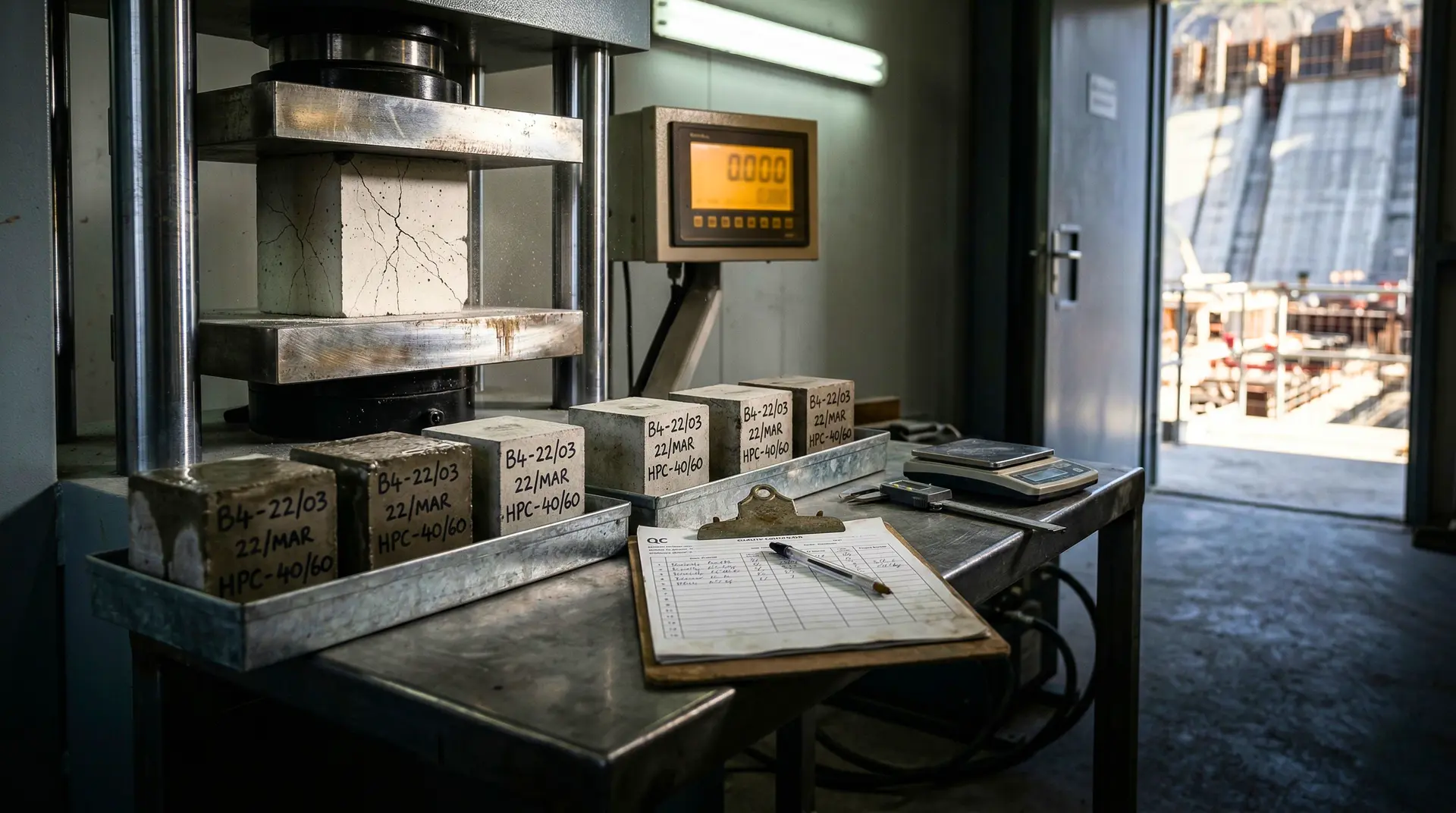
This is the core testing zone where cube and cylinder specimens are tested for compressive strength, the primary acceptance parameter for dam concrete.
Equipment required:
| Equipment | Capacity/Specification | Standard |
|---|---|---|
| Compression testing machine (CTM) | 2,000 kN (primary) | IS 14858 |
| Compression testing machine (CTM) | 3,000 kN (backup/high-strength) | IS 14858 |
| Flexure testing machine | 100 kN | IS 516 Part 1 Sec 1 |
| Core drilling machine | 50-150 mm diameter | IS 516 Part 5 |
| Core capping equipment | Sulphur or neoprene | IS 516 |
| Ultrasonic pulse velocity tester | 54 kHz transducers | IS 13311 |
| Rebound hammer (Schmidt type) | N-type | IS 13311 Part 2 |
| Vernier calipers (300 mm) | 0.02 mm accuracy | IS 516 |
| Specimen grinding/capping machine | 150 mm capacity | IS 516 |
The compression testing machines must be placed on a vibration-isolated foundation, typically a reinforced concrete pad of 1.5 x 1.5 x 1.0 metres, separated from the building floor by an isolation joint. Vibration from nearby construction activities can affect test accuracy.
Zone 3: Aggregate Testing Area (30-40 sq m)
Aggregate quality directly controls concrete performance. On dam projects, aggregates are typically crushed on site from quarry rock, and their properties can vary significantly as the quarry face advances.
Equipment required:
| Equipment | Standard | Purpose |
|---|---|---|
| Sieve shaker (mechanical, 300 mm dia) | IS 2386 Part 1 | Particle size distribution |
| Sieve set (75 micron to 80 mm) | IS 460 | Grading analysis |
| Los Angeles abrasion machine | IS 2386 Part 4 | Aggregate hardness |
| Aggregate impact value apparatus | IS 2386 Part 4 | Impact resistance |
| Aggregate crushing value apparatus | IS 2386 Part 4 | Crushing resistance |
| Specific gravity and absorption apparatus | IS 2386 Part 3 | Density and porosity |
| Flakiness and elongation gauge | IS 2386 Part 1 | Shape assessment |
| Sand equivalent apparatus | ASTM D2419 | Fine aggregate cleanliness |
| Drying oven (200 litre, 250°C capacity) | IS 2386 | Moisture content |
| Weighing balance (30 kg, 0.1 g accuracy) | IS 2386 | Mass measurement |
Zone 4: Cement and Admixture Testing Area (20-25 sq m)
On dam sites, cement arrives in bulk quantities and may be stored for extended periods. Regular testing verifies that the delivered cement matches the specification and that storage has not degraded its properties.
Equipment required:
| Equipment | Standard | Purpose |
|---|---|---|
| Vicat apparatus | IS 4031 Part 4/5 | Setting time |
| Le Chatelier apparatus | IS 4031 Part 3 | Soundness |
| Blaine air permeability apparatus | IS 4031 Part 2 | Fineness |
| Mortar cube moulds (70.6 mm) | IS 4031 Part 6 | Cement strength |
| Mortar mixer | IS 4031 | Specimen preparation |
| Chemical analysis equipment | IS 4032 | Composition verification |
| Admixture compatibility testing setup | IS 9103 | Admixture performance |
| Marsh cone | ASTM C939 | Grout fluidity |
Zone 5: Curing Room (20-30 sq m)
The curing room is the most environmentally controlled space in the laboratory. It must maintain conditions specified in IS 516: temperature of 27 plus or minus 2 degrees Celsius and relative humidity exceeding 95 percent.
Requirements:
- Insulated walls and ceiling (50 mm minimum insulation)
- Temperature-controlled water supply or misting system
- Continuous temperature and humidity recording (digital data logger)
- Shelving system capable of supporting 500 to 1,000 specimens
- Drainage system to handle water runoff
- Access control to prevent unauthorised handling of specimens
- Backup power supply to maintain conditions during power outages
On dam sites in tropical climates, maintaining 27 degrees Celsius requires active cooling. In cold climates (Himalayan projects), heating is needed during winter months. The curing room is not a luxury; it is a testing requirement. Specimens cured at incorrect temperatures produce misleading strength data.
Zone 6: Records Office and Data Management (15-20 sq m)
Every test result must be recorded, traceable, and retrievable. The records office manages:
- Test registers (fresh concrete, hardened concrete, aggregates, cement)
- Calibration certificates and schedules
- Mix design records and trial mix data
- Non-conformance reports (NCRs)
- Daily testing summaries
- Monthly quality reports
- Specimen identification logs with placement location tracking
Modern practice requires digital data management. Spreadsheet-based systems are the minimum; database systems with automatic chart generation are preferred for projects exceeding 100,000 cubic metres.
Testing Protocols for Dam Concrete
Sampling Frequency
The sampling frequency for dam concrete must account for the large volumes placed and the critical nature of the structure. IS 456:2000 specifies minimum frequencies, but dam projects typically adopt enhanced frequencies.
| Test | IS 456 Minimum | Recommended Dam Practice |
|---|---|---|
| Compressive strength (cubes) | 1 sample per 50 m³ | 1 sample per 25-50 m³ per mix |
| Slump | Each batch | Each batch |
| Air content | Each batch (if air-entrained) | Each batch |
| Concrete temperature | Not specified | Each batch |
| Aggregate grading | Weekly | Daily per stockpile |
| Aggregate moisture | Not specified | Every 4 hours during placement |
| Cement fineness | Per consignment | Per consignment + monthly |
A “sample” typically comprises a set of 6 cubes: 3 tested at 7 days and 3 tested at 28 days. For mass concrete, additional cubes are cast for 90-day and sometimes 180-day testing, because mass concrete mixes with high supplementary cementitious material (SCM) content develop strength slowly. This approach aligns with ACI 207.1R recommendations for mass concrete.
Compression Testing Protocol per IS 516
The compression test is the most frequently performed test in the laboratory and must follow IS 516 precisely:
-
Specimen measurement. Measure each dimension to the nearest 0.2 mm using vernier calipers. Calculate the cross-sectional area. Reject specimens with dimensional tolerances exceeding the standard limits.
-
Surface preparation. Ensure bearing surfaces are flat, parallel, and free from surface irregularities. If capping is required, use sulphur compound or high-strength gypsum applied in a thin, uniform layer.
-
Positioning. Centre the specimen on the lower platen of the CTM. The cast face should be perpendicular to the loading direction (i.e., the specimen is tested on its side relative to how it was cast).
-
Loading rate. Apply load continuously at a rate of 14 N/mm² per minute (for 150 mm cubes, this corresponds to approximately 315 kN per minute). Do not adjust the loading rate during the test.
-
Recording. Record the maximum load at failure and note the failure pattern. Calculate compressive strength as load divided by cross-sectional area.
-
Reporting. Report results to the nearest 0.5 MPa. Individual results, mean values, and standard deviations must all be recorded and tracked.
Temperature Monitoring Protocol
For mass concrete in dams, temperature monitoring is as important as strength testing. The protocol involves:
- Embedded thermocouples. Install at the centre and at multiple depths within each lift. Type T (copper-constantan) thermocouples are standard for concrete temperature measurement.
- Reading frequency. Every 4 hours for the first 7 days, then every 12 hours until temperature stabilises.
- Peak temperature tracking. Record the time and magnitude of peak temperature. Compare against the predicted value from the thermal model.
- Differential monitoring. Track the temperature difference between the interior and the surface. ACI 207.2R recommends limiting this differential to 20 degrees Celsius to prevent thermal cracking.
Aggregate Testing Schedule
Aggregate properties change as the quarry face advances. A robust testing schedule catches these changes before they affect concrete quality.
| Test | Frequency | Action Threshold |
|---|---|---|
| Grading (sieve analysis) | Daily | Deviation beyond IS 383 limits |
| Moisture content | Every 4 hours during placement | Greater than 1% change from reference |
| Flakiness + elongation index | Weekly | Greater than 25% combined |
| Specific gravity | Monthly or per new quarry face | Greater than 2% deviation from design value |
| Los Angeles abrasion | Monthly or per new quarry face | Greater than 30% for dam concrete |
| Alkali reactivity (mortar bar) | Per new quarry source | Any expansion above 0.1% at 14 days |
| Petrographic examination | Per new quarry source | Presence of reactive minerals |
Alkali-aggregate reactivity testing is particularly critical for dam projects. Dams are permanently wet, large, and difficult to repair. ASTM C1260 (accelerated mortar bar test) and ASTM C1293 (concrete prism test) provide different timeframes for assessment. Both should be performed when qualifying a new aggregate source.
Staffing Structure
The laboratory staff structure for a dam project must provide continuous coverage during placement operations, which often run 16 to 24 hours per day.
Recommended Structure (200-500 m³/day placement rate)
Lab In-Charge (1 person)
- Qualification: B.E./B.Tech Civil with 5+ years concrete testing experience
- Responsibilities: overall quality assurance, mix design validation, NCR management, liaison with client’s quality team, calibration oversight, reporting
Senior Technicians (2-3 persons)
- Qualification: Diploma in Civil Engineering with 3+ years lab experience
- Responsibilities: compression testing, aggregate testing, cement testing, mix proportioning calculations, mentoring junior staff
Field Testing Technicians (4-6 persons, working in shifts)
- Qualification: ITI/Diploma with concrete testing certification
- Responsibilities: sampling at placement point, slump testing, temperature measurement, air content testing, cube casting, specimen transport to curing room
Data Entry and Records Personnel (1-2 persons)
- Qualification: Graduate with computer proficiency
- Responsibilities: data entry, register maintenance, report generation, calibration schedule tracking, specimen inventory management
Helper/Attendant (2-3 persons)
- Responsibilities: cleaning, specimen handling, curing room maintenance, equipment maintenance support
Shift Coverage
| Shift | Hours | Minimum Staffing |
|---|---|---|
| Day shift | 06:00 to 14:00 | 1 senior tech + 2 field techs + 1 data entry |
| Evening shift | 14:00 to 22:00 | 1 senior tech + 2 field techs |
| Night shift (if placement continues) | 22:00 to 06:00 | 1 senior tech + 2 field techs |
| Lab In-Charge | 08:00 to 17:00 | Present daily, on-call 24 hours |
Calibration and Accreditation
Calibration Schedule
Equipment calibration is not optional. Uncalibrated equipment produces legally indefensible test results and can lead to acceptance of non-conforming concrete or rejection of conforming concrete. Both outcomes are costly.
| Equipment | Calibration Frequency | Calibrating Authority |
|---|---|---|
| Compression testing machine | Every 6 months | NABL-accredited lab |
| Flexure testing machine | Every 12 months | NABL-accredited lab |
| Weighing balances (all) | Every 6 months + daily verification | NABL-accredited lab |
| Thermometers and thermocouples | Every 6 months | NABL-accredited lab |
| Sieves | Every 3 months (verification) | Against reference sieves |
| Pressure gauges (air meter) | Every 12 months | NABL-accredited lab |
| Drying ovens | Every 12 months | NABL-accredited lab |
NABL Accreditation
For dam projects under government contracts, the site laboratory should seek accreditation from the National Accreditation Board for Testing and Calibration Laboratories (NABL). While not always mandatory, NABL accreditation provides:
- Third-party validation of testing competence
- Documented quality management system
- Traceability of all measurements to national standards
- Credibility of test results in dispute resolution
- Compliance with Central Water Commission (CWC) requirements for dam safety
Internal Quality Checks
Beyond calibration, the laboratory must conduct internal quality checks:
- Proficiency testing. Send split specimens to an independent laboratory quarterly. Compare results; investigate if differences exceed 10%.
- Control charts. Plot running averages and standard deviations of test results. Deviations from established patterns trigger investigation before they become problems.
- Technician competency. Conduct periodic inter-operator testing where multiple technicians test specimens from the same batch. Results should agree within the repeatability limits specified in IS 516.
Common Laboratory Deficiencies on Dam Sites
Experience across multiple dam projects reveals recurring deficiencies that compromise quality control effectiveness.
Inadequate Curing Conditions
The most common deficiency. Curing rooms that are too hot (in summer, uncontrolled rooms can exceed 40 degrees Celsius), too cold (Himalayan sites in winter), or too dry produce specimens whose strength does not represent the concrete in the structure. The result is either false alarms (apparent low strength triggering unnecessary investigation) or false assurance (apparent adequate strength masking actual deficiencies).
Solution. Invest in proper insulation, temperature control, and continuous monitoring. The cost of a well-built curing room is a fraction of a percent of total project cost.
Insufficient Moulds
During peak placement periods, a dam project can generate 60 to 100 specimens per day. If the laboratory has only 30 moulds, specimens must be demoulded before the recommended 24-hour period, potentially damaging them, or testing is curtailed.
Solution. Procure moulds based on peak placement rate, not average rate. Allow for 7, 28, and 90-day specimens to accumulate. A general rule: maintain at least 5 days’ worth of mould capacity.
Single Compression Testing Machine
If the CTM breaks down or is sent for calibration, all testing stops. On a dam project, this can halt placement decisions.
Solution. Always have two CTMs. One serves as the primary testing machine; the second provides redundancy and handles the backup testing load during calibration periods.
Poor Record Keeping
Test results recorded in loose notebooks, unlinked to specific placement locations, are nearly useless for quality assessment or dispute resolution. Records that cannot demonstrate where in the dam a particular batch of concrete was placed provide no basis for structural evaluation.
Solution. Implement a specimen tracking system that links every set of cubes to a specific pour card, placement location (monolith, lift, zone), concrete grade, batch plant record, and delivery vehicle. Digital systems with barcode or QR code tracking are increasingly standard on large projects.
Delayed Testing
Specimens tested significantly late (e.g., a 28-day cube tested at 35 days) produce results that are not directly comparable to the design strength. While concrete continues to gain strength beyond 28 days, the acceptance criteria are calibrated to specific testing ages.
Solution. Maintain a testing schedule board that shows every specimen, its casting date, and its scheduled test date. Assign testing as a morning priority, not an end-of-day afterthought.
Special Testing for Dam Concrete
Beyond the standard fresh and hardened concrete tests, dam projects require specialised testing that may not be part of a commercial laboratory’s routine capability.
Adiabatic Temperature Rise
Measures the heat generated by cement hydration under insulated (adiabatic) conditions. The data feeds into thermal models that predict temperature rise in mass concrete placements. Testing follows IS 14591 or the semi-adiabatic method adapted from USBR procedures.
Permeability Testing
Dam concrete must resist water penetration under sustained hydraulic head. IS 3085 specifies the water permeability test for concrete, and results are reported as the coefficient of permeability. For dam concrete, the target is typically below 1 x 10⁻¹² m/s.
Drying Shrinkage
Mass concrete mixes with high fly ash or slag content may exhibit different shrinkage characteristics than OPC concrete. IS 1199 Part 4 provides the test method. Results inform joint spacing and crack control strategies.
Thermal Diffusivity and Specific Heat
These thermal properties, measured on hardened concrete specimens, are inputs to the finite element thermal analysis used to predict temperature distributions within large concrete placements. ASTM C1113 provides the test method for thermal conductivity, from which diffusivity is calculated.
Creep Testing
Long-term creep data is needed for structural analysis of arch dams and for predicting stress redistribution in mass concrete. ASTM C512 defines the standard test, which requires loading frames maintained for 180 days to one year or more.
Laboratory Setup Budget Considerations
The total laboratory setup cost for a dam project depends on the project size and the range of testing required.
| Item Category | Approximate Cost Range (INR) |
|---|---|
| Compression testing machines (2 nos.) | 15-30 lakh |
| Aggregate testing equipment (complete set) | 8-15 lakh |
| Cement testing equipment | 5-10 lakh |
| Fresh concrete testing equipment | 3-6 lakh |
| NDT equipment (UPV + rebound hammer) | 4-8 lakh |
| Curing room construction and equipment | 5-12 lakh |
| Laboratory building (prefabricated, 200 sq m) | 20-40 lakh |
| Furniture, shelving, and utilities | 5-10 lakh |
| Calibration (first year) | 3-5 lakh |
| Total estimated range | 68-136 lakh |
This cost represents roughly 0.1 to 0.3 percent of total dam construction cost, a negligible investment relative to the value of the quality assurance it provides. A single rejected monolith lift, requiring removal and re-placement of 1,000 cubic metres of concrete, costs more than the entire laboratory setup.
Integration with Project Quality Systems
The site laboratory does not operate in isolation. It is part of a larger quality management system that includes:
- Batching plant controls. The laboratory validates what the batching plant produces. Automated batch records from the plant should be cross-referenced with laboratory test results.
- Pour planning. Laboratory results inform pour readiness decisions. If 28-day strengths trend downward, mix adjustments must be implemented before further placement.
- Third-party verification. The dam owner’s quality team or an independent consultant conducts parallel testing and audits laboratory practices. The site laboratory must accommodate this by providing split specimens and access to facilities.
- Regulatory compliance. For dams under the Dam Safety Act, 2021, the State Dam Safety Organisation may require specific testing programmes and reporting formats.
Conclusion
A site laboratory for dam construction is an engineering investment, not an administrative overhead. Its design, equipping, staffing, and operation require the same rigour applied to the dam itself. The tests performed in the laboratory are the evidence base upon which 100-year design life claims rest.
The key principles for an effective dam site laboratory are straightforward: equip it fully before the first pour, staff it with competent professionals, calibrate everything on schedule, record everything digitally with placement traceability, and treat every test result as a decision input rather than a filing requirement.
When a dam is commissioned and begins generating power, no one remembers the laboratory. But every cubic metre of concrete in that dam carries the laboratory’s signature: tested, verified, and approved for the structure that must endure.