Before the first aggregate is weighed
A concrete technology consultant’s work begins months, sometimes years, before the first concrete pour. The pre-construction phase is where the most impactful decisions are made.
Construction material investigation
Every dam project starts with a question: what materials are available near the site, and are they suitable for the concrete we need?
The consultant investigates potential aggregate sources (quarries, river deposits, crushed rock), conducting:
- Petrographic analysis: Examining the mineralogy of aggregates under microscope to identify reactive minerals (for AAR risk), weak zones, and suitability for concrete production
- Physical testing: Gradation, specific gravity, absorption, abrasion resistance, soundness, shape and texture
- Chemical testing: Alkali content, sulfate content, chloride content, organic impurities
- Source assessment: Volume availability, accessibility, consistency, and production feasibility
This investigation determines whether local materials can be used (reducing cost and carbon from transport) or whether materials must be sourced from further afield. On some projects, the consultant’s material investigation has identified aggregate sources that the project’s original designers had overlooked, saving millions in transportation costs.
Specification review and optimization
Before construction begins, the consultant reviews the project’s concrete specifications against the actual materials available and the structure’s real performance requirements. This is where prescriptive specifications that mandate excessive cement content or inappropriate testing criteria are identified and challenged, with technical justification.
A common finding
Many dam project specifications are adapted from building construction standards, which prioritize 28-day strength. For mass concrete, this is inappropriate; the relevant performance window is 90 to 365 days. Correcting this single specification parameter can enable 20-30% cement reduction without any compromise in structural adequacy.
During construction: the daily reality
Once concrete production begins, the consultant’s role shifts from planning to execution oversight. This is the most intensive phase, and where the consultant’s presence has the most direct impact on quality.
Mix design development and optimization
The consultant develops the project’s concrete mix designs through an extensive trial mix programme. For a typical dam project, this includes:
- Mass concrete: The primary structural concrete for dam body, powerhouse, and spillway. High-volume SCM replacement, low heat, high durability.
- Structural concrete: For reinforced elements, intake structures, and galleries. Higher strength, controlled workability.
- Shotcrete: For tunnel linings, slope stabilization, and emergency repairs. Rapid strength development, high adhesion.
- Grout: For foundation treatment, joint sealing, and crack injection. Specific rheology and penetration requirements.
- RCC (Roller Compacted Concrete): If applicable, for rapid mass placement. Zero-slump mix placed in continuous lifts.
Each of these concrete types requires its own set of trial mixes, testing protocols, and quality criteria. At Karchham Wangtoo HEP (1,000 MW), PCCI developed and managed mix designs for all three primary categories: concrete, shotcrete, and grout.
Quality control and quality assurance
The consultant designs and supervises the project’s QA/QC programme: the system of testing, inspection, and documentation that ensures every concrete pour meets specification.
This includes:
- Batch plant calibration and monitoring
- Aggregate stockpile management and testing
- Fresh concrete testing at point of placement (slump, air content, temperature, unit weight)
- Specimen preparation and curing for compressive strength testing
- Hardened concrete testing (cores, NDT, permeability)
- Statistical analysis of test results, identifying trends before they become problems
- Non-conformance management: when test results fail, determining root cause and corrective action
At Mangdechhu HEP (720 MW), PCCI managed quality control from inception through commissioning, a full-lifecycle engagement that provided continuous oversight across the entire construction period.
Thermal control supervision
For mass concrete dams, the consultant is responsible for ensuring the thermal control programme is properly implemented:
- Monitoring concrete placement temperatures
- Verifying pre-cooling system performance
- Overseeing embedded cooling pipe installation and operation
- Real-time temperature monitoring through embedded thermocouples
- Comparing measured temperatures against thermal model predictions
- Making real-time adjustments to cooling rates and lift schedules
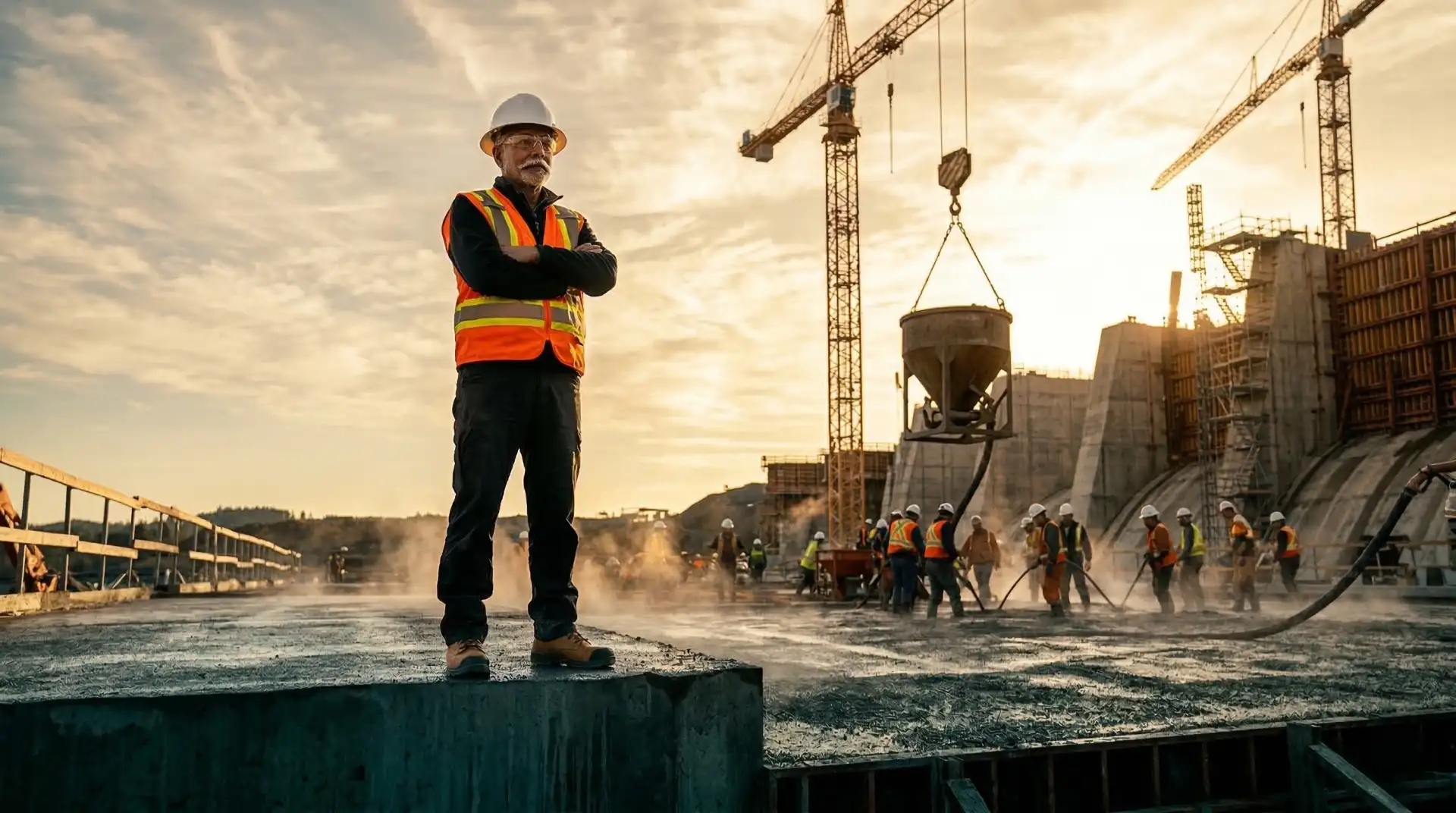
This is not desk work. It requires being at the placement face, at the batching plant, and at the monitoring station, often simultaneously.
Key Takeaway
The difference between a concrete technology consultant who writes reports and one who prevents problems is physical presence. PCCI's leadership has spent 40+ years on-site: at high-altitude dam sites in Bhutan, in the tunnels of Himachal Pradesh, and at placement faces in Nepal. You cannot control concrete quality from an office 500 kilometres away.
Troubleshooting: when things go wrong
No construction project of this scale proceeds without problems. The consultant’s role includes diagnosing and resolving concrete quality issues as they arise:
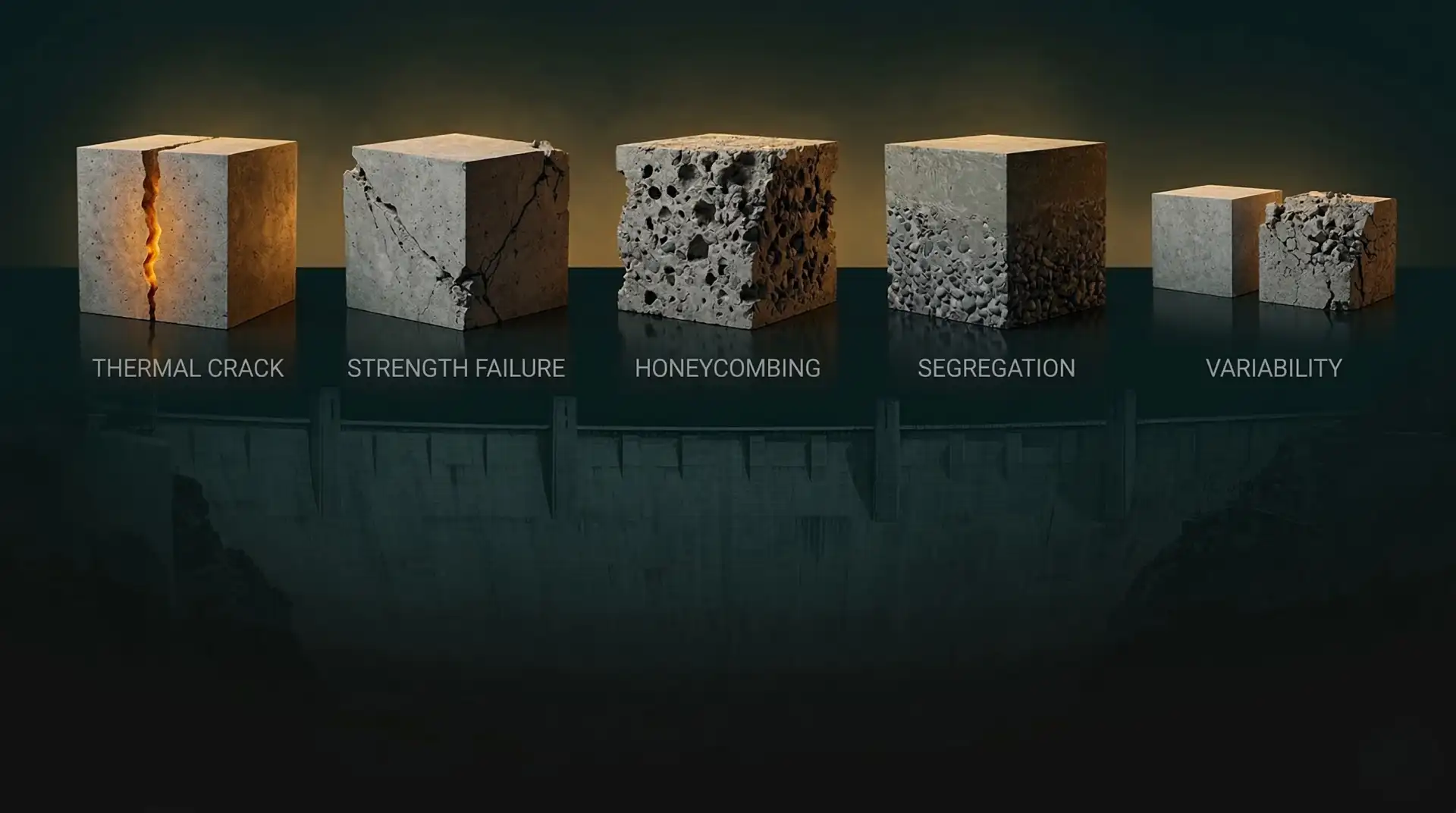
- Strength shortfalls: Test results below specification. Is it a material issue, a batching error, a curing problem, or a testing error? Root cause analysis determines the correct response.
- Thermal cracking: Cracks appearing during or shortly after curing. Assessment of extent, depth, structural significance, and repair strategy.
- Honeycombing and segregation: Defects at the placement face indicating vibration, formwork, or mix issues. Immediate correction to prevent recurrence.
- Mix variability: Inconsistent test results indicating source material changes, batching drift, or process control breakdowns.
PCCI’s Construction Troubleshooting & Root Cause Analysis service provides rapid response to construction-phase problems, drawing on 40+ years of field experience to diagnose issues that less experienced consultants might misattribute.
The independent review role
On some projects, particularly those funded by multilateral development banks (ADB, World Bank, AIIB), the concrete technology consultant serves as the owner’s independent technical reviewer. This Independent Review role adds a layer of impartial quality oversight:
- Reviewing the EPC contractor’s concrete programme and QC documentation
- Conducting independent testing to verify contractor results
- Assessing compliance with project specifications and international standards
- Providing technical recommendations to the project owner
- Reporting on concrete quality status at project review meetings
At Punatsangchhu-1 HEP (1,200 MW), PCCI authored the project’s comprehensive Quality Control Manual, defining the entire quality framework for the concrete programme.
Post-construction: the work does not end at commissioning
After the last concrete is placed, the consultant’s role transitions to assessment and monitoring:
- As-built documentation: Compiling the complete record of mix designs, test results, and quality data for the project archives
- Condition assessment: Evaluating the concrete’s as-built condition against design intent
- Non-destructive testing: Core sampling, rebound hammer, ultrasonic pulse velocity, and ground-penetrating radar to assess in-situ properties
- Remaining service life estimation: Projecting the structure’s durability based on actual material properties and exposure conditions
- Maintenance recommendations: Identifying areas requiring monitoring, treatment, or future intervention
Why this role matters
Large dams contain 300,000 to over 1,000,000 cubic metres of concrete, per ICOLD data. The concrete programme typically represents 25-40% of the total project cost. The structural safety and 100-year service life of the dam depend entirely on the quality of this concrete.
Without specialized concrete technology consulting, project owners rely on the EPC contractor’s internal QC, which, however competent, is not independent. The contractor has schedule and cost incentives that can conflict with quality optimization. The concrete technology consultant provides the independent technical authority that protects the owner’s investment.
PCCI's position
We are not a testing lab. We are not a structural design firm. We are concrete technology specialists, with 40+ years of leadership expertise, 4,000+ MW of project experience, and 48+ technical papers published, whose sole focus is ensuring that every cubic metre of concrete in your project performs exactly as intended, for its entire design life.
Book a Technical Call → to discuss how concrete technology consulting can de-risk your project.