The question comes up on nearly every new gravity dam project: should we use roller compacted concrete or conventional concrete?
The initial answer seems obvious. RCC costs 25-40% less and builds 5-10 times faster. Over 650 RCC dams have been completed worldwide. 55% of new dams globally now use RCC technology. The economics appear decisive.
But the question is more nuanced than cost per cubic metre. RCC and conventional concrete (CVC) are different materials with different strengths, different limitations, and different failure modes. Choosing between them, or designing a hybrid that uses both, requires understanding exactly what each technology gives you and what it costs you beyond the material price.
What RCC Actually Is
RCC is not simply conventional concrete placed by a different method. It is a fundamentally different material.
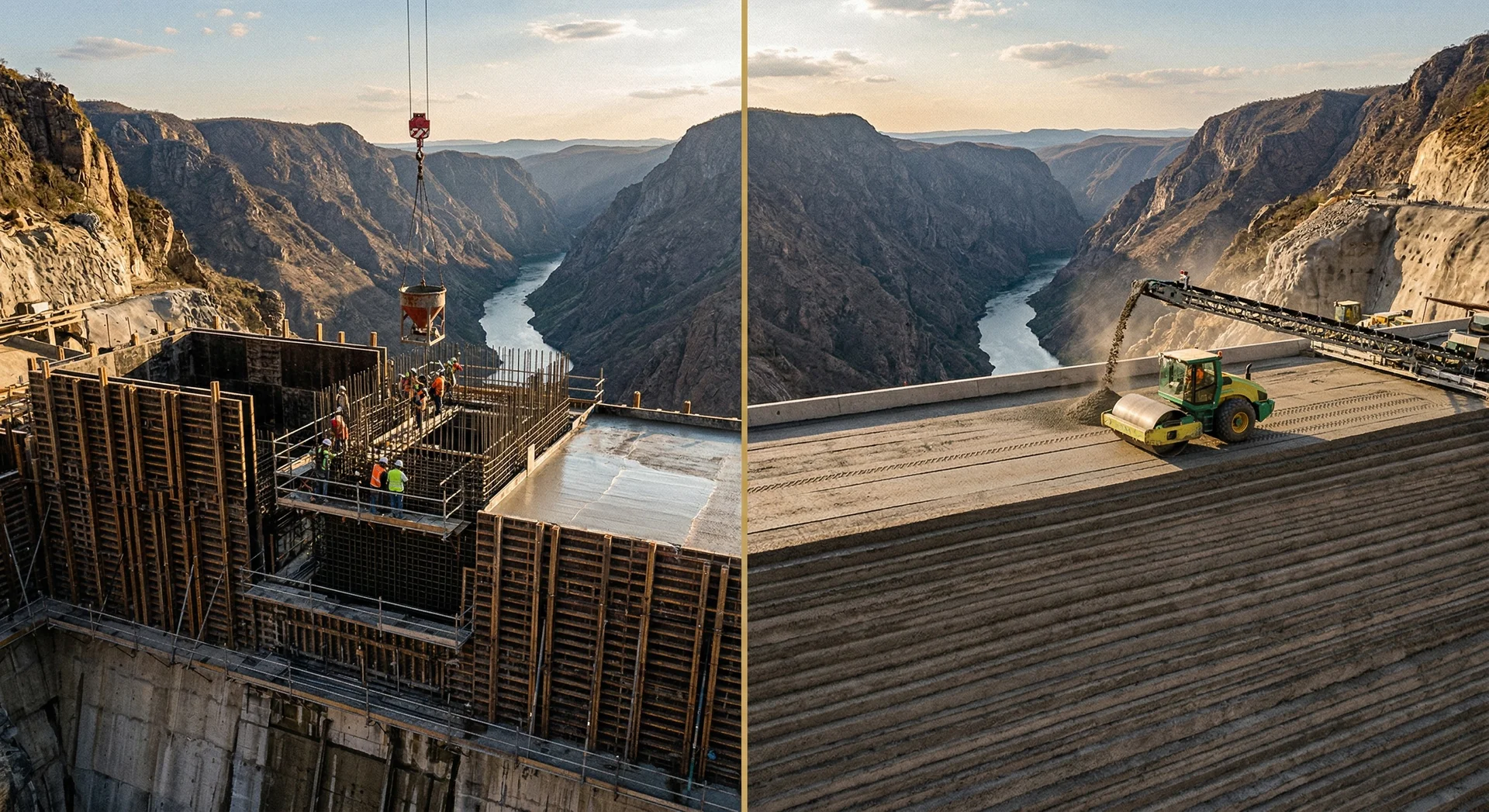
Conventional concrete has enough water and paste to flow: it is placed into forms, consolidated by internal vibration, and cures as a dense, impermeable mass. Typical cement content: 200-350 kg/m3. Water-cementitious ratio: 0.40-0.55. Slump: 75-150 mm.
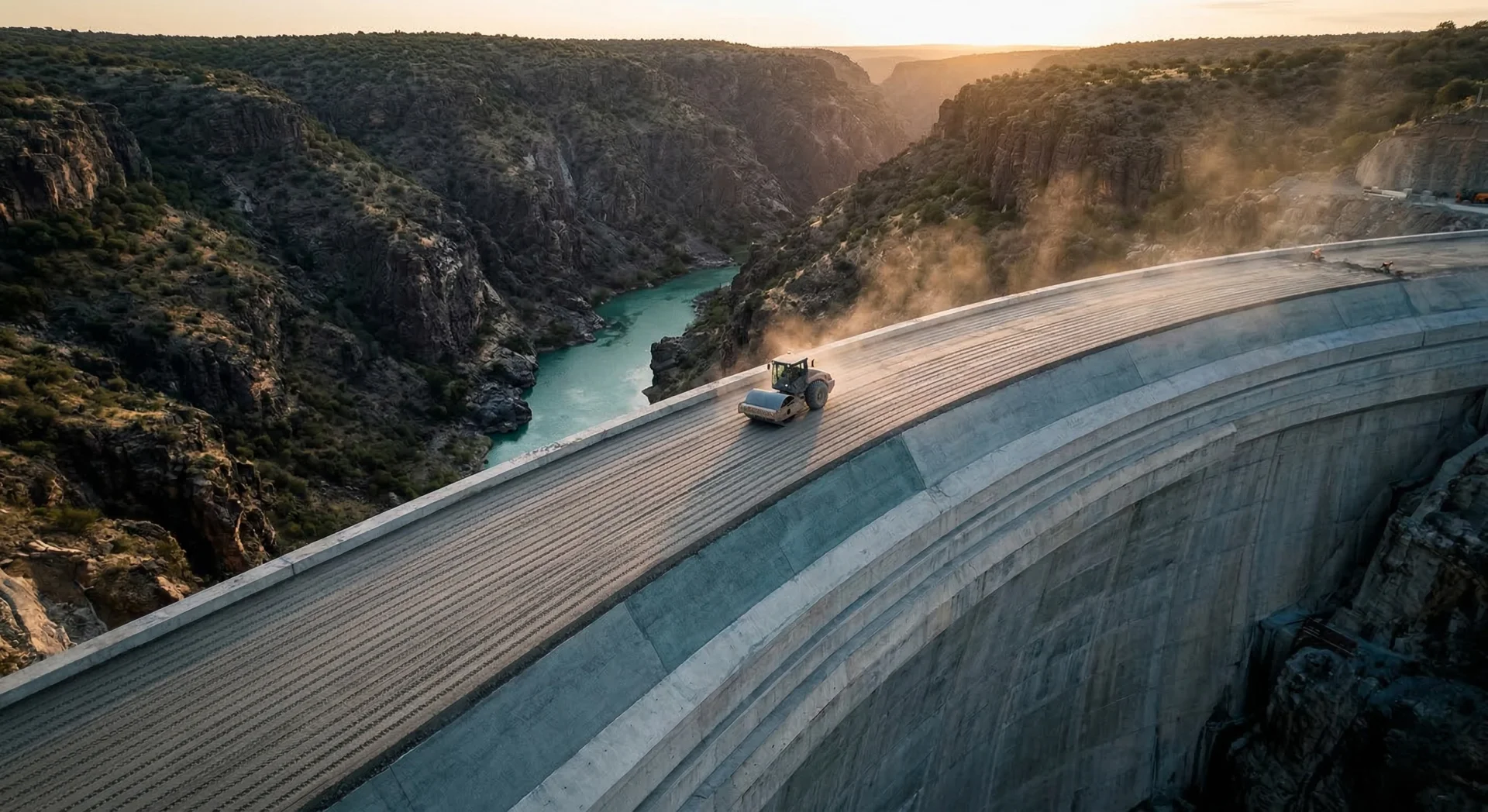
RCC has a dry, zero-slump consistency. It is delivered by dump trucks or conveyors, spread by bulldozers, and compacted by vibratory rollers in 300 mm lifts. Typical cement content: 100-150 kg/m3 (often with 40-60% fly ash replacement). Water-cementitious ratio: 0.45-0.80 (higher than CVC because of lower total cementitious content). Slump: zero.
The lower paste content is both the source of RCC’s cost advantage and its primary engineering trade-off.
The Cost Advantage
Material Savings
RCC uses 30-50% less cementitious material per cubic metre than CVC. Through careful cement optimization, the savings on a dam requiring 500,000 cubic metres of concrete can be Rs 50-100 crore in cement costs alone.
Speed and Schedule
RCC’s continuous placement method enables daily production rates of 3,000-10,000 cubic metres, compared to 500-1,500 for CVC. A gravity dam section that might take 5-7 years with CVC can potentially be completed in 3-4 years with RCC.
Schedule compression reduces:
- Interest during construction (often the largest single cost component on large dam projects)
- Mobilization and overhead costs
- Contractor preliminary and general items
- Risk of cost escalation over time
Equipment and Formwork
RCC requires minimal formwork (only at the dam faces and ends of each lift). CVC requires full formwork for every lift on every face. The saving in formwork material, labour, and cycle time is substantial.
The 25-40% Bottom Line
Industry data consistently shows RCC gravity dams costing 25-40% less than equivalent CVC gravity dams. The range depends on site-specific factors: aggregate availability, cement cost, logistical constraints, and dam geometry.
The Trade-offs
1. Lift Joint Quality
This is the fundamental engineering trade-off.
In a CVC dam, each 1.5-metre lift bonds to the previous lift through a combination of paste continuity and preparation. The joint is a construction discontinuity, but with proper treatment, it approaches the strength of monolithic concrete.
In an RCC dam, each 300 mm lift bonds to the previous lift primarily through the compaction energy of the vibratory roller. The bond at RCC lift joints typically achieves only 30-80% of the parent concrete’s tensile and shear strength, depending on:
- Time between lifts (hot, warm, or cold joint classification)
- Surface preparation (cleaning, moisture conditioning)
- Bedding mortar or GERCC (grout-enriched RCC) application
- Ambient conditions during the exposure period
An RCC dam may have 200-400 lift joints over its height. Each one is a potential weakness plane. The QC programme must classify, treat, and verify every joint. This is RCC’s most demanding quality requirement.
2. Impermeability
CVC is inherently less permeable than RCC because of its higher paste content and lower void ratio. An RCC dam’s interior, while durable, is not watertight at the lift joints.
Most RCC dams address this through one or more of:
- Upstream CVC facing: A conventional concrete facing layer (typically 300-600 mm) placed simultaneously with the RCC, providing an impermeable barrier on the upstream face
- Geomembrane: A PVC or bituminous membrane installed on the upstream face
- Grout-enriched RCC (GERCC): A paste-rich zone at the upstream portion of each lift to improve impermeability
The cost of these impermeability measures partially offsets the RCC material savings. A fair cost comparison must include the facing system.
3. Design Flexibility
RCC works best for simple, straight gravity dam cross-sections where the roller can operate efficiently across the full dam width. Complex geometries present challenges:
- Curved dams: RCC can accommodate moderate curvature, but tight-radius arch dams are typically built with CVC
- Spillway crests: The ogee shape requires CVC or precast elements
- Stilling basins: High-velocity flow areas need HPC with superior abrasion resistance, designed for long-term durability
- Intake structures, gate slots, piers: Complex shapes with reinforcement require CVC
- Galleries: Typically formed in CVC within or adjacent to the RCC mass
4. Surface Finish
The roller-compacted surface shows the compaction pattern of the drum roller and aggregate marks. It is structurally adequate but is not a finished surface. Any exposed surface requiring architectural quality, smooth contact surfaces, or precise geometric control must be CVC.
5. Production Continuity
RCC’s speed advantage depends on continuous production. Once the placement sequence starts, it must maintain the required production rate to avoid cold joints between lifts. Any interruption, from equipment failure, weather, or material supply disruption, risks the entire lift becoming a cold joint.
CVC is more tolerant of interruptions because its larger lift heights (1.5 metres vs. 300 mm) and slower placement rate provide longer time windows between lifts.
The Hybrid Approach
The binary choice between RCC and CVC is increasingly giving way to hybrid designs that use both materials optimally:
| Element | Typical Choice | Reason |
|---|---|---|
| Interior dam mass | RCC | Speed, cost |
| Upstream face (300-600 mm) | CVC or geomembrane | Impermeability |
| Downstream face | RCC (exposed) or CVC (if finished surface needed) | Cost vs. aesthetics |
| Spillway ogee crest | CVC | Complex geometry, abrasion resistance |
| Stilling basin | CVC (HPC) | Abrasion/cavitation resistance |
| Galleries | CVC | Formed space, reinforcement |
| Intake structures | CVC | Complex geometry, reinforcement |
| Gate slots and piers | CVC | Precision, reinforcement |
| Foundation treatment | CVC | Bond to rock, geometry |
This hybrid approach captures the speed and cost advantage of RCC for the bulk of the dam volume while using CVC where its properties are essential.
Thermal Control: Different Challenges
Both RCC and CVC generate heat from cement hydration, but the thermal control challenges differ.
CVC: Large lift heights (1.5 metres) with high cement content generate significant heat in thick sections. Post-cooling with embedded pipes is standard for conventional mass concrete dams. Pre-cooling of materials (chilled water, ice, aggregate cooling) reduces placing temperature.
RCC: Thin lifts (300 mm) with lower cement content per cubic metre generate less heat per lift. The high surface-to-volume ratio of thin lifts allows faster heat dissipation. Many RCC dams do not require embedded pipe cooling, a significant cost and complexity saving. However, the rapid placement rate means that multiple warm lifts are stacked quickly, and the cumulative temperature rise in the interior of a large RCC dam can still be substantial. Thermal modelling is essential regardless of the placement method.
Decision Framework: When to Choose RCC
RCC is generally the better choice when:
- The dam is a straight gravity section without complex geometry
- The concrete volume exceeds 100,000 cubic metres (scale needed to amortize RCC production setup)
- Schedule is a driver (RCC’s speed reduces interest during construction)
- Suitable aggregates and fly ash are available near the site (RCC requires large, continuous material supply)
- The dam site can accommodate the continuous production logistics (batching plant, haul roads, staging areas)
CVC is generally the better choice when:
- The dam is an arch or curved gravity design
- The concrete volume is small (below 50,000-100,000 cubic metres, the RCC setup cost is not justified)
- Complex appurtenant structures dominate the concrete scope (intakes, spillways, powerhouse)
- Impermeability requirements are extreme and facing systems are not preferred
- Material supply is uncertain or intermittent (RCC cannot tolerate production interruptions)
The Indian Context
RCC adoption in India has been slower than the global trend. Most Indian dam concrete experience is with CVC, and the institutional knowledge, specifications, and quality control frameworks are built around conventional placement.
However, with the IS 456:2025 draft revision including a dedicated RCC chapter for the first time, and India’s pumped storage pipeline requiring rapid construction of multiple new dams, the conditions for RCC adoption are stronger than ever.
The key is recognizing that RCC is not a substitute for concrete technology expertise. It demands different expertise: continuous production management, lift joint quality control, thermal analysis for thin-lift placement, and facing system design. Engaging a concrete technology consultant early ensures the RCC programme is designed for the specific site conditions. The cost savings are real, but they are realized only when the engineering is right.
Quick Reference: RCC vs CVC
| Parameter | RCC | CVC |
|---|---|---|
| Cost per m3 | 25-40% lower | Baseline |
| Placement rate | 3,000-10,000 m3/day | 500-1,500 m3/day |
| Lift height | 300 mm | 1,500 mm |
| Cement content | 100-150 kg/m3 | 200-350 kg/m3 |
| Slump | Zero | 75-150 mm |
| SCM content | 40-60% typical | 25-40% typical |
| Formwork | Minimal (faces only) | Full formwork every lift |
| Cooling pipes | Often not required | Standard in thick sections |
| Joint strength | 30-80% of parent | 70-95% of parent |
| Impermeability | Requires facing system | Inherent |
| Design flexibility | Straight gravity sections | Any geometry |
| Minimum economic volume | ~100,000 m3 | No minimum |
| Global adoption | 55% of new dams | 45% of new dams |
| Dams built worldwide | 650+ | Thousands |
The choice is not RCC or CVC. The choice is which concrete system, or which combination, delivers the required performance at the lowest lifecycle cost for the specific dam, site, and project constraints. That analysis starts with the concrete technology, not the cost sheet.