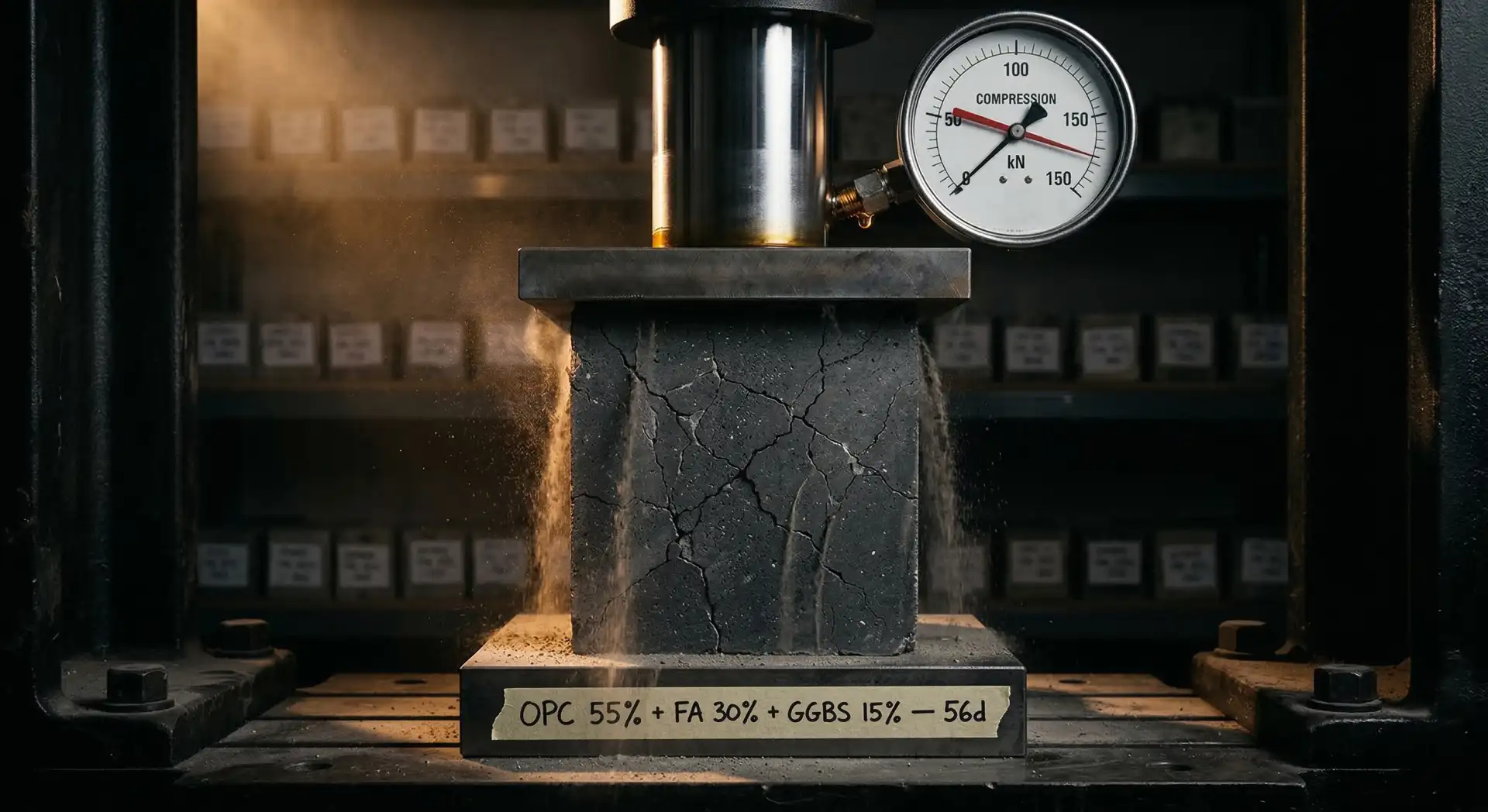

Thermal control in roller compacted concrete (RCC) dams is achieved without embedded cooling pipes, relying instead on three levers: high pozzolan mix design, placement scheduling and lift management, and thermal modelling, with practice bounded by ACI PRC-207.5-11 and ICOLD Bulletin 177.
The RCC thermal paradox
Roller compacted concrete (RCC) was adopted for dam construction because it is fast. A well-run RCC operation can place 200-400 m³ per hour, building a dam vertically at rates of 3-6 metres per week. Conventional mass concrete, by comparison, typically achieves 0.3-0.6 metres per week.
That speed creates a thermal problem. Each 300mm lift generates heat from cement hydration. When lifts are placed as often as every 12 to 24 hours, the heat from lower lifts has not yet dissipated before the next lift arrives. The dam body accumulates heat faster than it can release it.
In conventional mass concrete dams, engineers have several options to manage this heat: optimized mix design with high pozzolan replacement, pre-cooling of aggregates and mix water, surface insulation, and post-cooling through embedded cooling pipes. Among these, embedded cooling pipes (serpentine networks of steel or high-density polyethylene (HDPE) tubing through which chilled water circulates) are one of the most effective post-placement cooling tools available, directly extracting heat from the dam interior.
RCC dams cannot use it.
Why can’t RCC dams use cooling pipes?
RCC is placed and compacted differently from conventional concrete. The process has three characteristics that rule out embedded cooling pipes.
Vibratory roller compaction. RCC is compacted by 10-15 tonne vibratory rollers. The dynamic force transmitted through the roller drum would crush any pipes embedded in the lift. Even heavy-walled steel pipes cannot survive repeated passes of a vibratory roller at standard compactive effort.
Thin lifts, rapid coverage. Each RCC lift is typically 300mm thick (compared to 1.5-2.0m for conventional mass concrete). Laying cooling pipe networks in a 300mm layer, across the full dam width, at production rates exceeding 200 m³/hour, is not practically feasible.
Continuous placement. RCC placement is designed to be continuous. The goal is to place and compact each lift quickly enough that the surface remains “live” (workable) when the next lift arrives. Stopping to install pipe networks would break this continuity and create cold joints.
The fundamental constraint
In conventional mass concrete, thermal control follows a four-stage sequence: mix design, pre-cooling, post-cooling, and surface insulation. RCC eliminates the third stage entirely. Every thermal outcome must be achieved through the remaining three, which makes each of them more critical and less forgiving.
Mix design: the primary thermal lever
Without post-cooling, the cementitious system carries a heavier burden in RCC than in any other concrete application. The goal is to minimize heat generation while still achieving the required strength and durability.
High pozzolan replacement
RCC mixes typically replace 40-60% of Portland cement with pozzolanic materials: fly ash, natural pozzolans, or ground granulated blast furnace slag (GGBS). This is substantially higher than the 25-40% replacement common in conventional dam concrete.
The thermal benefit is significant. A typical RCC mix with 60% fly ash replacement generates roughly 40-50% less heat than an equivalent ordinary Portland cement (OPC) mix at 7 days. The peak temperature is lower, and the time to peak is delayed, giving the concrete more time to dissipate heat.
| Cementitious System | Total Cementitious Content (kg/m³) | 7-Day Adiabatic Temp Rise (°C) |
|---|---|---|
| 100% OPC | 150 | 28-32 |
| 60% OPC + 40% Fly Ash | 150 | 18-22 |
| 40% OPC + 60% Fly Ash | 150 | 14-18 |
| 40% OPC + 60% GGBS | 150 | 12-16 |
These values are typical ranges. Actual heat evolution depends on the specific cement and pozzolan source, which is why adiabatic temperature rise testing on project-specific materials, conducted per the USACE CRD-C 38-73 (Method of Test for Temperature Rise in Concrete) procedure or an equivalent calorimetry method aligned with ACI PRC-207.5-11 (Report on Roller-Compacted Mass Concrete), is a non-negotiable part of RCC mix design.
Low total cementitious content
RCC mixes also use lower total cementitious content than conventional concrete: typically 120-180 kg/m³ compared to 200-350 kg/m³ for conventional dam mixes. This further reduces absolute heat generation per cubic metre.
The tradeoff is that RCC achieves lower early-age strengths. RCC design typically relies on 90-day or 180-day strength rather than 28-day strength, allowing the slower pozzolanic reaction to contribute. This is acceptable because RCC dams are mass gravity structures where the full design load is not applied until the reservoir fills, often years after construction.
Placement scheduling and logistics
With the cementitious system optimized, the remaining thermal variables are controlled through placement logistics. Every scheduling decision affects the thermal profile of the dam.
Lift thickness
Standard RCC lift thickness is 300mm (compacted), chosen primarily for compaction efficiency. From a thermal perspective, thinner lifts dissipate heat more effectively because the surface-to-volume ratio is higher. Some projects have used 200mm lifts in thermally critical zones, though this reduces production rates.
Inter-lift timing
The interval between successive lifts is one of the most important thermal parameters in RCC construction. Too fast, and heat accumulates. Too slow, and the lift surface becomes a cold joint requiring surface preparation.
The thermal ideal is to wait long enough for each lift to dissipate a meaningful portion of its hydration heat before covering it with the next lift. In practice, this conflicts with the production imperative. The joint maturity requirement, as detailed in RCC lift joint quality, also constrains timing.
Thermal modelling determines the optimal balance. On tall RCC dams in warm climates, models may dictate that placement must pause during peak summer months, or that the placement rate must be deliberately slowed during certain construction stages.
The lane method
For large RCC dams, the placement area is often divided into lanes that are placed sequentially. While one lane is being placed and compacted, previously placed lanes are dissipating heat. This method allows continuous production while building in thermal cooling intervals.
The lane width and sequencing are determined by thermal analysis. Typical lane widths range from 8 to 15 metres, with 3-6 lanes active at any time depending on dam width and placement capacity.
Hot weather: the 60-minute race
Hot weather is the most challenging condition for RCC placement, and for thermal control the consequences compound.
Workability window
RCC must be mixed, transported, spread, and compacted before the mix loses workability. The generally accepted maximum time from mixing to final compaction is 45-60 minutes. In ambient temperatures above 35°C, this window can shrink to 30-45 minutes.
Vebe time, the standard measure of RCC workability, increases rapidly with temperature. A mix designed for a Vebe time of 15-25 seconds at 20°C may reach 40+ seconds at 40°C, making adequate compaction impossible. Under-compacted RCC has higher void content, lower density, reduced strength, and increased permeability.
Critical constraint
In hot weather, the workability clock and the thermal clock work against each other simultaneously. The mix stiffens faster (requiring quicker placement) while generating heat faster (requiring slower placement for thermal dissipation). Resolving this conflict requires a combination of night placement, pre-cooling of aggregates and water, and sometimes reducing daily production rates.
Night placement strategies
Many large RCC dam projects in tropical and subtropical climates shift to predominantly night placement during summer months. The benefits are substantial:
- Lower ambient temperatures reduce both the initial placement temperature and early-age heat gain.
- No solar radiation eliminates surface heating of freshly placed lifts and of aggregate stockpiles.
- Higher relative humidity reduces moisture loss and evaporative cooling differentials.
- Extended workability window allows the full 60-minute compaction window to be utilized.
Night placement does introduce logistical challenges: lighting, workforce scheduling, quality control visibility, and safety management all require additional planning.
Pre-cooling in RCC
Pre-cooling methods for RCC are similar to those for conventional concrete, with some differences:
- Chilled water and aggregate cooling are standard approaches on large RCC projects.
- Ice substitution is less common in RCC because the low water content (typically 100-120 litres/m³, compared to 150-180 for conventional concrete) limits the cooling contribution.
- Target placement temperature for RCC in tropical climates is typically 15-20°C, somewhat less aggressive than the 10-15°C target for conventional mass concrete, reflecting the lower cement content and thinner lift geometry.
Surface insulation between lifts
The exposed top surface of each RCC lift loses heat to the environment through convection, radiation, and evaporation. In hot climates, this is desirable: it helps the lift cool before the next one arrives. But in cold climates, or during cold nights in otherwise warm climates, rapid surface cooling creates a steep temperature gradient within the 300mm lift.
Surface insulation, typically thermal blankets or spray-applied insulating membranes, is used in the following scenarios:
- When ambient temperature drops below 5°C during curing.
- When diurnal temperature swings exceed 15-20°C.
- When a lift surface will be exposed for more than 24 hours before the next lift.
- During cold weather construction to maintain minimum curing temperatures.
The insulation decision must be coordinated with the inter-lift timing. Insulation slows heat loss, which helps prevent surface thermal cracking but also slows the overall cooling of the dam body. Thermal modelling quantifies this tradeoff.
Why is thermal modelling even more critical for RCC?
In conventional mass concrete construction, thermal modelling is important. In RCC construction, it is essential. The reasoning is straightforward: when you have fewer tools to control temperature, you need greater precision with the tools you have.
ACI PRC-207.2-07 (Report on Thermal and Volume Change Effects on Cracking of Mass Concrete) provides the framework for thermal analysis of mass concrete. For RCC, the model must account for:
- Continuous lift placement with realistic inter-lift intervals (not idealized schedules).
- Heat accumulation from rapid stacking of thin lifts.
- Seasonal variation across a construction period that may span 2-4 years.
- Gallery and transverse joint geometry that affects heat flow boundaries.
- Pozzolanic heat evolution curves that differ substantially from OPC curves.
The model outputs drive the entire construction plan: maximum placement rate by season, mandatory cooling pauses, required pozzolan content, target placement temperatures, lift thickness in critical zones, and galley sequencing.
Model inputs determine model value
A thermal model is only as reliable as its inputs. Adiabatic temperature rise testing on project-specific materials, calibrated against actual field thermocouple data from early placements, is necessary for the model to be predictive rather than theoretical. PCCI's approach includes recalibrating thermal models against field data during construction.
The tall RCC dam challenge
The thermal challenge intensifies with dam height. In a 50-metre RCC dam, the interior mass is relatively close to the upstream and downstream faces, allowing heat to dissipate laterally. In a 100-metre or 150-metre dam, the interior is deeply insulated by surrounding concrete, and temperatures can reach levels that would normally be managed with cooling pipes.
For tall RCC dams in warm climates, the thermal management strategy may include:
- Extended construction pauses during peak summer, accepting the schedule impact.
- Reduced daily placement rates to allow inter-lift cooling.
- CVC (conventional vibrated concrete) zones in the dam interior where cooling pipes can be installed, with RCC used for the upstream and downstream faces.
- Post-cooling galleries cast into the dam at intervals, through which chilled air or water is circulated after construction.
- Higher pozzolan content (approaching 60-70%) in interior zones to minimize heat generation.
ICOLD Bulletin 177 (Roller-Compacted Concrete Dams), which supersedes the widely cited Bulletin 126, addresses these strategies in detail, recognizing that the tallest RCC dams require hybrid approaches combining RCC speed with selective conventional thermal control measures.
RCC vs. conventional concrete: the thermal tradeoff
| Parameter | Conventional Mass Concrete | RCC |
|---|---|---|
| Typical lift thickness | 1.5-2.0 m | 0.3 m |
| Placement rate | 50-150 m³/hr | 200-400 m³/hr |
| Cementitious content | 200-350 kg/m³ | 120-180 kg/m³ |
| Pozzolan replacement | 25-40% | 40-60% |
| Post-cooling (pipes) | Yes, standard | Not feasible |
| Inter-lift interval | 5-14 days | 12-48 hours |
| Thermal modelling role | Important | Essential |
| Heat per lift (lower) | Higher per lift | Lower per lift |
| Heat accumulation rate | Slower | Faster |
The net result is that RCC and conventional concrete face the same underlying physics, but with different tool sets. RCC’s advantage is lower heat per lift and thinner geometry. Its disadvantage is faster heat accumulation and the absence of post-cooling. Effective thermal management of RCC requires understanding and exploiting the advantages while planning rigorously around the constraints.
How does PCCI approach RCC thermal control?
PCCI’s Thermal Control & Placement Engineering service includes specialized RCC thermal analysis as part of the full service offering. Our approach covers:
- Material-specific thermal modelling using adiabatic temperature rise data from project materials, calibrated against field measurements during early construction stages.
- Placement schedule optimization that balances production rates against thermal constraints, with seasonal adjustments built into the construction programme.
- Mix design development targeting the optimal pozzolan content for both thermal performance and long-term durability requirements.
- Hot weather placement protocols including trigger temperatures for shifting to night placement, aggregate cooling requirements, and workability monitoring procedures.
- QA/QC programmes with embedded thermocouple monitoring, Vebe time tracking, and density verification at the frequencies required for RCC production.
RCC thermal control is not a calculation exercise. It is a field discipline that requires real-time decision-making at the placement face.
Book a Technical Call to discuss thermal control strategy for your RCC dam project.