India is planning to multiply its pumped storage hydropower capacity by more than twenty times.
From approximately 4.7 GW operational today, the Central Electricity Authority’s January 2026 roadmap targets 100 GW of pumped storage by 2035-36. That is not a typographical error. The investment required: Rs 5-6 lakh crore, roughly $60-72 billion.
Thirty-nine projects totalling 50.67 GW have already been allocated by states for commissioning by 2032. Another 131 projects totalling 154.9 GW are in the environmental clearance pipeline. Greenko, Adani Green, and JSW Energy alone account for approximately 66% of the planned capacity. NHPC, SJVN, THDC, and Torrent Power make up much of the rest.
This is not a policy aspiration. Construction is underway. Tehri PSP (1,000 MW) commissioned three units in 2025. Pinnapuram (1,680 MW) has achieved wet commissioning. Turga (1,000 MW) is targeting 2028.
But here is what most coverage of India’s pumped storage ambitions overlooks: every one of these projects depends on concrete. Upper reservoir dams, lower reservoir dams, underground powerhouse caverns, penstocks, surge shafts, tail race tunnels, and reservoir lining. The concrete technology decisions made in the next five years will determine whether this 100 GW ambition delivers on schedule or becomes another chapter in India’s history of hydropower cost overruns.
What Makes Pumped Storage Concrete Different
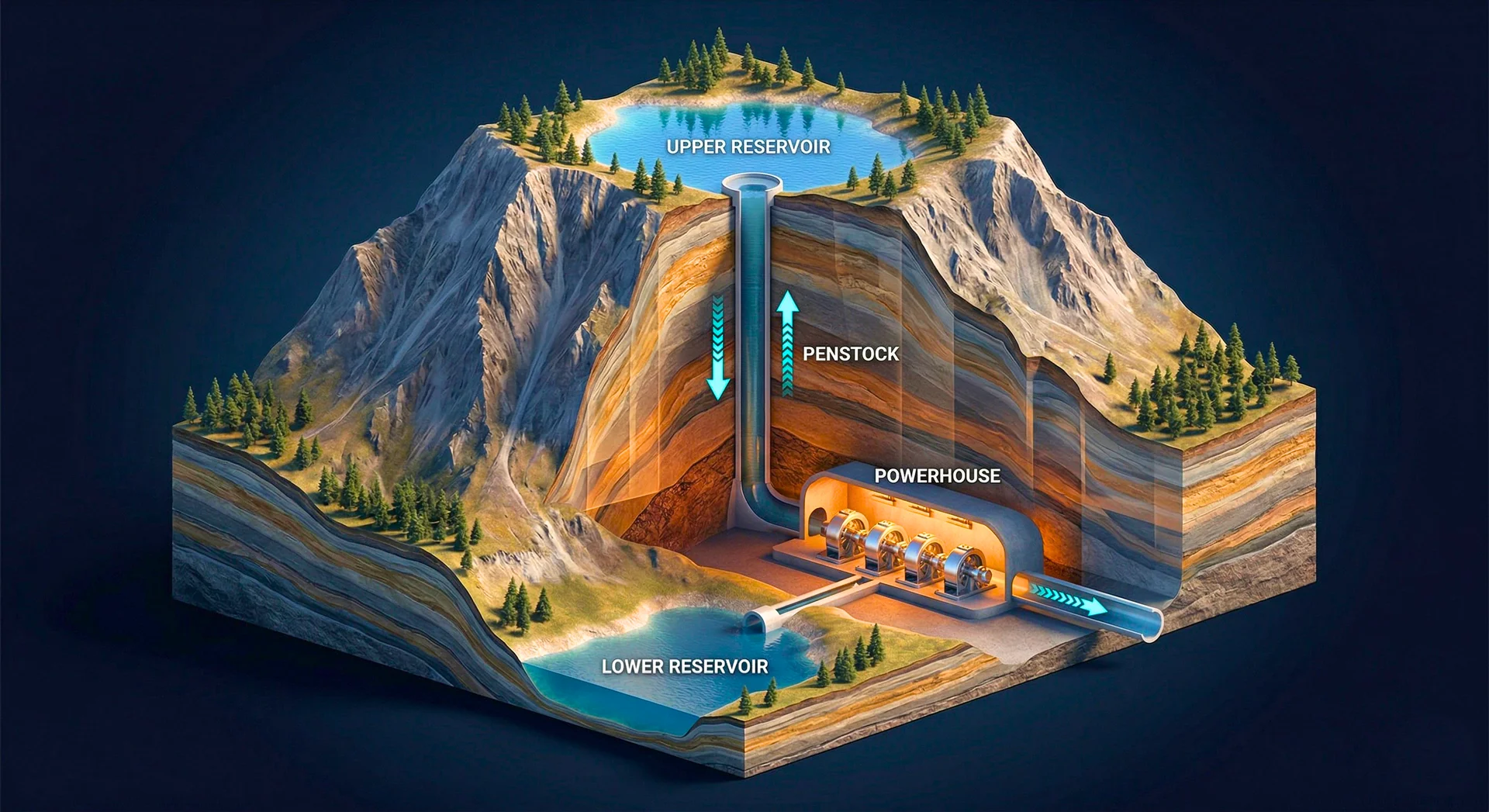
A pumped storage project is not just a dam with a turbine. It is two reservoirs at different elevations, connected by tunnels and penstocks, with reversible pump-turbines that can push water uphill to store energy and release it downhill to generate power.
This creates concrete challenges that conventional hydropower projects do not face.
Cyclic Water Level Fluctuation
This is the defining difference. A conventional dam maintains a relatively stable reservoir level, with seasonal variation and controlled drawdowns. A pumped storage reservoir cycles water levels multiple times every day, with variations of tens of metres.
Research published in ACS Omega has documented what this does to concrete: saturated water content increases logarithmically with repeated immersion-drying cycles, ultrasonic wave velocity decreases by approximately 10%, and load-bearing and elastic capacity degrades progressively. The U.S. Bureau of Reclamation has found that even at relatively low stress levels, cyclic loads cause permanent strains to accumulate. If the cyclic stress is high enough relative to concrete strength, failure can occur at absolute stress levels that would be considered safe under static loading.
For reservoir lining, slope protection, and upstream dam faces, this is a concrete durability problem unlike anything conventional dam engineers encounter. There are currently no design guidelines specifically addressing PSH reservoir lining under daily multi-cycle water level fluctuations.
Reversible Flow: Cavitation and Abrasion
In conventional hydropower, water flows in one direction: through the intake, down the penstock, through the turbine, out the tailrace. In pumped storage, water flows in both directions. This subjects tunnel linings, penstocks, and turbine chambers to:
- Cavitation from high-velocity reversible flow and pressure transients
- Abrasion from sediment-laden water (particularly relevant in Indian rivers) flowing in both directions
- Pressure cycling in surge shafts as pump-turbines switch between generating and pumping modes
These conditions demand high-performance concrete with superior abrasion resistance, or specialized coatings (polyurethane, epoxy, cermet) in critical flow zones. GF-reinforced concrete using alkali-resistant glass fibres is increasingly specified for spillway and flow channel surfaces.
Remote, Elevated Upper Reservoirs
Closed-loop (off-stream) pumped storage systems, which India is increasingly favouring for their smaller environmental footprint, require building both reservoirs from scratch. The upper reservoir is typically at a higher elevation, often in remote terrain with limited road access.
This means building dams at 1,500-2,400 metres above sea level (Kundah PSP in the Nilgiri Hills operates at approximately 2,400 metres), with all the logistical challenges that implies: short construction seasons, temperature extremes affecting concrete curing, scarce flat areas for batching plants, and uncertain availability of supplementary cementitious materials like fly ash and GGBS.
Underground Structures at Scale
Pumped storage projects require massive underground structures:
- Tehri PSP: Underground machine hall 203 metres long, 28.2 metres wide, 56 metres high
- Pinnapuram: Subsurface powerhouse 240 metres long, 24 metres wide, 58 metres high
- Purulia PSP: Underground powerhouse 157 metres long, 22.5 metres wide, 48.7 metres high
These caverns, along with surge shafts (Tehri’s upstream surge shafts are 20.92 metres in diameter and 145 metres high), require concrete that performs in challenging geological conditions. Tehri experienced squeezing rock, major cavity formation in surge shafts, and mega-shear zones during construction. Self-compacting concrete (SCC) was used at Tehri precisely because conventional concrete placement was not feasible in some of these complex geometries.
The Concrete Arsenal for PSH
Different elements of a pumped storage project demand different concrete solutions:
RCC for Gravity Dams
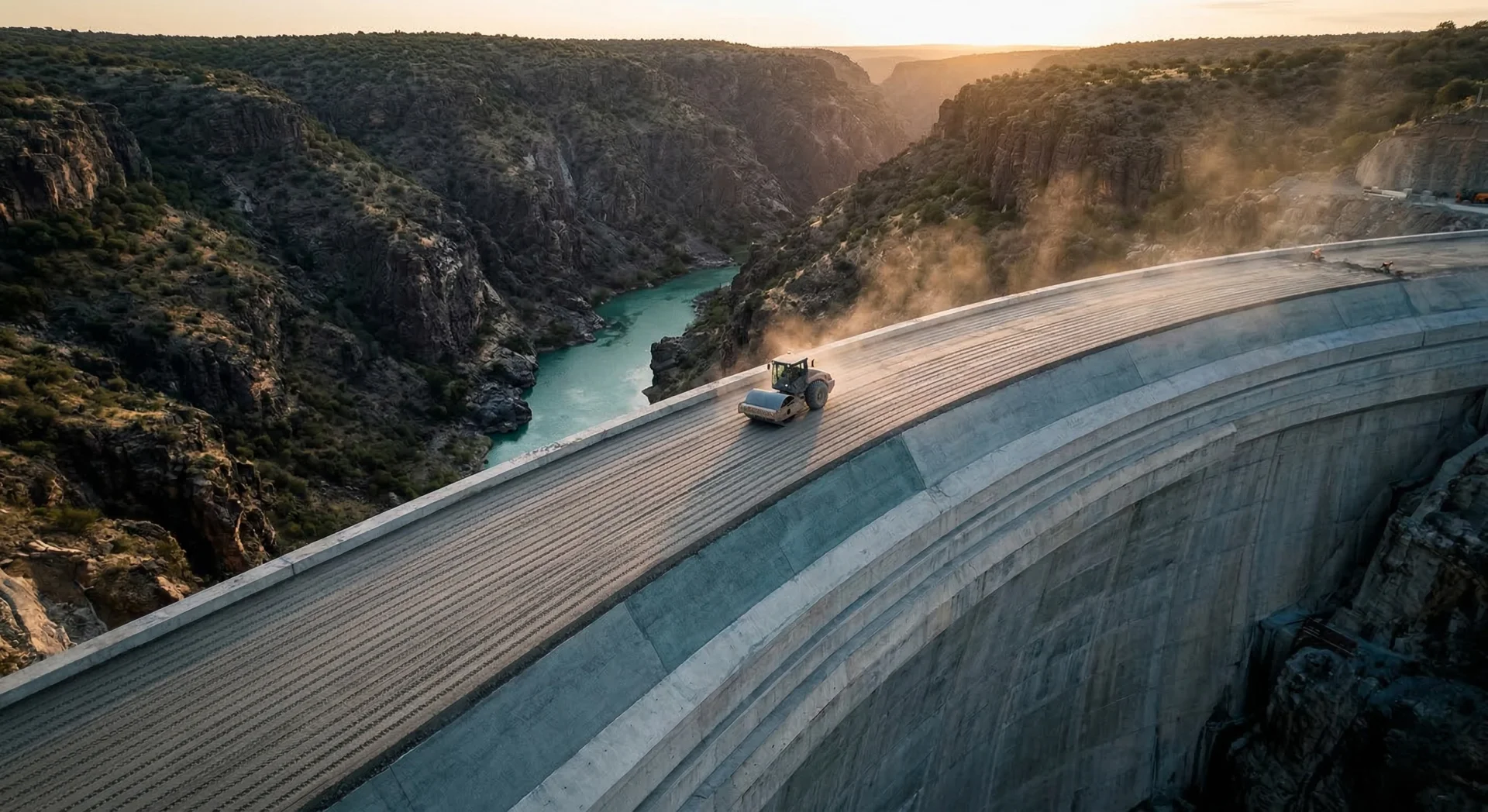
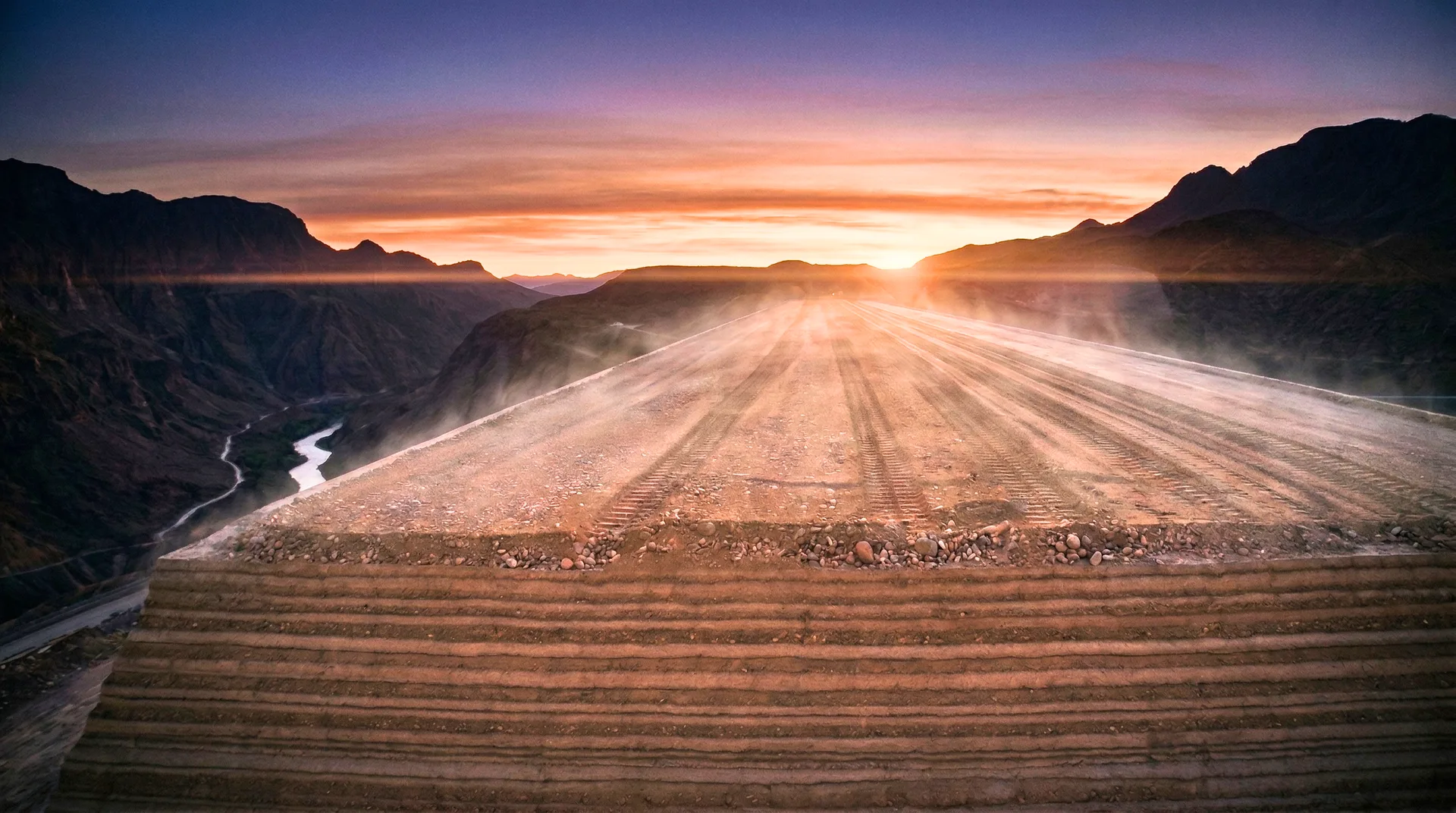
Roller compacted concrete offers a 25-40% cost advantage over conventional concrete gravity dams, with significantly faster placement rates. Over 650 RCC dams have been completed or are under construction worldwide. For pumped storage upper reservoir dams where speed of construction directly affects project economics, RCC is increasingly the default choice.
However, RCC in PSH has a nuance that conventional RCC dams do not face: lift joint quality must account for cyclic loading and daily water level fluctuation. Lower cohesion at lift surfaces, combined with repeated immersion-drying cycles, means lift joint treatment protocols for PSH dams may need to be more stringent than standard practice.
Concrete-Faced Rockfill Dams (CFRD)
CFRD remains common for PSH. Pinnapuram uses rockfill embankments with an average height of 12-14 metres (maximum 35 metres) stretching 9.6 kilometres. The concrete face provides waterproofing on the rockfill body.
The Taum Sauk failure in the United States, where a CFRD upper reservoir breached catastrophically, and its subsequent rebuild as the largest RCC dam in North America, serves as a cautionary example of what happens when upper reservoir dam concrete integrity is compromised.
High-Performance Concrete
HPC is specified for flow channels, turbine chambers, and any surface exposed to high-velocity reversible flow. Abrasion resistance and low permeability are the critical performance parameters.
Self-Compacting Concrete
Tehri PSP demonstrated the value of SCC for complex underground structures where conventional placement and vibration are difficult or impossible. The jump formwork technique used at Tehri for surge shaft construction relied on SCC’s ability to flow into dense reinforcement cages without segregation.
Shotcrete
Initial tunnel support and underground cavern stabilization rely heavily on fibre-reinforced shotcrete. With tunnels running 930-1,255 metres at Tehri, 760 metres at Pinnapuram, and up to 27 kilometres at Snowy 2.0 in Australia, shotcrete quality and durability are critical to project success.
India-Specific Challenges
Seismic Risk
Most Himalayan PSH sites fall in Seismic Zones IV and V, the highest vulnerability categories. The Indian plate continues thrusting against the Eurasian plate, and reservoir-induced seismicity has been specifically noted as a concern for Tehri. Complex geology with shear zones, folds, faults, and lineaments complicates foundation design and underground excavation.
Environmental Constraints
Environmental clearance is a significant bottleneck. While 124 Terms of Reference and 9 Environmental Clearances have been issued for PSP since 2013, 70% of these came after FY 2022-23, reflecting the recent acceleration. The 2,000 MW Sharavathi PSP in Karnataka has been on hold since November 2025 due to concerns about 287 acres of evergreen forest and a lion-tailed macaque sanctuary.
Off-stream closed-loop designs minimize environmental impact and are increasingly preferred. In August 2025, off-stream closed-loop PSPs were exempted from Central Electricity Authority concurrence requirements, streamlining approvals.
The Peninsular Shift
The geography of India’s PSH pipeline is shifting. While early projects were concentrated in the Himalayas and Western Ghats, the current pipeline is moving toward peninsular India. Andhra Pradesh leads with 43.89 GW of identified potential and a target of 22 GW by 2030. Over 57% of the planned 51 GW capacity is concentrated in Andhra Pradesh and Maharashtra.
These peninsular sites offer better geology, silt-free water, easier accessibility, and proximity to renewable energy generation. The concrete challenges are different from Himalayan sites: less seismic risk, no freeze-thaw, but potentially higher ambient temperatures affecting concrete placement and curing.
What the Numbers Mean for Concrete Demand
Consider what 100 GW of pumped storage means in concrete volume:
Each project requires upper and lower reservoir dams, tunnels, underground powerhouses, surge shafts, penstocks, and ancillary structures. A single 1,000 MW project like Tehri involves multiple tunnels, surge shafts over 20 metres in diameter, and a powerhouse cavern the size of a cathedral.
At the planned scale of 39 projects by 2032 and potentially hundreds more by 2036, the cumulative concrete demand will be measured in tens of millions of cubic metres. The mix design, thermal control, placement engineering, and QC systems for this concrete will directly affect whether projects meet their cost and schedule targets.
India’s hydropower sector already has a troubled history with concrete-related delays and cost overruns. The Koyna Left Bank PSP (80 MW) was delayed 12 years with a 473% cost overrun. Tehri PSP’s cost escalated from Rs 1,657.60 crore to Rs 4,825.60 crore. These overruns have complex causes, but concrete technology problems, foundation issues, and geological surprises during underground excavation are recurring contributors.
The Opportunity
Pumped storage is not a niche technology. At 189 GW globally and growing, it provides over 90% of existing grid-scale energy storage. Its round-trip efficiency of 75-80% and lifespan of 50+ years make it fundamentally different from battery energy storage systems (BESS), which offer 10-15 years of service life.
India’s 100 GW ambition, if even partially realized, represents the largest single sustained demand for dam and underground concrete engineering in the country’s history. The question is not whether these projects will be built. The policy support is there. The investment commitments are there. The renewable energy integration need is real.
The question is whether the concrete technology expertise exists at the scale required to deliver them without repeating the delays and overruns that have characterized past hydropower construction. That is a question the industry needs to answer now, not after the first foundation pour.