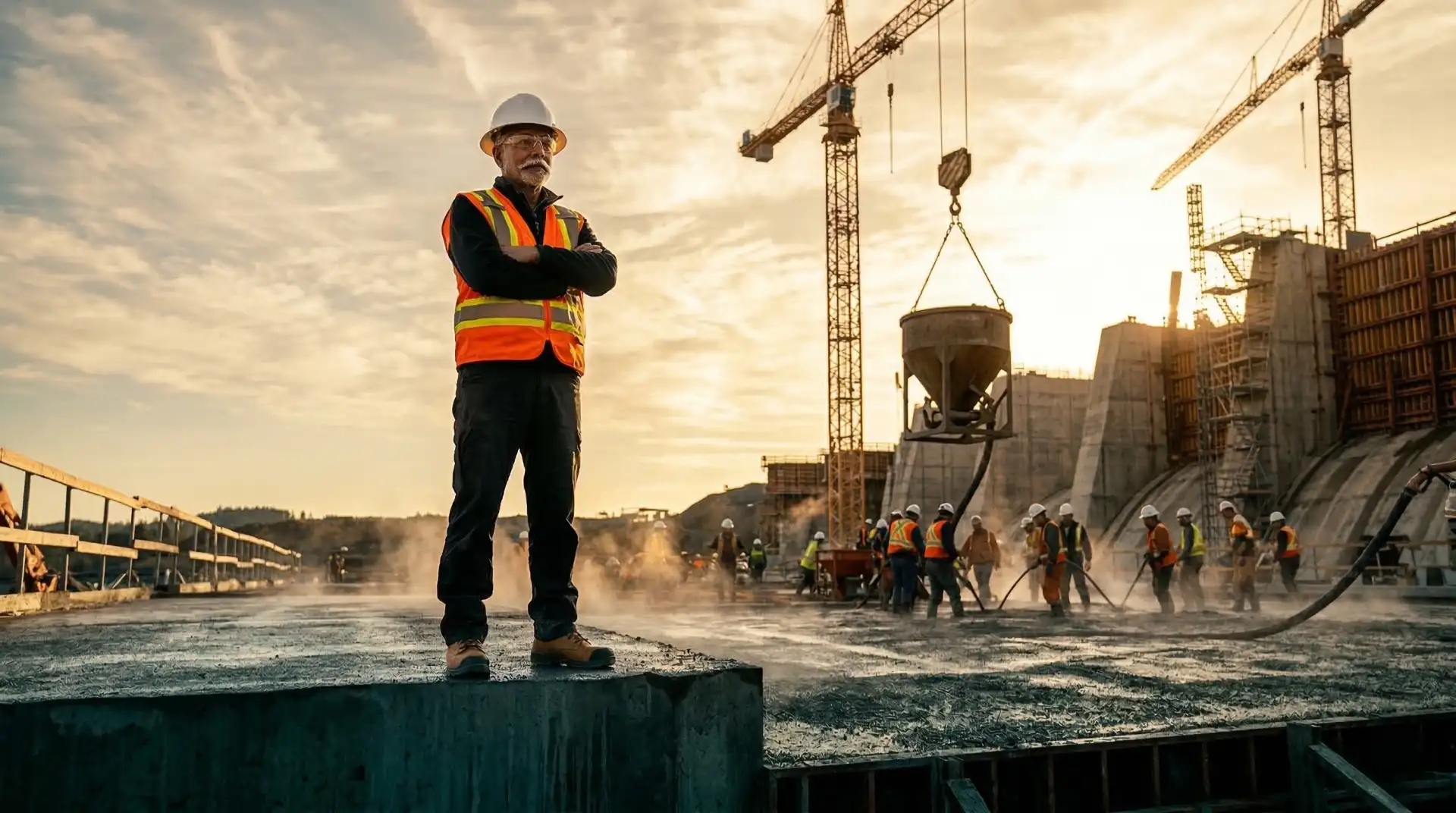

There is a role on every major dam project that determines whether the concrete performs for 100 years or develops problems within the first decade. It is not the structural designer (who determines the dam’s shape and dimensions). It is not the geotechnical engineer (who characterises the foundation). It is not the contractor’s site manager (who coordinates the construction activities).
It is the concrete technology consultant.
This specialist engineers the concrete itself: the cementitious system, the mix proportions, the thermal control strategy, the placement methodology, and the quality control programme. They translate the structural designer’s performance requirements into material specifications that can be produced, placed, and verified on site. They solve the problems that arise when 500,000 cubic metres of concrete, produced from natural materials in variable conditions over 3-5 years, must meet a specification written before the first aggregate sample was tested.
Selecting the right concrete technology consultant, and defining their scope correctly, is one of the most consequential procurement decisions a project owner makes. Yet it is routinely undervalued, late-stage, and poorly defined.
Why the Selection Matters
The Cost Asymmetry
A concrete technology consultant’s fee on a dam project is typically 0.5-2% of the total concrete cost. For a Rs 500 crore dam with Rs 200 crore in concrete, the consulting fee might be Rs 1-4 crore.
The cost of the problems a good consultant prevents:
- Thermal cracking remediation: Rs 50 lakh to Rs 5 crore per cracking event
- Cold joint grouting: Rs 25 lakh to Rs 2 crore per treatment programme
- AAR-related rehabilitation: Rs 1-10 crore (Rihand Dam’s AAR damage rendered the powerhouse inoperable)
- Schedule delay from concrete quality problems: Rs 1-5 crore per month of delay
- Re-testing and specification disputes: Rs 10-50 lakh per dispute cycle
A single thermal cracking event that the consultant prevents pays for the entire consultancy. The return on investment is asymmetric: the consultant’s fee is a fraction of the cost of any single quality failure.
The Business Case: What a Specialist Consultant Delivers in Practice
Beyond preventing failures, a concrete technology consultant generates measurable project value in ways that are often invisible until you compare projects that had one with projects that did not.
Cement cost reduction through mix optimization. Most dam specifications default to conservative cement contents because the designer has no basis for optimization without site-specific trial data. A specialist consultant develops optimized mixes using fly ash, GGBS, or other supplementary cementitious materials that can reduce cement content by 15-30% while maintaining or improving performance. On a project placing 500,000 m3 of concrete, reducing cement by even Rs 200 per cubic metre saves Rs 10 crore directly. The savings come not from cutting corners but from understanding the materials: which aggregates respond to which cementitious systems, what water-to-cement ratio achieves the target strength with the actual materials available at the site, and how to balance economy with thermal control and durability.
Comprehensive trial mix programmes. A rigorous consultant does not submit mix designs based on textbook calculations. They manage complete trial mix programmes through accredited partner laboratories, testing multiple cementitious combinations against the project’s actual aggregates, water sources, and admixtures. Testing extends to 180 days with interim reporting at 28, 90, and 180 days, because mass concrete with high fly ash content continues gaining strength well beyond 28 days. This level of rigour, conducted to both ASTM and IS/BIS standards where required by multilateral lenders, produces mix designs that are genuinely optimized rather than conservatively safe.
Schedule protection through thermal planning. The Ghatghar Pumped Storage Scheme in Maharashtra lost 13 months and Rs 500 million when a mid-project switch from conventional to roller compacted concrete failed to deliver the expected time advantage. The root cause: the thermal behaviour, aggregate logistics, and realistic placement rates of RCC were not properly analyzed before the decision. A consultant’s thermal control plan, developed at the pre-tender stage, prevents exactly this type of schedule failure by establishing placement rates, lift thicknesses, cooling requirements, and inter-lift intervals based on thermal modelling rather than assumptions.
Compliance confidence for multilateral-funded projects. Projects funded by the Asian Development Bank, World Bank, or AIIB typically require independent verification of concrete technology decisions. The consultant’s documentation (trial mix reports, thermal analyses, QC programme design) satisfies lender requirements and prevents funding disbursement delays. For projects like Tanahu Hydropower in Nepal, where ACI and ASTM standards are contractually required alongside Indian practice, the consultant ensures dual-standard compliance without duplication.
100-year accountability in a 6-month window. Dam concrete is designed for a service life exceeding 100 years. But the decisions that determine whether the structure actually lasts that long, the cementitious system, the aggregate selection, the AAR mitigation strategy, the thermal control regime, are all made within the first 6 months of construction. After that, the concrete is placed, and what is inside it cannot be changed. The consultant’s value is concentrated in this narrow window where the cost of getting it right is negligible compared to the cost of getting it wrong.
The Knowledge Gap
Dam concrete is a speciality within a speciality. A structural engineer who designs the dam may not have deep expertise in cementitious materials, thermal modelling, or placement engineering. A construction contractor who builds the dam may not have expertise in mix design optimisation, AAR prevention, or grouting design.
The concrete technology consultant bridges this gap with knowledge that is both deep (materials science, thermal physics, chemistry) and practical (what works on site, what does not, and why the laboratory and the field always differ).
When to Engage
Pre-Tender (Ideal)
Phase: Project feasibility and detailed project report (DPR) preparation.
What the consultant does:
- Reviews the geological investigation results for aggregate suitability, AAR potential, and foundation treatment requirements
- Develops preliminary mix design parameters for the DPR cost estimate
- Designs the thermal control strategy (pre-cooling, post-cooling, placement scheduling) that affects the project schedule and cost
- Specifies the concrete testing programme for the tender documents
- Defines acceptance criteria that are achievable, measurable, and enforceable
Why it matters: Decisions made at the DPR stage are embedded in the tender documents. If the concrete specification is poorly written (unrealistic temperature limits, inappropriate strength criteria, missing AAR provisions), the contractor bids against a flawed document. Problems emerge during construction as specification disputes, variation claims, and quality failures.
Post-Award (Common but Suboptimal)
Phase: After the construction contract is awarded, during mobilisation.
What the consultant does:
- Reviews the existing specification and identifies gaps or inconsistencies
- Develops the detailed mix design programme (trial mixes, material qualification)
- Designs the thermal control and QC programmes within the constraints of the existing specification
- Provides construction-phase support
Why it matters less: The consultant inherits decisions they did not make. The specification is fixed by the contract. The project schedule is committed. The consultant’s influence is limited to execution within the existing framework, not to shaping the framework itself.
Construction Phase Only (Reactive)
Phase: Called in when problems arise during construction.
What the consultant does:
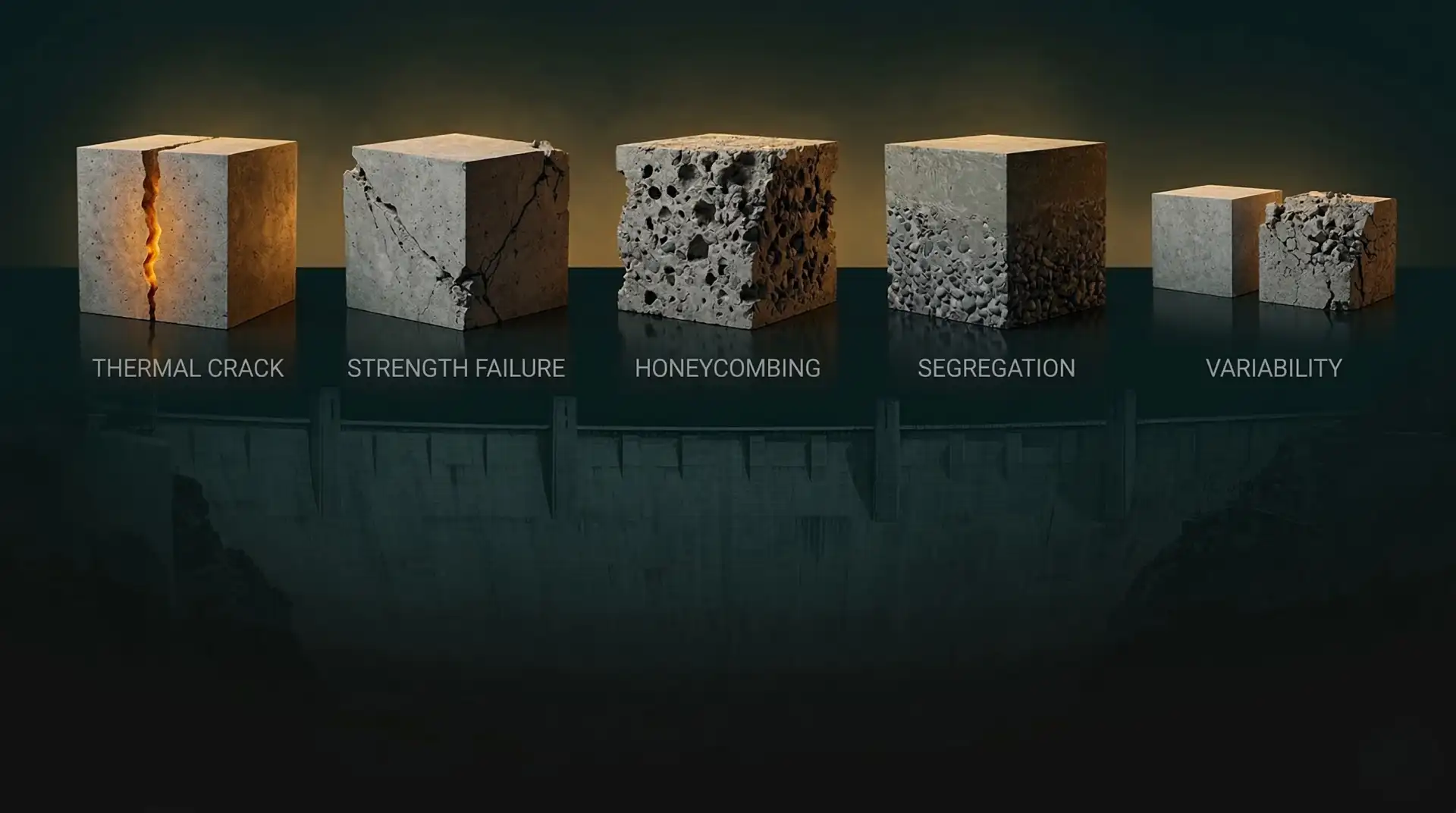
- Diagnoses the cause of quality failures (cracking, cold joints, low strength, honeycombing)
- Recommends remedial measures
- Mediates specification disputes between the owner and contractor
Why it matters least: The consultant is firefighting, not engineering. The problems they are called to solve were often preventable if a consultant had been engaged at the pre-tender stage.
Defining the Scope
A complete scope of work for a concrete technology consultant on a dam project includes:
1. Material Investigation (Pre-Construction)
- Aggregate source identification and testing (physical, chemical, petrographic, AAR potential)
- Cement and SCM evaluation (fly ash, GGBS, silica fume sources and quality)
- Admixture compatibility testing
- Water quality assessment
2. Mix Design Development
- Trial mix programme design and supervision
- Mix design for all concrete types: mass concrete (interior), HPC (spillway, stilling basin), shotcrete (tunnels), grout (foundation, contact, curtain), RCC (if applicable)
- Optimisation for thermal performance, durability, workability, and economy
- Design age selection (28, 90, 365 days) and interim acceptance criteria
3. Thermal Control Plan
- Finite element thermal modelling of the dam section
- Pre-cooling system design (chilling plant, ice plant, aggregate cooling)
- Post-cooling system design (pipe layout, flow rates, duration)
- Placement scheduling (lift height, interval, seasonal adjustments)
- Thermal instrumentation plan (sensor locations, monitoring system, alarm thresholds)
4. QA/QC Programme
- Testing programme design (what tests, at what frequency, with what acceptance criteria)
- Laboratory setup requirements (equipment, calibration, staffing)
- Non-conformance reporting and disposition procedures
- Statistical analysis framework for test results
5. Construction Support
- On-site presence during critical placements
- Placement engineering (lift sequencing, joint treatment, curing)
- Real-time problem solving (batching issues, admixture adjustments, weather response)
- Monthly concrete technology reports
6. Grouting
- Foundation grouting design (curtain, consolidation, contact)
- Grout mix design and testing
- Grouting supervision and quality control
7. Independent Review
- Review of the contractor’s concrete programme against the specification
- Acceptance or rejection of material sources, mix designs, and construction methods
- Expert opinion on disputes between owner and contractor
Evaluation Criteria
Project Experience (40% typical weight)
- Number and type of dam projects (gravity, arch, RCC, pumped storage)
- Total concrete volume supervised across career/firm
- Geographic relevance (Indian/South Asian dam experience)
- Specific experience with the challenges of the project (RCC, high altitude, seismic zone, hot weather)
Key Personnel (30% typical weight)
- Individual experience of the proposed project lead (not firm experience)
- Number of years on dam sites (not in offices)
- Published papers and conference presentations (evidence of technical leadership)
- Availability commitment (will the proposed lead actually be on site, or will a junior substitute appear?)
Technical Approach (20% typical weight)
- Understanding of the project’s specific challenges (demonstrated in the methodology)
- Proposed thermal control approach
- Proposed QC programme structure
- Knowledge of applicable standards (IS, ACI, ICOLD)
Cost (10% typical weight for QCBS)
- For qualification-based selection (QBS, used for complex consultancies): cost is not an evaluation criterion
- For quality-and-cost-based selection (QCBS): cost weight should be low (10-20%) to ensure quality is not sacrificed for price
Red Flags in Evaluation
- Firm experience without personnel experience: The firm has a portfolio, but the proposed personnel have not worked on the credited projects
- No dam-specific experience: General concrete consulting experience does not transfer directly to dam construction
- No published work: A leading concrete technology specialist without any papers, articles, or conference presentations is unusual
- Overcommitted key personnel: The proposed lead is already committed to another project during the critical period
- Price significantly below market: A consultant offering to do dam concrete work at half the market rate is either understaffing the project or misunderstanding the scope
The Owner-Consultant Relationship
Independence
The consultant must have the contractual independence to enforce quality requirements even when they conflict with the contractor’s preferences. This requires:
- Direct reporting to the project owner (not through the contractor)
- Contractual authority to reject non-conforming concrete
- Access to all test results, production records, and construction activities
- Protection from contractor pressure (the consultant’s fee should not be contingent on the contractor’s satisfaction)
Continuity
Concrete technology consulting on a dam project spans 3-7 years. The lead consultant must be committed for the full duration. Rotating junior staff through the role destroys continuity, institutional knowledge, and the credibility needed to enforce standards.
Site Presence
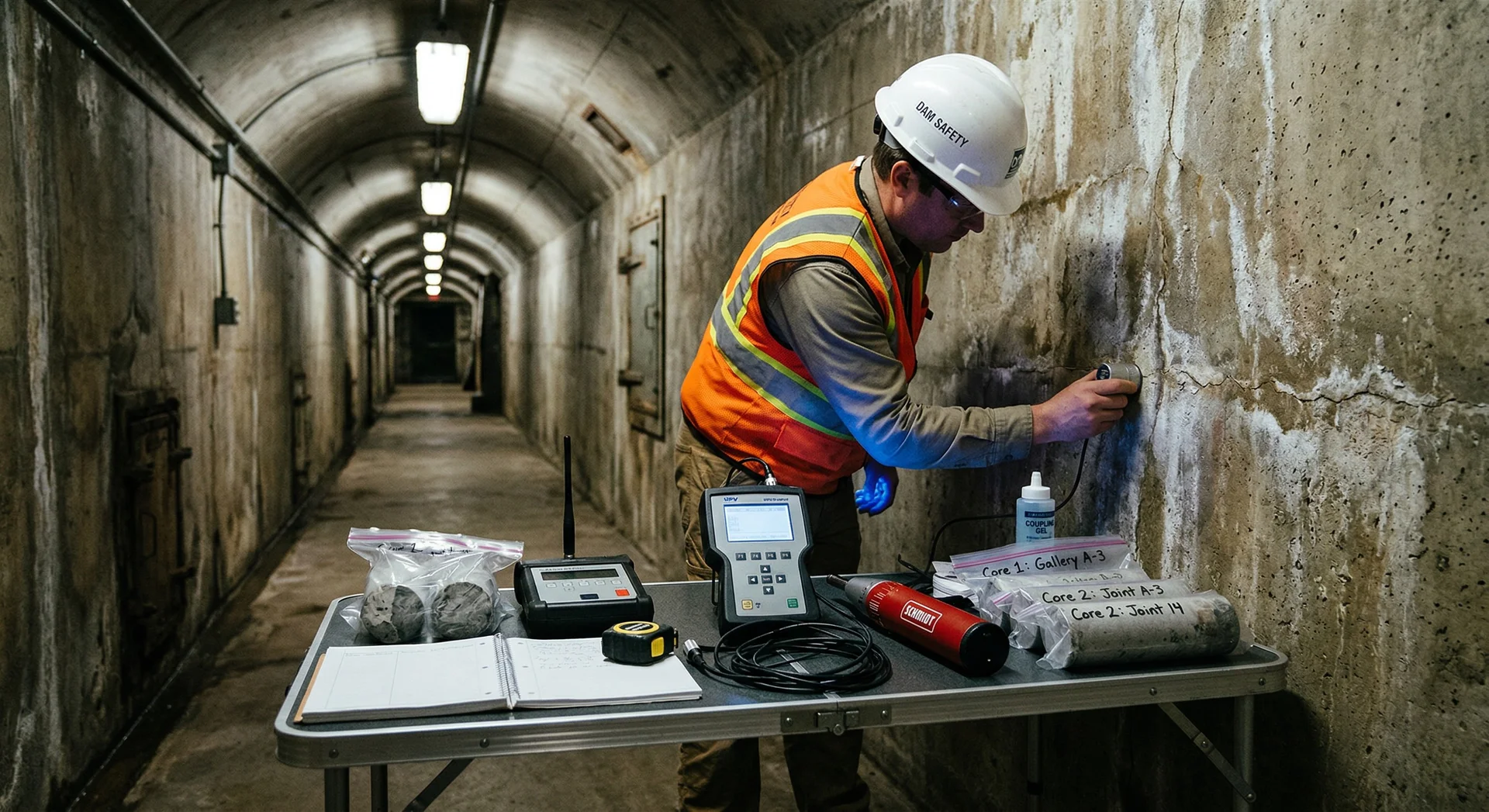
The consultant must be on site during critical activities: first placements, gallery pours, spillway pours, foundation grouting, and any period of intensive placement. Remote review of test results is not consulting: it is auditing. The value of a concrete technology consultant is in their presence at the placement face, not in their review of reports.
What the Consultant Delivers
At the end of the project, the concrete technology consultant’s deliverables include:
- Approved mix designs for all concrete types, with full documentation of the trial mix programme
- Thermal control plan with as-built thermal records showing compliance
- QC records including all test results, NCRs, and dispositions
- Grouting records for foundation, contact, and any remedial grouting
- Concrete performance report summarising the quality achieved across the project
- Recommendations for long-term monitoring and maintenance
These documents become part of the dam’s permanent record. When a safety assessment is conducted 30 years later, these are the records that reveal what concrete was placed, how it was tested, what problems were encountered, and how they were resolved.
The Bottom Line
The concrete in a dam is the dam. The structural design determines the shape. The foundation determines the base. But the concrete is the material that resists the water, bears the load, and endures the decades.
The specialist who engineers that concrete, who selects the materials, designs the thermal plan, specifies the QC programme, and solves the problems on site, is the concrete technology consultant. Their contribution is invisible in the finished structure but embedded in every cubic metre.
Selecting the right consultant is not a procurement exercise. It is a project performance decision. The few crore spent on expert concrete technology consulting buys assurance that the hundreds of crore spent on concrete placement will produce a structure that performs for its design life.
The dam will stand for 100 years. The decisions about its concrete are made in the first 100 days of the consultant’s engagement. Choose well.