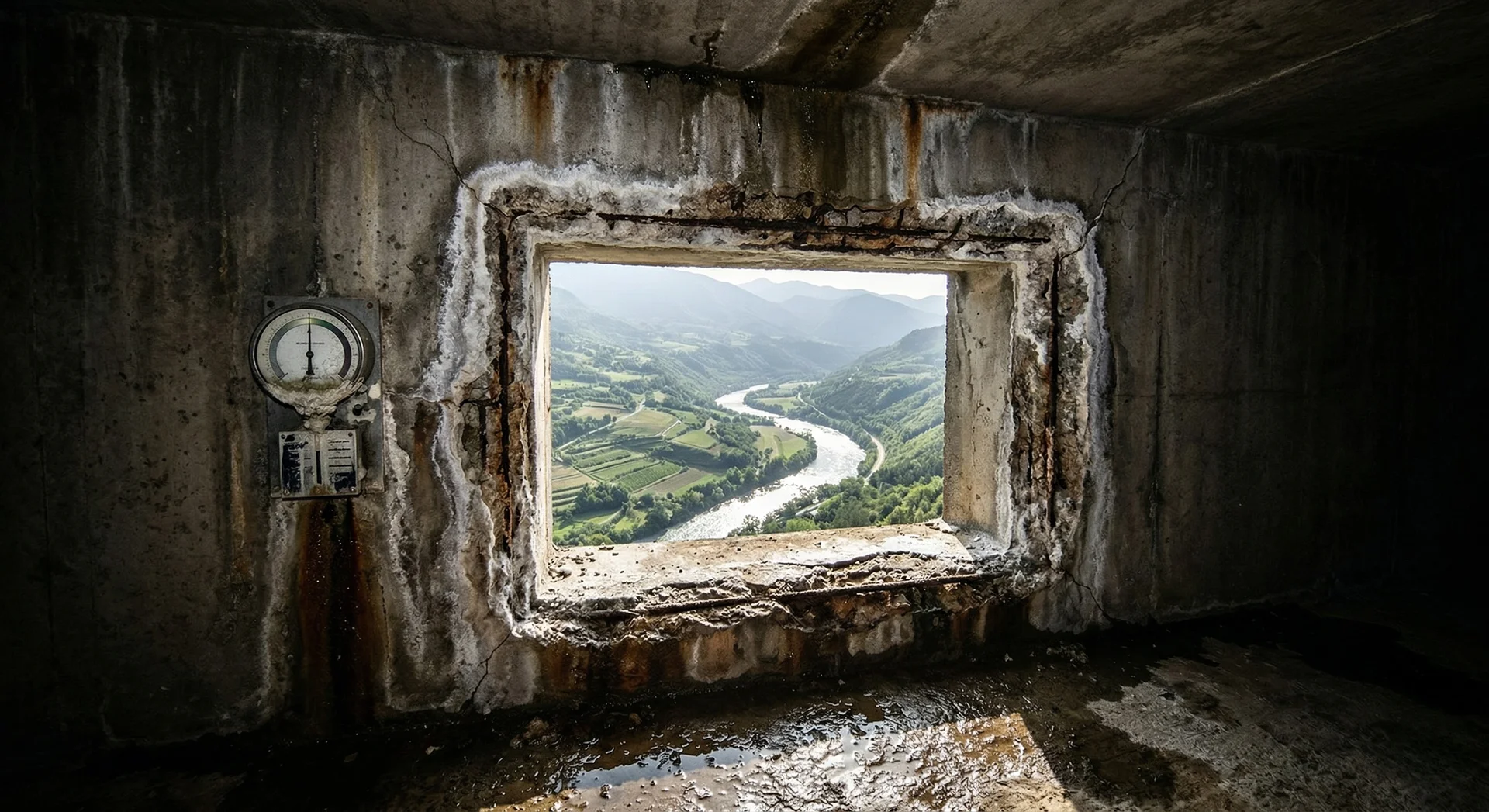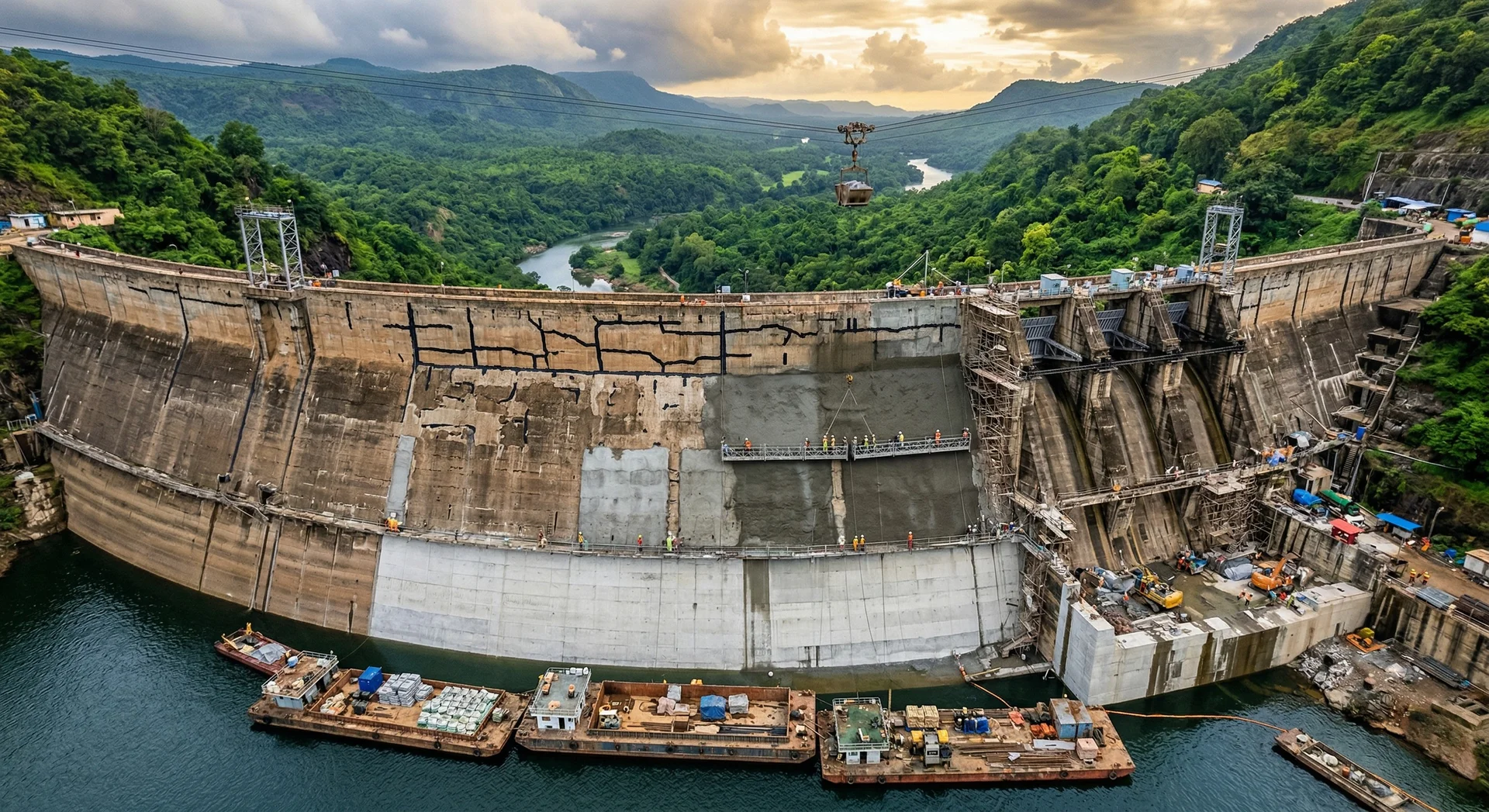
India’s dam concrete is aging at scale. More than 80% of the country’s 5,700+ large dams have passed 25 years of service. Per the Jal Shakti Ministry’s 2024 statement, 1,065 are between 50 and 100 years old, and 224 are over a century old. Globally, ICOLD estimates that more than 40% of the world’s dams are in a phase of progressive deterioration, and over 100 large dams have been identified as seriously affected by alkali-aggregate reaction alone.
The traditional approach to assessing this deterioration is fundamentally reactive. Engineers inspect, core, test, and characterise the damage that has already occurred. Rehabilitation decisions are based on the current condition, with future deterioration projected using empirical models calibrated decades ago to laboratory data that may not represent the dam’s actual materials, exposure, or construction history.
Machine learning offers a different approach: models trained on deterioration data that learn the non-linear relationships between environmental exposure, material properties, and degradation rates, producing predictions that improve as more data accumulates. The RILEM TC 315-DCS comprehensive review (2025) documented the state of ML in concrete durability across carbonation, chloride penetration, sulphate attack, frost damage, and corrosion, finding that approximately 30% of models now use ensemble methods and that accuracy has improved significantly since 2020.
The question for dam engineers is specific: can these models work for dam concrete, which differs fundamentally from the structural concrete they were trained on?
What ML Can Predict Today
Carbonation Depth
Carbonation, the neutralisation of concrete’s alkaline pore solution by atmospheric CO2, is the dominant deterioration mechanism for exposed concrete surfaces. ML models for carbonation prediction are the most mature in the literature.
XGBoost achieves the highest reported accuracy: R-squared = 0.977, RMSE = 2.27 mm on a database of 688 samples. A stacking-ensemble ANN trained on 1,031 data points from 13 countries achieved R-squared = 0.91 and RMSE = 1.43 mm. A standalone ANN achieved R-squared = 0.95 for natural environment exposure conditions.
For dam concrete, carbonation has a specific relevance profile. Unreinforced mass concrete in the dam body has no reinforcement to corrode, making carbonation structurally less critical than in reinforced structures. However, reinforced concrete in powerhouses, galleries, piers, and abutments is vulnerable. The carbonation models’ applicability to dam concrete is limited by the different mix proportions: dam concrete’s lower cement content (120 to 180 kg/m3 versus 300 to 400 for structural concrete) produces lower calcium hydroxide reserves and different carbonation kinetics than the training data assumes.
ASR/AAR Expansion
Alkali-aggregate reaction is the deterioration mechanism with the highest consequence for dam structural integrity. ICOLD’s 1985 survey documented 76 confirmed AAR cases in hydraulic structures, and expansions have been observed to continue unabated after 40+ years in many affected dams.
ML prediction of ASR expansion has achieved remarkable accuracy on laboratory data:
| Model | Metric | Value | Dataset |
|---|---|---|---|
| XGBoost | R-squared | 0.98 (test) | Standard algorithms comparison |
| PSO-XGBoost | R-squared | 0.9695 | Particle swarm optimised |
| Hybrid Ensemble | R (correlation) | 0.972 | 1,997 data sets |
| Hybrid Ensemble | RMSE | 0.066 mm | Same study |
Key input features driving prediction accuracy include reaction days, alkali content, aggregate particle size, and silica content (contributing up to 35% of variation). SHAP explainability analysis, which became standard after 2020, allows engineers to understand which input variables most influence the prediction for a specific case.
The critical limitation: these models predict expansion from accelerated laboratory test parameters. Translating laboratory ASR expansion to in-situ structural behaviour of a specific dam requires coupling the expansion model with structural finite element analysis. A 3D simulation of alkali-silica expansion applied to a real gravity dam showed good correlation between computed crest displacements and 25 years of in-situ measurements, but this remains a research result, not a standardised methodology.
Chloride Ingress
Chloride-induced reinforcement corrosion affects dam concrete in marine environments, de-icing salt exposure (rare for dams), and groundwater with high chloride content. A CNN framework trained on 284 samples achieved R-squared = 0.849 for surface chloride concentration prediction. Ensemble models combining ANN and random forest outperform single models for chloride migration coefficient prediction.
ACI 365.1R-17 (Report on Service Life Prediction) and the Life-365 companion software provide the traditional framework for chloride-driven service life prediction. ML enhances these by handling non-linear interactions between SCM type, w/cm ratio, exposure severity, and temperature that the Fick’s law-based models simplify.
The data problem for dams
Nearly all published ML deterioration models are trained on laboratory data from structural concrete (buildings, bridges, marine structures). No peer-reviewed study has trained and validated an ML deterioration model specifically on dam concrete field data. Dam concrete's unique mix proportions, exposure conditions, and deterioration mechanisms make direct model transfer questionable without recalibration.
NDT Data as ML Input
Non-destructive testing generates the spatial and temporal data that ML models need. For dam concrete, the most valuable NDT-to-ML pathways are:
Ultrasonic Pulse Velocity
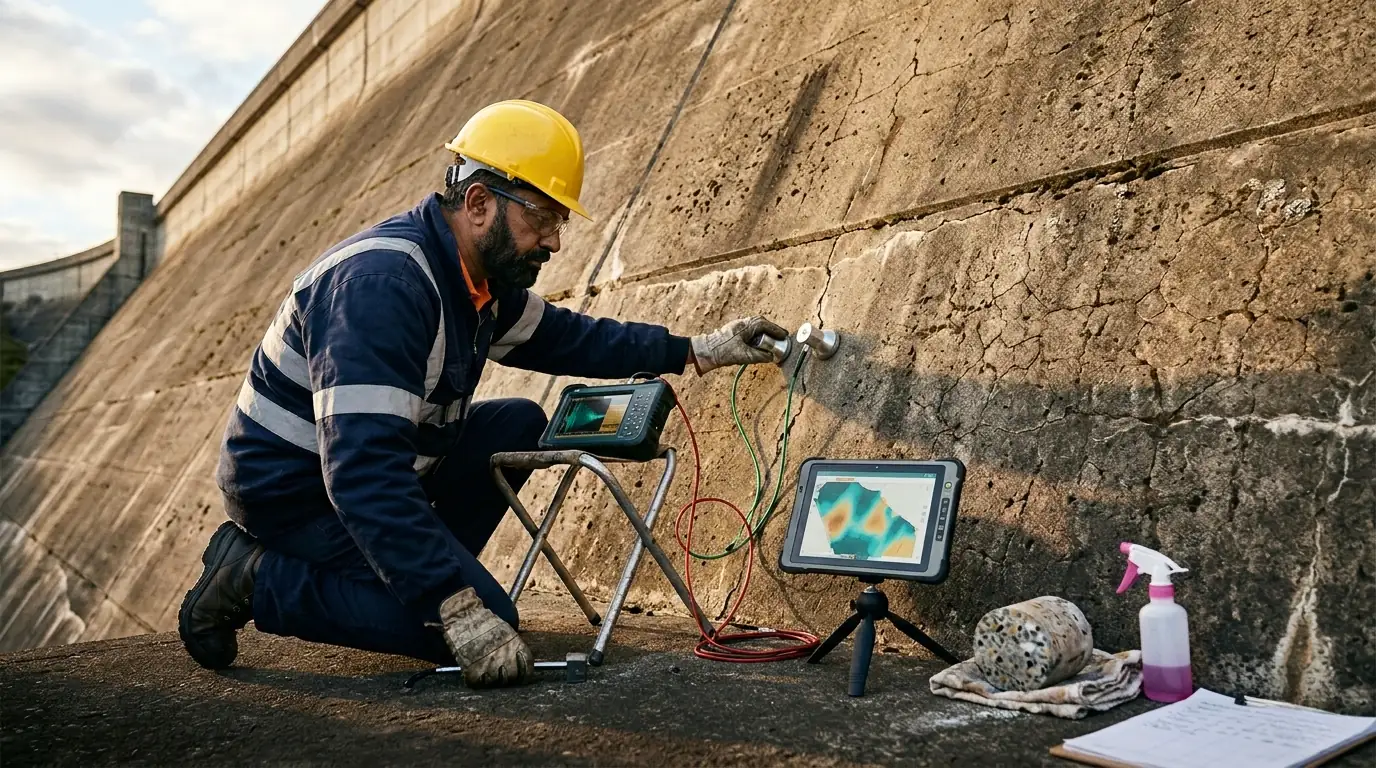
UPV correlates with concrete integrity. Research on ASR/DEF-damaged concrete shows velocity reductions of up to 20% compared to undamaged concrete. ML models using XGBoost and SVR predict UPV values from mix and exposure parameters, enabling comparison between predicted (undamaged) and measured (potentially damaged) values to flag deterioration.
For dam owners, systematic UPV surveys across dam faces create spatial deterioration maps that, when repeated over time, reveal deterioration progression rates suitable for ML trend analysis.
Impact Echo
An ML-based impact echo framework achieved 73% accuracy for automated defect localisation and multi-class classification using k-means clustering, generalised topographic mapping overlays, and LSTM classifiers. This automates a task that traditionally requires expert interpretation of frequency spectra for each test point.
Ultrasonic Deep Learning
An unsupervised deep auto-encoder framework for ultrasonic damage detection achieved 95.0% accuracy for damaged and 93.0% accuracy for intact classification. The unsupervised approach is particularly valuable for dam concrete because it does not require pre-labelled training data: the model learns the statistical signature of intact concrete and flags deviations.
Emerging: Empirical Physics-Informed Neural Networks
EMP-PINNs integrate empirical equations (rebound number correlations, UPV-strength relationships) with neural networks and use generative adversarial networks (GANs) to create comprehensive synthetic datasets. This approach combines the physical grounding of empirical methods with the flexibility of data-driven learning, addressing the training data scarcity that limits pure ML approaches for dam concrete.
The Indian Context: DRIP and the Data Opportunity
Scale of the Problem
India’s dam aging statistics are stark:
- 5,700+ large dams per the CWC National Register of Large Dams (PIB summary), more than 80% older than 25 years
- 1,065 dams between 50 and 100 years old, 224 dams exceeding 100 years (Jal Shakti Ministry, 2024)
- Documented deterioration at major dams including Hirakud (commissioned 1957), Rihand, and Nagarjuna Sagar
The Dam Safety Act 2021 and DRIP Phase II (Rs 10,211 crore covering 736 dams) represent India’s institutional response. In 2024-2025, DRIP conducted over 6,500 pre-monsoon and 6,500 post-monsoon inspections. Interventions include crack treatment, seepage reduction, drainage improvement, and spillway adequacy assessment.
The Untapped Dataset
The inspection data being generated across 736 dams under DRIP constitutes potentially the largest dam concrete condition dataset in the world. If digitised and standardised, it would enable India-specific deterioration models that account for Indian aggregates (including Himalayan reactive aggregates), tropical exposure conditions (monsoon cycling, high ambient temperatures), Indian cement and SCM characteristics, and IS code concrete formulations.
Currently, this data remains largely in paper-based inspection reports or proprietary systems. The gap between the data being collected and the predictive analytics it could support is the single largest missed opportunity in Indian dam safety management.
What DRIP’s Digital Tools Could Become
Current DRIP digital tools focus on administrative functions: inspection scheduling, compliance tracking, and documentation per CWC and BIS requirements. The infrastructure exists to evolve these into predictive platforms:
- Standardise inspection data formats across all 736 dams (condition ratings, NDT results, seepage measurements, core sample test data)
- Centralise in a queryable database with geospatial referencing (dam section, elevation, face)
- Apply trend analysis to identify dams with accelerating deterioration
- Pilot ML prediction on the highest-priority deterioration mechanisms (ASR for Himalayan dams, carbonation for reinforced components, seepage for RCC dams)
Physics-Based vs. Data-Driven vs. Hybrid
The engineering question is not which approach is better in the abstract, but which is appropriate for a given dam at a given stage of assessment.
Physics-Based Models (FEM, Analytical)
Strengths: Mechanistic understanding. Can predict behaviour without historical data. Results are interpretable in engineering terms (stress, strain, displacement). USBR DSO-05-05 provides the framework for modelling material properties of aging concrete.
Limitations: Requires detailed material properties that may not be available for older dams. Computational cost limits real-time application. Cannot capture complex multi-mechanism deterioration (simultaneous ASR, carbonation, and freeze-thaw) without excessive model complexity.
Data-Driven Models (ML/DL)
Strengths: Learn non-linear relationships from data. Handle multiple input variables simultaneously. Improve with additional data. The RILEM TC 315-DCS review shows consistent improvement in accuracy over the past decade.
Limitations: Require large, representative training datasets (dam-specific data is scarce). No physical interpretability without explainability tools (SHAP). Cannot extrapolate beyond the training data distribution. Risk of overfitting to laboratory conditions that do not represent field behaviour.
Hybrid: Physics-Informed ML
The current frontier. Physics-informed neural networks (PINNs) embed differential equations governing concrete behaviour (diffusion, reaction kinetics, mechanical equilibrium) as constraints in the neural network training process. The physics prevents impossible predictions; the ML learns the corrections that the physics oversimplifies.
For dam deformation prediction, a digital twin using deep transfer learning integrated with FEM achieved 47.1% improvement in prediction accuracy over traditional FEM. An LSTM-Kalman filter hybrid model improved R-squared by 11% and reduced RMSE and MAE by approximately 45% for dam deformation monitoring.
For dam concrete deterioration specifically, hybrid approaches are the logical path: use physics-based carbonation or chloride diffusion models as the backbone, with ML learning the residuals from site-specific monitoring data. This addresses the training data scarcity problem (the physics model provides the initial prediction; the ML only needs to learn the site-specific corrections) while maintaining physical plausibility.
Practical Recommendations for Dam Owners
Phase 1: Digitise Existing Data (Immediate)
Convert paper-based inspection reports, NDT results, core sample test data, and seepage measurements into a structured digital database. Use consistent formatting, geospatial referencing (location on dam), and temporal indexing. This is the single most valuable preparatory step and the lowest-cost intervention.
For dams under DRIP Phase II, advocate for standardised digital data collection formats that enable future analytics. The marginal cost of structured data entry versus unstructured reporting is negligible; the downstream value is transformative.
Phase 2: Baseline Deterioration Profiles (6 to 12 Months)
Plot deterioration trends for each monitored parameter: seepage flow rates over time, UPV values across dam faces, crack width progression, carbonation front advance from periodic core samples. Traditional statistical trend analysis (linear regression, moving averages) provides the first predictive layer without requiring ML infrastructure.
This phase identifies which deterioration mechanisms are active, which are accelerating, and which dams require priority attention, using methods that every dam engineer already understands.
Phase 3: Pilot ML Prediction (12 to 24 Months)
For dams with known ASR, train expansion prediction models on the dam’s own monitoring data supplemented by published datasets. For dams with carbonation concerns, calibrate published carbonation models to local conditions using core sample data. Start with gradient boosting or random forest models (simplest effective methods) before advancing to deep learning.
Validate predictions against subsequent inspection results. If the model predicts increasing expansion and the next inspection confirms it, confidence builds. If predictions diverge from reality, recalibrate.
Throughout All Phases
Maintain conventional assessment methods (visual inspection, selective NDT, core sampling, expert panel review) as the primary basis for rehabilitation decisions. ML predictions improve prioritisation and timing. They do not replace the engineering judgment that determines what rehabilitation intervention is appropriate for a specific dam with specific structural, hydrological, and operational constraints.
PCCI’s durability consulting and troubleshooting practice integrates traditional assessment with emerging analytical tools. Our leadership’s 40+ years of hands-on expertise across 4,000+ MW of hydroelectric projects provides the engineering context that no model, however accurate, can substitute.
For dam concrete condition assessment and deterioration analysis backed by decades of hydroelectric project experience, contact PCCI’s consulting team.