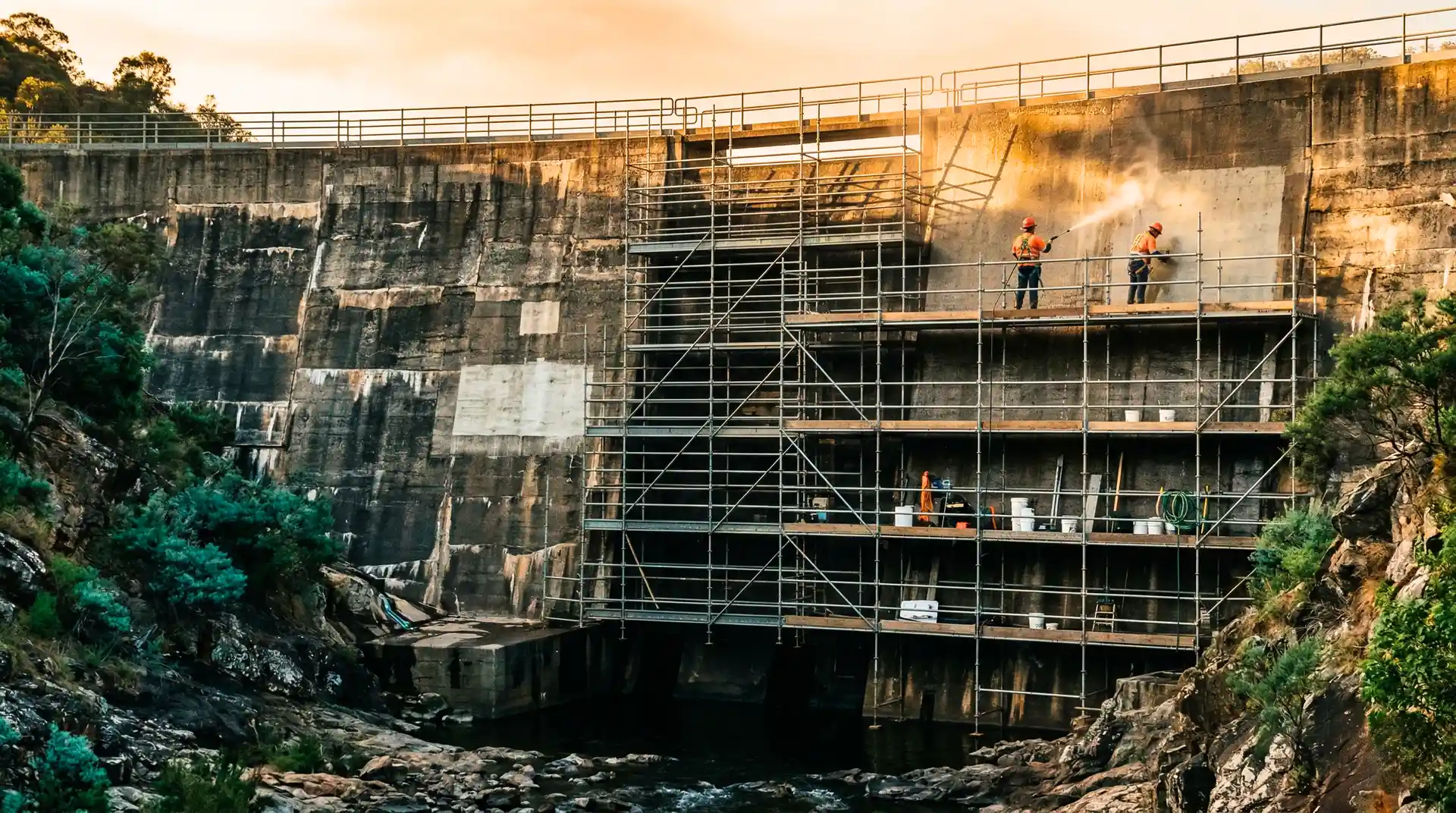

The technical authority on the owner’s side
The Owner’s Engineer is a role created by the structural reality of large infrastructure projects. The owner (typically a public-sector utility, a developer, or a government agency) is paying for the project and is ultimately responsible for its outcomes. The contractor is delivering the project under a contract that defines what is to be done. Between the two stands the Owner’s Engineer: a technical authority that reviews the contractor’s work, witnesses critical activities, raises issues before they become defects, and certifies progress for payment.
The role is well-established in international practice. The FIDIC contract suite (Yellow Book and Silver Book) both contemplate the Owner’s Engineer (sometimes called simply ‘the Engineer’). World Bank, ADB, and JICA project funding typically requires an independent Owner’s Engineer to be appointed and to operate in defined ways. Indian PSU projects use various names for the same function: Project Management Consultant, Authority’s Engineer, or Technical Review Consultant.
For concrete-intensive hydropower projects, the concrete portion of the Owner’s Engineer’s scope is one of the most consequential parts of the engagement. Concrete defects discovered late are very expensive to fix; concrete defects caught at construction by an attentive Owner’s Engineer can be corrected at the contractor’s cost without disrupting the project schedule. The depth and quality of concrete oversight in the Owner’s Engineer scope directly affect the project’s outcome.
What the concrete scope should cover
A well-defined concrete scope for the Owner’s Engineer covers the full project lifecycle.
Pre-construction phase
| Activity | Owner’s Engineer role |
|---|---|
| Specification review | Review draft tender concrete specifications; recommend additions, deletions, and modifications |
| Bidder evaluation | Review bidders’ technical capability for the concrete scope; assess proposed mix design approach |
| Contractor mobilisation | Review the contractor’s proposed concrete production setup, lab, QC team, and method statements |
| Mix design qualification | Review contractor’s mix designs; witness trial mixing and trial pours; recommend approval or revision |
| QC plan review | Review contractor’s project QA/QC plan; verify it meets specification requirements |
Construction phase
| Activity | Owner’s Engineer role |
|---|---|
| Daily concrete operations | Spot-check inspection; review batch plant records; monitor mix consistency |
| Major pours | Full-time on-site witness; pre-pour readiness check; placement supervision |
| Mass concrete (dam body) | Continuous monitoring of thermal control compliance; cooling pipe operation review |
| RCC operations | Lift quality inspection; bedding mortar and joint treatment witness |
| Tunnel concreting | Pre-pour inspection; consolidation witness; contact grouting verification |
| Embedded liner concreting | Liner alignment witness; contact grouting verification |
| QC test results | Independent review of all test results; investigation of non-conformances |
| Independent testing | Periodic independent sampling and testing for verification |
| Non-conformance management | Review NCRs; recommend disposition; witness corrective actions |
| Progress certification | Certify concrete works progress for payment based on quality and quantity |
Commissioning and handover
| Activity | Owner’s Engineer role |
|---|---|
| Pre-impoundment tests | Witness watertightness tests on tunnels and shafts |
| Hydrostatic tests | Witness pressure tests on penstocks, pressure shafts, and embedded liners |
| First filling and operation | Monitor concrete behaviour under first reservoir loading |
| Defect liability period | Periodic inspection during the contractor’s defect liability period |
| Final completion | Recommend release of contractor’s retention and performance bonds |
The owner who reads this scope carefully sees what it actually requires: a senior concrete specialist with deep experience, supported by sufficient junior staff for site presence, with access to specialist mix design and durability expertise as needed.
Sizing the scope for a typical project
The intensity of concrete oversight depends on project complexity, contractor capability, and the owner’s risk tolerance.
For a typical 500 to 1,000 MW gravity dam project with concrete works value of Rs 800 to 2,500 crore over 24 to 48 months, the concrete portion of the Owner’s Engineer scope typically requires:
- 1 senior concrete specialist (full-time during the active construction phase). This person leads the concrete oversight, reviews mix designs, signs off on trial pours, and is the technical authority on disputes.
- 1 to 2 junior QC engineers with rotating on-site presence during major pours. These resources can flex up during peak concrete activities and down during slower periods.
- Periodic involvement of specialist consultants for review activities such as thermal modelling review, durability assessment, RCC mix design verification, and dispute resolution.
- Independent testing laboratory for verification testing, typically with quarterly or monthly sampling depending on project intensity.
Total fee for the concrete-only scope typically runs 0.3 to 0.8 percent of the concrete works value. This excludes the broader Owner’s Engineer scope (geotechnical, hydromechanical, electrical, contracts management) which is typically the larger part of the overall engagement.
Right-size the scope to the contractor's capability
Owners often size the Owner's Engineer concrete scope based on a generic template, regardless of who the contractor turns out to be. This is inefficient. A contractor with strong recent experience in mass concrete or RCC needs lighter oversight on those specific activities; a contractor new to the technology needs much heavier oversight. The scope should ideally be flexible enough to adjust intensity based on the actual contractor selected.
What separates a good Owner’s Engineer concrete team from a generic civil engineering team
The Owner’s Engineer concrete role is sometimes filled by a general civil engineering firm with limited concrete-specific specialism. The result is a team that can witness pours and review documentation but cannot provide the substantive technical input that the owner needs.
A specialist Owner’s Engineer concrete team brings:
- Technical depth in mix design, mass concrete, RCC, durability, and the specific concrete technologies the project requires
- Familiarity with the contractor’s likely playbook from having seen similar projects elsewhere, allowing rapid identification of issues
- Mature judgment on what to escalate, what to negotiate, and what to accept as practical compromise
- Standing relationships with Indian Concrete Institute (ICI), industry standards bodies, and academic researchers for second opinions on novel issues
- Documentation rigour that holds up to the audit standards required by the World Bank Procurement Framework, ADB Operational Procurement Policy, and other multilateral lenders
The premium for a specialist Owner’s Engineer concrete team over a generic civil engineering team is typically 15 to 30 percent of the concrete-scope fee. The avoided cost of one significant concrete defect is usually multiples of that premium.
How to write the concrete scope into the procurement document
The Owner’s Engineer scope of work, including the concrete portion, is typically procured separately from the construction contractor. The procurement document for the Owner’s Engineer should:
- Define the deliverables with specificity: what reports, what frequency, what review activities
- Define the level of effort for each role, with full-time or part-time specifications
- Specify the qualifications for each role, including years of experience, specific project types, and certifications
- Define the relationship with the construction contractor: independent, advisory, decision-making authority
- Set the fee structure (lump sum, time-based, or hybrid) with transparent rate structures
- Define the change-order procedure for scope changes during the engagement
A well-written procurement document attracts qualified consultants and avoids the dispute-rich situation where a generic scope is interpreted differently by the owner and the consultant.
The Owner's Engineer is the cheapest insurance an owner buys
The total Owner's Engineer fee on a typical hydropower project is 1 to 2 percent of the project value. The exposure to concrete defects, schedule delays, and post-construction repair without effective oversight can easily be 5 to 15 percent of the project value. The economics of a competent Owner's Engineer engagement are overwhelming. The question is not whether to invest, but how to specify the engagement so it actually delivers the protection the owner needs.
How PCCI approaches Owner’s Engineer concrete scope
PCCI’s independent review service is built on the experience of the 4,000+ MW portfolio, including Punatsangchhu-1 (1,200 MW) where PCCI’s leadership prepared the comprehensive QC manual that defined the quality framework for the entire concrete program, Mangdechhu (720 MW) where end-to-end QC was managed from inception to commissioning, and Tanahu (140 MW) where ACI and ASTM-aligned consulting was provided to the project authority.
For PSU and EPC clients procuring Owner’s Engineer services on hydropower projects, our QA/QC and mix design services map directly onto the concrete portion of typical Owner’s Engineer scopes.
Book a Technical Call → to discuss your project’s Owner’s Engineer concrete scope requirements.