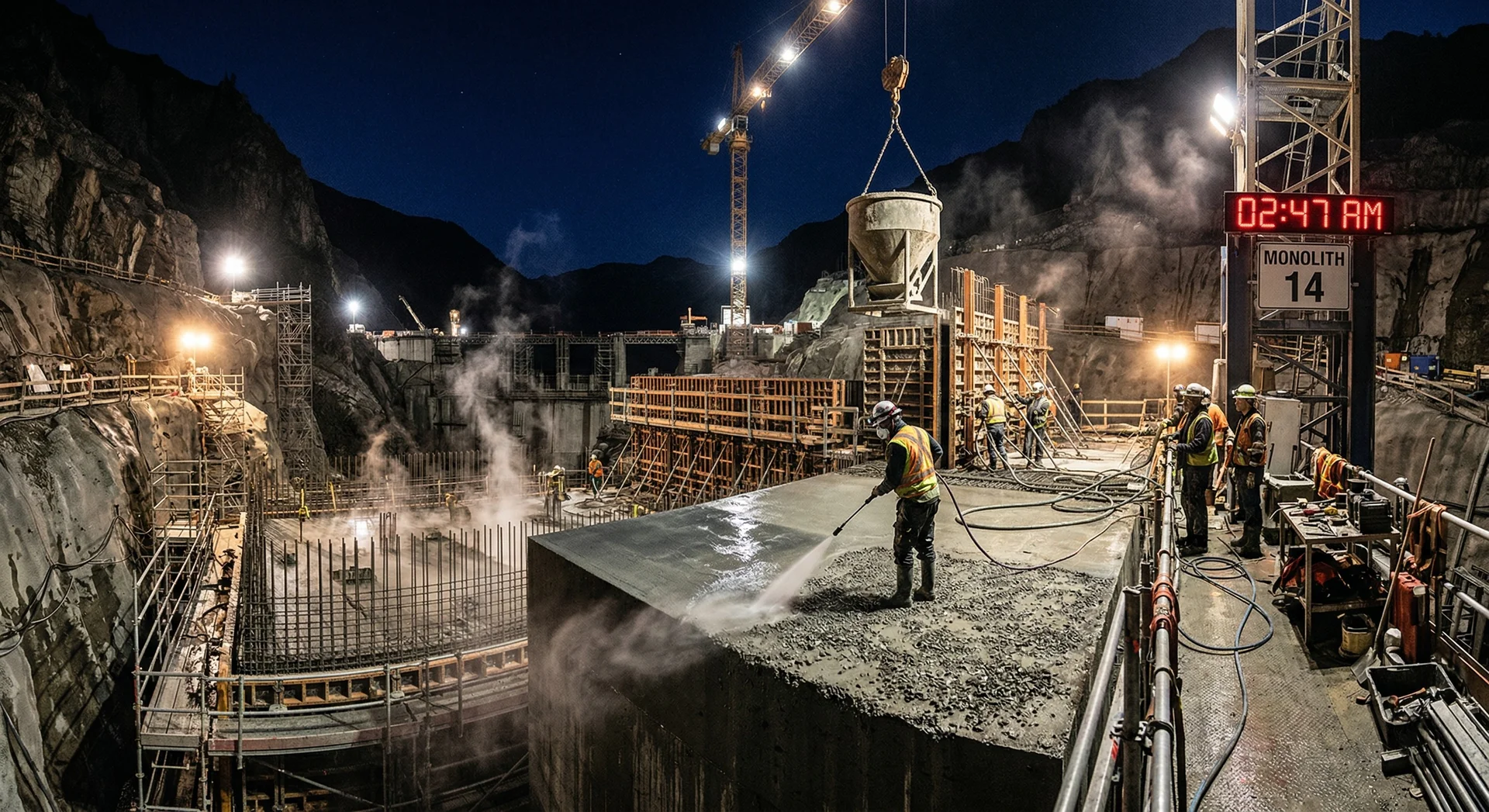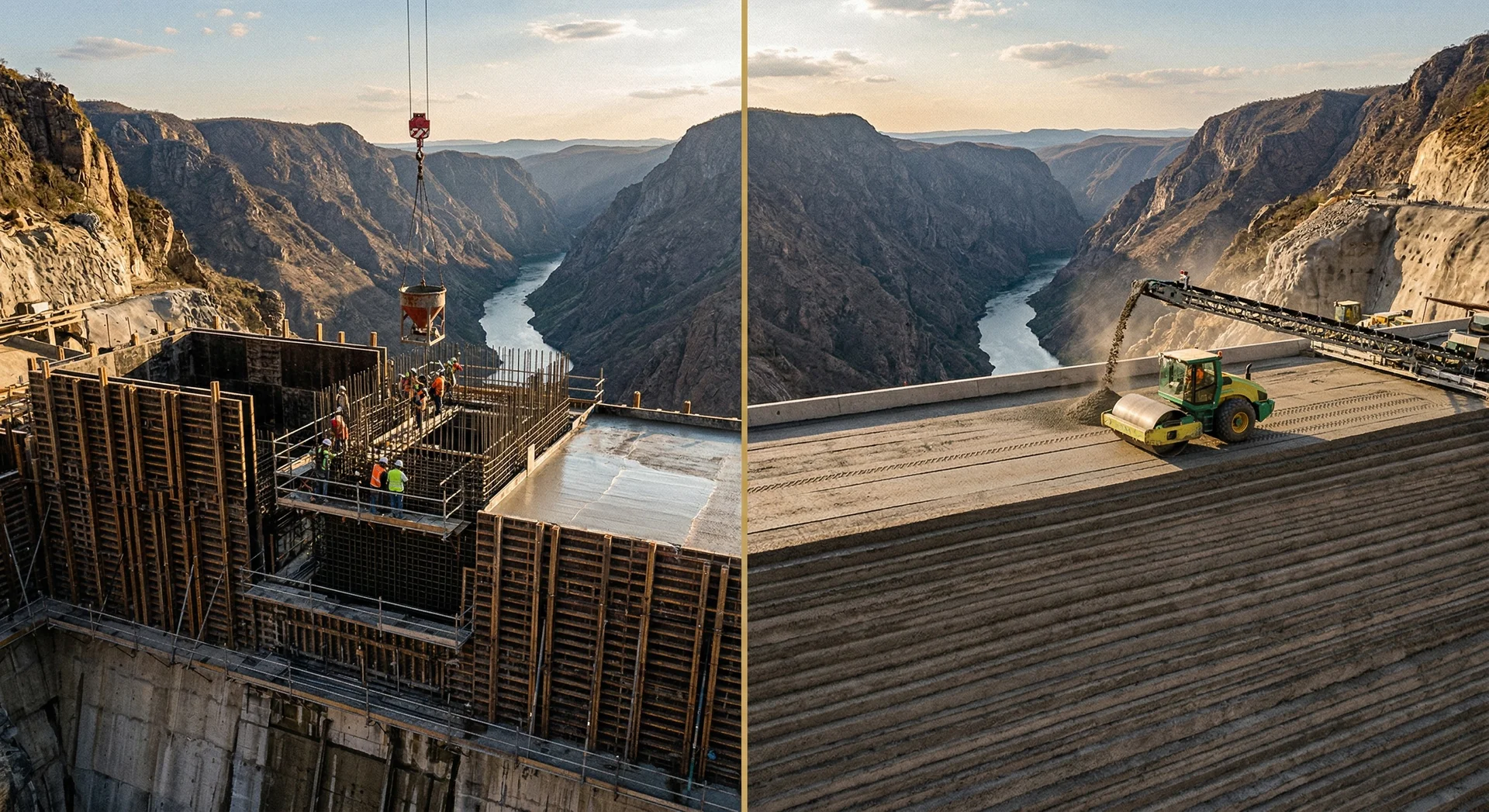

The difference between an RCC dam that performs for 100 years and one that seeps within the first decade often comes down to a 10-20 mm layer of mortar.
RCC is placed in 300 mm lifts. A 60-metre dam has approximately 200 lift joints. Each joint is a potential plane of weakness: lower bond strength, higher permeability, and a preferential path for seepage under hydrostatic pressure.
Bedding mortar is the engineering intervention that addresses this inherent weakness. By spreading a thin layer of paste-rich mortar on the prepared lift surface immediately before placing the next RCC lift, the bond at the joint is enhanced from the 30-50% of parent strength typical of untreated joints to 50-80% with proper mortar application.
The concept is simple. The execution, on a dam where hundreds of joints must be treated consistently across thousands of square metres of surface area, with crews working around the clock to maintain the RCC placement rate, is anything but.
Why RCC Joints Need Mortar
The root cause of weak RCC joints is paste deficiency.
Conventional mass concrete (CVC) has 200-350 kg/m3 of cementitious material, producing abundant paste to fill voids and bond to adjacent surfaces. The differences between RCC and conventional concrete are most pronounced at lift joints. When a new CVC lift is placed on a prepared joint, the paste from the fresh concrete flows into the irregularities of the underlying surface and creates a continuous bond.
RCC has 100-150 kg/m3 of cementitious material. The paste volume is barely sufficient to coat the aggregate particles within each lift. There is no excess paste available to flow into the underlying surface and create the bond that CVC achieves naturally.
The result: the interface between RCC lifts is paste-starved. The coarse aggregate particles from the new lift sit on the surface of the previous lift with minimal paste between them. The contact is physical (aggregate touching aggregate) but not chemical (paste bonding to paste).
Bedding mortar floods this paste-starved zone with additional cementitious material. The mortar fills the surface irregularities of the previous lift, surrounds the bottom aggregate particles of the new lift, and creates a paste-rich transition zone that approaches the bonding effectiveness of CVC joints. The U.S. Bureau of Reclamation has documented this practice extensively in its RCC dam design and construction guidelines.
Joint Classification and Treatment Requirements
The treatment required at each joint depends on the maturity of the underlying RCC surface: how far the hydration has progressed since that surface was placed.
Hot Joint (No Bedding Mortar Required)
Definition: The new lift is placed before the previous lift has reached initial set. Typical timing: Within 4-6 hours in warm conditions (above 25 degrees C), up to 8-12 hours in cool conditions. Treatment: Surface cleaning to remove any contamination (dust, debris, standing water). No mortar required because the previous lift is still fresh enough for the paste in the new RCC to bond directly. Bond strength: 60-80% of parent RCC strength.
Warm Joint (Bedding Mortar Required)
Definition: The previous lift has reached initial set but has not developed significant hardening. Typical timing: 6-24 hours after placement, depending on temperature and mix design. Treatment: Surface cleaning, moisture conditioning (saturated surface-dry), and bedding mortar application across the full joint area (or at minimum the upstream zone). Bond strength with mortar: 50-70% of parent RCC strength. Bond strength without mortar: 30-50% of parent RCC strength.
Cold Joint (Full Treatment Required)
Definition: The previous lift has hardened significantly, with a visible crust on the surface. Typical timing: Beyond 24-48 hours after placement. Treatment: Mechanical surface preparation (green cutting with high-pressure water, or sandblasting/bush hammering for fully hardened surfaces), moisture conditioning, and bedding mortar application across 100% of the joint area. Bond strength with mortar: 40-60% of parent RCC strength. Bond strength without mortar: 20-40% of parent RCC strength.
The modified maturity factor (MMF) method provides a more precise basis for joint classification than elapsed time alone, because it accounts for the actual temperature history of the exposed surface. ACI 207.5R provides detailed guidance on roller-compacted mass concrete including joint treatment protocols. Proper RCC lift joint quality depends fundamentally on accurate joint classification.
Bedding Mortar Mix Design
Standard Mix
| Component | Proportion |
|---|---|
| Cement | 1 part (same type as RCC mix) |
| Fine aggregate | 1-2 parts (passing 2.36 mm sieve) |
| Water | To achieve creamy, spreadable consistency |
| w/c ratio | 0.45-0.55 |
| Fly ash (optional) | 10-20% cement replacement |
| Superplasticiser (optional) | For improved flow in thin application |
Consistency
The mortar must be fluid enough to spread in a uniform thin layer and fill the surface irregularities of the previous lift, but not so fluid that it runs off sloped surfaces or segregates. The flow table test (per ASTM C1437 or equivalent) provides a quantitative measure: target flow of 200-250 mm. The mix design for bedding mortar must be developed alongside the RCC mix to ensure material compatibility.
Thickness
Target: 10-20 mm. This is critical.
Too thin (less than 10 mm): insufficient paste to fill the surface irregularities and bridge between the lifts. The mortar dries out before the RCC is placed.
Too thick (more than 20 mm): the mortar layer becomes a distinct stratum within the dam, with different properties from both the RCC above and below. A thick mortar layer can:
- Create a weak plane (the mortar is weaker in compression than the RCC)
- Shrink and crack during curing (high paste content = high shrinkage)
- Create a plane of different elastic modulus that concentrates stress under load
The 10-20 mm range is a balance: enough mortar to provide bonding but not so much that the mortar itself becomes a weakness.
Batch Size
Mortar should be mixed in quantities that can be applied within 30-45 minutes. Mortar that sits in the bucket begins to stiffen and lose its bonding effectiveness. For a large placement, multiple small batches are preferable to one large batch.
Application Methods
Manual Application (Most Common in India)
Workers spread mortar using shovels, rakes, and brooms. The mortar is dumped on the prepared surface in controlled quantities and spread to uniform thickness.
Advantages: Low equipment cost. Flexible for irregular surfaces and around embedded items. The crew can apply mortar just ahead of the RCC spreading equipment.
Limitations: Labour-intensive. Coverage uniformity depends on crew training and supervision. Slower than mechanical methods.
Mechanical Spreading
A mortar pump delivers mortar through a distribution hose, and the mortar is spread by a mechanical screed or by workers with squeegees.
Advantages: More uniform thickness control. Faster coverage for large, flat joint areas. Consistent delivery rate.
Limitations: Higher equipment cost. More complex setup. Less adaptable to irregular surfaces.
The Advancing-Front Method
The preferred approach for large RCC dams: mortar is applied in a strip just ahead of the advancing RCC placement front. As the RCC spreading equipment moves forward, the mortar crew stays 2-5 metres ahead, applying mortar just before the RCC covers it.
This minimises the time between mortar application and RCC placement, which is the most critical variable in bedding mortar effectiveness. In hot weather concreting conditions typical of Indian dam sites, the advancing-front method becomes even more critical as the timing window shrinks dramatically.
The Timing Window
This is where most bedding mortar failures occur.
The mortar must be applied after the lift surface is prepared and before the next RCC lift is placed. But the mortar itself has a limited working life: once applied, it begins to lose moisture to the underlying concrete surface (which absorbs water from the mortar) and to the air (evaporation, especially in hot weather).
Maximum time between mortar application and RCC placement:
- Cool conditions (below 20 degrees C): 45-60 minutes
- Warm conditions (20-30 degrees C): 30-45 minutes
- Hot conditions (above 30 degrees C): 15-30 minutes
If the RCC is not placed within this window, the mortar has partially set and lost its bonding capacity. Placing RCC on partially set mortar creates a double cold joint: the mortar has set against the previous lift, and the RCC sets on top of the mortar, with poor bond at both interfaces.
The coordination challenge: The mortar crew, the RCC delivery system, the spreading equipment, and the compaction rollers must all move in synchronisation. Any delay in any element, a truck breakdown, a batching plant hiccup, a roller mechanical fault, extends the mortar exposure time and risks the bond quality. Effective cold joint prevention depends on this coordination more than any other single factor.
Quality Control
Pre-Application Verification
Before mortar is applied to any joint:
- Surface preparation verified: clean, free of loose material, saturated surface-dry
- Joint classification confirmed: hot, warm, or cold, based on maturity monitoring or elapsed time
- Mortar mix tested: flow table consistency, visual check for lumps or segregation
During Application
- Coverage visually confirmed: no gaps, no dry patches, no excessive thickness
- Timing recorded: time of mortar application and time of RCC placement for each zone
- Photographs of the mortared surface before RCC placement
Post-Construction Verification
- Core extraction through joints at specified frequency (typically 1 core per 500-1,000 square metres of joint area)
- Visual examination of core at joint: Is the mortar visible? Is the bond continuous? Are there voids at the interface?
- Direct tensile or shear testing of cored joints at 90 or 365 days per ICOLD Bulletin 126 recommendations for RCC dam construction
- Comparison of joint strength with the specification requirement
A comprehensive QA/QC programme must integrate bedding mortar verification into the overall RCC placement quality plan.
The Honeycomb Test
A simple field check: after placing and compacting the first 50-100 mm of RCC over the mortared joint, stop and examine a small exposed area. The mortar should be visible at the interface, with the RCC aggregate embedded into it. If the aggregate sits on top of the mortar without embedding, the mortar was too stiff or was applied too long before the RCC.
Common Failures
Mortar Applied Too Early
The mortar sits on the surface for too long, begins to set, and loses its bonding capacity. The RCC lifts sit on a layer of set mortar with poor bond above and below.
Prevention: Apply mortar in the advancing-front method, just ahead of the RCC placement.
Mortar Applied Unevenly
Thick patches alternate with thin or bare areas. The thick patches create planes of different properties. The bare areas have no improved bond.
Prevention: Trained crew. Consistent application technique. Visual inspection verification before RCC placement.
Wrong Consistency
Too thick (excess water): the mortar flows off sloped surfaces, pools in low areas, and leaves thin areas dry. Too stiff (insufficient water): the mortar cannot spread uniformly or fill surface irregularities.
Prevention: Flow table testing of every batch. Consistent batching with measured water addition. A well-equipped site laboratory is essential for this level of batch-by-batch testing.
Mortar Not Covering Full Joint (Warm Joints)
On warm joints where the specification requires mortar only on the upstream zone (to save time and material), the mortar boundary is often placed too far from the upstream face, leaving a gap. Or the mortar does not extend far enough into the dam section.
Prevention: Clearly marked application zones on the lift surface. QC verification of coverage limits.
The Economics of Bedding Mortar
The material cost of bedding mortar is negligible relative to the total RCC cost: approximately Rs 50-100 per square metre of joint area, or less than 1% of the RCC cost per cubic metre.
The labour cost is more significant: the mortar crew, the coordination effort, and the potential slowdown of the RCC placement rate. For a dam placing 5,000 cubic metres of RCC per day, the bedding mortar operation adds approximately 30-60 minutes per lift cycle.
But compare this to:
- Seepage remediation: Rs 5-25 lakh per metre of dam length for post-construction grouting and repair
- Bond strength deficiency: Structural reassessment and potential strengthening if joint strength testing fails
- Construction claim: Disputes between the owner and contractor over joint quality and specification compliance
The mortar costs rupees per square metre. The consequences of omitting it cost lakhs per metre.
Key Principles
-
Fresh mortar on a clean surface, immediately before RCC placement. These three conditions must all be met simultaneously. Missing any one negates the others.
-
10-20 mm. No more, no less. Thinner loses bonding effectiveness. Thicker creates a distinct weak layer.
-
The timing window is absolute. Mortar that has been sitting on the surface beyond its working life must be removed and replaced. There is no “it looks fine” exception.
-
Verify every joint. Photographs, timing records, and visual confirmation before RCC covers the mortar. Once the RCC is placed, the joint is invisible for the next 100 years.
-
Core and test at regular intervals. The visual QC during construction provides assurance, but only core extraction and bond strength testing prove the joint meets the specification.
Bedding mortar is the simplest material on an RCC dam project: cement, sand, and water. But its correct application, consistently across hundreds of joints over months of construction, is one of the most demanding quality challenges in dam engineering. Engaging a concrete technology consultant with RCC-specific experience can help establish the mortar specifications and QC protocols before the first lift is placed. The dams that get it right perform. The dams that get it wrong seep.