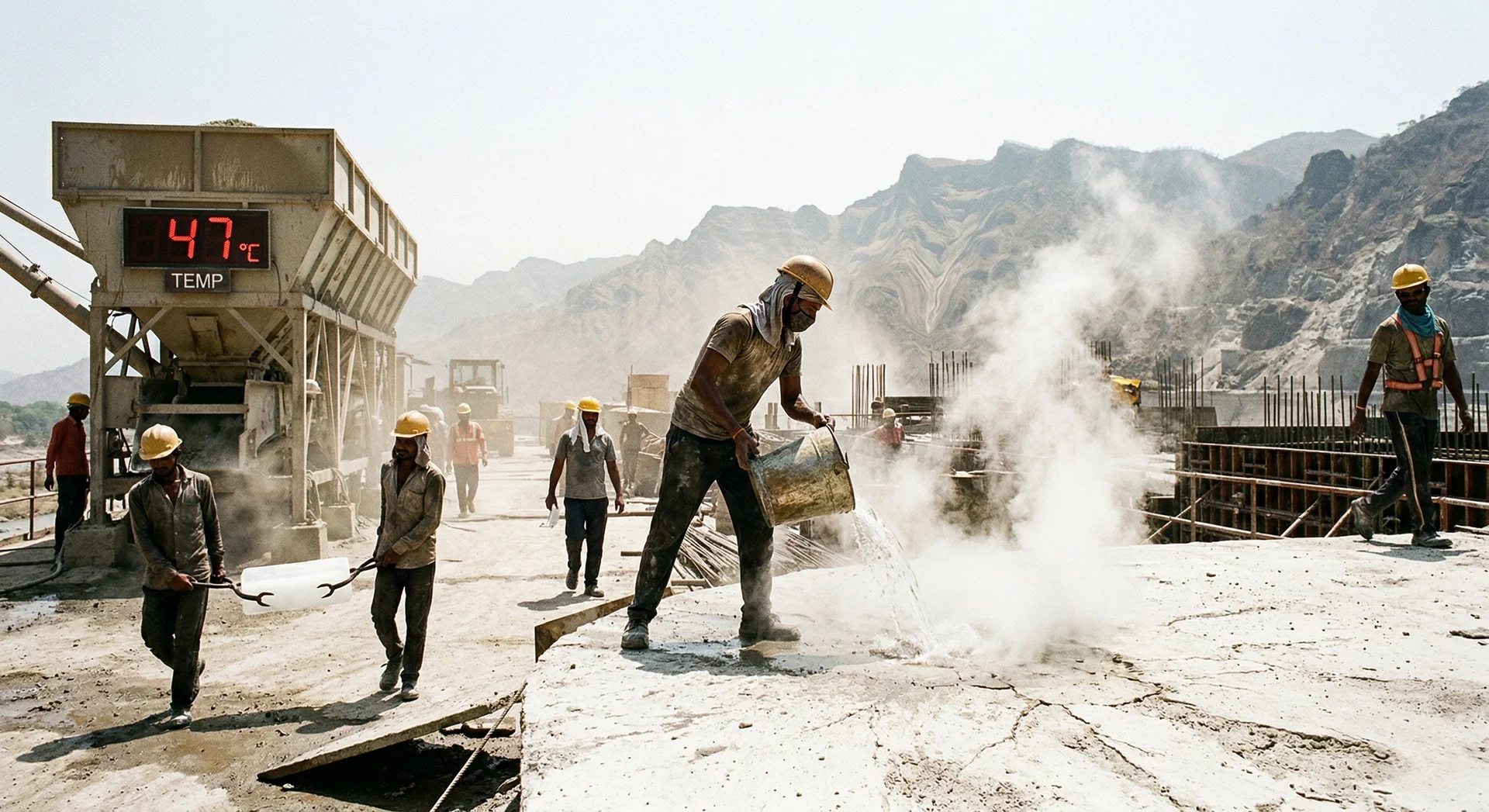
The single most effective thing a dam engineer can do to prevent thermal cracking is to reduce the temperature of the concrete before it enters the forms.
This is not intuitive. The thermal cracking problem in mass concrete comes from heat generated by cement hydration inside the concrete after placement. It seems logical that the solution should focus on removing that heat, through embedded cooling pipes or insulation design. And those post-placement measures do matter.
But the physics is straightforward: the peak temperature inside a mass concrete section is approximately equal to the placing temperature plus the adiabatic temperature rise from hydration. If the placing temperature is 30 degrees C and the adiabatic rise is 25 degrees C, the peak reaches approximately 55 degrees C. If pre-cooling reduces the placing temperature to 15 degrees C, the peak drops to approximately 40 degrees C.
That 15-degree reduction in peak temperature, achieved before the concrete is even placed, reduces the thermal gradient between the interior and the surface, which reduces the tensile stress at the surface, which reduces the probability of thermal cracking. Every degree of placing temperature reduction is approximately one degree of peak temperature reduction. No post-placement measure is as efficient per unit cost.
ACI 207.4R, the definitive reference on cooling systems for mass concrete, dedicates its first chapters to pre-cooling for exactly this reason.
The Thermodynamic Basis
Concrete temperature is a weighted average of the temperatures of its components, each contributing in proportion to its mass and specific heat.
The governing equation:
T_concrete = (Sum of m_i × c_i × T_i) / (Sum of m_i × c_i)
Where:
- m_i = mass of each component (cement, water, coarse aggregate, fine aggregate, ice)
- c_i = specific heat of each component
- T_i = temperature of each component
The specific heats (in kJ/kg per degree C):
- Water: 4.18 (highest)
- Cement: 0.92
- Aggregates: 0.80-0.92 (depends on rock type)
- Ice: 2.09 (plus 334 kJ/kg latent heat of fusion when it melts)
This equation reveals why each cooling method has a different effect: water has the highest specific heat per unit mass, so cooling the water has the greatest impact per kilogram. But aggregates constitute 60-75% of the concrete mass, so even small reductions in aggregate temperature have large effects on the total.
Method 1: Chilled Mixing Water
Principle
Cooling the mixing water from ambient temperature (typically 25-38 degrees C on Indian sites) to 2-5 degrees C reduces concrete temperature in proportion to the water content of the mix and water’s high specific heat.
Temperature Reduction
For a typical dam concrete mix with 120-160 litres of water per cubic metre:
- Cooling water from 30 degrees C to 5 degrees C reduces concrete temperature by approximately 3-5 degrees C
Equipment
- Chilling plant: Mechanical refrigeration units that cool water in a closed loop. Capacity sized for the concrete production rate: a 1,000 m3/day operation with 150 litres/m3 water content requires cooling 150,000 litres per day.
- Insulated storage tanks: Hold chilled water at 2-5 degrees C until batching
- Insulated delivery pipes: Prevent temperature gain between storage and batching plant
Typical capacity: 50,000-200,000 litres per hour
Practical Considerations
- Chilled water is the baseline pre-cooling method. Every dam project with hot weather exposure should have it.
- Power consumption is significant: approximately 30-50 kW per 10,000 litres/hour of cooling capacity.
- Redundancy is essential: a chiller breakdown during active placement forces either stopping concrete (risking cold joints) or placing warm concrete (risking thermal cracking).
Method 2: Ice Replacement
Principle
Replacing part of the mixing water with flaked or crushed ice provides cooling from two sources: the sensible heat absorbed as ice warms from storage temperature to 0 degrees C (minor), and the latent heat of fusion (334 kJ/kg) absorbed as ice melts to water (major). This latent heat effect makes ice the most thermally efficient cooling medium per kilogram.
Temperature Reduction
Replacing 50-75% of the mixing water with ice provides an additional 5-10 degrees C reduction beyond chilled water alone.
Equipment
- Ice-making machine: Drum, plate, or tube type. Produces flaked ice (2-3 mm thick) that melts rapidly during mixing. Capacity: 20-100 tonnes per day for typical dam projects.
- Insulated ice storage bin: With mechanical extraction (screw auger or rake) to deliver ice to the weighing system
- Weighing hopper: To dose the correct mass of ice into each batch
- Backup machine: Ice production cannot be interrupted. A backup machine (minimum 50% of primary capacity) is essential.
Practical Considerations
- Ice must completely melt during mixing. If ice fragments remain in the placed concrete, they create voids when they melt later. Mixing time must be extended (typically 60-90 seconds additional) when ice is used.
- Flaked ice is preferred over crushed or block ice because it melts faster and distributes more uniformly.
- Ice measurement must be by weight, not volume. Ice density varies with formation method and storage compaction.
- The ice-making machine requires a reliable water supply (chilled water feed), a reliable power supply, and a cool ambient environment (ice production efficiency drops in high ambient temperatures).
Method 3: Aggregate Cooling
Principle
Coarse aggregate constitutes 40-50% of the concrete mass. Cooling the aggregate reduces concrete temperature in proportion to this large mass fraction, even though aggregate’s specific heat (0.80-0.92 kJ/kg per degree C) is lower than water’s.
Temperature Reduction
Cooling coarse aggregate from 45 degrees C (sun-exposed stockpile) to 20 degrees C can reduce concrete temperature by 8-12 degrees C.
Methods
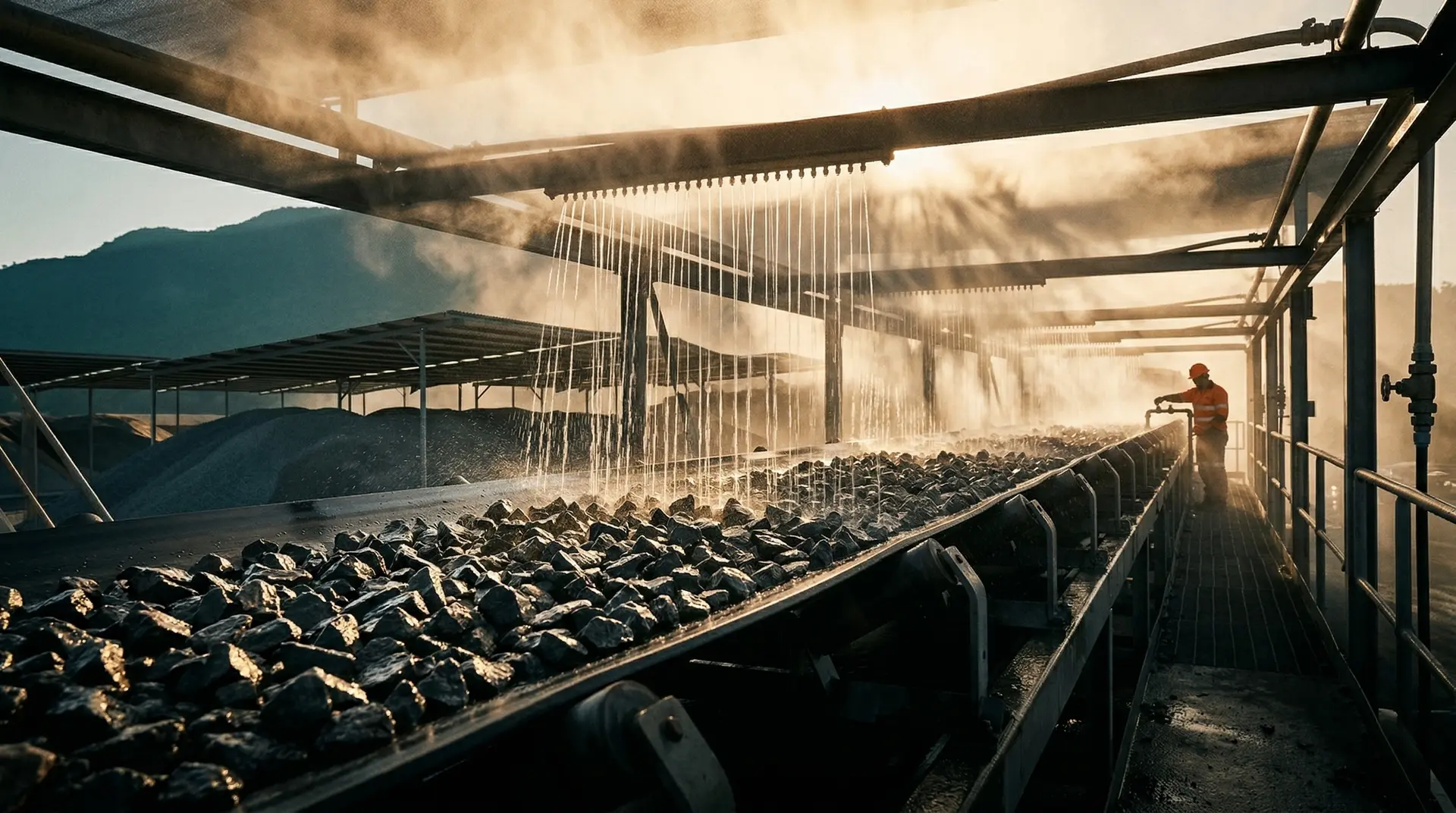
Chilled water spray: The most common method on Indian dam sites. Chilled water (5-10 degrees C) is sprayed over the aggregate stockpile or on aggregate as it moves along conveyor belts. The aggregate must then drain to saturated surface-dry (SSD) condition before batching. Excess water in the aggregate increases the effective water-cementitious ratio.
Immersion cooling: Aggregate is passed through a bath of chilled water. More effective than spraying but requires more infrastructure (conveyor system through a water bath, drainage and recirculation).
Shading: Covering aggregate stockpiles with shade structures reduces solar heat gain by 10-15 degrees C. This is a passive, low-cost supplement to active cooling. On Indian dam sites where aggregate stockpiles cover large areas, simple shade cloth over the active stockpile face can reduce the cooling energy required.
Night processing: Processing and stockpiling aggregate during cooler night hours reduces the starting temperature for the next day’s production.
Practical Considerations
- Fine aggregate cooling is less effective per tonne because fine aggregate is typically stored wet (already partially cooled by evaporation) and has a smaller mass fraction.
- Aggregate moisture content after cooling must be measured accurately to adjust batch water.
- Drainage time between cooling and batching must be managed to prevent excess free water.
Method 4: Liquid Nitrogen
Principle
Liquid nitrogen (LN2) at minus 196 degrees C absorbs approximately 198 kJ/kg as it vaporises and warms to concrete temperature. It is injected directly into the mixer, providing precise temperature control.
Temperature Reduction
Liquid nitrogen can reduce concrete temperature by 5-15 degrees C depending on dosage.
Equipment
- Cryogenic storage tank: Vacuum-insulated tank for storing liquid nitrogen at site
- Injection system: Controlled delivery of LN2 into the mixer through a lance or injection nozzle
- Temperature monitoring: Real-time concrete temperature measurement to control dosage
- Safety systems: Nitrogen displaces oxygen; ventilation and monitoring in the mixing area are critical
Practical Considerations
- Liquid nitrogen is expensive: Rs 30-60 per kg, with consumption of 3-8 kg per cubic metre of concrete. For a 1,000 m3/day project using 5 kg/m3, the daily LN2 cost alone is Rs 1.5-3 lakh.
- Supply logistics are complex: LN2 must be delivered by cryogenic tanker from an industrial gas plant. Remote dam sites may have delivery lead times of days.
- LN2 is a supplementary method, not a primary method. It is used when chilled water, ice, and aggregate cooling together cannot achieve the target placing temperature.
- LN2 provides the most precise temperature control of any pre-cooling method: the dosage can be adjusted in real time based on the temperature reading of each batch.
Designing the Pre-Cooling System
Step 1: Establish the Target Placing Temperature
The thermal analysis, conducted in accordance with IS 14591 (Temperature Control of Mass Concrete for Dams) and ACI 207.4R, determines the maximum placing temperature that keeps peak internal temperatures and thermal gradients within acceptable limits. Typical target: 15-25 degrees C depending on the section thickness, ambient conditions, and whether post-cooling is also used.
Step 2: Determine the Worst-Case Ingredient Temperatures
For the hottest month of the year at the dam site:
- Cement: typically at ambient temperature (35-45 degrees C at Indian sites)
- Coarse aggregate: 40-55 degrees C if sun-exposed
- Fine aggregate: 30-40 degrees C (lower due to moisture)
- Water: 25-38 degrees C depending on source
Calculate the no-cooling concrete temperature using the weighted average equation. This is the baseline.
Step 3: Calculate the Required Temperature Reduction
The difference between the no-cooling temperature and the target placing temperature is the required reduction. Typical requirement for Indian dam sites in summer: 15-25 degrees C.
Step 4: Select the Cooling Methods
Apply methods in order of cost-effectiveness:
| Method | Temperature Reduction | Relative Cost | Reliability |
|---|---|---|---|
| Aggregate shading | 3-5 degrees C | Very low | High |
| Chilled water | 3-5 degrees C | Low | High |
| Aggregate cooling (spray) | 8-12 degrees C | Medium | High |
| Ice replacement | 5-10 degrees C | Medium-high | Medium |
| Liquid nitrogen | 5-15 degrees C | High | Medium |
Combine methods until the cumulative reduction meets the requirement. Most Indian dam projects use shading + chilled water + aggregate cooling + ice, achieving 20-30 degrees C total reduction.
Step 5: Size the Equipment
Each cooling system must be sized for the peak concrete production rate, not the average. On a day when the placement schedule demands maximum output and the ambient temperature is at its highest, every system must deliver its designed cooling without bottleneck.
Add 20-30% capacity margin above the calculated requirement. Pre-cooling equipment that is undersized during peak demand results in either warm concrete (thermal cracking risk) or reduced production rate (schedule impact).
Step 6: Plan for Redundancy
No single component should be a single point of failure. The consequences of a chiller or ice machine breakdown during active placement, specifically cold joints from stopped placement or thermal cracking from warm concrete, are far more expensive than backup equipment.
Minimum redundancy:
- Two chilling units (each sized for 60% of peak demand)
- Two ice machines (each sized for 60% of peak demand)
- Backup power supply (generator) for all cooling systems
Integration with the Thermal Control Plan
Pre-cooling does not operate in isolation. As ICOLD Bulletin 177 on RCC dams and related technical bulletins emphasise, it is one element of a comprehensive thermal control plan that includes:
- Pre-cooling (placing temperature control)
- Mix design (low-heat cementitious systems with high SCM replacement)
- Placement scheduling (lift thickness, placement interval, night placement)
- Post-cooling (embedded pipe systems for thick sections)
- Curing and insulation (surface protection to control thermal gradients)
- Monitoring (embedded thermocouples for real-time temperature verification)
The pre-cooling system design must be coordinated with each of these elements. A mix design with 40% fly ash reduces the adiabatic temperature rise, which reduces the pre-cooling requirement. Night placement reduces the ambient heat gain, which reduces the aggregate cooling demand. Post-cooling handles the residual heat that pre-cooling could not eliminate.
The thermal control plan is a system. Pre-cooling is its first and most cost-effective component.
Cost-Benefit
The pre-cooling investment for a medium-sized dam project typically represents 2-5% of the total concrete cost. The return:
- Thermal crack prevention: A single major thermal cracking event in a gallery or on the upstream face can cost Rs 50 lakh to several crore to repair.
- Schedule protection: Warm concrete requires extended placement intervals or reduced lift heights, directly impacting the construction schedule.
- Quality consistency: Pre-cooled concrete has more predictable setting behaviour, more uniform strength development, and lower variability in the finished product.
- Design compliance: The thermal control plan specifies a maximum placing temperature. Without pre-cooling, that specification cannot be met during Indian summers. Non-compliance triggers contract disputes, remediation requirements, and potential structural reassessment.
The pre-cooling system is not an added cost. It is the cost of producing concrete that meets the thermal specification. The alternative, placing warm concrete and accepting the consequences, is always more expensive.