There is a rhythm to Indian dam construction that is unique in the world: eight months of intensive work, then the monsoon arrives and everything changes.
The Indian monsoon delivers 70-90% of the annual rainfall in June through September. In the Himalayas, this can mean 2,000-4,000 mm of rainfall over four months. In the Western Ghats, 3,000-6,000 mm. During peak monsoon weeks, daily rainfall can exceed 100 mm, turning access roads into rivers, flooding work areas, and making concrete placement impractical.
For dam projects, the monsoon does not merely delay work. It creates a set of concrete quality challenges that do not exist in dry weather:
- Prepared lift joints are contaminated by rainfall and must be re-cleaned or abandoned
- Aggregate stockpiles become saturated, changing the effective water content of every batch
- Fresh concrete surfaces are at risk of washout if rain arrives during placement
- Completed but young concrete loses its controlled curing regime to uncontrolled wetting
- Access roads become impassable, disrupting material supply chains
- River levels rise dramatically, sometimes threatening the work site itself
Every Indian dam engineer knows the monsoon is coming. The question is how to prepare for it, work through it where possible, and resume full production after it passes.
The Monsoon Timeline for Dam Projects
Pre-Monsoon (April-May)
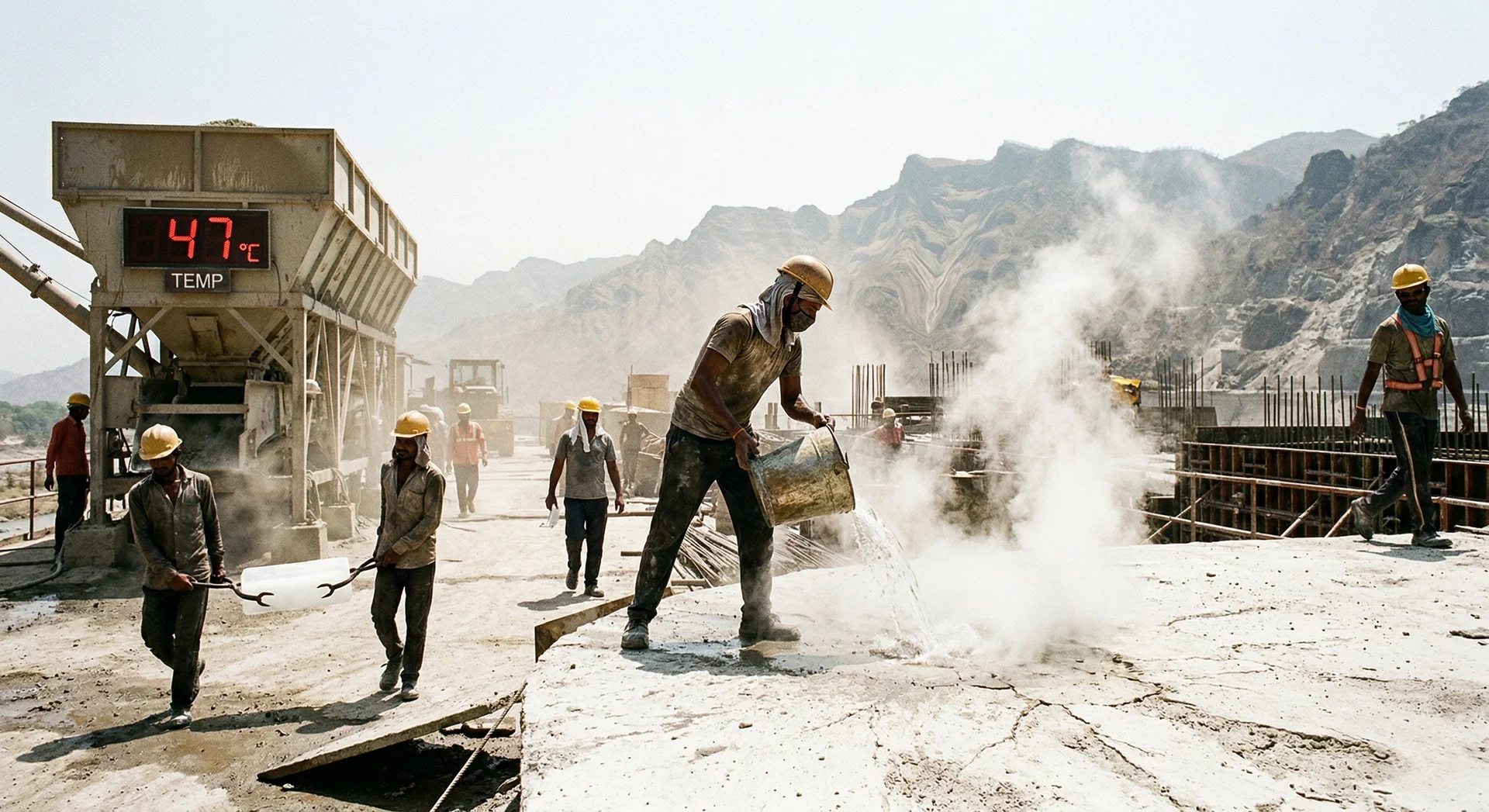
Ambient temperatures at their highest. Hot weather concreting protocols in full effect. The focus: maximum production to complete as many lifts as possible before the rain arrives.
Pre-monsoon storms begin: isolated thunderstorms that interrupt placement for hours but do not constitute sustained rainfall. These are manageable but require weather monitoring and rapid response protocols.
Critical task: Ensure the last lift placed before monsoon shutdown has adequate thickness and is properly cured. A thin, incomplete lift exposed to monsoon rainfall is vulnerable to surface damage.
Early Monsoon (June)
The monsoon onset is erratic: it may arrive as a sustained weather system or as a series of increasingly frequent rain events. Dam projects typically transition to reduced operations: placing concrete during dry windows between rain events, with full standby readiness to stop and protect work at short notice.
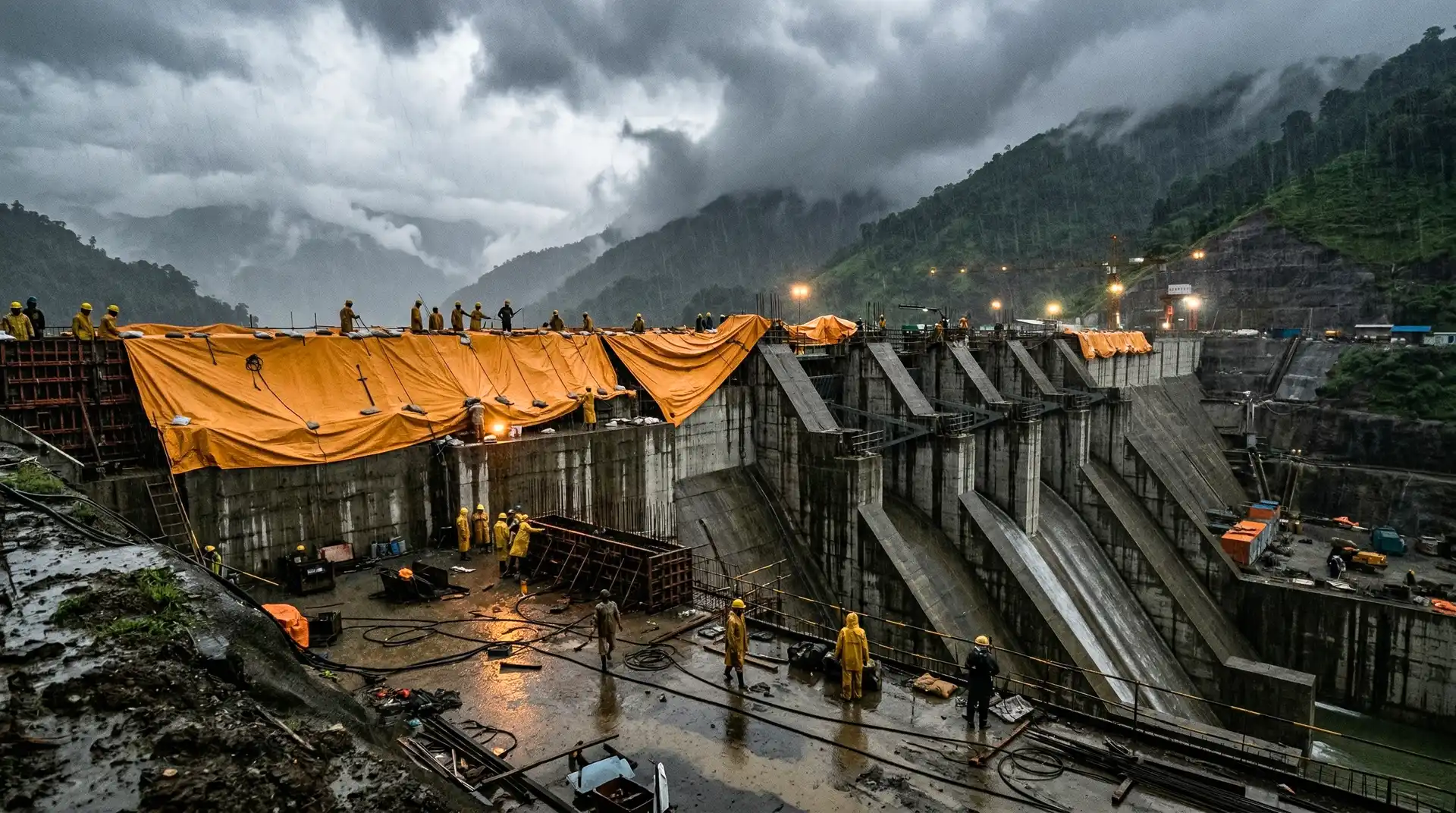
Critical task: Protect all exposed construction joints. Cover with waterproof sheeting. Ensure drainage around exposed surfaces. Apply curing compounds or membranes.
Peak Monsoon (July-August)
Most dam projects suspend concrete placement entirely during peak monsoon. The frequency and intensity of rainfall makes sustained production uneconomical and quality-risky. River levels are at their highest, and site access is most difficult.
Critical task: Maintenance of equipment, review of QC data from the previous production season, preparation for post-monsoon restart. This is also the time for planning: updating the placement schedule, reviewing mix design performance, calibrating instruments.
Late Monsoon (September)
Rainfall frequency decreases. Dry intervals become longer and more predictable. Dam projects begin mobilising for restart: cleaning joint surfaces, testing aggregate moisture, calibrating batching plants, and conducting trial mixes.
Critical task: Re-inspection and re-classification of all exposed lift joints. Some will have been exposed for 2-3 months and require full surface preparation as cold joints.
Post-Monsoon (October-November)
Full production resumes. Ambient temperatures are declining from summer peaks, reducing the pre-cooling requirement. This is often the most productive period of the year: moderate temperatures, low rainfall, adequate daylight hours.
Critical task: Accelerated placement to recover schedule lost during the monsoon. But acceleration must not compromise quality: the temptation to cut corners after months of inactivity is when most quality problems originate.
Protecting Work During Monsoon Shutdown
Exposed Lift Joints
Every lift joint that will not receive its next lift before the monsoon must be protected:
- Apply curing compound to the surface within 24 hours of placement to maintain hydration and prevent surface carbonation
- Cover with polyethylene sheeting weighted against wind, with sufficient overlap at edges (minimum 300 mm) and provisions for water runoff
- Provide drainage around the covered area to prevent ponding on or adjacent to the exposed surface
- Remove any formwork that could trap water against the concrete surface
Aggregate Stockpiles
Aggregate left in open stockpiles during the monsoon absorbs significant moisture. Fine aggregate can reach 8-10% moisture content. Coarse aggregate can reach 2-4%.
Management options:
- Roofed stockpiles for the active batching area (cost-effective for large projects)
- Drainage at the base of stockpiles to prevent saturation from below
- Separate dry zone: Maintain a small, covered stockpile of aggregate at known moisture content for early post-monsoon production
Batching Plant and Equipment
- Cover all cement and admixture storage
- Drain water from all pipes, valves, and mixing components
- Maintain all equipment during the shutdown (the monsoon period is ideal for overhauls)
- Calibrate all weighing and metering equipment before restart
Placing Concrete During Monsoon Breaks
On some projects, particularly those with tight schedules, concrete placement continues during dry intervals within the monsoon. This is feasible but requires:
Weather Monitoring
A dedicated weather forecasting system (even basic radar and local weather station data) to predict dry windows. Minimum requirement: 8-12 hours of confirmed dry weather to complete a lift placement from preparation through initial curing.
Rapid Cover Protocol
Every placement crew must have waterproof covers (polyethylene rolls, tarpaulins) immediately available at the work face. If rain begins during placement, the response must be immediate:
- Stop concrete delivery
- Cover the freshly placed surface
- Protect the batching and mixing area
- Document the extent of any rain exposure
Adjusted Aggregate Moisture
Saturated aggregates carry excess free water that effectively increases the water-cementitious ratio. The batching programme must account for this per IS 7861 (Part 1) and ACI 305R guidelines:
- Measure aggregate moisture content every batch during monsoon operations (not daily, as in dry weather)
- Adjust batch water proportionally
- Reduce or eliminate added water to compensate for aggregate moisture
Joint Re-preparation
Any prepared lift joint that has been exposed to rainfall must be re-inspected. If contamination is visible (silt deposits, algae growth, standing water marks), the surface must be re-cleaned to sound concrete before placement resumes. ICOLD Bulletin 126 provides detailed guidance on joint treatment for roller-compacted concrete dams, and similar principles apply to conventional mass concrete joints exposed to monsoon conditions.
The Impact on the Construction Schedule
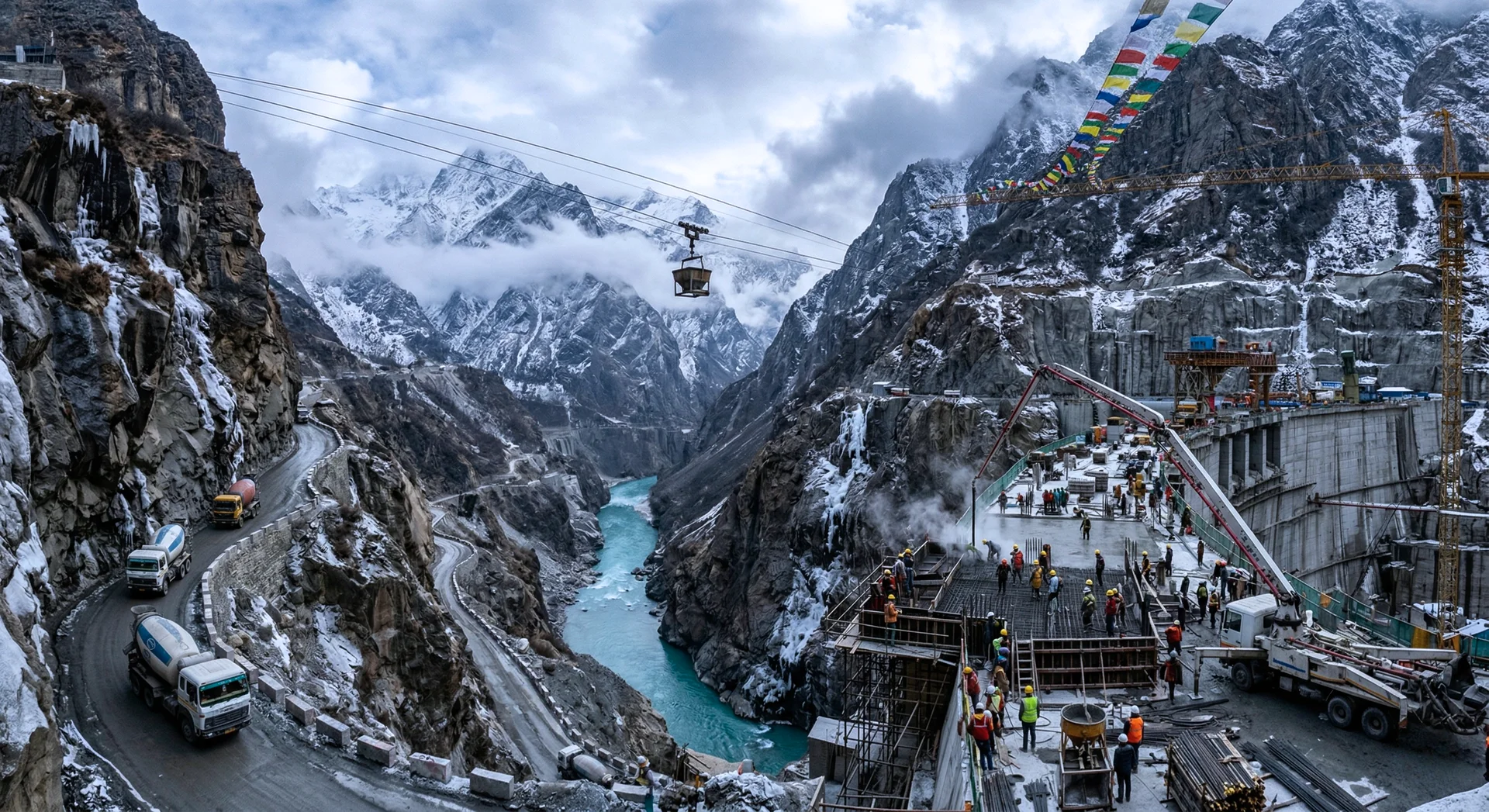
For a dam project in the Himalayan region with a 5-year concrete placement programme:
- Annual effective production: approximately 8 months (October through May)
- Annual monsoon shutdown: approximately 4 months (June through September)
- Total effective production time: approximately 40 months out of 60
- Schedule impact: 33% reduction in available placement time
This compression has cascading effects:
- Higher peak production rates during the active season to compensate for lost monsoon time
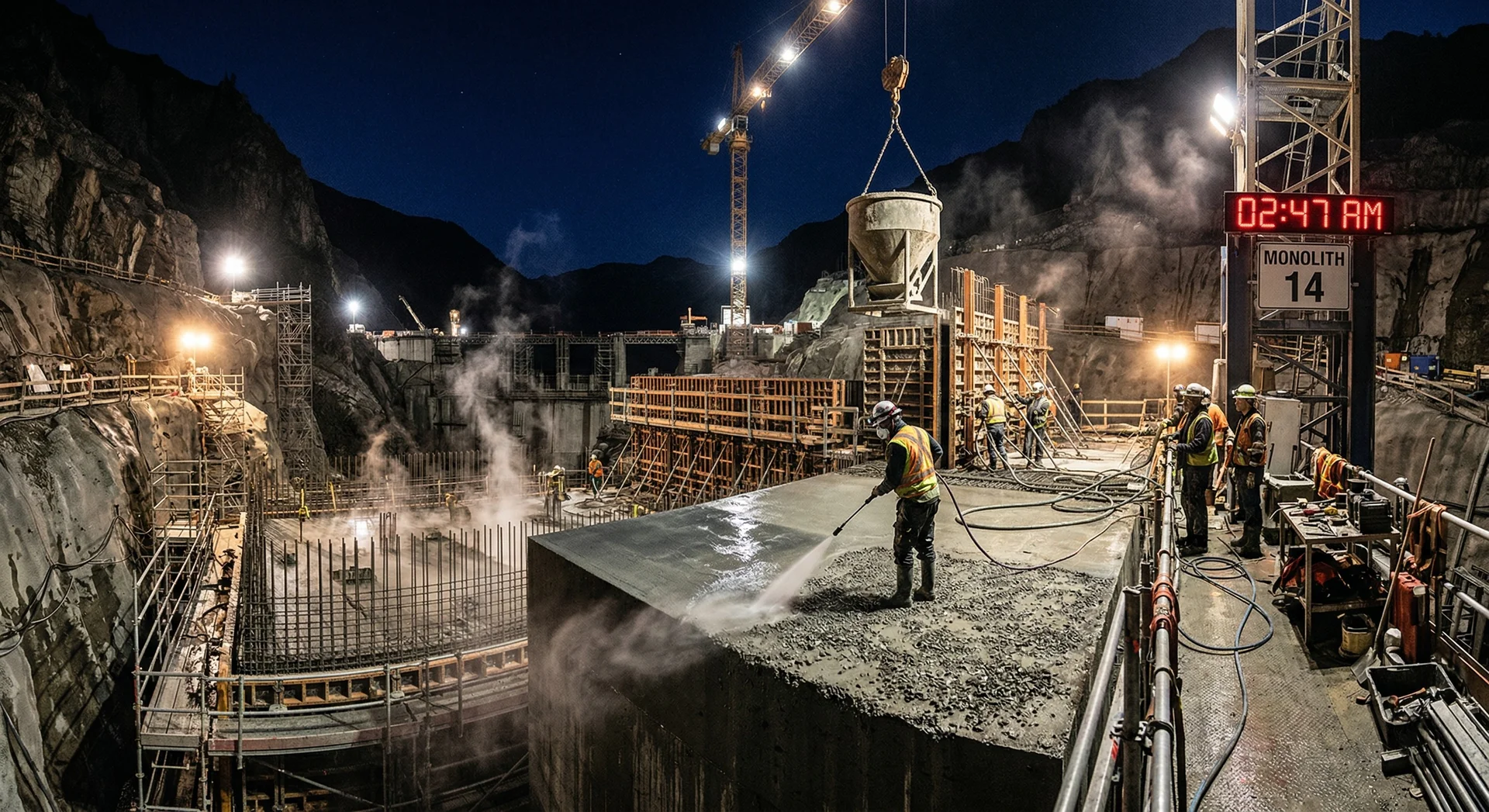
- More shift operations (night placement) to maximise daily output
- Greater pressure on QC as the pace of work increases
- Less tolerance for equipment downtime because every lost production day cannot be recovered during the monsoon
The most common quality problems on Indian dam projects occur in the pre-monsoon rush (April-May, when teams try to maximise output before shutdown) and the post-monsoon restart (October, when teams accelerate to recover schedule). These are the periods that require the most vigilant quality control.
Monsoon as Curing Opportunity
One often-overlooked benefit: the monsoon provides excellent curing conditions for concrete placed in the weeks immediately before shutdown.
Concrete placed in April-May typically suffers from rapid moisture loss, high ambient temperature, and aggressive evaporation. The same concrete, once the monsoon arrives, is enveloped in 80-100% relative humidity for weeks. This sustained moisture environment promotes continued hydration and can result in excellent long-term strength.
To maximise this benefit:
- Place the last pre-monsoon lifts with adequate curing compound application
- Ensure monsoon rainwater does not pond on young concrete surfaces (drainage, not sealing)
- Allow the high humidity to provide ambient curing without erosive water contact
The concrete placed in the last 2-3 weeks before monsoon onset, if properly protected from direct rainfall damage, often achieves the highest long-term strength of any concrete placed during the year.
Lessons from the Field
-
Plan the monsoon into the schedule from day one. A construction programme that treats the monsoon as an unexpected disruption will always be behind schedule. Build the 8-month production year into the baseline programme.
-
Invest in protection infrastructure. Roofed aggregate stockpiles, waterproof joint covers, and drainage systems around work areas cost a fraction of the schedule delay and quality problems that unprotected monsoon exposure creates.
-
Use the shutdown productively. Equipment maintenance, QC data analysis, mix design review, instrument calibration, and planning updates during the monsoon months prepare the team for an effective restart.
-
Control the post-monsoon restart. The first lift placed after monsoon shutdown sets the quality standard for the entire next production season. Rushing the restart to recover schedule is where quality failures begin.
-
Monitor weather, not the calendar. The monsoon does not start on June 1 and end on September 30. Weather monitoring systems that track actual rainfall and provide short-term forecasting allow smarter decisions about when to place and when to stop.
-
Treat every monsoon-exposed joint as a cold joint. After 2-3 months of exposure, no previously prepared surface retains its readiness. Full surface preparation, including cleaning, roughening if needed, moisture conditioning, and bedding mortar, must be completed before the first post-monsoon lift.
The monsoon is not an obstacle to dam construction. It is a feature of the Indian construction environment that must be engineered around with the same rigour applied to thermal control, seismic design, and foundation treatment. The projects that treat it this way finish on time and on quality. The projects that treat it as an inconvenience do neither.