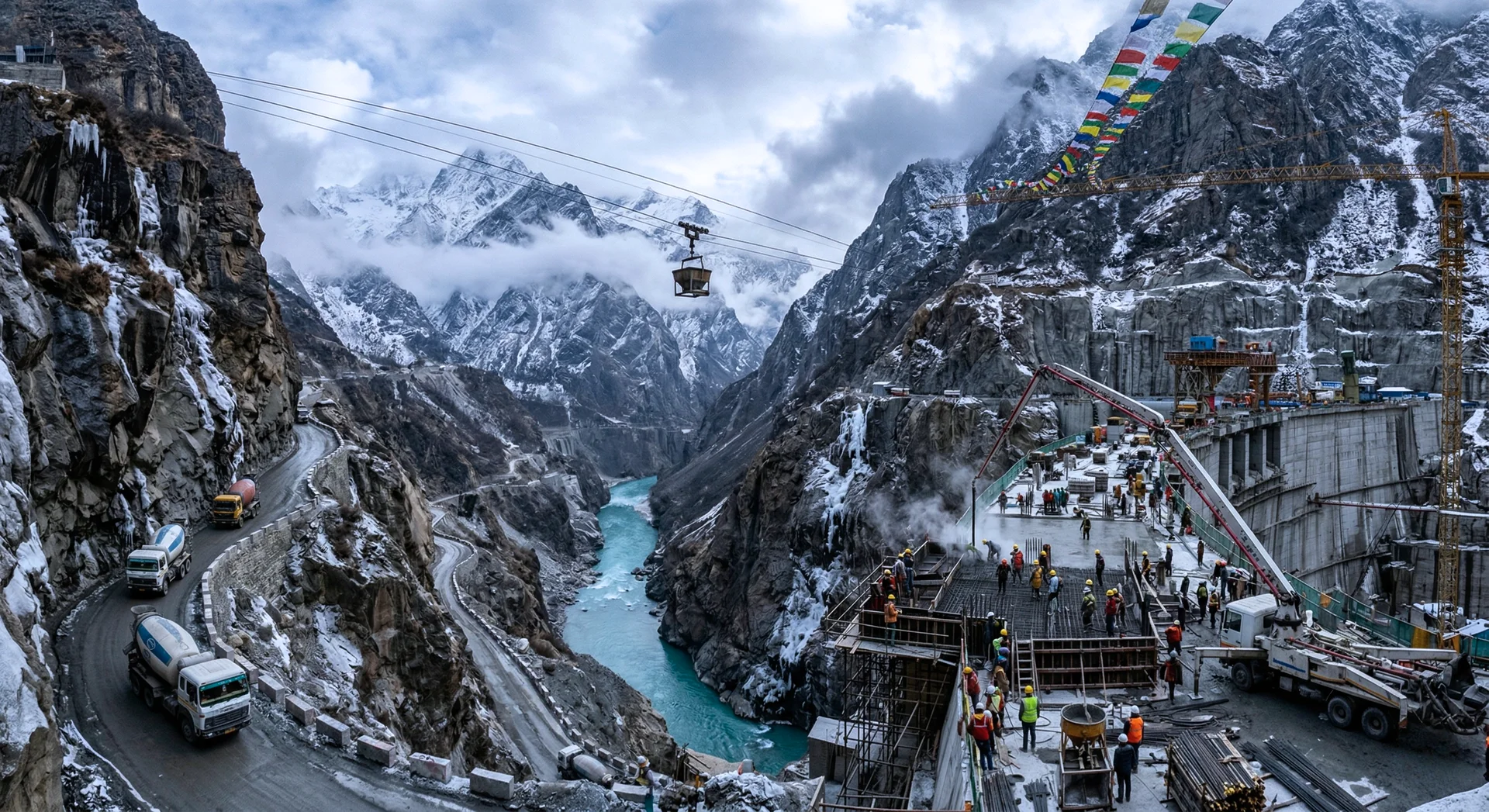
The Punatsangchhu-1 dam in Bhutan sits in a narrow Himalayan gorge at approximately 1,200 metres elevation. The river cuts through young, tectonically active rock with multiple shear zones and fault lines. Ambient temperatures range from near freezing in January to above 35 degrees C in pre-monsoon May. The monsoon delivers over 3,000 mm of rainfall between June and September. The site is in Seismic Zone V.
Every one of these conditions affects the concrete. Not marginally, not theoretically, but in ways that determine whether the dam performs for its 100-year design life or develops problems within the first decade.
This is not an unusual project. It is a typical Himalayan hydropower site. And India’s pipeline includes dozens more like it: Subansiri, Dibang, Teesta, Ratle, Pakal Dul, Kiru, Kwar, and the expanding pumped storage programme across Uttarakhand and the Northeast.
The concrete technology for these projects cannot be imported from textbooks written for temperate climates. It must be engineered for the specific, compounding challenges of the Himalayan environment.
Challenge 1: Freeze-Thaw at Altitude
The Mechanism
Water in concrete pores expands by approximately 9% when it freezes. In a single cycle, this expansion creates microscopic pressure on the surrounding concrete matrix. Over hundreds of cycles, the cumulative damage manifests as surface scaling, aggregate pop-outs, micro-cracking, and progressive mass loss.
At Himalayan dam sites above 1,500 metres, concrete can experience 50-100+ freeze-thaw cycles per year. The damage is most severe in the splash zone: the band of concrete near the waterline that alternates between saturated (when submerged) and frozen (when exposed above the winter water level). This is exactly the zone where impermeability and structural integrity matter most.
The Defence
Air entrainment is the primary protection against freeze-thaw damage. Air-entraining admixtures create a system of microscopic, uniformly distributed air bubbles (target: 4-8% air content, bubble spacing factor less than 0.2 mm) throughout the concrete matrix. These bubbles act as pressure relief chambers: when pore water freezes and expands, it can migrate into the nearby air void rather than stressing the surrounding paste.
For Himalayan dam concrete:
- Air content should target 5-7% for concrete in the freeze-thaw exposure zone
- Air content must be verified at the point of placement, not just at the batching plant (air can be lost during transport and pumping)
- The air-void system quality (spacing factor, specific surface) matters more than the total air content. A good air-void analyser (per ASTM C457) should be part of the QC programme
The trade-off: every 1% increase in air content reduces compressive strength by approximately 3-5%. For mass concrete where strength requirements are moderate (M15-M25), this is acceptable. For high-performance concrete in spillway elements, the strength loss must be accounted for in the mix design.
The Complication
Fly ash, the most commonly used SCM in Indian dam concrete, interferes with air entrainment. The carbon content in fly ash (measured as Loss on Ignition) adsorbs air-entraining admixture, reducing its effectiveness. Indian fly ash LOI varies from 1% to 12%. A batch with high carbon content can collapse the air-void system, leaving the concrete vulnerable to freeze-thaw.
The solution: test every fly ash delivery for LOI. Adjust air-entraining admixture dosage based on the actual carbon content, not the previous batch. This requires on-site LOI testing capability and a responsive batching system.
Challenge 2: Seismic Loading
The Terrain
The Himalayan states, Jammu and Kashmir, Himachal Pradesh, Uttarakhand, Sikkim, Arunachal Pradesh, and the northeastern states, fall in Seismic Zones IV and V per IS 1893. The Indian plate continues thrusting beneath the Eurasian plate at approximately 40-50 mm per year, making the Himalayas one of the most seismically active regions on earth.
What Seismic Loading Does to Dam Concrete
Seismic events subject dam concrete to:
- Dynamic tensile stress at lift joints and construction joints (the weakest planes in the dam)
- Cyclic loading that can propagate existing micro-cracks
- Foundation displacement along faults and shear zones beneath the dam
- Hydrodynamic pressure from the reservoir water accelerating against the upstream face during shaking
For gravity dams that rely on mass and friction for stability, the critical failure mode under seismic loading is sliding along a lift joint or the dam-foundation interface. The joint’s shear strength and tensile capacity under dynamic loading determine whether the dam remains stable.
Concrete Implications
- Joint quality is paramount. Every lift joint and construction joint must achieve the shear and tensile strength assumed in the seismic analysis. A cold joint with 30% of parent concrete strength may be adequate under static loading but insufficient under seismic loading.
- Foundation treatment must ensure adequate bond between the dam concrete and the foundation rock. In fractured Himalayan rock with shear zones and clay-filled discontinuities, this often requires extensive consolidation and curtain grouting.
- Reinforcement may be required in specific zones (gallery roofs, spillway piers, intake structures) to resist dynamic tensile forces that the concrete alone cannot carry.
Reservoir-Induced Seismicity
The weight of impounded water can trigger seismic activity in the dam’s vicinity. This has been documented at Tehri Dam and noted as a concern for multiple Himalayan projects. The concrete must be designed not just for tectonic earthquakes but for the additional seismicity that the dam itself may cause.
Challenge 3: Extreme Temperature Range
A single Himalayan dam site can experience ambient temperatures from minus 10 degrees C in January to plus 40 degrees C in May. That is a 50-degree annual range.
What This Means for Concrete
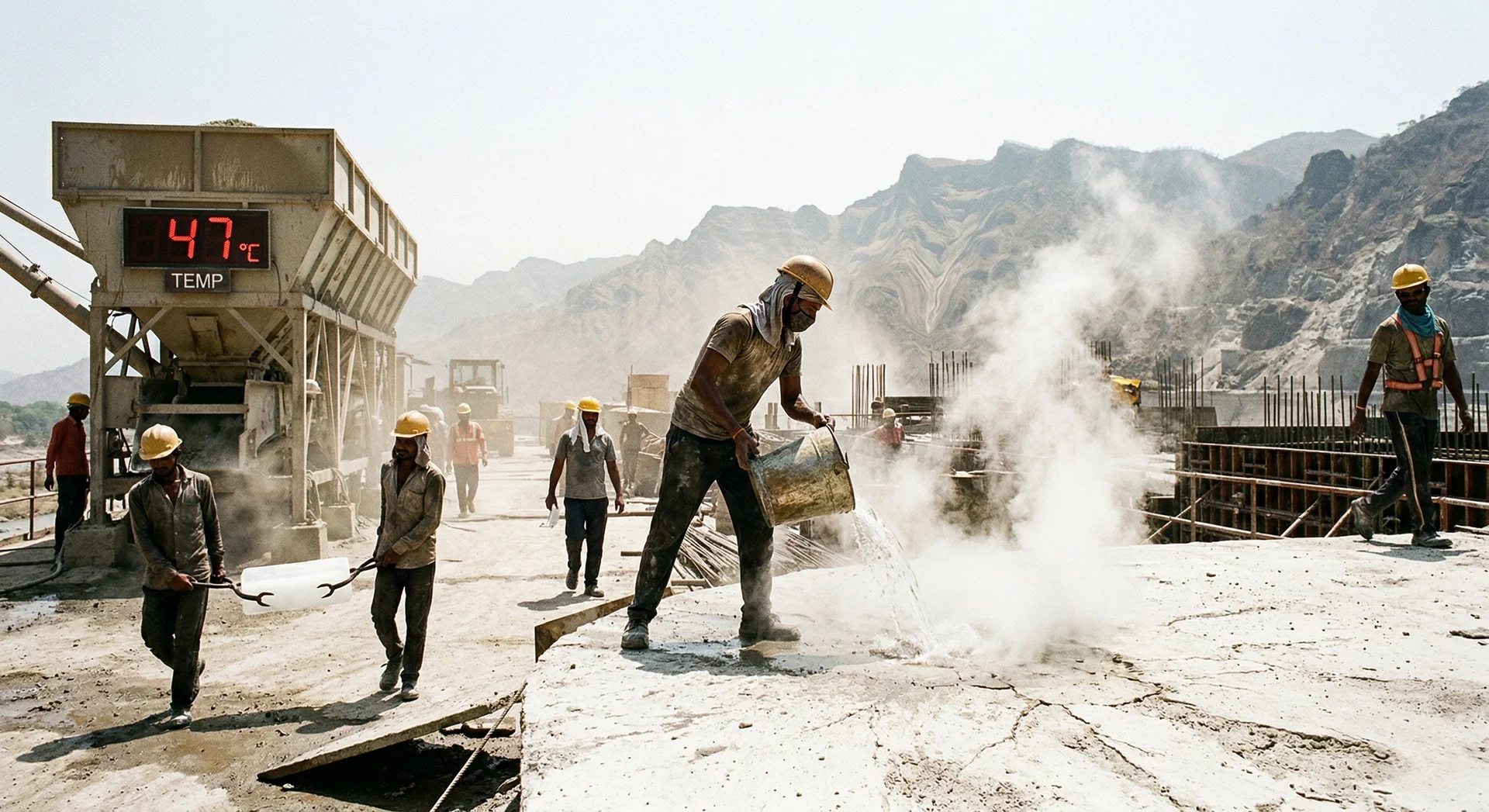
- Summer placement requires the full hot weather concreting protocol: pre-cooling, retarders, night placement, surface protection
- Winter placement requires cold weather protection: heated water, preheated aggregates, insulated formwork, extended curing
- Transition seasons (March-April, October-November) may require both protocols within the same week as temperatures swing
- Thermal cycling of hardened concrete creates expansion-contraction stresses that compound over decades
The thermal control plan for a Himalayan dam must accommodate three distinct placement regimes: summer, winter, and transition. Each requires different admixture dosages, different placement procedures, and different curing protocols. The QC programme must switch between these regimes responsively, based on actual conditions, not calendar dates.
Challenge 4: Monsoon Disruption
The Himalayan monsoon delivers 2,000-4,000 mm of rainfall between June and September. Daily intensities can exceed 100 mm. During peak monsoon:
- Concrete placement is suspended during heavy rain to prevent surface washout and contamination
- Prepared lift joints are contaminated by rainfall and must be re-cleaned before placement can resume
- Aggregate processing is disrupted as stockpiles become saturated
- River levels rise dramatically, sometimes threatening the work site itself
- Access roads become impassable due to landslides and flooding
The practical effect: most Himalayan dam projects have an effective construction season of only 6-8 months per year. Concrete that would take 12 months to place on a plains site may take 18-24 months in the Himalayas simply because of monsoon shutdown.
This compression makes every productive day critical. Placement scheduling must maximise output during the available months while maintaining quality, a tension that is the root cause of many quality problems on Himalayan projects.
Challenge 5: Young, Unstable Geology
Himalayan geology is young and tectonically active. Dam foundations encounter:
- Shear zones with crushed and weathered rock requiring extensive treatment
- Fault lines that may pass through or near the dam foundation
- Clay-filled discontinuities that reduce foundation shear strength
- High permeability zones requiring extensive grouting curtains
- Squeezing ground in underground excavations (powerhouse caverns, tunnels) where the rock mass deforms under the overburden pressure
For concrete, the geological challenges translate into:
- Variable foundation conditions requiring different concrete mixes for different foundation zones
- Extensive grouting programmes consuming large volumes of cement grout
- Foundation treatment concrete that must bond to irregular, fractured rock surfaces
- Underground concrete placed in conditions of high water inflow, squeezing ground, and confined access
The Tehri Pumped Storage Plant experienced squeezing rock conditions, major cavity formation in surge shafts, and mega-shear zones during construction. These geological surprises directly affected the concrete programme: self-compacting concrete was used specifically because conventional concrete placement was not feasible in the distorted geometries created by rock deformation.
Challenge 6: Remote Logistics
Many Himalayan dam sites are accessible only by single-lane mountain roads. The logistics chain for concrete materials stretches hundreds of kilometres:
- Cement transported from plains-based plants, subject to monsoon road closures and landslides
- Fly ash from thermal power plants typically located in the Gangetic plain or peninsular India
- Admixtures from urban manufacturing centres
- Equipment spares with long lead times due to remote location
A broken conveyor belt that would be replaced in 24 hours on a plains project may take 5-7 days in the Himalayas. A cement supply disruption that would mean switching suppliers on a plains project may mean no concrete for a week in the mountains.
The implications for concrete technology:
- Material buffer stocks must be larger (30-45 days vs. 7-14 days on plains projects)
- Mix designs must accommodate material variability because switching cement or fly ash sources is sometimes the only option
- Local aggregates from river-bed sources may have variable quality, requiring more frequent testing
- Self-reliance in testing is essential because external laboratories may be days away
Designing for the Himalayan Environment
The concrete for a Himalayan dam must simultaneously:
- Resist freeze-thaw (air entrainment, low permeability)
- Withstand seismic loading (high joint quality, adequate tensile capacity)
- Be placeable in extreme heat (pre-cooling, retarders)
- Be placeable in near-freezing conditions (heating, insulation)
- Survive monsoon-interrupted construction (robust lift joint protocols)
- Perform with variable material supply (adaptable mix designs)
- Develop strength on schedule despite a compressed construction season
These requirements can conflict. Air entrainment for freeze-thaw resistance reduces strength. High fly ash content for heat control slows early strength development. Seismic requirements demand high joint quality while compressed schedules pressure teams to accelerate placement.
Resolving these conflicts is the concrete technology consultant’s core role on a Himalayan project. The mix design is not a single document but a family of mixes tailored to each element, each season, and each set of site conditions. The thermal control plan spans three placement regimes. The QC programme adapts in real time to the conditions that the mountains present.
There is no standard solution for Himalayan concrete. There is only site-specific engineering, informed by deep experience with the terrain, the climate, and the geological reality of building in the world’s youngest, most active mountain range.