The supply transition is already happening
A decade ago, most Indian hydropower projects used river sand as fine aggregate for concrete. The supply was abundant, the quality was generally acceptable, and the cost was low. River sand was the default.
Today, the supply picture is different. Many states have restricted in-stream sand mining, citing environmental damage to river channels and aquifers. Monsoon access to river quarries is unreliable. Demand from the broader construction industry has driven prices up and supply variability up. Major Indian infrastructure projects, including hydropower dams, have transitioned to manufactured sand (M-sand) as the primary fine aggregate, with river sand as a supplementary or alternative supply.
The technical case for M-sand is strong. The procurement framework under IS 383:2016 (Coarse and Fine Aggregate for Concrete) is established. The mix design adjustments are well-understood. Projects that have not yet made the transition should understand what is involved.
What M-sand is
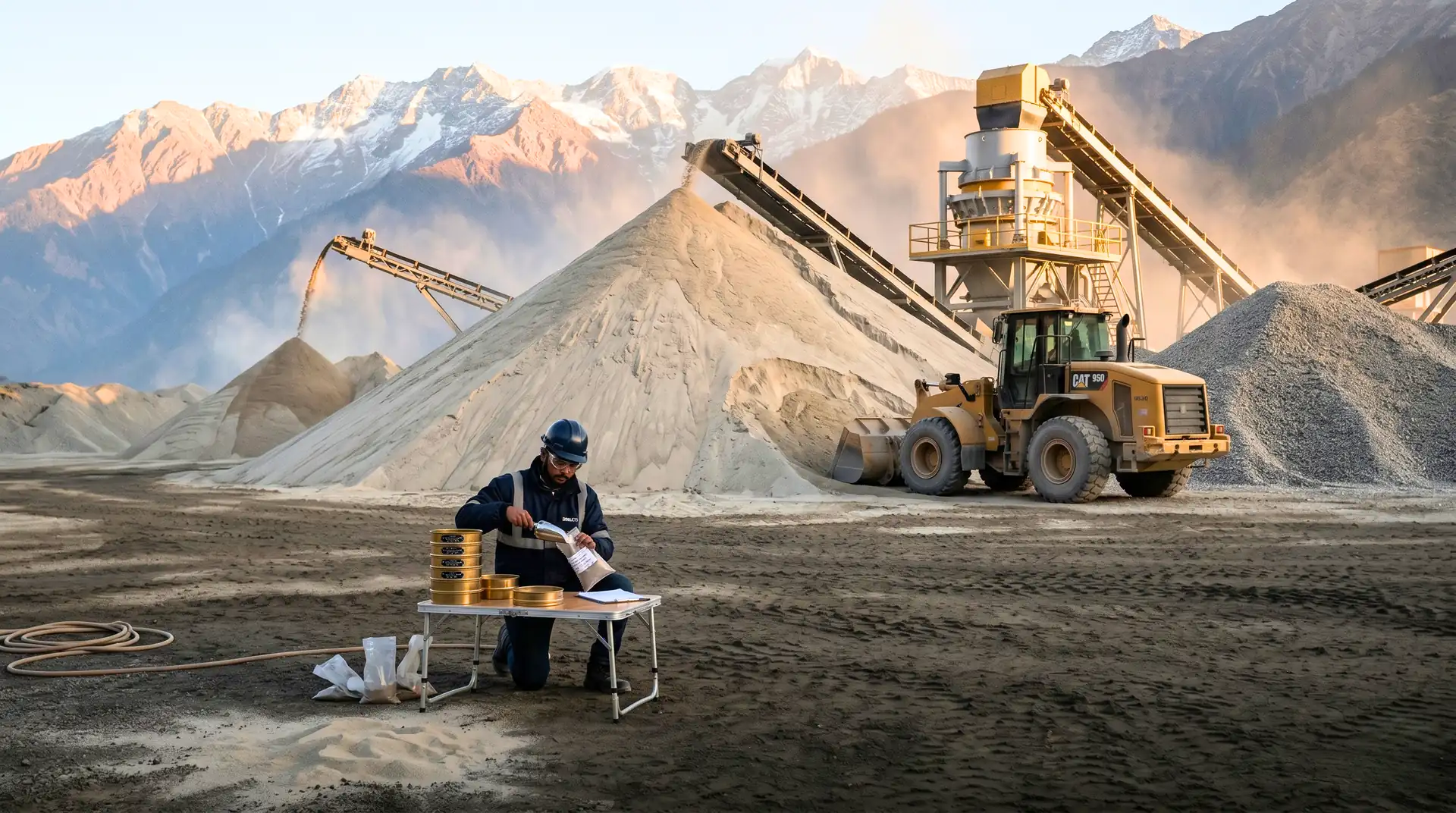
Manufactured sand is fine aggregate produced by crushing hard rock to gradations suitable for concrete, in dedicated crushing plants with sand-shaping equipment. The production process:
- Source rock extraction from a quarry, typically the same parent rock used for coarse aggregate
- Primary crushing to reduce rock to manageable particle sizes
- Secondary and tertiary crushing to produce fine aggregate gradation
- Sand shaping (using vertical shaft impactors or similar equipment) to improve particle shape from angular to more rounded
- Washing and screening to remove excess fines and produce specified gradations
- Stockpiling and quality control at the production plant
The output is a controlled-gradation fine aggregate with consistent properties from batch to batch, unlike river sand whose properties vary by source location and season.
How M-sand differs from river sand
The two materials are fine aggregates suitable for the same applications, but their properties differ.
| Property | M-sand | River sand |
|---|---|---|
| Particle shape | Angular (improved by sand shaping) | Rounded by water |
| Surface texture | Rougher | Smoother |
| Gradation control | Controlled at plant | Variable by location/season |
| Fines content (passing 75 micron) | Up to 15% allowed in IS 383:2016 | Up to 3% allowed in IS 383:2016 |
| Silt and clay | Minimal (controlled by washing) | Variable, can be problematic |
| Organic impurities | None | Possible |
| Water demand for equivalent workability | Higher | Lower |
| Workability | Slightly stiffer for same w/c | More plastic |
| Cohesiveness | Higher | Lower |
| Bond to cement paste | Better (due to roughness) | Adequate |
| Strength of resulting concrete | Equivalent or slightly higher | Baseline |
The differences mean M-sand is not a drop-in replacement for river sand at constant mix design. The mix must be re-designed for M-sand specifically, with adjusted water content, admixture dosage, and possibly cement content.
M-sand from different quarries is not the same material
The properties of M-sand depend on the parent rock and the production equipment. M-sand from a granite quarry behaves differently from M-sand from a basalt quarry. M-sand from a plant with vertical shaft impactor sand shaping behaves differently from M-sand from a plant without it. Mix design with M-sand requires trial mixes using the actual project M-sand, not generic M-sand assumptions. This is one of the most common errors when projects transition from river sand to M-sand.
What IS 383:2016 actually requires
The 2016 revision of IS 383 (Coarse and Fine Aggregate for Concrete - Specification) explicitly recognises manufactured sand as equivalent to natural sand. Key requirements:
Gradation within Zones I to IV defined in IS 383, similar to river sand zones. The Zone determines the suitability for different concrete grades and applications.
Fines content (particles passing 75 micron sieve) limited to 15 percent for M-sand, compared to 3 percent for natural (uncrushed) river sand. The higher fines limit for M-sand reflects the inherent fines production in crushing and the recognition that controlled, washed fines act as filler material.
Particle shape and texture requirements ensuring the M-sand has adequate roundness and not excessive flaky or elongated particles. Specific tests include the flakiness index and elongation index per IS 2386.
Deleterious substances including clay, silt, organic matter, and light particles, all subject to maximum limits.
Soundness by sodium sulphate or magnesium sulphate test per IS 2386, indicating durability against weathering.
Alkali reactivity through testing per ASTM C1260 (Potential Alkali Reactivity of Aggregates, Mortar-Bar Method) or IS 2386 Part 7, particularly important for dam concrete with long design life.
Specific gravity, water absorption for mix design calculations.
The full specification is in the BIS IS 383:2016 Product Manual. M-sand from approved quarries that meets the specification is acceptable for structural and dam concrete.
Mix design adjustments for M-sand
Three adjustments are typically needed when transitioning from river sand to M-sand.
Water content adjustment. M-sand requires more water for equivalent slump. Typical adjustment is 5 to 10 percent more water for the same workability target. To maintain the water-cement ratio at the design value, cement content increases proportionally, or a higher-dosage water-reducing admixture compensates.
Admixture dosage. Water-reducing admixtures and superplasticisers behave slightly differently with M-sand than with river sand, due to the different particle surface area and chemistry. Optimal dosage may be different. Trial mixes with the project M-sand and the project admixtures establish the actual dosage.
Sand-coarse aggregate ratio. M-sand has different packing characteristics than river sand. The optimum sand-coarse aggregate ratio (typically 0.30 to 0.45 by mass for dam concrete) may shift slightly. Trial mixes confirm the actual optimum.
The trial mix programme for a project transitioning to M-sand typically includes 6 to 10 mixes spanning the expected variations in cement, water, admixture dosage, and aggregate ratio. The output is a project-specific mix design that produces the target properties consistently with the M-sand source.
Field experience with M-sand on dam projects
Five practical observations from M-sand use on hydropower projects:
Cohesiveness improves placement. M-sand concrete is more cohesive and segregation-resistant than river sand concrete, which is helpful for confined placements where consistent flow and cold joint prevention are critical to lift quality.
Pumpability requires admixture optimisation. M-sand concrete pumps acceptably with proper admixture selection but is less forgiving of admixture errors than river sand concrete.
Heat of hydration may be marginally lower. With slightly higher cement content offsetting some of the cooling effect of higher water demand, the net heat of hydration is similar to or slightly higher than river sand concrete. The difference is small but worth tracking on mass concrete pours where thermal control is design-critical.
Surface finish differs. M-sand concrete has a slightly different surface appearance and texture from river sand concrete, particularly visible on formed surfaces. This is cosmetic, not structural.
Quality from the plant matters more. M-sand from a well-operated plant with consistent crushing and washing is excellent. M-sand from a poorly operated plant can have variable fines content, gradation drift, and contamination. Plant selection and ongoing QC are critical.
M-sand is a procurement and quality system, not just a material
The transition from river sand to M-sand requires investing in plant qualification, ongoing supply QC, mix design optimisation, and crew familiarisation. Done properly, M-sand produces concrete equivalent to or better than river sand concrete, with better supply security and consistency. Done as a quick substitution without the supporting investment, M-sand can produce variable concrete and contractor frustration.
How PCCI approaches M-sand for dam projects
M-sand has become the standard fine aggregate on most projects in PCCI’s portfolio over the last several years. The transition has been managed through structured approach to plant qualification (per IS 383:2016), trial mix programmes for each project’s specific M-sand source, and ongoing QC during production.
Our mix design service addresses the M-sand-specific water demand, admixture, and sand-coarse aggregate ratio adjustments. Our QA/QC service covers the ongoing M-sand monitoring during construction.
Book a Technical Call → to discuss your project’s M-sand requirements.