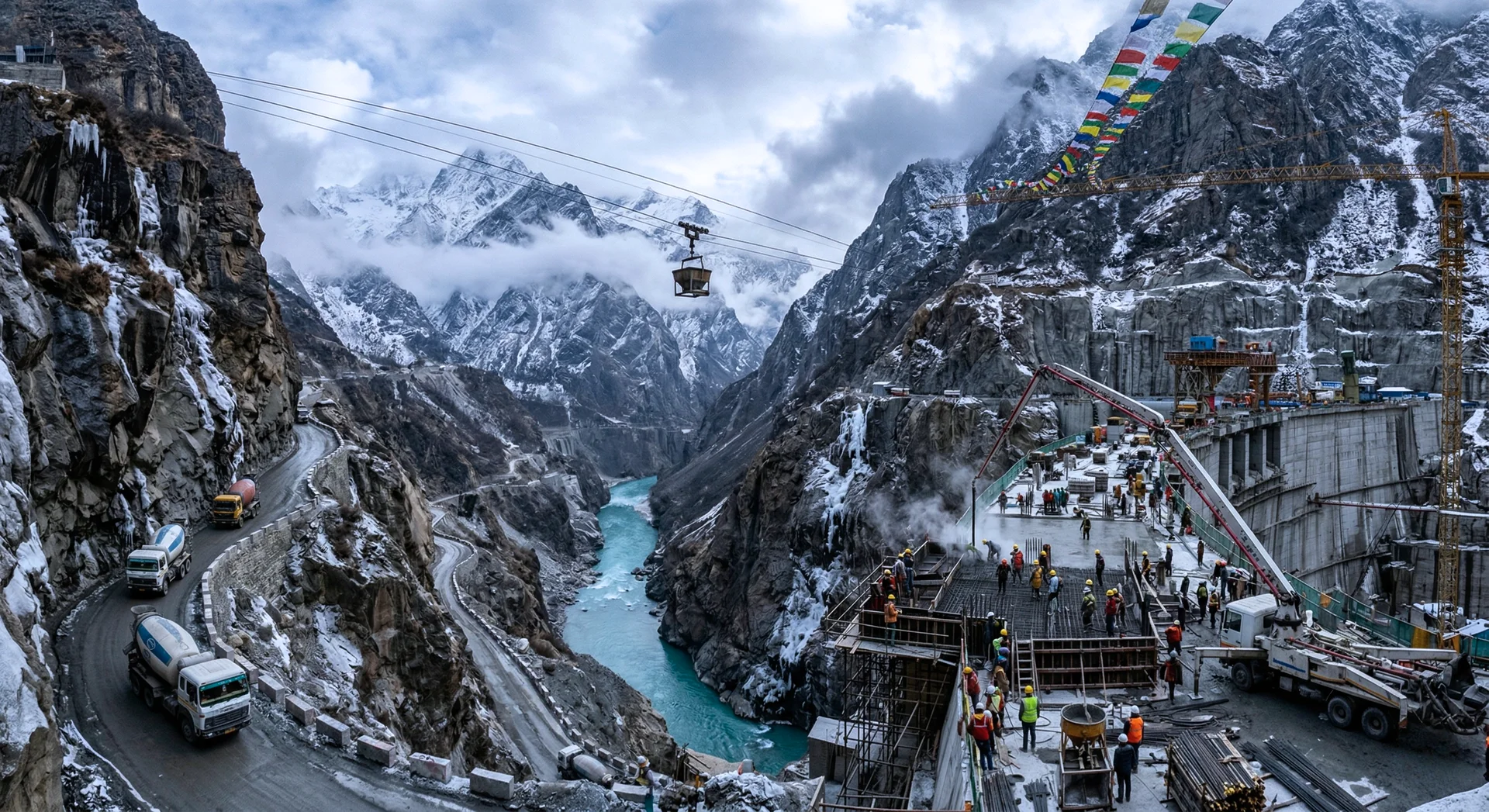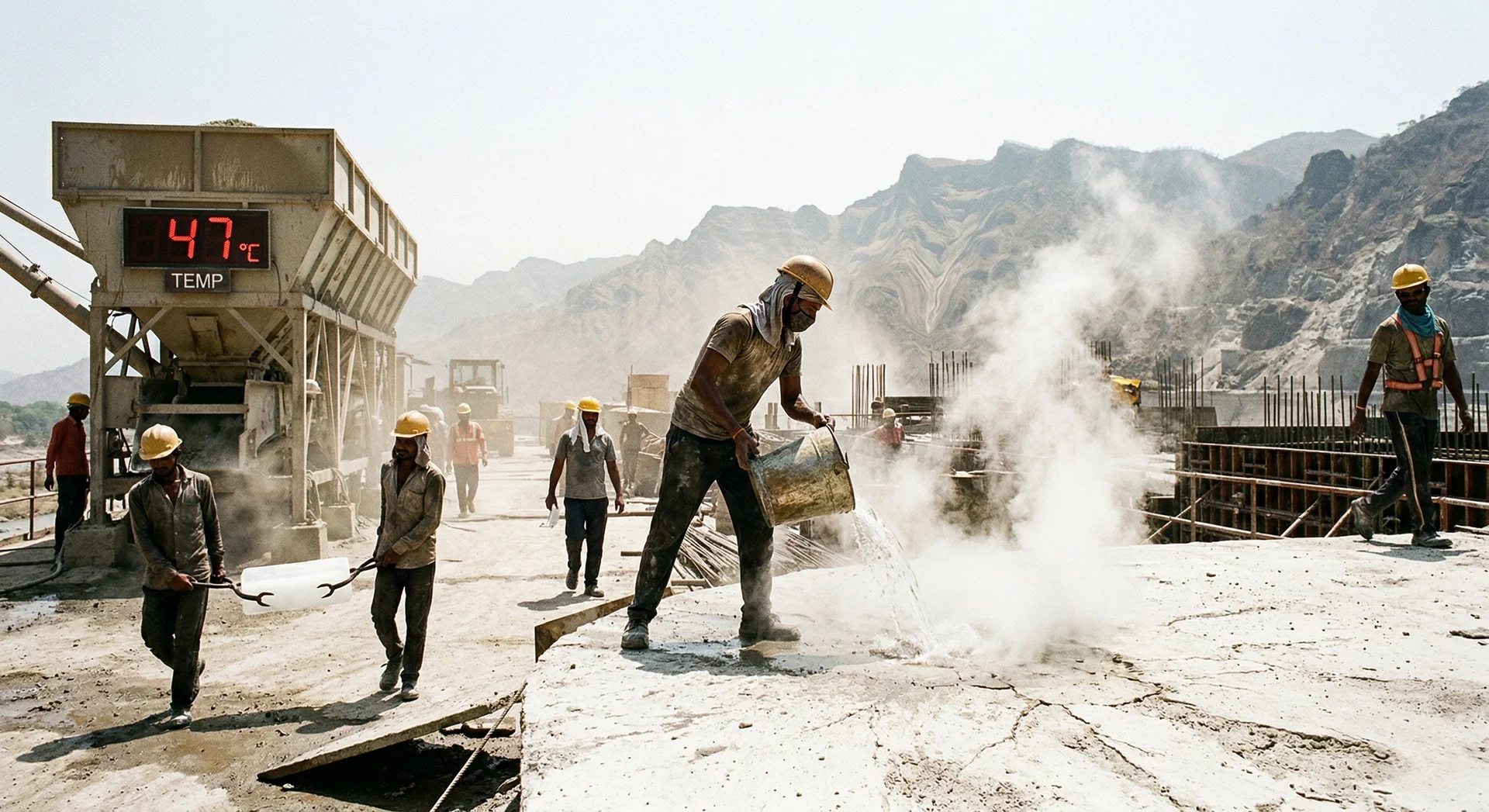
The Kundah Pumped Storage Project in the Nilgiri Hills of Tamil Nadu sits at approximately 2,400 metres above sea level. The Sach Khas Dam in Himachal Pradesh is at over 2,000 metres. Multiple proposed pumped storage and hydropower projects across Uttarakhand, Sikkim, and Arunachal Pradesh are at 1,500-3,000+ metres.
At these elevations, concrete faces an environment that it was not intuitively designed for. The textbooks, the standards, and most of the accumulated field experience assume moderate climates where temperatures rarely drop below freezing and never freeze inside the concrete. At 2,000+ metres in the Himalayas, freezing inside the concrete is not an occasional risk. It is a certainty, dozens of times every year, for the entire service life of the structure.
High-altitude dam concrete must be designed, placed, cured, and protected with this certainty in mind. The concrete challenges specific to Himalayan hydropower extend well beyond freeze-thaw, but freeze-thaw is among the most visibly destructive. The consequences of getting it wrong are visible on dam surfaces across the Himalayan region: scaling, pop-outs, spalling, and progressive surface loss that accumulates year after year.
The Freeze-Thaw Mechanism
What Happens Inside the Concrete
Concrete is not solid. Its cement paste matrix contains a network of capillary pores and gel pores filled with water from the original mix and from external moisture absorption. At high-altitude sites, this water freezes when temperatures drop below 0 degrees C.
Water expands by approximately 9% when it freezes. In a confined space (a capillary pore in hardened cement paste), this expansion generates hydraulic pressure on the surrounding paste. If the pressure exceeds the tensile strength of the paste, a micro-crack forms.
A single freeze-thaw cycle creates negligible damage. But the damage is cumulative: each cycle extends existing micro-cracks and creates new ones. After 50-100 cycles, the cumulative damage becomes visible as surface scaling (flaking of the outer 1-5 mm), pop-outs (conical fragments ejected by pressure beneath a near-surface aggregate particle), and progressive mass loss.
The process accelerates over time because each cycle increases the concrete’s permeability, allowing more water to enter during the next thaw, which creates more ice during the next freeze.
The Critical Zone
Not all concrete in a dam is equally vulnerable. The critical zone for freeze-thaw damage is concrete that is both saturated (pores filled with water) and exposed to freezing temperatures:
- Splash zone: The band of dam face near the waterline where wave action and reservoir fluctuation keep the concrete wet
- Upstream face above winter water level: Saturated during high reservoir periods, then frozen when exposed
- Gallery walls and floors where seepage keeps the concrete wet and winter air enters through gallery openings
- Spillway surfaces that are wet during monsoon operations and then freeze during winter
- Downstream face where seepage emerges and the surface is wet year-round
Interior mass concrete deep within the dam body is generally not at risk: it stays at a relatively constant temperature (the thermal mass of the dam body insulates the interior from ambient temperature swings).
Air Entrainment: The Primary Defence
The Principle
Air-entraining admixture (AEA) creates a system of microscopic, uniformly distributed air bubbles within the cement paste. These bubbles, typically 10-1,000 micrometres in diameter, serve as pressure relief chambers. When pore water freezes and expands, the ice can migrate into the nearest air void (which is partially filled with air at lower pressure) rather than exerting destructive pressure on the paste.
The effectiveness depends on three parameters:
-
Total air content: Target 5-7% for dam concrete in freeze-thaw exposure zones (higher than the 3-5% typical for non-freeze-thaw exposure)
-
Spacing factor: The maximum distance from any point in the paste to the nearest air void. Must be less than 0.2 mm (200 micrometres) for effective freeze-thaw protection. This is verified by hardened air-void analysis per ASTM C457.
-
Specific surface: The total surface area of the air voids per unit volume of air. Higher specific surface (smaller bubbles) provides better protection. Minimum: 24 mm2/mm3.
The Challenge in Dam Concrete
Maintaining a proper air-void system in dam concrete is more difficult than in standard construction concrete:
Fly ash interference: The carbon content in fly ash adsorbs air-entraining admixture, reducing its effectiveness. Indian fly ash LOI varies from 1-12%. A high-carbon batch can collapse the air-void system. Solution: test every fly ash delivery for LOI and adjust AEA dosage accordingly. Broader strategies for managing supplementary cementitious materials in dam concrete are critical to getting this balance right.
Prolonged mixing and transport: Extended mixing time and transit mixer rotation can either increase or decrease air content unpredictably. Solution: measure air content at the point of placement, not just at the batching plant. A robust QA/QC system with testing at the point of placement is essential.
Vibration: Internal vibration during placement removes large voids (good) but can also remove entrained air (bad) if vibration is excessive. Solution: limit vibration duration to the minimum required for full consolidation. Do not re-vibrate concrete in the freeze-thaw zone.
Temperature effects: Air content varies with concrete temperature. Hot concrete holds less air than cold concrete at the same AEA dosage. At high-altitude sites where temperatures vary dramatically between morning and afternoon placement, the AEA dosage must be adjusted in real time.
The Strength Trade-off
Every 1% increase in air content reduces compressive strength by approximately 3-5%. For dam concrete in the freeze-thaw zone:
| Air Content | Approximate Strength Reduction |
|---|---|
| 4% | 12-20% |
| 5% | 15-25% |
| 6% | 18-30% |
| 7% | 21-35% |
This reduction must be accounted for in the mix design. For M20 dam concrete requiring 5-7% air, the mix must be designed for a higher target strength (M25-M30 without air) so that the air-entrained concrete achieves the required M20 after the strength reduction.
Cold Weather Placement
The Critical Period
Freshly placed concrete is most vulnerable to freezing damage. Before it reaches approximately 3.5-5.0 MPa compressive strength (typically 24-48 hours at 20 degrees C, but 48-96+ hours at 5 degrees C with high fly ash content), freezing will destroy the developing cement paste structure. The damage is permanent and irreversible.
ACI 306R and IS 7861 Part 2 define cold weather concreting as any period when:
- The ambient temperature is at or below 5 degrees C for more than 3 consecutive days, OR
- The mean daily temperature is below 5 degrees C
At high-altitude Himalayan sites, these conditions typically prevail from November through February, and night-time temperatures may drop below 5 degrees C as early as October and as late as April.
Protection Measures
Heating mixing water: Raising the water temperature to 40-60 degrees C (not exceeding 60 degrees C, which can cause flash set with cement) increases the concrete temperature at placement. Combined with aggregate at ambient temperature and cement at ambient temperature, heated water can raise the concrete temperature by 5-10 degrees C.
Preheating aggregates: Steam heating, hot water immersion, or heated storage in enclosed bins raises the aggregate temperature. Since aggregate constitutes 60-75% of the concrete mass, even small increases in aggregate temperature have large effects on the concrete temperature.
Minimum placing temperature: IS 7861 Part 2 and ACI 306R recommend a minimum placing temperature of 5-13 degrees C depending on the section thickness and ambient conditions. For mass concrete sections (more than 1.8 metres thick), the minimum is typically 5-7 degrees C. For thin sections, the minimum is 10-13 degrees C.
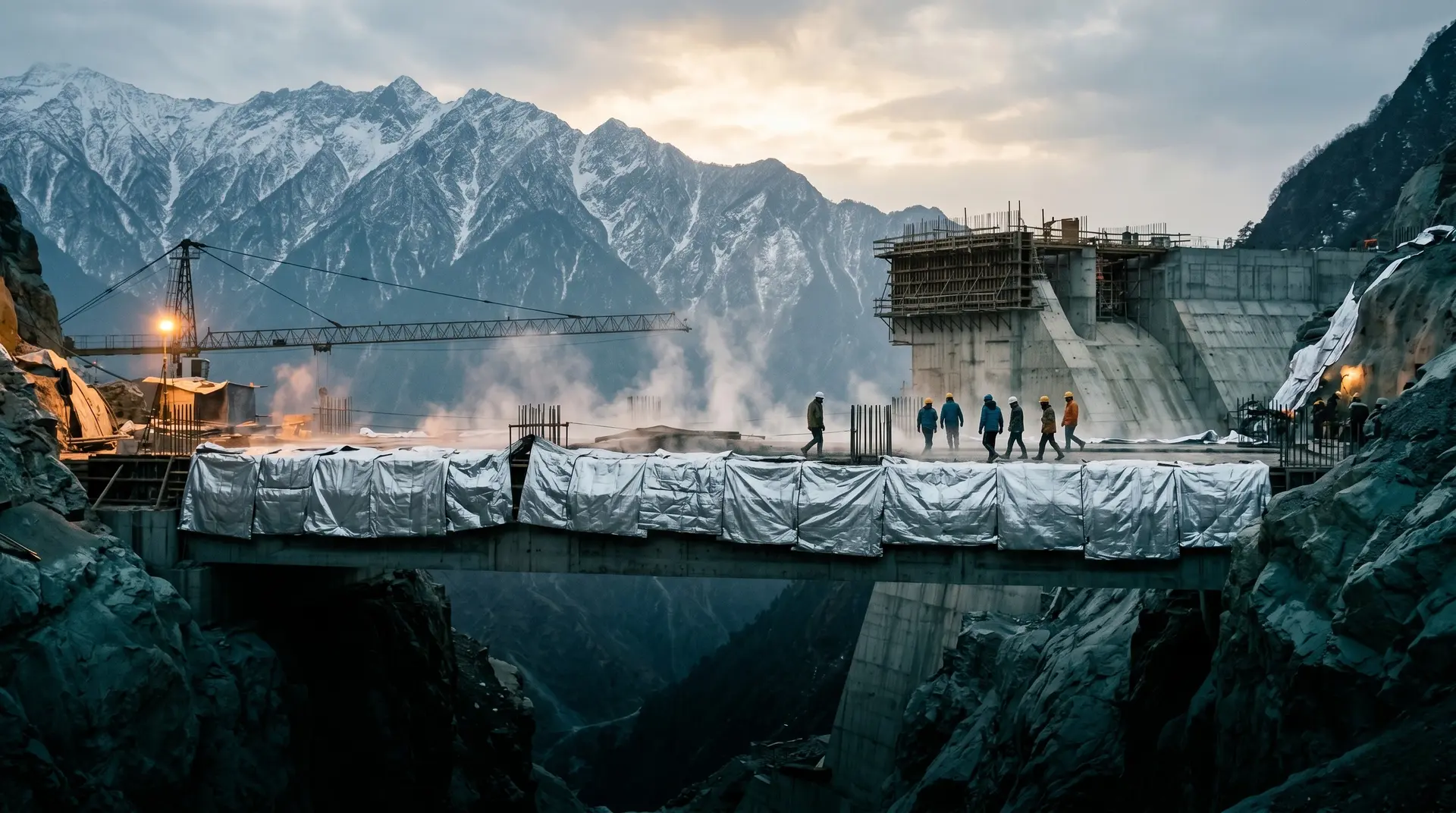
Insulated formwork: Formwork lined with insulation (polystyrene, mineral wool, or insulated formwork panels) retains the heat of hydration within the concrete, raising the internal temperature and protecting against surface freezing. This is closely related to thermal control in mass concrete, where managing internal heat is equally critical. For mass concrete, the heat of hydration alone, if retained by insulated formwork, can maintain concrete temperature above freezing for several days.
Heated enclosures: For small or critical placements, temporary enclosures with heating (electric, gas, or steam) maintain the ambient temperature around the fresh concrete above 10 degrees C. This is expensive and impractical for large dam placements but useful for gallery construction, spillway elements, and other smaller concrete operations.
Extended curing: Cold temperatures slow hydration. Concrete cured at 5 degrees C develops strength approximately half as fast as concrete cured at 20 degrees C. The curing period (the time before formwork is removed and the concrete is exposed to ambient conditions) must be extended proportionally. For high-altitude dam concrete with 35%+ fly ash, curing periods of 14-28 days (vs. 7-14 days at moderate temperatures) are appropriate.
The Construction Season Decision
At most high-altitude Himalayan dam sites, the practical decision is: do not place concrete when overnight temperatures drop below minus 5 degrees C.
The cost of cold weather protection (heating, insulation, extended curing, increased QC) exceeds the productivity gained from winter placement unless the project schedule absolutely requires it. Most high-altitude dam projects define a concrete construction season of April/May through October/November, with winter months dedicated to non-concrete activities (excavation, steel fabrication, equipment maintenance).
This reduces the effective construction season to 6-8 months per year, significantly affecting project schedules and requiring aggressive placement rates during the available months.
Mix Design for High Altitude
The high-altitude dam concrete mix design must simultaneously achieve:
- Freeze-thaw resistance: 5-7% air entrainment with spacing factor less than 0.2 mm
- Adequate strength after air content reduction: Higher target strength to compensate for air content
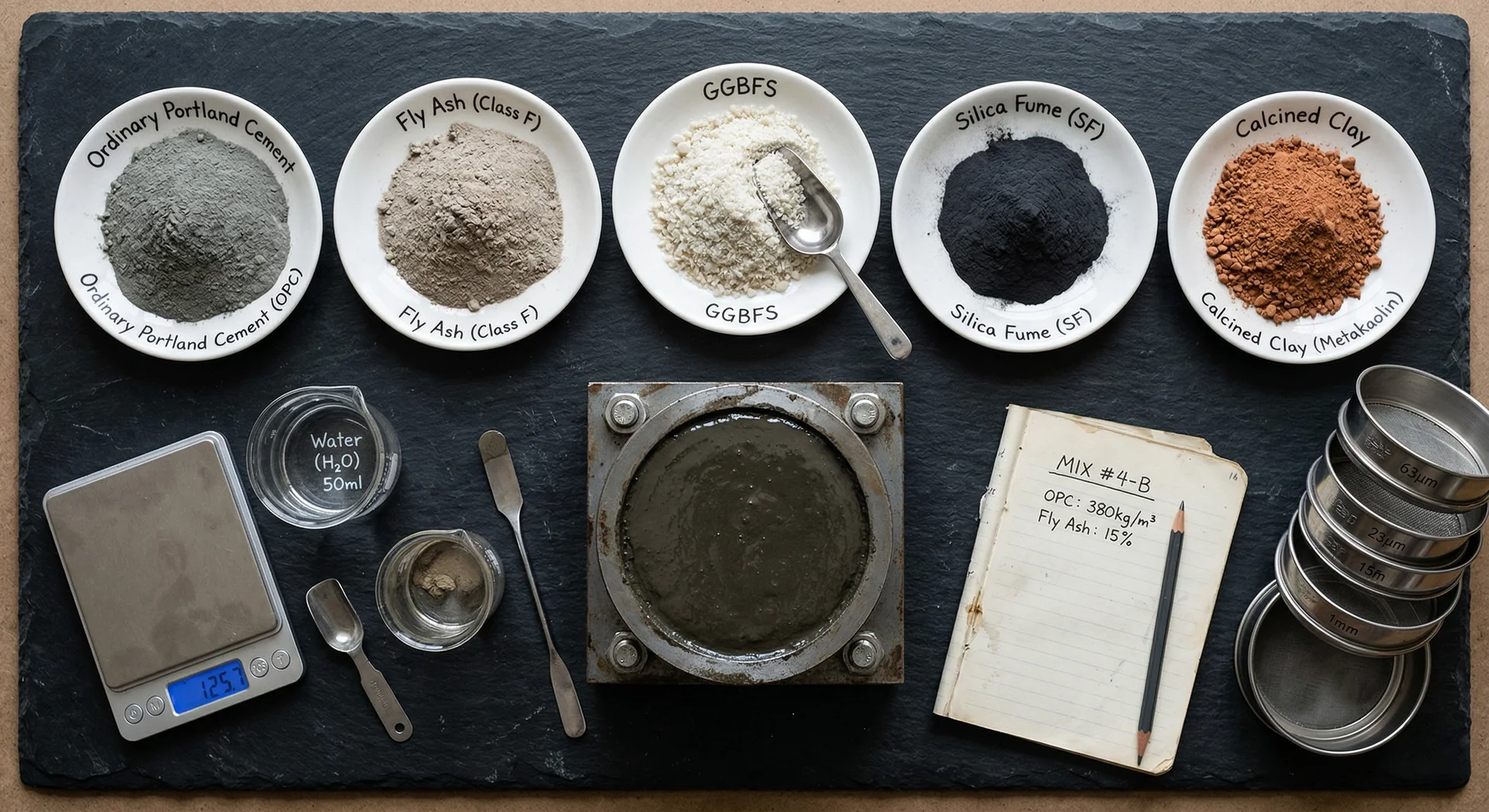
- Low heat of hydration: SCM replacement (30-50% fly ash or equivalent) for thermal control
- Workability at low temperatures: Longer working time because cold temperatures extend setting
- Early strength for freeze protection: Enough strength in 24-48 hours to survive overnight freezing
Requirements 2 and 3 conflict (higher target strength means more cement, but lower heat means less cement). Requirements 3 and 5 also conflict (high fly ash slows early strength, but early strength is needed to survive freezing).
The resolution requires careful optimisation:
- Fly ash at 25-35% (lower than typical mass concrete to maintain adequate early strength)
- Silica fume at 5-8% (compensates for fly ash reduction by providing early strength and reduced permeability)
- Water-cementitious ratio at 0.40-0.45 (lower than typical mass concrete for better freeze-thaw resistance)
- Air-entraining admixture at dosage calibrated to achieve 5-7% at the actual fly ash LOI and concrete temperature
- Superplasticiser to maintain workability at the lower w/c ratio
This produces a concrete that is more expensive per cubic metre than standard mass concrete but significantly more durable in the high-altitude environment.
Long-Term Durability Monitoring
High-altitude dam concrete durability must be monitored throughout the structure’s life:
Annual Inspection (Post-Winter)
After each winter cycle:
- Document surface scaling, pop-outs, and spalling on all exposed surfaces
- Measure depth of scaling at reference locations
- Photograph the same locations each year for trend analysis
- Check gallery walls and floors for freeze-thaw damage (water seepage + freezing = accelerated damage)
Periodic Testing (Every 5-10 Years)
- Core extraction from the freeze-thaw exposure zone for:
- Compressive strength comparison with original design values
- Air-void analysis (ASTM C457) to verify the air-void system is intact
- Petrographic examination for micro-cracking
- Water absorption testing (increasing absorption indicates progressive deterioration)
- UPV testing to map concrete quality across exposed surfaces
Intervention Triggers
- Surface scaling exceeding 5 mm depth: apply protective sealer or coating to reduce water ingress
- Pop-outs or spalling exceeding 20 mm depth: patch repair with freeze-thaw-resistant mortar
- Core testing showing loss of air-void system integrity: structural assessment and surface protection programme
- Compressive strength declining below 80% of original: engineering assessment of structural adequacy
Key Principles
-
Air entrainment is non-negotiable above 1,500 metres. Every cubic metre of concrete in the freeze-thaw exposure zone must have 5-7% entrained air with proper spacing factor. No exceptions, no waivers, no “it will be fine.”
-
Protect fresh concrete from freezing for a minimum of 48 hours. Longer for high-fly-ash mixes. This is a construction planning constraint that must be built into the placement schedule, not managed as an afterthought.
-
Test air content at the point of placement. The batching plant result does not predict the air content after transport, pumping, and placement. The test that matters is the one done at the forms.
-
Account for the strength trade-off in the mix design. Do not discover at 28 days that the air-entrained concrete does not meet the strength requirement. Design the mix for the target strength plus the air content penalty.
-
Limit the construction season rather than fight the winter. The cost of cold weather protection for large concrete placements at high altitude is rarely justified by the productivity gained. Use winter for non-concrete activities.
-
Monitor for life, not just during construction. Freeze-thaw damage is cumulative and progressive. The concrete that passes all construction QC tests can still deteriorate over decades of freeze-thaw cycling if the air-void system was marginal or if the exposure conditions are more severe than assumed.
Building a dam at 2,000+ metres is an engineering challenge unlike anything at lower elevations. The concrete must survive an environment that actively tries to destroy it, 50-100 times every year, for a century. For hydropower dam projects at these altitudes, the mix design, the placement, the curing, and the monitoring must all be calibrated for this reality. Anything less is a bet against the mountain, and the mountain always wins eventually.