Before a single cubic metre of dam concrete is placed, the foundation must be prepared to do three things: support the weight, resist the water pressure, and block the seepage.
Natural rock does none of these adequately. Even apparently sound rock at a dam site is fractured, jointed, and permeable at depth. The geological processes that created it, tectonic movement, erosion, weathering, and stress relief, have left a network of discontinuities through which water can flow and along which the rock mass can deform.
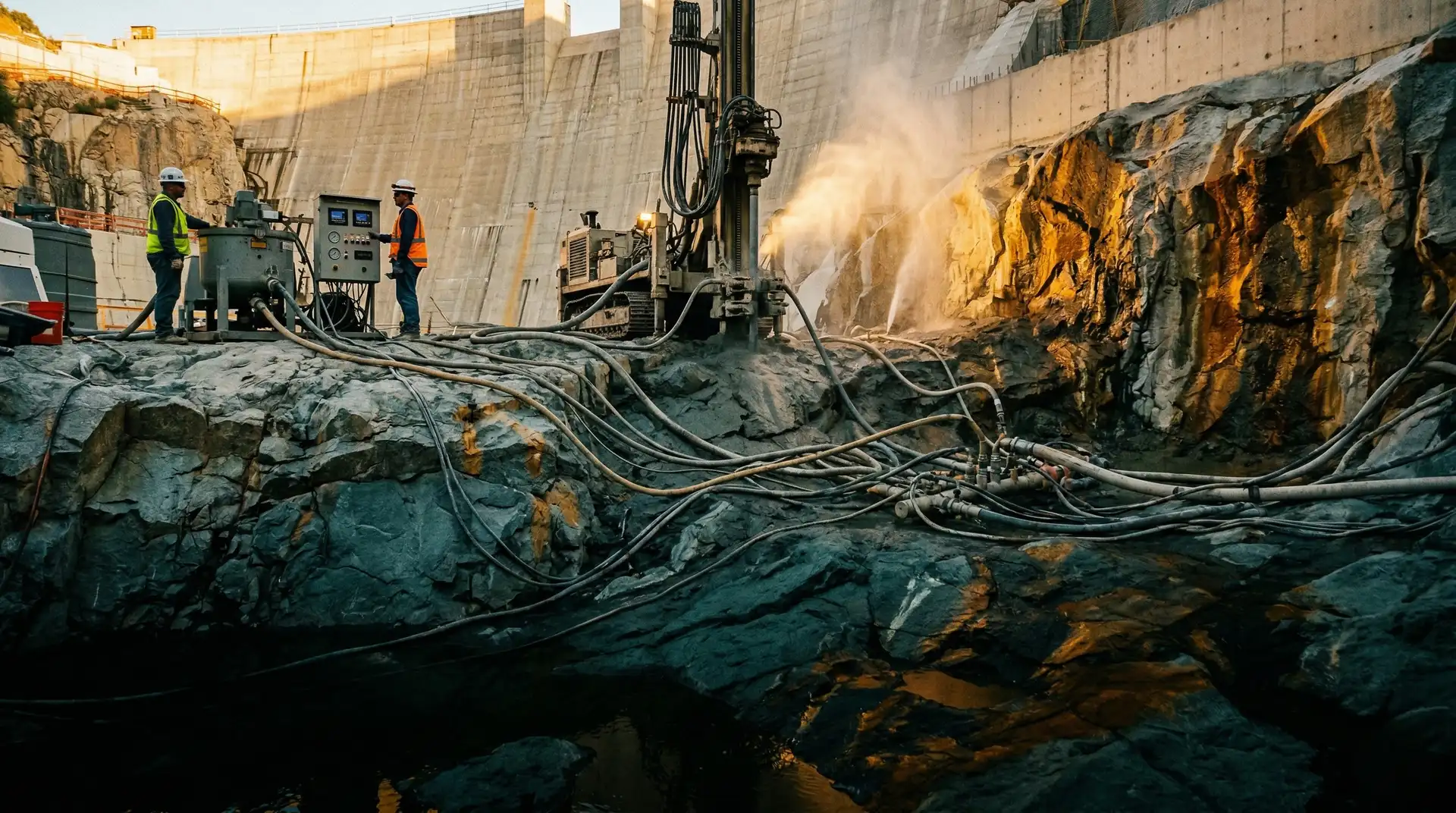
Foundation grouting transforms this natural rock into an engineered foundation. Cement grout, a mixture of Portland cement, water, and sometimes additives, is injected under pressure into drilled holes. The grout fills fractures and voids, bonding the rock mass into a denser, stronger, less permeable material. The International Commission on Large Dams (ICOLD) recognises foundation treatment as one of the most critical phases in dam construction, and grouting quality control is a core discipline in any competent dam engineering programme.
Three distinct grouting programmes serve different purposes, and confusing them leads to either inadequate treatment or wasted resources.
The Three Grouting Programmes
1. Curtain Grouting: The Seepage Barrier
Purpose: Create a vertical or near-vertical barrier of grouted rock upstream of the dam to reduce seepage beneath the foundation.
Location: A single line (or occasionally double line) of grout holes along the upstream edge of the dam foundation, extending the full length of the dam and into both abutments. The holes are drilled from the dam gallery or from the foundation surface before concrete placement.
Depth: Typically 30-70% of the maximum reservoir head. For a dam with 100 metres of head, the curtain might extend 50-70 metres into the foundation. The required depth is determined by the geological structure: the curtain must penetrate below the permeable rock zone and into competent, tight rock.
Hole spacing: Initial (primary) holes at 6-12 metre centres. Secondary holes drilled at the midpoints of primary holes. Tertiary holes at midpoints of secondaries. This split-spacing approach progressively reduces the spacing until the permeability target is achieved.
Grout mixes: Starting with thin mixes (water:cement ratio 5:1 or 3:1 by weight) and thickening progressively (to 1:1 or 0.8:1) as the rock takes grout. Modern practice uses stable, high-mobility grouts with superplasticiser and micro-cement for penetrating fine fractures. Grout mix design follows the same material science principles as structural concrete, though the proportioning logic differs.
Pressures: Generally limited to avoid hydraulic fracturing of the rock. A common rule: maximum pressure in bar equals 0.023 times the depth in metres, or a site-specific value based on rock mechanics testing.
Quality criterion: The target permeability after grouting, measured by Lugeon testing in verification holes, is typically less than 3 Lugeons (some specifications require less than 1 Lugeon for critical dam foundations). Compliance with Bureau of Indian Standards (BIS) specifications and relevant IS codes governs acceptance criteria on Indian dam projects.
2. Consolidation Grouting: Strengthening the Foundation
Purpose: Improve the mechanical properties (strength, stiffness, and uniformity) of the shallow rock mass directly beneath the dam foundation.
Location: A pattern of holes across the entire dam footprint, typically on a grid of 1.5-3 metres. The pattern covers the full width and length of the dam-rock contact.
Depth: Shallow: typically 5-15 metres, targeting the zone of weathered, fractured, and stress-relieved rock immediately below the excavation surface.
Why it matters: The excavation process that prepares the dam foundation (blasting, mechanical excavation) inevitably disturbs the top few metres of rock, creating blast-damaged zones with open fractures and reduced stiffness. The natural rock below the excavation surface may also be weathered and fractured. Consolidation grouting fills these fractures, compresses the rock mass, and creates a more uniform bearing surface.
Grout mixes: Relatively thick mixes (w:c ratio 1:1 to 0.6:1) because the fractures being filled are near-surface, wider, and more accessible than the deep fractures targeted by curtain grouting.
Pressures: Low to moderate (typically 3-7 bar for the shallowest zones, increasing with depth). Higher pressures risk lifting the rock surface or displacing loosened blocks.
Sequence: Consolidation grouting should be completed before curtain grouting. The logic: consolidation grouting fills the shallow fractures that would otherwise provide short-circuit paths around the deeper curtain. If the curtain is grouted first, shallow fractures may still allow seepage to bypass the curtain. This sequencing discipline is one of the reasons that independent technical review during the foundation treatment phase can prevent costly rework later.
3. Contact Grouting: Sealing the Interface
Purpose: Fill any voids at the interface between the dam concrete and the foundation rock.
Location: Holes drilled through the dam concrete into the rock surface, typically on a 3-6 metre grid across the entire foundation contact.
Why it matters: Despite careful concrete placement, small voids inevitably form at the concrete-rock interface due to:
- Irregularities in the rock surface that concrete did not fill completely
- Bleeding water that migrated to the interface and left voids when absorbed or evaporated
- Shrinkage of the concrete as it cures, creating separation from the rock
These voids create preferential seepage paths directly beneath the dam and reduce the effective contact area for load transfer. Identifying and resolving such interface defects falls squarely within construction troubleshooting and root cause analysis.
Sequence: Contact grouting is performed after the dam concrete has gained sufficient strength (typically 28+ days) so the grout pressure does not damage the young concrete. It is the last grouting programme in the sequence: after consolidation, after curtain, after concrete placement.
Grout mixes: Thin, fluid mixes to penetrate the narrow interface voids. Often includes additives for improved flowability.
Pressures: Very low (typically 1-3 bar) to avoid lifting the concrete off the rock or fracturing the dam base.
The Foundation Investigation: Before Any Grouting
Grouting without adequate geological investigation is grouting blind. The investigation programme determines:
Rock Mass Characterisation
- Core drilling with full core recovery to identify rock types, fracture frequency, weathering depth, and fault/shear zone locations
- Rock quality designation (RQD) calculated from core logs: the percentage of core pieces longer than 100 mm in each run
- Geological mapping of the excavated foundation surface to identify joints, faults, shear zones, and weathered zones
These investigation methods overlap with the broader non-destructive testing programme that supports dam concrete quality assurance throughout construction.
Permeability Assessment
- Lugeon testing in investigation holes at multiple depth intervals to establish the permeability profile of the foundation
The Lugeon test injects water at controlled pressure into a sealed section of a drilled hole and measures the flow rate. One Lugeon unit equals one litre per minute per metre of hole at 10 bar pressure.
| Lugeon Value | Rock Condition | Grouting Need |
|---|---|---|
| Less than 1 | Very tight | Generally no grouting needed |
| 1-3 | Tight | Marginal: may not benefit from grouting |
| 3-10 | Moderately permeable | Grouting likely beneficial |
| 10-50 | Permeable | Grouting required |
| Greater than 50 | Highly permeable | Extensive grouting programme required |
Foundation Classification
The investigation data is synthesised into a foundation classification that guides the grouting programme design: which areas need consolidation grouting, where the curtain must be deepest, where special treatment (dental concrete, fault zone treatment) is required, and where the rock is competent enough that minimal treatment suffices.
Grout Mix Design
The cement grout injected into the foundation is itself an engineered material. Its properties must match the purpose:
Components
- Cement: Ordinary Portland cement (OPC) for standard grouting. Micro-cement (ground to Blaine fineness of 8,000-12,000 cm2/g vs. 3,200-3,800 for OPC) for penetrating fine fractures that OPC particles cannot enter.
- Water: Clean, free from organic matter and dissolved salts
- Superplasticiser: Reduces water demand, allowing lower w:c ratios without losing fluidity. Essential for stable grouts.
- Bentonite: Added to prevent cement settling (bleed) in thin mixes. Typical addition: 2-4% by weight of cement.
Mix Stability
A stable grout is one where the water and cement remain uniformly mixed without significant bleed (water separation). Unstable grouts (high w:c ratio without bentonite or superplasticiser) bleed water from the grout after injection, leaving a partially filled fracture with a weak, porous deposit.
Modern practice uses stable grouts with w:c ratios of 0.8:1 to 1.2:1, bentonite or superplasticiser for stability, and high-shear mixing for uniform dispersion.
The GIN Method
The Grouting Intensity Number (GIN) method, developed by Professor Giovanni Lombardi, provides a rational framework for controlling grout injection. The methodology is well documented in ACI technical literature and ICOLD bulletins. The GIN value (pressure x volume per metre of hole) is kept constant along a limiting curve:
P x V = GIN (constant)
Where P is the injection pressure and V is the cumulative volume of grout injected per metre.
The GIN curve ensures that:
- In highly permeable zones (where the rock takes large volumes), the pressure is kept low to avoid damage
- In tight zones (where the rock takes little volume), higher pressure is applied to force grout into fine fractures
- Over-grouting (injecting excessive volume) and under-grouting (stopping too early) are both prevented
Typical GIN values: 500-2,500 bar-litres/metre, depending on rock conditions and the grouting objective.
Grouting Sequence and Quality Control
The Split-Spacing Approach
The standard approach for curtain grouting:
- Primary holes drilled at wide spacing (6-12 metres)
- Primary holes grouted and tested
- Secondary holes drilled at midpoints of primary holes
- Secondary holes grouted and tested
- Tertiary holes (if needed) drilled at midpoints of secondaries
- Process continues until the permeability target is achieved
This progressive approach reveals the rock’s response to grouting: primary holes show the virgin permeability, secondary holes show the effect of primary grouting, and tertiary holes confirm whether the target has been achieved.
Real-Time Monitoring
Modern grouting uses automated monitoring systems that record pressure, flow rate, and cumulative volume for every hole in real time. The data is plotted as:
- Pressure-volume curves for each stage (showing rock response)
- GIN curves (showing compliance with the intensity limit)
- Lugeon values before and after grouting (showing effectiveness)
Verification
After the grouting programme is complete, verification holes are drilled between grouted holes and tested with Lugeon tests. If the verification holes meet the permeability target (typically less than 3 Lugeons), the curtain is accepted. If not, additional holes are drilled and grouted.
Common Problems on Indian Dam Sites
Over-Consumption
Some Indian dam foundations, particularly in the Himalayas where the rock is young, fractured, and tectonically disturbed, consume very large volumes of grout. Consumption can reach 100-500 kg of cement per metre of hole in severely fractured zones. The concrete challenges specific to Himalayan hydropower extend well beyond grouting into every aspect of concrete placement and curing.
Response: Thicken the grout mix progressively (reduce w:c ratio). Add sand to create a mortar for filling large cavities. In extreme cases, pre-treatment with lean concrete or sand-cement mortar before grouting.
Grout Escape
Grout injected at one location emerges at the surface or in an adjacent excavation, indicating a connected fracture system that extends to daylight.
Response: Reduce pressure. Thicken the mix. Consider staged grouting (grout the shallow zone first to create a plug, then grout deeper).
Hydrojacking
Excessive grouting pressure opens existing fractures or creates new ones, reducing the rock quality rather than improving it.
Response: Never exceed the safe pressure limit. Monitor pressure-volume curves for signs of fracture opening (sudden increase in flow at constant pressure). Use the GIN method to prevent over-pressuring.
Incomplete Curtain
The grouted curtain has gaps, typically where a fault zone or highly permeable zone was not adequately treated, allowing seepage to bypass the curtain.
Response: The foundation drainage system downstream of the curtain provides a backup. Supplementary grouting can be performed from the gallery after the dam is built. Verification holes before concrete placement should identify gaps.
The Himalayan Foundation Challenge
Himalayan dam foundations present specific challenges:
- Shear zones with crushed, clay-filled rock that is both weak and permeable. Grouting alone may not be adequate: dental concrete (filling large cavities with concrete) and shear key construction may be required.
- High in-situ stresses that make drilling and grouting more difficult and increase the risk of hole collapse.
- Seismic considerations: The grout curtain must survive earthquake shaking. Seismic events may open new fractures that bypass the curtain, requiring post-earthquake inspection and supplementary grouting. For a deeper look at how seismic forces affect dam concrete design in the region, see seismic design of dam concrete in the Himalayas.
- Varying rock quality over short distances: a dam foundation may encounter competent gneiss, weathered schist, and a major shear zone within 50 metres of length.
The Cost of Getting It Right (and Wrong)
Foundation grouting typically represents 5-15% of the total dam construction cost. For a Rs 500 crore dam, the grouting programme might cost Rs 25-75 crore.
The cost of inadequate grouting:
- Under-dam seepage: Reduces the effective weight of the dam (uplift), requiring either a heavier dam section (more concrete, more cost) or post-construction remedial grouting (difficult, expensive, and less effective than original grouting)
- Foundation instability: Deformation of the rock under dam load, causing cracking in the dam concrete and potential structural distress
- Piping failure: In extreme cases, concentrated seepage through an untreated permeable zone can erode foundation material, creating a pipe that progressively enlarges and can lead to foundation collapse. Post-construction assessment of such deterioration is covered in detail in the context of concrete deterioration warning signs in Indian dams
The grouting programme is an investment in foundation integrity. The consequences of under-investment, unlike the consequences of over-investment, can be catastrophic.
Key Principles
-
Investigate before you grout. The grouting programme design must be based on geological investigation, not assumptions. The same rock type at different dam sites can have radically different permeability and fracture patterns.
-
Follow the sequence: Consolidation first, then curtain, then contact (after concrete). Each programme depends on the previous one being complete.
-
Use the split-spacing approach. Progressive hole spacing reveals the rock’s response and prevents both over-treatment and under-treatment.
-
Monitor in real time. Automated pressure-volume recording with GIN method control ensures consistent quality across thousands of metres of grouting.
-
Verify before you accept. Verification holes with Lugeon testing between grouted holes are the only way to confirm the curtain meets the permeability target. The grout consumption records alone do not prove the curtain works.
-
Design the drainage as a backup. Even a well-executed grout curtain degrades over decades. The foundation drainage system downstream of the curtain provides a long-term backup that controls uplift pressure regardless of the curtain’s condition.
The foundation grouting programme is invisible: it is underground, behind the concrete, beneath the reservoir. But it is the foundation upon which the entire dam’s safety depends. Getting it right requires geological understanding, grouting expertise, and a quality control system that verifies every metre of treatment. For hydropower dam projects, where durability and service-life expectations span 100+ years, the foundation treatment programme is one of the earliest and most consequential engineering decisions.