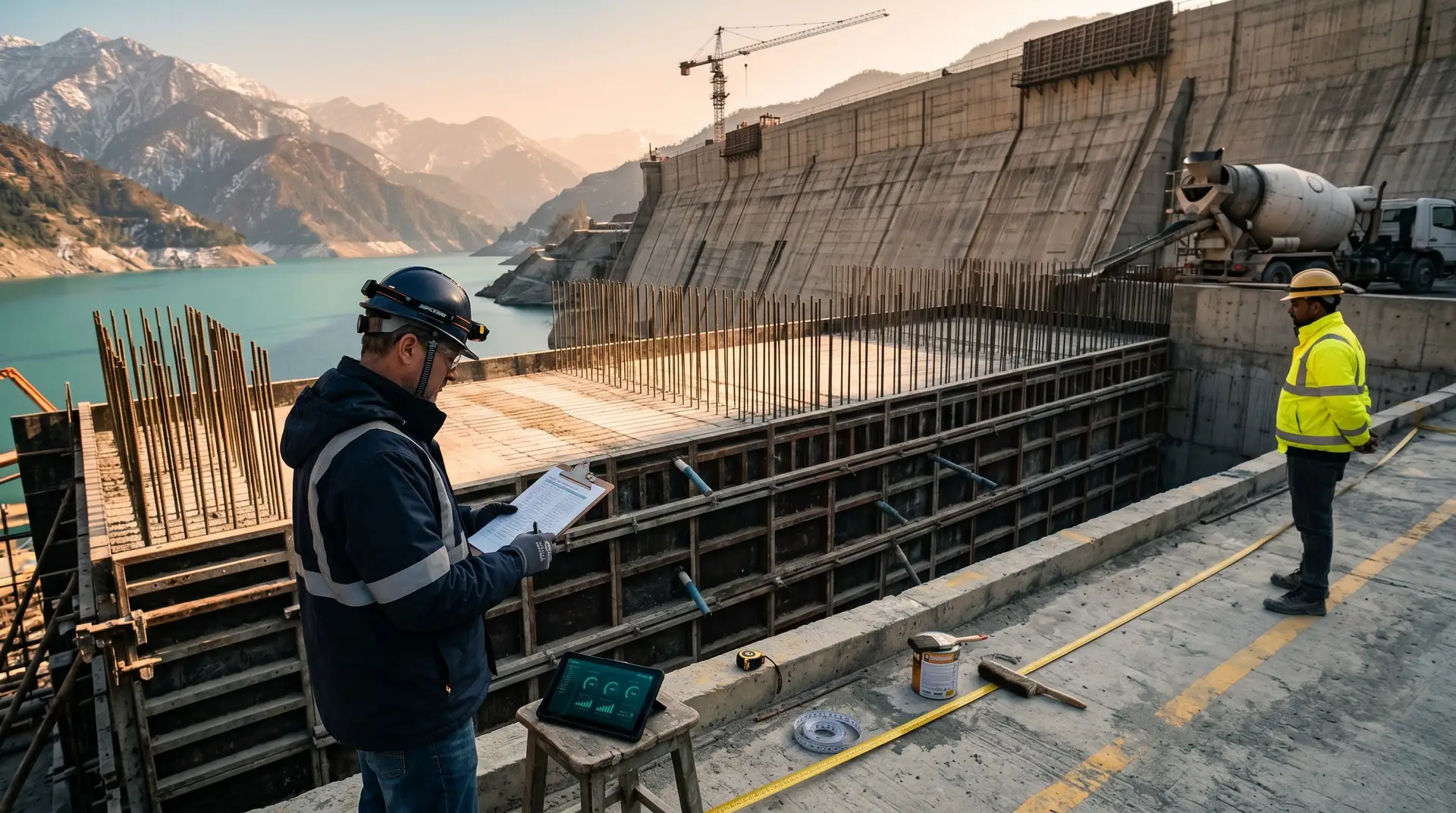

The largest line item, the most disputed document
The Bill of Quantities for concrete works on a typical hydropower project is the largest single line item category in the overall project BOQ. On a 500 to 1,000 MW gravity dam project, the concrete BOQ commonly accounts for 30 to 50 percent of total civil works value, sometimes more. The pricing accuracy of this single document directly affects the project’s overall budget reliability.
It is also one of the most disputed documents on the project. Most contractor change orders and many owner claims trace back to BOQ ambiguities: items that mean different things to different parties, units of measurement that are inconsistent, scope inclusions and exclusions that are not stated explicitly. The cost of these disputes is large because the underlying quantities are large.
Most concrete BOQs are inherited from previous project templates with limited adaptation. The result is a document that is 70 to 80 percent reusable from project to project, with critical project-specific items either missing, mispriced, or ambiguously defined. For multilateral-funded hydropower projects (such as World Bank or ADB-financed works executed by NHPC, SJVN, or THDC), the procurement document structure typically follows the World Bank Procurement Framework or equivalent ADB procurement guidelines, both of which require the BOQ to reconcile cleanly with technical specifications and drawings. This article sets out the framework for a clean concrete BOQ and the recurring errors to watch for.
What a comprehensive concrete BOQ contains
A well-structured concrete BOQ for a hydropower project covers six primary categories.
| Category | Typical sub-categories | Pricing basis |
|---|---|---|
| Mass concrete (dam body) | By grade (M15 to M30), by location (dam body, spillway, intake), by lift level | Cubic metre placed |
| Roller compacted concrete (RCC) | By placement zone, including bedding mortar | Cubic metre placed |
| Reinforced concrete (structures) | By grade, by location (foundations, walls, slabs, beams, columns) | Cubic metre placed (or by structural element where complex) |
| Shotcrete | By location (tunnel primary support, slope stabilisation), by thickness, by reinforcement (plain, mesh, fibre) | Cubic metre placed or square metre by thickness |
| Specialised concrete | High-performance, abrasion-resistant, second-stage, repair concrete | Cubic metre or by structural element |
| Ancillary items | Embedded cooling pipes, waterstops, drain pipes, instrumentation, embedded steel | Linear metre, per number, or per kilogram |
Within each primary category, items are broken further by:
- Concrete grade (M15 / M20 / M25 / M30 / M35 / M40 / M45 / M50 typical for hydropower)
- Location (specific structure or zone)
- Pour conditions (mass concrete with thermal control, regular concrete, special placement)
- Reinforcement (plain, reinforced specifying steel separately)
The BOQ structure should follow the project specification structure so items can be cross-referenced unambiguously between BOQ and specification. Internationally, the most widely-adopted reference for structural concrete specifications is ACI 301 (Specifications for Structural Concrete), which most hydropower specifications either adopt directly or use as a structural template. Indian projects reference IS 456 (plain and reinforced concrete) as the primary specification anchor, supplemented by IS 4926 (ready-mixed concrete) and Central Water Commission guidelines for mass concrete in dams.
Units of measurement: where ambiguity creates disputes
The standard unit of measurement for concrete is the cubic metre of placed volume. The complications arise from what ‘placed volume’ means.
| Method | Definition | When used |
|---|---|---|
| Theoretical volume | Volume from design drawings (no waste) | Owner-friendly, used in some PSU contracts |
| Net placed volume | Volume actually placed (excluding spillage and waste) | Most common, requires definition of waste threshold |
| Gross volume delivered | Total volume delivered from batching plant | Contractor-friendly, rare in modern contracts |
| Volume from formed surface area | Calculated from formwork dimensions | Can over-estimate for complex shapes |
The BOQ should state which method applies and how waste is treated. For mass concrete pours where some spillage and waste are unavoidable, a typical specification allows up to 2 to 5 percent waste in the unit rate without separate compensation. International ready-mix specifications such as ASTM C94/C94M (Standard Specification for Ready-Mixed Concrete) treat water-added concrete and delivery-quality issues with similar quantitative tolerances. Ambiguity on this point produces disputes when actual waste exceeds the implicit allowance.
Reinforcement is measured by mass of steel placed (tonnes or kilograms), typically per IS 1786 nominal mass. Waste in steel reinforcement (cuttings, lap lengths, bends) is also a common dispute point: typical allowances are 2 to 5 percent above net required mass.
Formwork is measured in square metres of formed concrete surface. Common ambiguities include whether reused formwork is paid only once or per reuse, and whether complex formwork (curved, sloped, climbing) is paid at a different unit rate.
State the inclusions and exclusions explicitly
Every BOQ item should have explicit inclusions and exclusions stated either in the item description or in BOQ general conditions. For concrete unit rates, the inclusions typically cover materials, mixing, placement, compaction, finishing, and curing. Exclusions typically include reinforcement, formwork, embedded items, and special activities (post-cooling, mock-ups). Disputes about what is in the unit rate are usually about items that should have been explicitly stated and were not.
The five most-often-missed BOQ items
In our review of hydropower BOQs across multiple projects, five categories of items are most often missing or under-priced.
1. Embedded cooling pipes for post-cooling
Post-cooling pipe systems for mass concrete dam bodies are a significant cost item, including pipe material, installation labour, cooling water supply equipment, monitoring instrumentation, and operation and removal labour. BOQs that lump cooling pipes into the mass concrete unit rate without separate identification leave the contractor exposed if cooling pipe quantity exceeds the implicit allowance, and leave the owner exposed if cooling pipe operation is reduced to save the contractor cost.
The BOQ should have separate items for: cooling pipe supply by linear metre, cooling pipe installation labour, cooling water plant capacity, cooling water operation by duration, and cooling pipe removal and grouting after cooling is complete.
2. Bedding mortar for RCC lift joints
Bedding mortar is a separate cementitious product placed between RCC lifts to ensure inter-lift bond and seepage control. It is typically priced as a separate line item from RCC mass concrete, with quantity calculated as the lift joint area times bedding mortar thickness (typically 10 to 20 mm).
BOQs that include bedding mortar in the RCC unit rate leave the contractor without explicit compensation for bedding mortar variations, and leave the owner without ability to verify bedding mortar quantity against actual usage.
3. Contact grouting
Contact grouting of embedded steel liners and tunnel linings is a separate operation from the primary concrete placement. It involves grout material, installation of grout pipes, injection labour, monitoring, and verification testing.
The BOQ should have separate items for: grout pipe installation by linear metre, grout material by cubic metre or kilogram, injection labour by area or zone, and verification testing.
4. Second-stage concrete
Second-stage concrete in turbine pits and powerhouse foundations has different mix design (tighter water-cement ratio, smaller aggregate, higher cement content), different placement method (often self-compacting), and different unit cost from first-stage concrete.
The BOQ should have a separate line for second-stage concrete by location and grade, not lump it into the general powerhouse concrete category.
5. Trial pours and mix design qualification
The specification typically requires mix design qualification through trial mixing and trial pours before production placement. These activities have material cost (cement, aggregate, admixtures), labour cost, and QA/QC testing cost.
The BOQ should have items for: mix design qualification testing, trial mixing per number, and trial pours per number (with separate items for different pour types if multiple are required).
Other recurring errors
Beyond outright missing items, the following errors recur across hydropower concrete BOQs.
Unit rate inflation by repeated description. The same item is described in two slightly different ways in different parts of the BOQ, both with the same unit rate. The contractor prices both, the owner pays both, even though only one work activity is performed.
Quantity error from drawing inconsistency. The BOQ quantity is taken from one set of drawings; the actual project is built to a later set with revised quantities. The discrepancy becomes a change order during construction.
Mismatched grade specifications. The BOQ specifies M30 for an element that the specification specifies M35. The contractor prices to the lower grade and disputes the higher grade requirement during construction.
Unrealistic placement rates. The BOQ assumes higher concrete placement rates than the contractor can actually achieve at site, leading to schedule extension claims when the actual placement rate falls short.
Missing temporary works. Temporary works such as access tracks, working platforms, batching plant infrastructure, and dewatering systems are sometimes assumed to be included in unit rates, sometimes are separate items, and the inconsistency creates disputes.
A clean BOQ is a project risk-management tool
The BOQ is not just a pricing document. It is the framework against which the project's progress will be measured for the next several years. A clean, comprehensive BOQ with explicit inclusions, exclusions, and units of measurement reduces the dispute incidence during construction by an order of magnitude. The cost of preparing a clean BOQ is small; the cost of arbitrating disputes from a poor BOQ is large. The math favours investment in BOQ quality.
How PCCI approaches BOQ review
PCCI’s independent review service is regularly engaged for BOQ review during tender preparation on hydropower projects. The review identifies missing items, ambiguous descriptions, inconsistent units, and pricing errors before the BOQ is issued to bidders.
For the 4,000+ MW portfolio of projects PCCI’s leadership has been involved with, the BOQ structure for concrete works has been developed and refined across Tala (1,020 MW), Mangdechhu (720 MW), and Karchham Wangtoo (1,000 MW).
Book a Technical Call → to discuss your project’s concrete BOQ requirements.