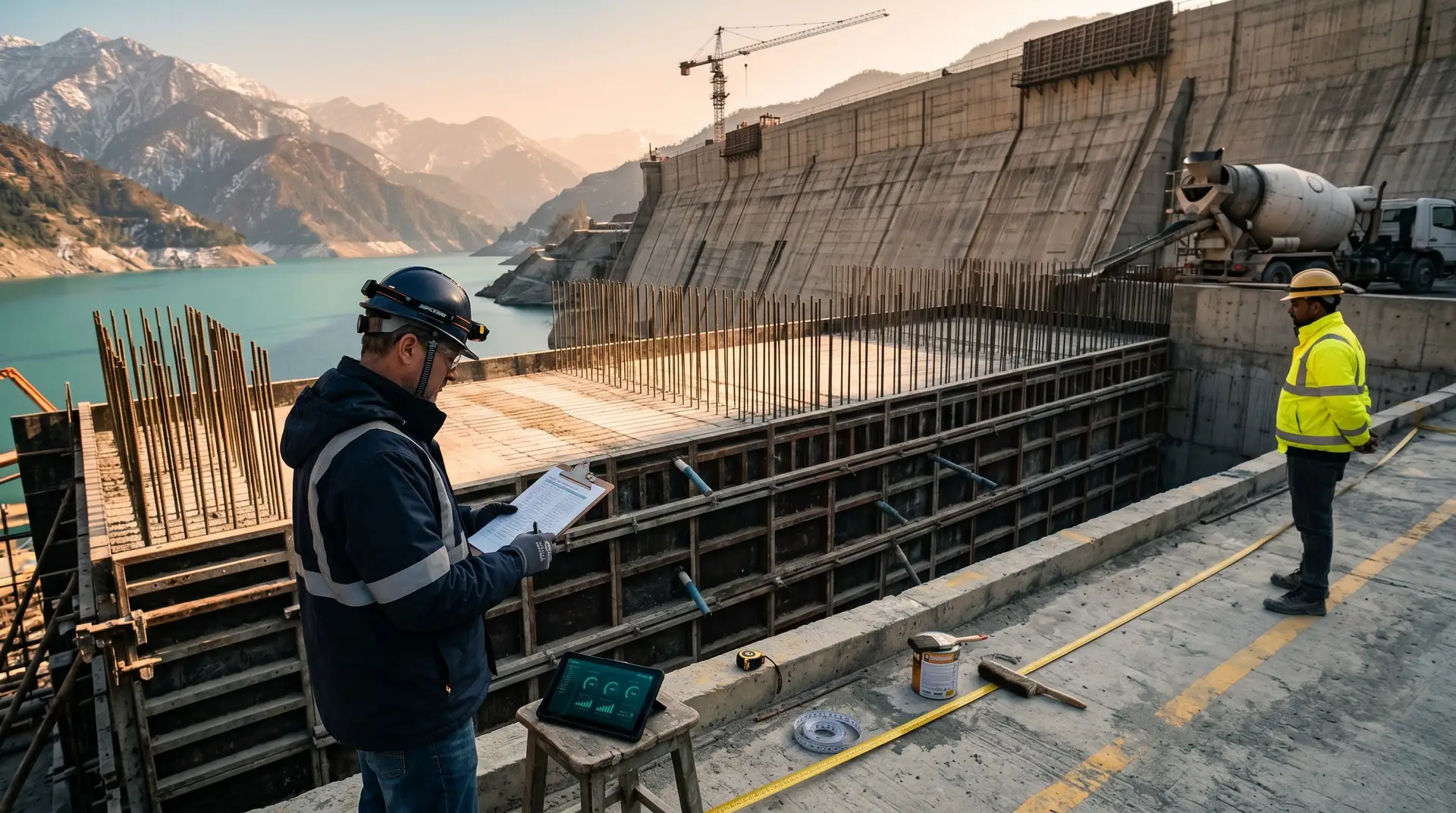

The bid stage decides the project
Most concrete-related disputes on hydropower projects originate in the gap between what the bidder assumed at bid stage and what the site actually delivered during construction. The bidder priced the work based on aggregate from quarry A, cement from supplier B, summer placement temperatures of 32 degrees C, and a contractor team with five years of recent mass concrete experience. The actual aggregate yield from quarry A was lower than expected, supplier B was disrupted by a strike, summer temperatures hit 41 degrees C, and the team that arrived had two years of recent mass concrete experience between them.
These gaps are not unforeseeable. They are the outputs of a thorough pre-bid concrete risk assessment. The bidder who conducts the assessment, prices the risks honestly, and plans the mitigations is the bidder who delivers the project profitably. The bidder who skips the assessment is the bidder who absorbs the gaps as losses or, more often, transmits them to the owner through claims and disputes.
This article is for both sides of the table. For bidders, it is a framework for doing the assessment well. For owners, it is a guide to what a credible bidder should be able to demonstrate.
What a pre-bid concrete risk assessment is
A pre-bid concrete risk assessment is a structured analysis of the concrete-relevant uncertainties on a hydropower project, conducted by a bidder during the bid preparation period. The output is:
- A risk register listing each identified concrete risk with description, probability, impact, ownership, and mitigation actions
- An estimated cost loading to be priced into the bid for each risk, broken into direct cost, contingency, and risk premium
- A mitigation plan describing how each significant risk will be managed during construction
- A pre-mobilisation action list of investigations, supplier confirmations, and contractual clarifications that should precede contractor mobilisation
A typical assessment for a 500 to 1,000 MW project takes two to four weeks, with engagement of internal bid team members, technical consultants, and on-site investigation as warranted.
The six risk categories
A comprehensive assessment covers six risk categories.
1. Aggregate availability and quality
The single most common source of bidder loss on hydropower projects. Bidders typically assume the proposed quarry sources will deliver the volume, grading, and quality required at the bid stage. The reality is often different: the quarry yields less than projected, the gradings require additional crushing, the alkali-silica reactivity tests come back positive, or environmental clearances delay quarry opening.
Pre-bid checks:
- Confirm quarry licences, environmental clearances, and operational status
- Sample and test (or review existing data) for aggregate gradation, alkali-silica reactivity, deleterious substances per ASTM C1260 and ASTM C33
- Validate haulage cost from quarry to site under realistic monsoon-season constraints
- Identify alternative sources with cost implications
2. Cement and SCM supply
Cement supply on hydropower projects is rarely simple. Remote sites have limited supplier options, single suppliers carry risk, low-heat or sulphate-resistant cements may need to be sourced from specific plants, and SCM availability (fly ash, GGBS, calcined clay) varies by region.
Pre-bid checks:
- Identify primary and at least two alternative cement suppliers
- Confirm fly ash or GGBS availability with named supply contracts or letters of intent
- Validate cement haulage logistics and storage capacity at site
- Assess price volatility risk over the project’s cement consumption period
3. Site ambient conditions
Concrete operations are sensitive to temperature, humidity, wind, and rainfall. Bidders who underestimate ambient extremes pay for it in pre-cooling capacity, wasted concrete, and schedule delays.
Pre-bid checks:
- Review historical weather data (India Meteorological Department or equivalent) for the construction period
- Identify worst-case design ambient (typically 95th percentile summer maximum, monsoon-season rainfall extremes)
- Validate that the proposed mix design and pre-cooling capacity work under the worst-case ambient
- Identify any seasonal restrictions on placement (monsoon-season constraints, winter extremes at high altitude)
4. Specification compliance and ambiguity
Hydropower tender specifications are often inherited from previous projects with limited site-specific adaptation. Bidders should review the specification systematically:
- Identify clauses that may be difficult to meet under actual field conditions
- Identify clauses that conflict with each other or with referenced standards
- Identify element-specific requirements (mass concrete, RCC, tunnel, embedded liner) and price them appropriately
- Identify ambiguities that should be clarified through pre-bid queries
A specification with significant ambiguity that the bidder accepts without clarification creates dispute risk during construction. Either clarify before bid submission or price the ambiguity into the bid.
5. Logistics
Concrete production and delivery logistics on a hydropower site are not trivial. Batching plant location, conveying systems, haul routes, and access to placement areas all affect the achievable production rate and unit costs.
Pre-bid checks:
- Validate the proposed batching plant location (rock foundation, road access, water supply, power supply)
- Identify conveying systems needed for high-head pours, deep underground works, and remote pours
- Validate haul routes and access during monsoon
- Identify any seasonal access constraints (rivers in flood, road closures)
6. Bidder execution capability
The most under-assessed risk. Bidders often assume the project team for the new bid will perform at the level of the firm’s best past project. Statistical reality: project teams perform at average, not best, past performance.
Pre-bid checks:
- Identify the actual team members proposed for key positions (project manager, concrete manager, QC manager)
- Validate their recent project experience on similar concrete technologies
- Identify any sub-contractors or specialist suppliers required and confirm their availability
- Identify equipment (batching plants, cooling plants, embedded cooling systems, vibrators, pumps) and confirm sourcing
Risk allocation under FIDIC
The FIDIC Yellow Book and Silver Book contracts allocate risks differently. Under Yellow Book (Plant and Design-Build), site condition risk is largely retained by the owner with provisions for adjustment if conditions differ materially from expectations. Under Silver Book (EPC/Turnkey), most site condition risks are transferred to the contractor, who is expected to investigate and price them. The pre-bid risk assessment for a Silver Book bid must be significantly more thorough than for a Yellow Book bid because the risk transfer is greater. Bidders who price a Silver Book bid as if it were a Yellow Book bid take on un-priced risk.
Pricing risk into the bid
Three pricing approaches, used in combination:
Direct cost loading for identified additional costs:
- Longer haulage to alternative aggregate sources
- Additional pre-cooling capacity for higher-than-design ambient
- Sulphate-resistant cement premium
- Extended concrete delivery hours during monsoon
Contingency allocation for probabilistic risks:
- Cement supply disruption probability times impact
- Quarry yield variance probability times impact
- Aggregate alkali reactivity probability times impact
- Schedule delay probability times escalation cost
Risk premium on margin for residual unquantified risks:
- Owner change orders
- Specification interpretation disputes
- Force majeure events
- Geopolitical risk
The total risk loading on a typical hydropower bid runs 5 to 12 percent of the concrete works value, depending on project risk profile and contract type. Bids significantly below this loading are typically unsustainable; bids significantly above lose competitively.
Document the assessment internally even if not submitted
Whether or not the owner requires the pre-bid risk assessment as part of the bid submission, the bidder should document it internally. The documentation protects the bidder if the project develops disputes during construction (the bidder can demonstrate what was foreseen and priced), and it informs lessons learned for future bids. Bidders who do the assessment but do not document it lose the institutional learning.
What owners should look for
Owners reading this article should consider requiring elements of the pre-bid risk assessment in the tender document:
- Bidder’s mix design approach with materials sources identified
- Bidder’s thermal control strategy for mass concrete
- Bidder’s contingency provisions with categories disclosed (not specific values)
- Bidder’s QC organization with named team members
- Bidder’s suppliers with confirmation letters from primary suppliers
- Bidder’s previous project experience on similar concrete technologies
Requiring this content does not require disclosing the bid price; it requires demonstrating that the bidder has done the work to bid responsibly. Owners who require this content typically receive higher-quality bids and have lower dispute incidence during construction.
How PCCI approaches pre-bid concrete risk assessment
PCCI’s independent review service is regularly engaged by EPC bidders during bid preparation for hydropower dam projects in India, Bhutan, and Nepal. Our experience across Tala (1,020 MW), Mangdechhu (720 MW), and Karchham Wangtoo (1,000 MW) covers the aggregate sourcing, cement supply, and ambient condition risks that have historically dominated bidder loss exposure on the region’s hydropower projects.
For owners, PCCI is also engaged at the bid evaluation stage to review bidders’ submitted technical proposals, identify the bidders who have done the work and the bidders who have not, and inform the owner’s selection decision.
Book a Technical Call → to discuss your project’s pre-bid concrete risk assessment requirements.