A tail risk that is no longer in the tail
For decades, glacial lake outburst floods were treated by the Indian and Bhutanese hydropower industry as a low-probability hazard: rare events, mostly in remote upper basins, of academic interest more than design relevance.
Two events have changed that calculation.
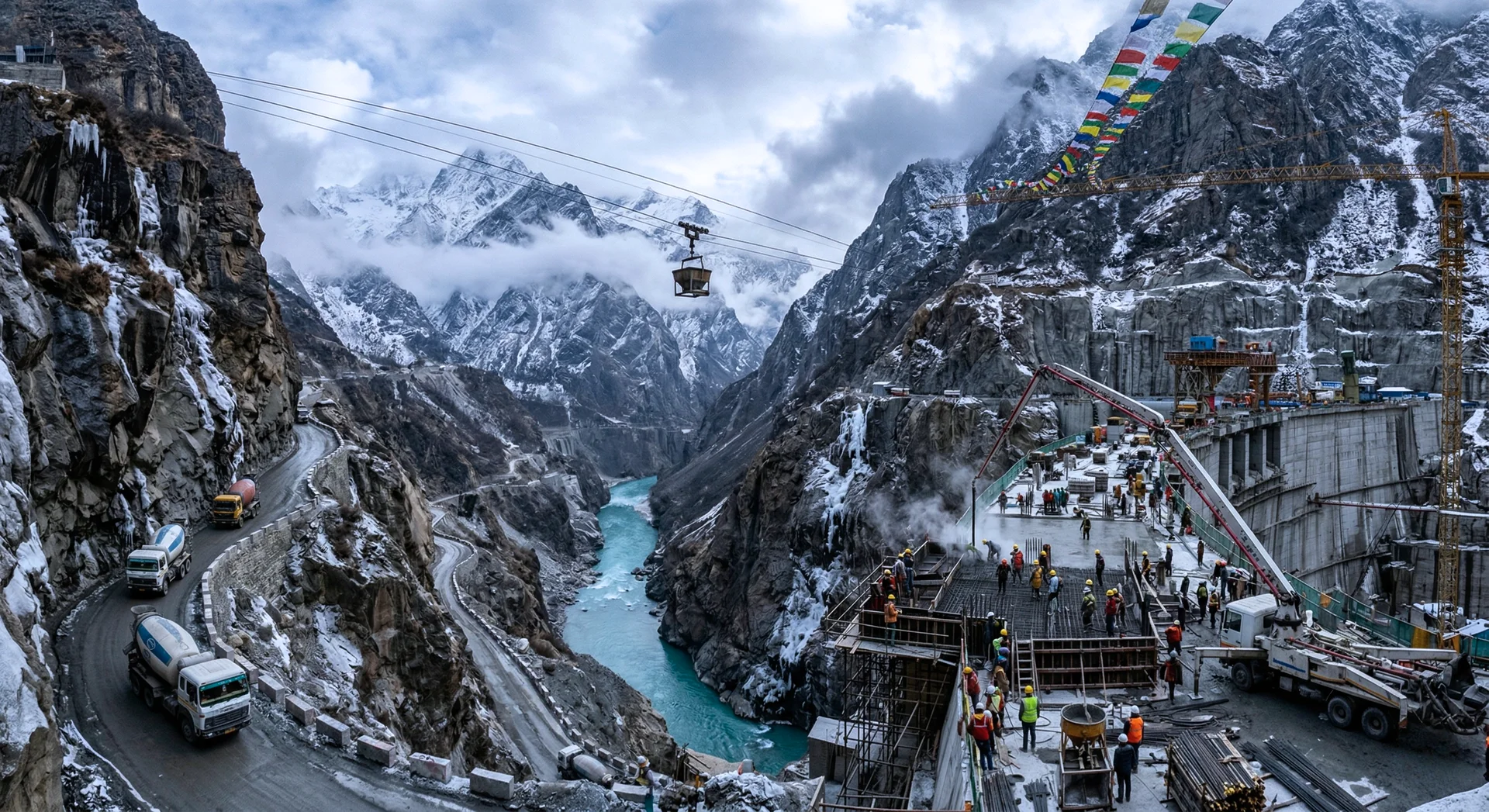
On 7 February 2021, the Chamoli flood (also called the Tapovan disaster) swept through the upper Dhauliganga and Alaknanda valleys in Uttarakhand, killing over 200 people (most missing later declared dead) and severely damaging the under-construction Tapovan-Vishnugad (520 MW) and Rishiganga hydropower projects. The trigger was a rock and ice avalanche from Ronti peak, mobilising sediment and water into a debris flow with GLOF-like characteristics.
In October 2023, the Teesta-III dam in Sikkim was destroyed by a GLOF triggered by the breach of South Lhonak Lake. The 60-metre concrete-faced rockfill dam at Chungthang was overtopped and washed away within minutes, with approximately 90 confirmed dead and dozens more missing, ending the operating life of the 1,200 MW project.
These events, combined with the accelerating documentation of glacial lake growth across the Himalayas by ICIMOD’s Status of Glacial Lakes inventory and others, have moved GLOF from tail risk to design-relevant scenario. Indian regulatory authorities, through the NDMA Guidelines on Management of GLOFs and the CWC Guidelines for Structural Measures to Mitigate GLOF (July 2025), now require GLOF assessment for new Himalayan hydropower projects and vulnerability assessment for existing ones.
For dam concrete specifically, the implications are significant. This article describes what they are.
Why GLOF risk has grown
Three trends have converged to increase GLOF risk for Himalayan hydropower projects.
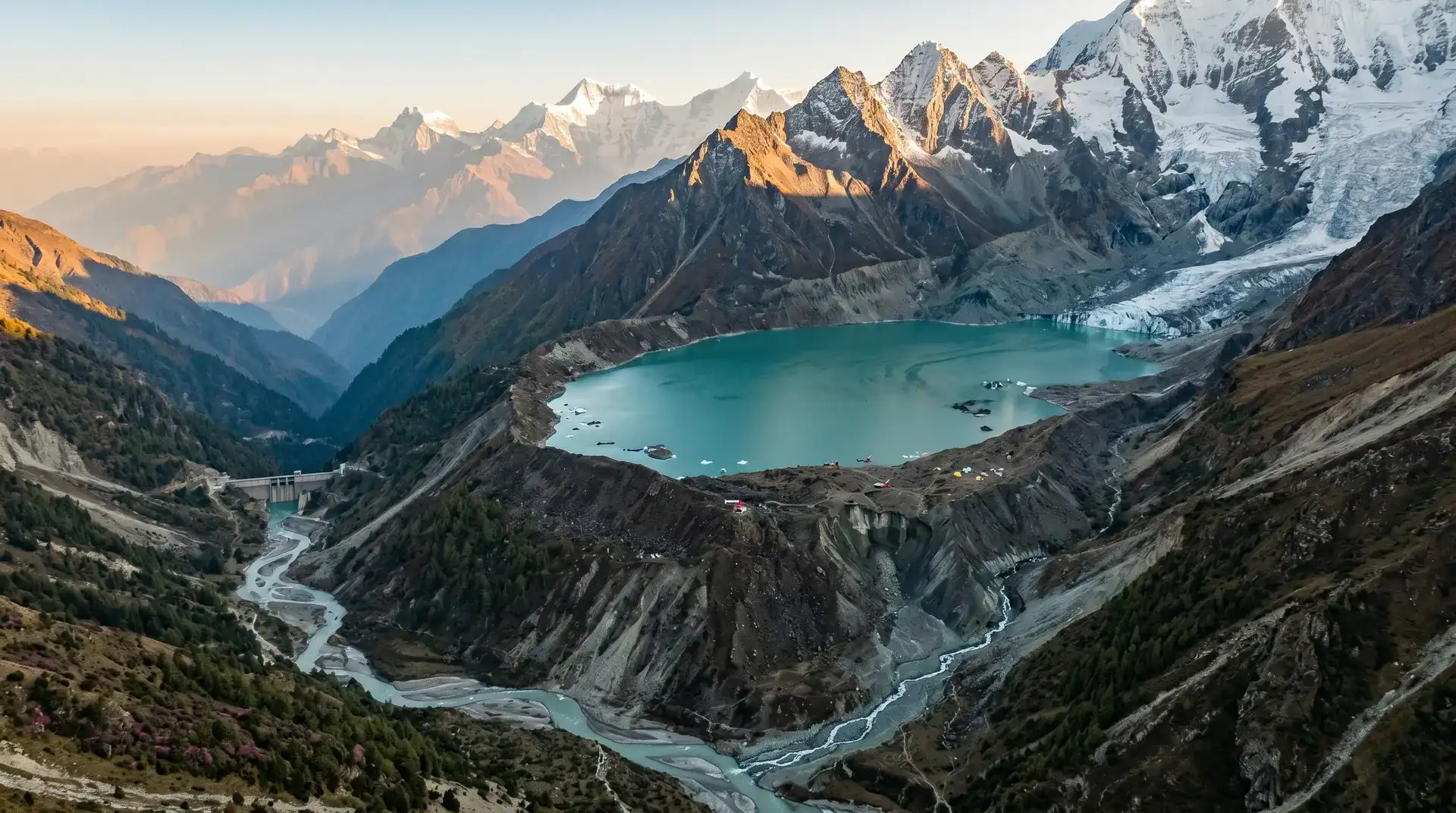
Glacier retreat under warming. Himalayan glaciers have been retreating at rates ranging from a few metres to tens of metres per year, depending on location. Retreat exposes the rock and till that previously underlay the glacier, creating new lakes in the depressions. The number of glacial lakes in the Himalayan region has grown significantly over the last several decades, with the volume of stored water increasing accordingly.
Moraine dam instability. The natural dams that contain glacial lakes are typically composed of unconsolidated moraine (rock debris deposited by the glacier). These dams are not engineered structures; they are inherently weaker than engineered dams of similar height. Earthquakes, ice avalanches, and slope failures can trigger moraine dam breach.
Cascading failure potential. A breach of one glacial lake can trigger downstream events: debris flow that overtops the next dam downstream, sediment loading that fails downstream weaker structures, secondary slope failures triggered by the passing flood. The cascading nature of GLOF events makes the consequences difficult to fully bound.
The combined effect is that GLOF probability for any given Himalayan hydropower project has increased over time and is likely to continue increasing as glaciers continue to retreat.
What GLOF does to concrete dam infrastructure
A GLOF event produces several effects on a downstream concrete dam.
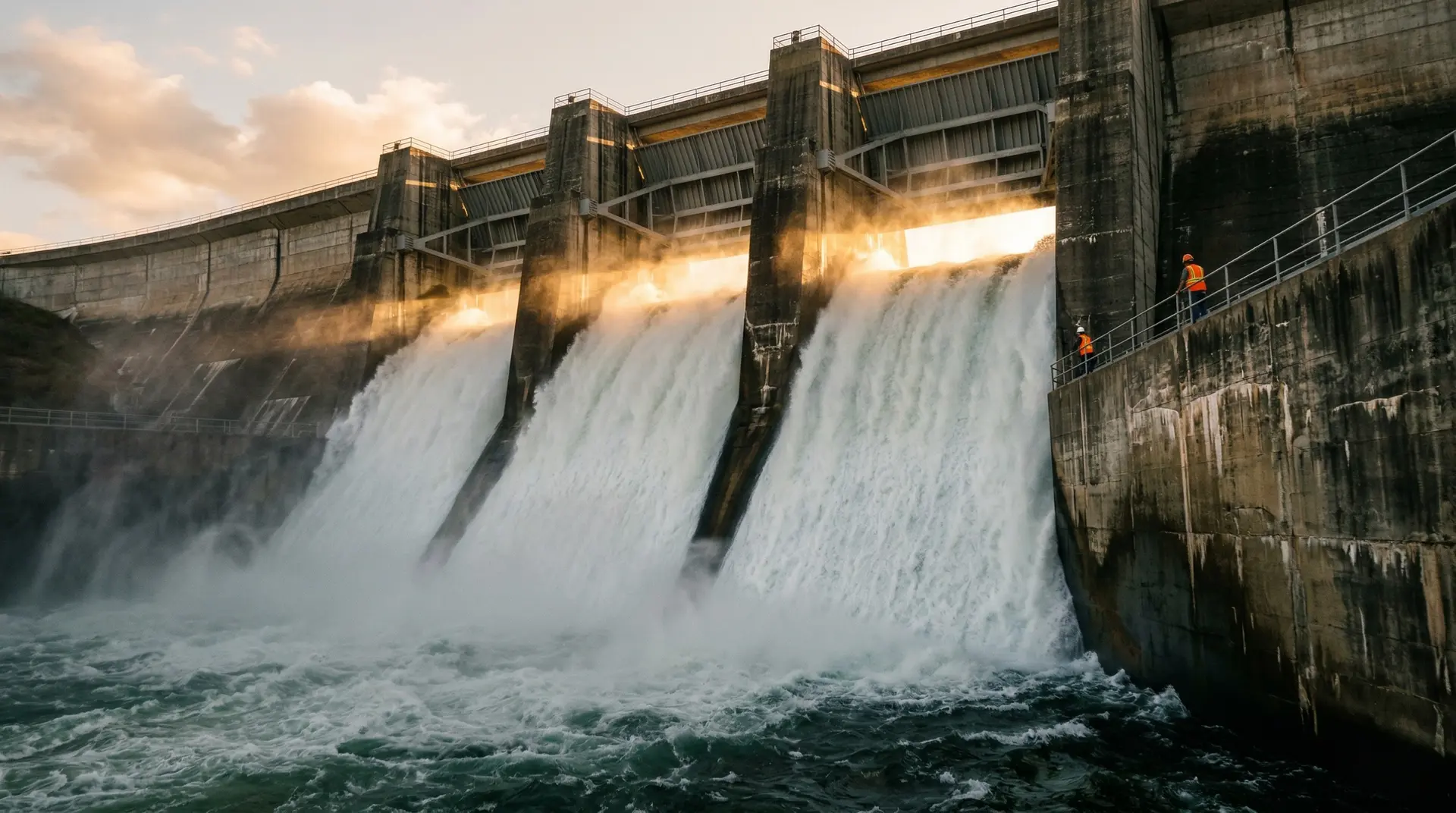
Hydraulic loading. Peak discharges from GLOF events can be 10 to 100 times the normal design flood, depending on lake volume, breach mode, and downstream attenuation. Spillways sized for normal design floods can be overwhelmed.
Debris and sediment loading. GLOF flows carry high sediment loads (often 20 to 60 percent solids by volume) and large debris (boulders, ice fragments, fallen trees, infrastructure debris from upstream). This loading abrades concrete surfaces, blocks spillway gates, and impacts dam structures.
Wave loading. Sudden inflow from a GLOF can generate large waves in the reservoir, causing run-up against the dam crest that can exceed normal freeboard provisions.
Foundation scour. GLOF flows passing the dam can scour the river bed at the toe, undermining concrete foundations and potentially destabilising the dam.
Loss of upstream protection. Upstream check dams, sediment traps, and flow regulation infrastructure may be destroyed by the GLOF, leaving the main dam facing the unattenuated event.
For concrete dams specifically, the most vulnerable elements are: spillway concrete (high velocity flow with debris), energy dissipator concrete (cavitation and abrasion under high discharge), dam crest and parapet (wave run-up), and toe protection (foundation scour).
The 2023 Teesta-III lesson
The Teesta-III dam was a concrete-faced rockfill dam, not a concrete gravity dam, but the lesson applies to all dam types in GLOF-prone basins. The dam was overtopped because the GLOF discharge exceeded what the spillway could safely pass, and overtopping of a CFRD or rockfill dam causes rapid breach. Concrete gravity dams have higher overtopping resistance than rockfill dams, but the consequences of GLOF for the spillway, energy dissipator, and downstream infrastructure remain severe. The lesson is not about dam type but about the magnitude of design flood that needs to be considered.
Concrete-specific design implications
Five concrete-specific implications for new Himalayan hydropower dam design.
1. Spillway capacity and concrete design
Spillway capacity must be sized for credible GLOF scenarios in addition to the normal probable maximum flood (PMF). The combined design discharge can be significantly higher than the conventional PMF, requiring larger spillway dimensions or additional spillway capacity (auxiliary spillway, fuse plug spillway).
The concrete in the augmented spillway must handle the higher velocities. Reference USBR Design Standards No. 14 (Spillways and Outlet Works) and ACI 210R Erosion of Concrete in Hydraulic Structures for abrasion and cavitation resistance. High-strength concrete (M50 to M60), low water-cement ratio, and dense aggregate gradation are typical. Steel armouring of high-velocity zones may be necessary.
2. Debris loading provisions
GLOF debris loading affects design in several ways:
- Spillway gates must be designed for debris impact and blocking, with provisions for clearing
- Spillway piers and walls must withstand boulder impact
- Energy dissipator design must account for sediment-laden flow
- Trash racks at intakes need design for GLOF debris size distribution
The structural design of these elements goes beyond conventional flood design and requires impact analysis and possibly physical modelling.
3. Freeboard and crest design
Conventional dam freeboard provisions cover wind-generated waves, normal flood passage, and seismic-induced waves. GLOF inflow can produce different wave conditions: sudden displacement of large water volumes, surge waves, and reservoir oscillation modes. Modern dam design in GLOF-prone basins includes specific GLOF freeboard provisions, often increasing crest elevation by 1 to 3 metres above conventional requirements.
Crest concrete itself, including parapet walls and any housings on the crest, must be designed for wave overtopping that may exceed conventional design assumptions.
4. Foundation and toe protection
GLOF discharge passing the dam can scour at the toe, undermining the concrete foundation. Toe protection, including stilling basin concrete and downstream apron, becomes more important. Designs may include extended apron length, deeper cutoff walls, and rock fill protection beyond the apron.
5. Real-time monitoring and warning
Modern GLOF resilience design integrates upstream lake monitoring (satellite, in-situ instruments), downstream river gauging, and dam crest instrumentation into a real-time warning system. The design includes the physical infrastructure for the monitoring (gauge stations, communications, control room) and the operational protocols for response.
What existing projects should do
For existing Himalayan hydropower projects, GLOF vulnerability assessment is increasingly required under Dam Safety Act, 2021 periodic reviews. A typical assessment covers:
- Catchment GLOF inventory of glacial lakes within the upstream basin, with current volumes and breach scenarios
- Hydraulic modelling of credible GLOF events from each significant lake to project arrival time, peak discharge, and sediment load at the dam site
- Comparison with original design to identify shortfalls in spillway capacity, freeboard, or other provisions
- Concrete condition assessment of spillway, energy dissipator, and downstream protection elements likely to be exposed
- Adaptation options analysis including spillway augmentation, freeboard increase, instrumentation upgrade, and emergency action planning
- Implementation roadmap with priorities, costs, and timing
The assessment outputs feed into the project’s dam safety review and inform any DRIP-funded rehabilitation interventions.
GLOF resilience is becoming a procurement criterion
For new Himalayan hydropower projects, GLOF assessment is now expected in the bid documents and the Owner's Engineer scope. Bidders who do not address GLOF in their proposal face questions from owners, lenders, and dam safety regulators. Owners who do not require GLOF assessment from bidders may face questions from lenders, particularly multilateral banks like the World Bank and ADB, who increasingly require climate resilience analysis as part of project appraisal.
How PCCI approaches GLOF resilience
PCCI’s 4,000+ MW portfolio, particularly the projects in Bhutan (Tala (1,020 MW), Mangdechhu (720 MW), Punatsangchhu-1 (1,200 MW)), is in basins where GLOF assessment is increasingly part of the dam safety review framework. Our consulting addresses spillway concrete, abrasion-resistant concrete, and stilling basin concrete with attention to extreme flow conditions including GLOF scenarios.
Our independent review service supports owners and dam safety authorities with GLOF vulnerability assessment for both new and operating projects in the Himalayan region.
Book a Technical Call → to discuss your project’s GLOF resilience requirements.