
The five-minute window
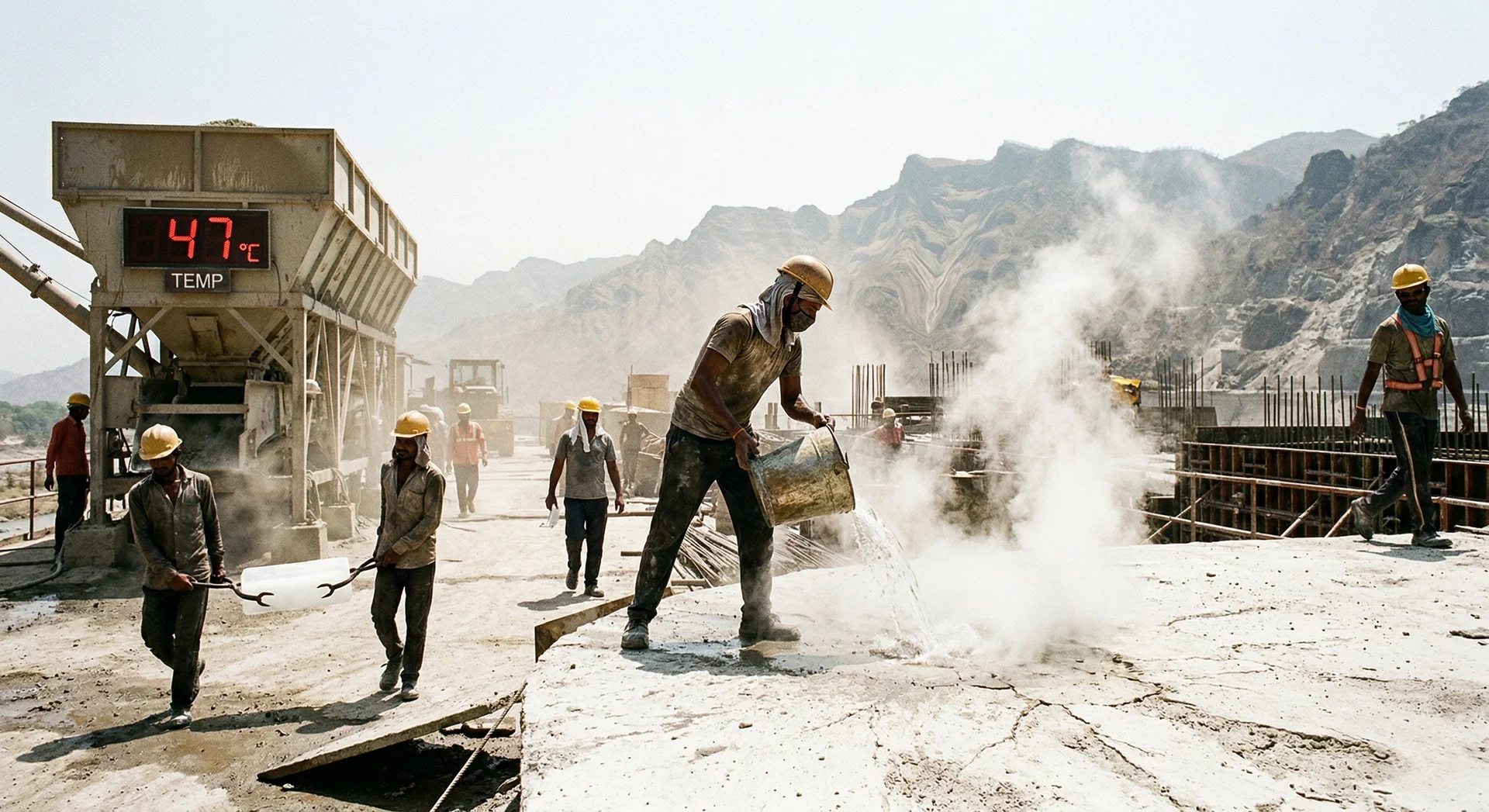
On a hot-weather dam pour, the concrete temperature creeping above target is one of the most common QC events. The truck mixer arrives at the placement face. The QC engineer measures the temperature. The reading is 33 degrees C. The project target is 30 degrees C. The specification absolute maximum is 35 degrees C. The next truck is on the haul road, 18 minutes out.
The QC engineer has five minutes to decide. Place this truck and accept the slight temperature deviation? Hold it and try to bring the temperature down somehow? Reject it and send it back?
The decision is real, the consequences are real, and the time to make it is short. The 5-minute rule is a field-discipline framework: it gives the QC engineer at the placement face approximately five minutes to decide whether to accept, intervene, or reject a truck mixer load when the measured concrete temperature exceeds the project target. This article explains how it works, the three-tier thresholds, the measurement procedure, the authority structure, and the documentation that make the decision defensible.
Why five minutes
Three things constrain the decision time.
Truck mixer queue. In a continuous pour, the next truck is 15 to 30 minutes behind. Holding the current truck delays subsequent trucks and slows the placement rate.
Placed-concrete workability. Previously placed concrete loses workability with time. If the placement rate drops because trucks are being held, the concrete in the placement face starts to set, and the next placement creates a cold joint between layers.
Concrete in the truck deteriorates. A truck held for too long with high-temperature concrete continues to lose workability and may itself become unplaceable. Holding too long can waste the entire load.
Five minutes is the practical window where intervention is possible without secondary consequences. Held longer than this, the cost of holding starts to exceed the cost of placing.
How the temperature is measured
The reading itself must be defensible. The QC engineer follows ASTM C1064: a representative sample is collected from the truck discharge into a steel sampling pan, the probe of a calibrated digital thermometer is inserted to a depth of at least 75 mm into the centre of the sample, and the reading is taken after the probe stabilises (typically 2 minutes for a wired probe in fresh concrete).
The rule is applied on the basis of this measurement, not on an infrared spot reading on the chute, a guess from the truck cab thermometer, or a single deep probe in the drum. The reading is logged with the truck identification, the time, and the ambient temperature. Without a defensible measurement, the downstream decision is also indefensible.
The three-tier framework
A standard temperature management framework has three tiers based on the deviation magnitude.
| Tier | Concrete temperature deviation | Action |
|---|---|---|
| Accept (Tier 1) | 0 to 3 degrees C above target, within tolerance band | Accept and place; log the deviation; check next batches |
| Intervene (Tier 2) | 3 to 7 degrees C above target, below absolute maximum | Hold for cooling intervention; communicate with plant; accept after intervention if temperature drops within tolerance |
| Reject (Tier 3) | Above the absolute maximum threshold (typically 32 to 35 degrees C per IS 7861 Part 1 or ACI 305.1) | Reject and return to plant; halt subsequent batches until plant calibration verified |
The specific thresholds for each tier are project-specific and should be agreed at the pre-pour meeting with reference to the project specification.
Tier 1: accept
The most common case: a small temperature deviation, within tolerance. The QC engineer accepts the load and places it. The deviation is logged with the truck identification and load size. The next two or three batches are watched closely to see if the deviation is a one-off (a single warm truck) or a systematic drift (the batching plant calibration has changed).
If subsequent batches return to within target, the issue is closed. If subsequent batches also show the same deviation, the QC engineer escalates to Tier 2 management: communicate with the plant, request adjustment of the next batches, monitor the trend.
Tier 2: intervene
The deviation is significant but not absolute. The QC engineer holds the truck and considers options.
Communicate with the batching plant. The plant operator is informed of the deviation. The plant may have just lost a refrigeration unit, or the chilled water supply may be running warm, or the aggregate moisture has just dropped (less aggregate cooling, higher mix temperature). The communication may identify the cause and trigger plant-side correction.
Adjust subsequent batches. The plant adjusts the cooling system or mix temperature target on subsequent batches to bring them back into range. This typically takes 10 to 20 minutes to take effect, so subsequent batches in transit may still arrive warm.
Hold the current truck. If the truck can be held in shade for a few minutes without losing workability significantly, the concrete temperature may drop slightly. Limited and not always practical.
Add ice or chilled water within mix design limits. Where pre-approved in the project specification, a small ice addition can drop the temperature by a few degrees. Must be done with QC engineer authority and within mix design water-cement ratio limits.
If the intervention brings the temperature within tolerance, the truck is accepted. If not, it escalates to Tier 3.
Document the intervention
Whatever Tier 2 intervention is taken, it is documented: action taken, measurement after, decision rationale. The documentation supports the QC engineer's decision and provides traceability if the placed concrete later shows non-conformance. An undocumented intervention is the worst of both worlds: the action is taken but cannot be defended.
Tier 3: reject
The temperature exceeds the absolute maximum threshold. The truck is rejected and returned to the batching plant. The placement is halted while the plant cause is investigated.
Tier 3 is uncommon if the batching plant and pre-cooling systems are operating correctly. When it does happen, the cause is usually identifiable: a refrigeration unit failure, a chilled water plant issue, a hot ambient that exceeded the design envelope. The placement does not resume until the cause is corrected and the next batch arrives within tolerance.
The disposition of the rejected load is documented. Common options:
- Return to plant and dump (most common)
- Use in non-structural application (rare; usually not worth the logistics)
- Convert to lower-grade application elsewhere on site (rare; depends on specification)
Why authority matters
The 5-minute rule works only if the QC engineer has authority to act. If every rejection requires escalation to the project manager, who escalates to the contractor’s director, who escalates to the owner’s representative, the 5-minute window has expired before any decision is taken.
The QC plan must give the senior QC engineer on duty the authority to make Tier 1, Tier 2, and Tier 3 decisions within agreed parameters. The placement crew foreman does not have rejection authority. The contractor’s project manager does not override the QC engineer’s decision. The owner’s engineer observes and recommends but typically does not directly reject.
This authority structure is set out in the project QC plan and confirmed at the pre-pour meeting, with reference to the ACI inspection framework and ACI 304R guidance. When a Tier 3 event happens at hour two of a Sunday-morning pour, the QC engineer needs to act, not seek permission.
Pre-agreed thresholds enable fast decisions
The five-minute decision is fast only because the thresholds are pre-agreed. The QC engineer does not need to think about whether 33 degrees C is acceptable; they look at the threshold and apply the action. Trying to negotiate thresholds in real time is what produces slow, inconsistent, and disputed decisions. The pre-pour meeting is where the thresholds get agreed.
How PCCI applies the 5-minute rule
The temperature management framework is part of PCCI’s QA/QC service on hot-weather concrete projects. The discipline has been refined on landmark engagements including Tala HEP (1,020 MW), Bhutan, where mass concrete pours for the gravity dam demanded cement-optimized thermal management across long continuous placements. The pre-agreed thresholds, ASTM C1064 measurement procedure, authority structure, and documentation discipline are part of how the QC engineer can act decisively in the five-minute window.
Book a Technical Call → to discuss your project’s hot-weather concrete management requirements.