The cement industry is responsible for approximately 8% of global CO2 emissions, according to the Global Cement and Concrete Association. For every tonne of Portland cement clinker produced, approximately 0.8 tonnes of CO2 is released: roughly half from the chemical decomposition of limestone in the kiln and half from the fossil fuel burned to reach the required 1,450 degrees C.
The concrete industry has spent decades reducing this footprint through supplementary cementitious materials, primarily fly ash and GGBS. These have been remarkably successful. But they share a fundamental limitation: they are industrial byproducts. Their supply depends on coal combustion and steel production, industries that are themselves under pressure to decarbonise.
As coal power plants close and steel production shifts to electric arc furnaces, the supply of fly ash and GGBS will decline. The concrete industry needs a low-carbon cementitious material that is not dependent on other industries’ waste streams.
LC3, Limestone Calcined Clay Cement, is that material. It uses clay and limestone, two of the earth’s most abundant geological resources, to replace up to 50% of clinker. The technology was developed through research at EPFL (Ecole Polytechnique Federale de Lausanne) in Switzerland, IIT Madras, IIT Delhi, and TARA (Technology and Action for Rural Advancement) in India, with support from the Swiss Agency for Development and Cooperation.
For dam construction, where concrete volumes are measured in hundreds of thousands of cubic metres and project timelines span decades, LC3 offers a path toward lower-carbon infrastructure using locally available materials.
How LC3 Works
The Chemistry
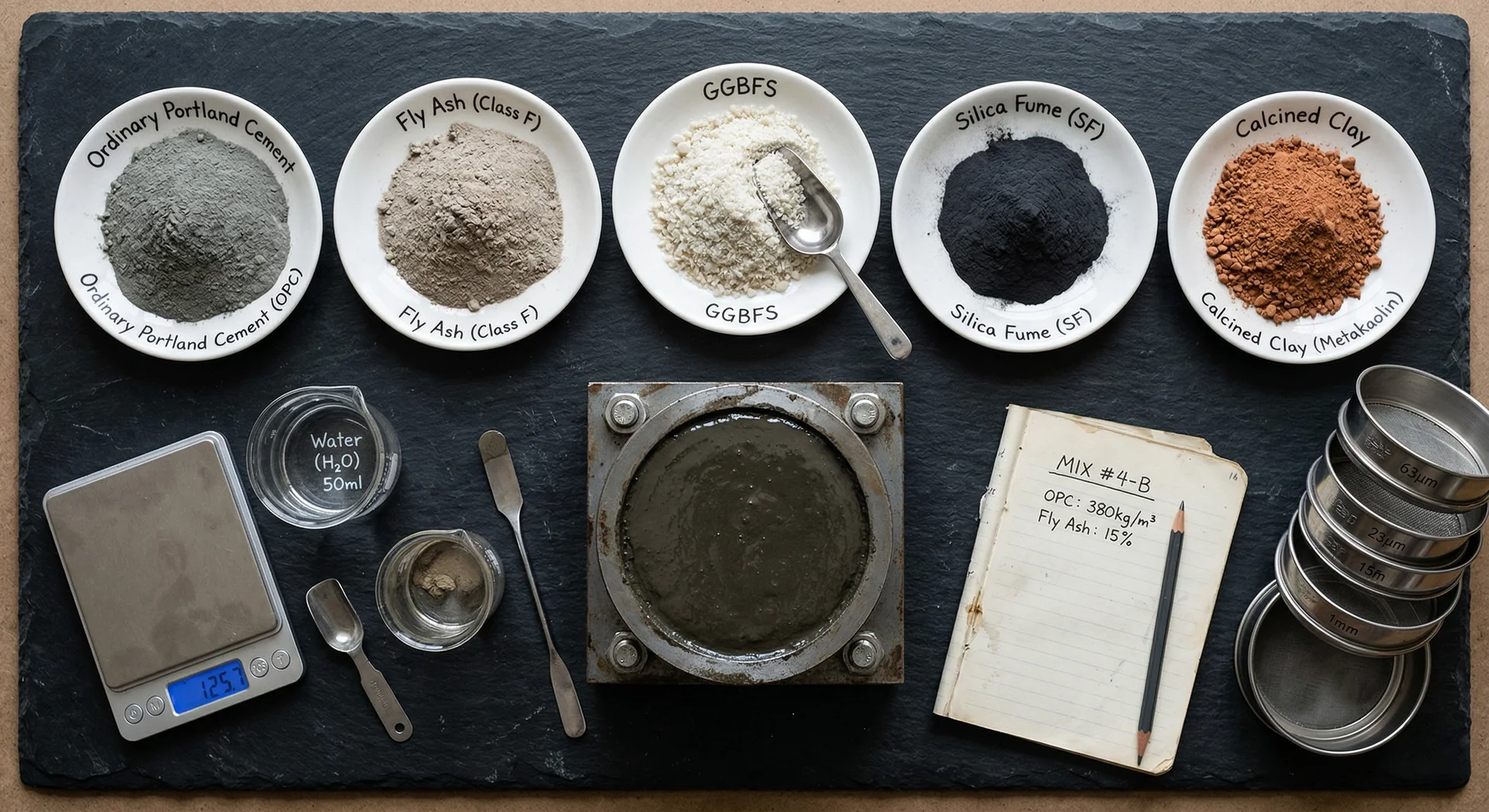
LC3 combines three components with clinker:
-
Calcined clay (metakaolin): Kaolinite clay heated to 700-850 degrees C. At this temperature, the crystalline structure of kaolinite (Al2Si2O5(OH)4) collapses, producing an amorphous, highly reactive material called metakaolin (Al2O3.2SiO2). The reactive alumina and silica in metakaolin are the key ingredients.
-
Limestone (CaCO3): Ground to cement fineness. In LC3, the limestone is not calcined (not heated to 900+ degrees C to produce lime). It participates in its raw form.
-
Clinker: Standard Portland cement clinker, reduced from 95% in OPC to approximately 50% in LC3.
-
Gypsum: Standard set regulator.
A typical LC3 composition:
- 50% clinker
- 30% calcined clay
- 15% limestone
- 5% gypsum
The Reaction Mechanism
The performance of LC3 comes from a synergistic reaction that does not occur when calcined clay or limestone is used alone:
Step 1: Clinker hydrates normally, producing calcium silicate hydrate (C-S-H, the primary binding phase) and calcium hydroxide (CH, a byproduct).
Step 2: The reactive silica and alumina in metakaolin react with the calcium hydroxide in a pozzolanic reaction, producing additional C-S-H and calcium aluminate hydrates (C-A-H). This consumes the CH, which is beneficial because CH is the weakest phase in the cement paste.
Step 3: The aluminate phases from the calcined clay react with the calcium carbonate from the limestone to form monocarboaluminate (Mc) and hemicarboaluminate (Hc). These carboaluminate phases fill pore space, refine the pore structure, and contribute to strength.
This three-step mechanism is what makes LC3 more than the sum of its parts. The limestone, which in a conventional Portland limestone cement (PLC) acts mainly as a filler, becomes chemically active in the presence of the reactive alumina from the calcined clay.
Why 30% Calcined Clay?
The optimal proportion of calcined clay is governed by the alumina content of the source clay. Higher kaolinite content means more reactive alumina, which means more carboaluminate formation. Research has established that clays with kaolinite content above 40% produce high-quality LC3. Clays with 60%+ kaolinite are ideal.
India has extensive kaolinite clay deposits across Rajasthan, Gujarat, Kerala, West Bengal, and Jharkhand. The raw material base for LC3 production is not a constraint.
Performance: What the Data Shows
Compressive Strength
LC3 concrete develops strength through both clinker hydration (early) and pozzolanic + carboaluminate reactions (ongoing). Typical performance:
| Age | LC3 vs. OPC Concrete |
|---|---|
| 3 days | 80-90% of OPC |
| 7 days | 85-95% of OPC |
| 28 days | 90-100% of OPC |
| 90 days | 95-105% of OPC |
| 365 days | 100-110% of OPC |
The early strength is slightly lower than OPC due to the reduced clinker content, but the continued pozzolanic and carboaluminate reactions mean LC3 catches up by 28 days and often exceeds OPC at later ages.
For dam concrete designed on 90-day or 365-day strength (standard practice for mass concrete), the lower early strength is not a design constraint. The mix design process simply targets the later-age specification.
Heat of Hydration
LC3 generates moderately less heat than OPC due to the reduced clinker content. The reduction is not as dramatic as high fly ash mixes (which can reduce peak temperature by 15-20 degrees C) but is typically 5-10 degrees C lower than equivalent OPC.
For mass concrete, this moderate heat reduction is beneficial but may need to be supplemented with other measures (pre-cooling, placement scheduling) for thick sections.
Chloride Resistance
This is where LC3 significantly outperforms OPC. The refined pore structure from carboaluminate formation and continued pozzolanic reaction dramatically reduces chloride penetration. Rapid chloride permeability test (RCPT) values for LC3 concrete are typically 50-70% lower than equivalent OPC concrete.
For dam concrete exposed to de-icing salts (Himalayan sites), groundwater with dissolved salts, or marine environments (coastal infrastructure), this improved chloride resistance translates directly to extended service life.
Sulphate Resistance
LC3 shows generally good sulphate resistance due to the reduced C3A content (tricalcium aluminate from clinker is the phase most vulnerable to sulphate attack) and the consumption of calcium hydroxide by the pozzolanic reaction. For dam foundations in sulphate-bearing soils or groundwater, LC3 can be an effective option, though independent technical review should verify performance under site-specific exposure conditions.
Carbonation
This is the one durability parameter where LC3 may perform slightly less well than OPC. Carbonation advances faster through LC3 concrete in some studies, attributed to the lower calcium hydroxide content (which acts as a buffer against carbonation in OPC concrete). The IS 456 Amendment No. 6 restriction on LC3 in certain underground and groundwater-contact applications reflects this concern.
For dam concrete, where most of the mass is either submerged (no carbonation risk) or in thick sections where carbonation cannot penetrate to significant depth, this limitation is generally manageable. Surface elements exposed to air and carbon dioxide may require additional consideration.
LC3 in Indian Standards
Current Position (as of March 2026)
- IS 16415: Specifies composite cement. LC3 falls under this standard as Portland Calcined Clay Limestone Cement.
- IS 456:2000 Amendment No. 6 (2024): Recognises composite cement conforming to IS 16415 for reinforced concrete construction. Requirements: clinker content not less than 45%, fly ash not more than 25%, minimum 28-day compressive strength of 43 MPa.
- Restriction: LC3 (specifically Portland Calcined Clay Limestone Cement) is restricted from use in underground structures and elements in contact with groundwater at locations where temperatures are predominantly below 15 degrees C for six months.
- IS 456:2025 draft: The fifth revision includes provisions for new cementitious systems but specific LC3 provisions in the published standard will depend on the final draft.
What This Means for Dam Projects
LC3 can currently be specified for:
- Above-ground structural elements (piers, abutments, parapets, gallery superstructure)
- Non-submerged portions of the dam body (above maximum waterline)
- Appurtenant structures not in contact with groundwater
- General infrastructure (buildings, roads, utilities) at the dam site
LC3 currently cannot be specified for:
- Foundation concrete in contact with groundwater (at cold-climate sites)
- Underground structures (powerhouse caverns, tunnels) at cold-climate sites
- Submerged portions of the dam body (at cold-climate sites)
The restriction is specifically linked to cold-climate conditions (below 15 degrees C for six months), which means peninsular dam sites in warm climates may have broader scope for LC3 use.
Where LC3 Fits in Dam Construction
Most Promising Applications
Non-structural and secondary concrete: Site roads, buildings, retaining walls, drainage channels, and precast elements. These consume significant concrete volume on dam projects and have no structural constraints against LC3 use.
Above-waterline dam elements: Parapets, pier caps, railing bases, and the upper portions of the dam body that are never submerged. These elements are exposed to air (carbonation) and weather (freeze-thaw in Himalayan sites), so mix design must account for these exposure conditions.
Pumped storage upper reservoirs in warm climates: For the growing pipeline of pumped storage projects in peninsular India (Andhra Pradesh, Maharashtra, Karnataka, Tamil Nadu), where groundwater temperatures do not trigger the cold-climate restriction, LC3 could potentially be used for a wider range of structural elements.
Current Limitations for Dam Use
Submerged elements at cold-climate sites: The IS 456 restriction currently prevents LC3 use in the largest concrete volumes of a Himalayan dam (the submerged mass concrete sections).
Limited field data: While laboratory performance data for LC3 is extensive (hundreds of published studies from EPFL, IIT Madras, IIT Delhi), field performance data from large dam projects is still limited. No major dam worldwide has been built entirely with LC3 concrete as of 2026.
Production scale: LC3 production capacity in India is still ramping up. For a dam project requiring 50,000-100,000 tonnes of cementitious material per year for 3-5 years, the cement supplier must guarantee consistent LC3 supply for the entire project duration.
The Supply Advantage
This is where LC3 has a structural advantage over fly ash and GGBS for remote dam sites.
Fly ash requires a thermal power plant within economic transport distance. As India transitions away from coal, fly ash supply will tighten, particularly for remote Himalayan and Northeast dam sites far from the Gangetic plain thermal power belt.
GGBS requires a blast furnace steel plant. These are concentrated in specific industrial regions (Jamshedpur, Rourkela, Bhilai, Visakhapatnam). Transport to remote dam sites is expensive and supply is dependent on steel market conditions.
Calcined clay can be produced from locally available kaolinite deposits. India has extensive clay resources across multiple geological formations. A calcination plant (essentially a rotary kiln operating at 700-850 degrees C, significantly simpler and lower temperature than a cement kiln) can be established near the clay source or near the dam site.
For dam projects in locations where fly ash and GGBS supply is uncertain or uneconomical, locally produced calcined clay offers supply security that no other SCM can match.
The Path Forward
LC3 is not a replacement for fly ash or GGBS in dam concrete today. It is a complementary option that addresses specific conditions:
-
Where fly ash supply is uncertain: Remote sites far from thermal power plants, or projects spanning timelines beyond the operational life of nearby coal plants.
-
Where carbon reduction is a project requirement: Multilateral-funded projects (World Bank, ADB, AIIB) increasingly require environmental impact assessments that account for embodied carbon. LC3 provides a documented 30-40% reduction.
-
Where warm-climate conditions allow broader use: Peninsular India dam projects, where the IS 456 cold-climate restriction does not apply, have greater scope for LC3 adoption.
-
Where ternary blends can optimise performance: LC3 + fly ash combinations are being researched, with the calcined clay compensating for fly ash variability and supply risks while fly ash provides the deep heat reduction that mass concrete needs.
The trajectory is clear. As production capacity grows, standards evolve, and field data accumulates, LC3 will move from a niche option to a mainstream cementitious material for dam construction. The question for dam engineers is not whether to use LC3, but when the project conditions, standard provisions, and supply chain align to make it the right choice. Optimising cement content has always been central to mass concrete practice; LC3 is the next evolution of that discipline.
That alignment is approaching faster than most practitioners expect.