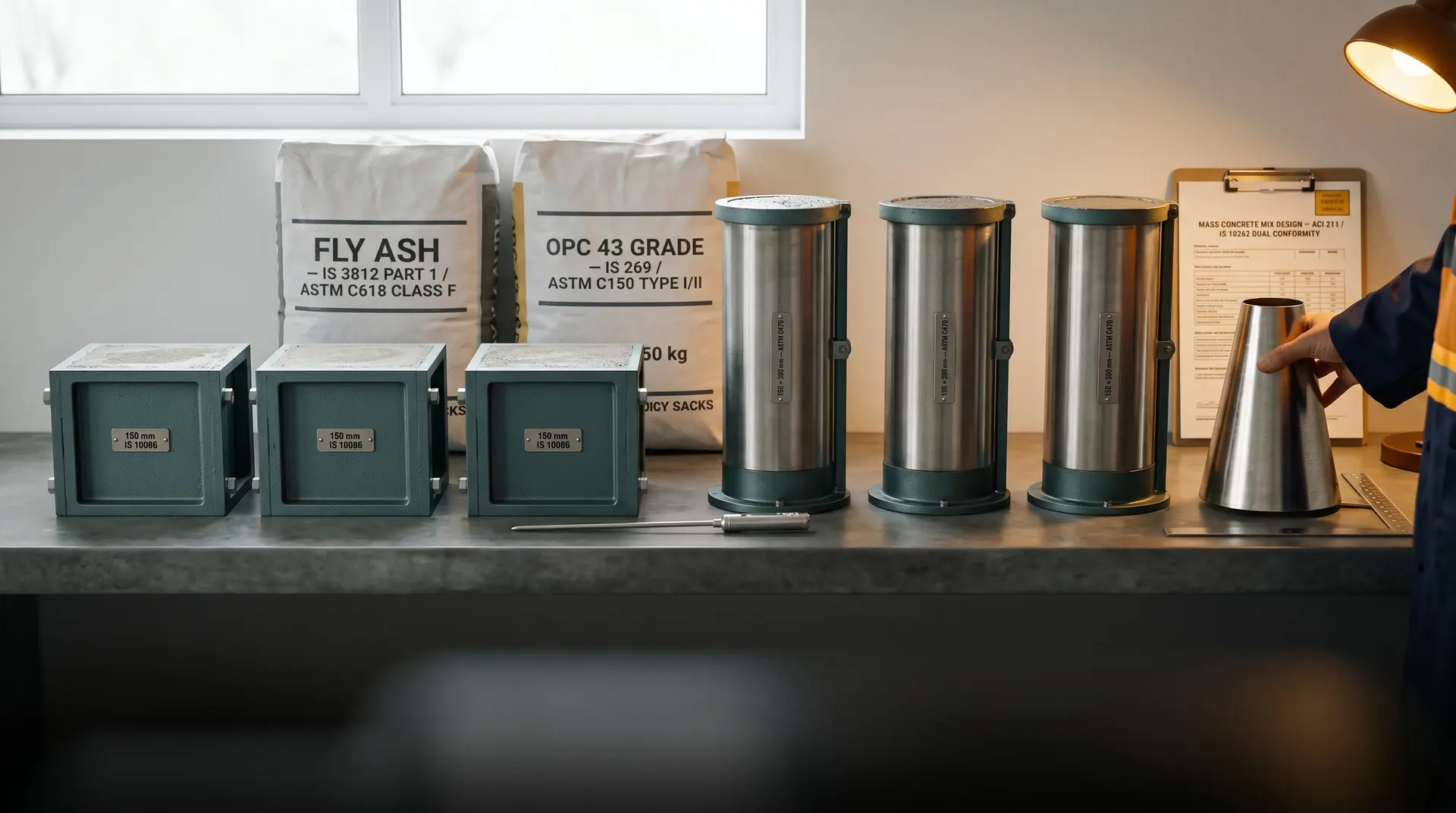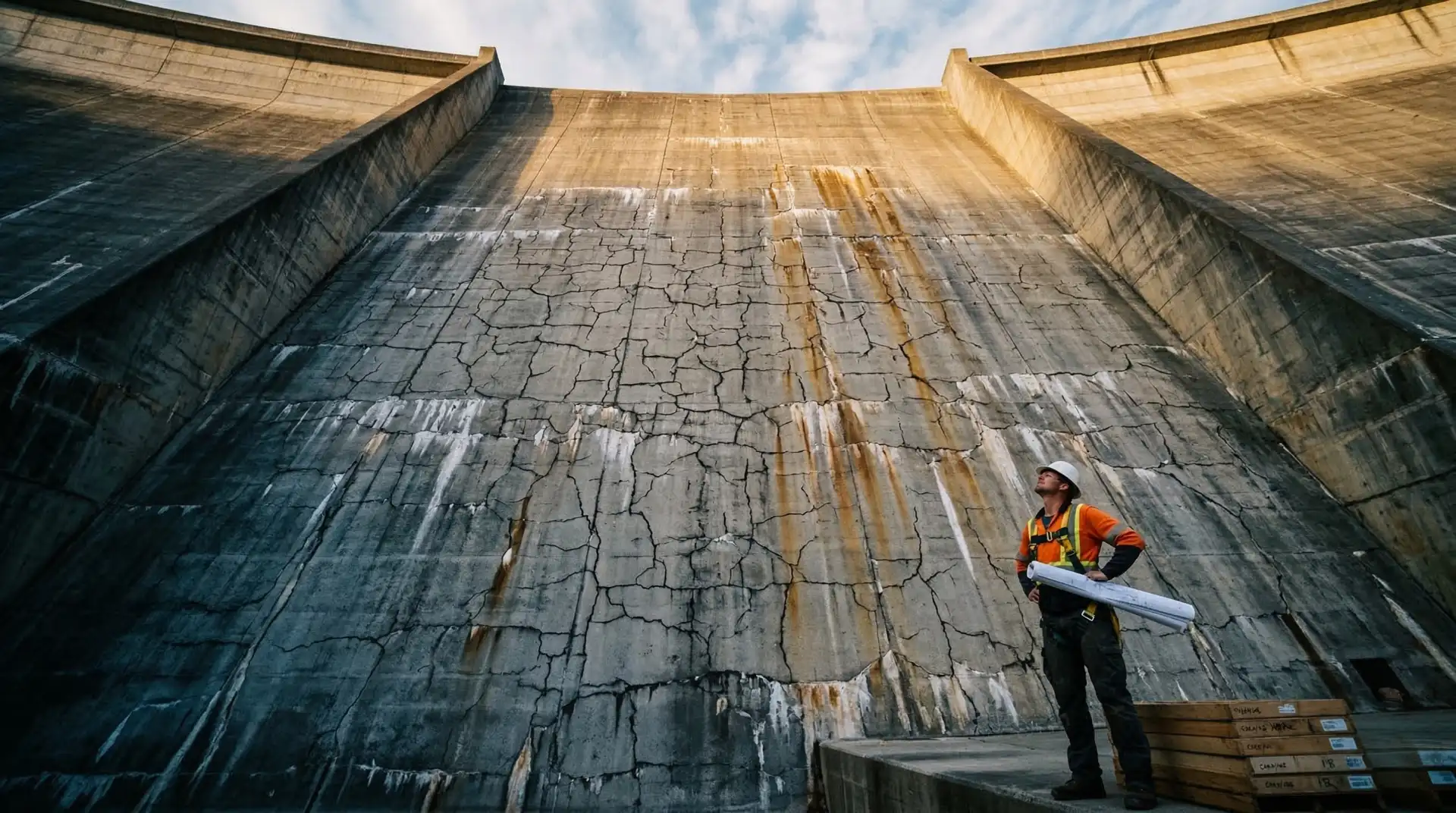
USACE EM 1110-2-2000 (Standard Practice for Concrete for Civil Works Structures) is the US Army Corps of Engineers’ procedural manual for concrete in hydraulic structures, organised as 11 chapters and five appendices that carry a project from materials investigation (Chapter 2) through to the final Concrete Report (Chapter 11), anchored by the Concrete Materials Design Memorandum in Appendix C.
The US Army Corps of Engineers maintains an engineering manual stack that covers civil works concrete from materials investigation through final report. The cornerstone document of that stack is EM 1110-2-2000, titled “Standard Practice for Concrete for Civil Works Structures.” For Indian hydropower and civil works projects where international lender involvement or US-derived design specifications bring USACE references into the project stack, EM 1110-2-2000 is the practical procedural companion to the ACI codes and ICOLD bulletins that fill the regulatory layer.
Unlike ACI 207 (a technical guide) or ICOLD Bulletin 165 (an international consensus reference on materials), EM 1110-2-2000 is procedural. It walks the project team from materials investigation through to the final Concrete Report. This brief walks the manual chapter by chapter, explains the Concrete Materials Design Memorandum at its heart, and shows how to integrate it with ACI, ASTM, ICOLD, and IS standards on Indian civil works concrete projects.
What is USACE EM 1110-2-2000?
Title: Standard Practice for Concrete for Civil Works Structures. Publisher: US Army Corps of Engineers, Department of the Army. Document number: EM 1110-2-2000 (base manual dated 1 February 1994). The manual covers concrete for hydraulic structures and points to separate USACE documents for specialist topics it does not itself address:
| Specialist topic | Governing USACE document |
|---|---|
| Roller-compacted concrete (RCC) | EM 1110-2-2006 |
| Shotcrete | EM 1110-2-2005 |
| Rigid pavement | TM 5-822-7 |
| Architectural concrete | EM 1110-1-2009 |
| Concrete evaluation and repair | EM 1110-2-2002 |
| Waterstops and joint materials | EM 1110-2-2102 |
| Stability analysis of concrete structures | EM 1110-2-2100 |
| Gravity dam design | EM 1110-2-2200 |
EM 1110-2-2000 is the procedural manual that ties all of these together for the structural civil works concrete on a project. The manual is applicable to all USACE Commands having civil works responsibilities and serves as the procedural backbone of the concrete delivery workflow on USACE projects.
For Indian hydropower and dam projects, the manual is relevant whenever the project specification invokes USACE references, which is most common on multilateral-lender-financed projects where the design consultant is US-based or where the project owner has adopted USACE practice as a reference framework.
What are the 11 chapters of EM 1110-2-2000?
| Chapter | Title | What it governs |
|---|---|---|
| 1 | Introduction and Policy | Scope, applicability, definitions |
| 2 | Investigation and Selection of Materials | Cement, aggregate, SCMs, admixtures, water |
| 3 | Construction Requirements and Special Studies | Pre-design studies, thermal analysis, AAR investigation |
| 4 | Mixture Proportioning Considerations | Mix design philosophy, trial mixes, optimisation |
| 5 | Preparation of Plans and Specifications | Specification language, drawing notes, contract provisions |
| 6 | Coordination Between Design and Field Activities | Design-construction interface |
| 7 | Preparation for Construction | Pre-construction submittals, contractor qualification, plant inspection |
| 8 | Concrete Construction | Batching, mixing, transport, placement, consolidation, curing |
| 9 | Concrete Quality Verification and Testing | Fresh and hardened tests, acceptance criteria, NCR management |
| 10 | Special Concretes | Preplaced-aggregate, underwater, blockout, high-strength, pumped, fiber-reinforced, porous, flowing, silica-fume |
| 11 | Concrete Report | Final project deliverable closing the concrete delivery loop |
Plus appendices:
| Appendix | Content |
|---|---|
| A | References |
| B | Abbreviations |
| C | Concrete Materials Design Memorandum (CMDM) format |
| D | Alkali-Silica Aggregate Reactions |
| E | Alkali-Carbonate Rock Reactions |
The structure is procedural rather than regulatory. A project team can use the manual as a step-by-step workflow from project inception through final report rather than as a code lookup.
Chapter 2: Materials investigation, the foundation of everything else
Chapter 2 sets the framework for materials selection and is the longest chapter in the manual. It covers:
- Cement: Portland cement per ASTM C150 (Types I, II, III, IV, V), blended hydraulic cements per ASTM C595, and hydraulic cements per ASTM C1157.
- Supplementary cementitious materials: fly ash per ASTM C618 (Class F and Class C), slag cement per ASTM C989 (Grades 80/100/120), silica fume per ASTM C1240, natural pozzolans per ASTM C618 Class N.
- Aggregates: coarse and fine aggregate per ASTM C33 with civil-works-specific provisions on gradation, deleterious substances, soundness, reactivity, and abrasion resistance.
- Admixtures: water-reducing, retarding, accelerating, air-entraining, and specialty admixtures per ASTM C260, C494, C1017, and others.
- Mixing water: requirements per ASTM C1602.
- Reactivity testing: aggregates must be qualified for alkali-silica and alkali-carbonate reactivity per Appendix D and E protocols.
The chapter requires the project team to investigate candidate material sources, document the investigation findings, and select the materials that will be qualified through trial mixes. For dam concrete the investigation extends to multiple cement plants, multiple aggregate quarries, and multiple SCM sources where available, with selection based on a combination of technical fit and supply reliability.
For deeper context on the aggregate-source investigation step see aggregate sourcing and quarry investigation for dam projects.
Chapter 3: Special studies, including thermal and AAR
Chapter 3 covers the special studies that must be completed during the design phase before mix design proceeds. The two most relevant for dam concrete are:
Thermal analysis
For mass concrete elements the chapter requires a thermal analysis demonstrating that the proposed mix and placement plan will control peak temperatures and core-surface differentials within the cracking thresholds. This typically involves:
- Adiabatic temperature rise testing on the project mix (the standard input to the thermal model).
- Finite element thermal modelling of representative dam blocks.
- Cooling system design (pre-cooling, post-cooling, or thin-lift placement) sized from the model output.
For the test methodology behind this step see adiabatic temperature rise testing for mass concrete in dams. For the broader thermal control framework see mass concrete thermal control under ACI 207, IS 7861, and IS 14591.
AAR investigation
Chapter 3 also requires aggregate reactivity investigation following Appendix D (ASR) and Appendix E (ACR) protocols. The investigation involves:
- ASTM C295 petrographic examination of every candidate aggregate source.
- ASTM C1260 accelerated mortar bar test (14-day rapid screening).
- ASTM C1293 concrete prism test (1-year confirmatory test, mandatory for major projects).
- If reactivity is confirmed: mitigation strategy through low-alkali cement, SCM substitution (typical fly ash 25-30%, slag 50%+), or lithium-based admixtures.
For Indian projects in catchments with known or suspected reactive aggregates the Appendix D/E framework is directly applicable. For deeper coverage see alkali-aggregate reaction in dam concrete.
Chapter 4: Mixture proportioning the USACE way
Chapter 4 governs mix design. It cross-references ACI 211 (the proportioning method) and ACI 207 (mass concrete provisions) while overlaying USACE-specific procedural requirements:
- The mix design is documented in the Concrete Materials Design Memorandum (Appendix C format).
- Trial mixes must be cast at the project laboratory or at a qualified third-party lab with full fresh and hardened testing.
- Target strength is calculated using the ACI 318 statistical margin approach.
- Durability ceilings on w/cm and minimum cementitious are applied per ACI 318 Chapter 19 exposure classes.
- The final mix is qualified by 28-day and where applicable 90-day cylinder strength per ASTM C39.
For the comparison of the underlying proportioning method against IS practice see ACI 211 vs IS 10262 for mass concrete in dams.
The 1.25x cube-cylinder factor
USACE references cylinder strength (ASTM C39). IS references cube strength (IS 516). For the same mix the cube strength is approximately 1.25 times the cylinder strength. An IS M30 (30 N/mm² cube) corresponds approximately to a USACE 24 MPa (3500 psi) cylinder. The dual-regime project must track both.
Chapters 5 and 6: Specifications and design-field coordination
Chapter 5 covers the preparation of plans and specifications. EM 1110-2-2000 itself references the legacy USACE Guide Specifications (the CW-series, such as CW-03301 for cast-in-place structural concrete and CW-03305 for mass concrete); on current projects these have been superseded by the Unified Facilities Guide Specifications (UFGS) for contract-language standardisation. The chapter sets out how the project’s specific concrete provisions are written into the contract specification, including:
- Acceptance criteria for fresh and hardened tests.
- Submittal requirements for the contractor’s mix designs, batching plant qualification, and quality control plan.
- Inspection hold and witness points.
- Non-conformance management.
For deeper context on hold and witness points see hold and witness points: a dam concrete 18-point reference.
Chapter 6 covers the design-field interface. The USACE practice ensures that the design team supports the field team through pre-construction conferences, mix design approval, batch plant inspection, and ongoing technical liaison. For Indian projects the Owner’s Engineer role parallels this USACE design-field bridge.
Chapter 7: Pre-construction preparation
Chapter 7 covers the work that must be completed before any concrete is placed:
- Contractor pre-qualification (experience, equipment, key personnel).
- Batching plant inspection and certification.
- Pre-construction meeting and submittal review.
- Trial mix verification at the production plant.
- Aggregate stockpile inspection.
- Material certification review.
The pre-construction step is where the project’s quality discipline is established. Issues missed here propagate through every cubic metre placed afterward.
Chapter 8: Concrete construction discipline
Chapter 8 covers concrete construction itself: batching, mixing, transport, placement, consolidation, finishing, and curing. The chapter sets out the procedural standards for:
- Batching tolerances (typically ±1% on cement, ±2% on water, ±2% on aggregate).
- Mixing time (minimum 1 minute for stationary mixers, minimum 70 revolutions for truck mixers).
- Transport (segregation prevention, temperature control, time limit from batching to placement).
- Placement (lift heights, vibration requirements, cold joint prevention).
- Consolidation (vibrator type, spacing, duration).
- Finishing (surface texture, floating, troweling for relevant surfaces).
- Curing (duration, methods, ambient condition adjustment).
The chapter is the practical execution layer that determines whether the mix design that passed trial mixes actually performs the same way in the dam itself.
Chapter 9: Quality verification and testing
Chapter 9 sets out the testing protocol that verifies the placed concrete meets specification:
- Fresh tests on every batch or every truck: slump, air content, temperature, density.
- Strength tests: typically one set of cylinders per 100 m³ or per day, with 7-day and 28-day breaks.
- Durability tests: chloride permeability, freeze-thaw, abrasion, sulphate resistance as applicable per the project specification.
- In-place tests: cored cylinders for verification, especially where strength results are marginal.
- Non-conformance management: when a test fails specification, the chapter sets out the investigation, retest, and disposition process.
For the broader QA/QC framework see concrete QA/QC plan for hydropower dam sections.
Chapter 10: Special concretes
Chapter 10 covers special concrete types beyond conventional structural concrete:
- Preplaced-aggregate concrete: coarse aggregate placed in the forms and then grouted, used on large or congested placements and certain repairs.
- Underwater concrete: tremie or pump placement through water, with cohesive, anti-washout mixes.
- Blockout and pumped concrete: provisions for second-stage blockout placements around embedded items and for pumped delivery.
- High-strength and silica-fume concrete: for compression-critical elements and for high strength, low permeability, and abrasion resistance on hydraulic surfaces.
- Fiber-reinforced, porous, and flowing concrete: specialised mixes for specific structural or hydraulic needs.
Mass concrete, by contrast, is not a Chapter 10 special concrete: it is treated under the materials and mixture-proportioning chapters and cross-referenced to ACI 207, with the thermal control workflow handled through the Chapter 3 special studies.
Chapter 11: The Concrete Report
Chapter 11 sets out the Concrete Report, a final project deliverable that documents the actual concrete construction outcome. The report includes:
- As-built materials: cement supplier and certifications, aggregate sources and properties, SCM source and certifications, admixture lots and certifications.
- Actual mix proportions placed: with any field adjustments from the design CMDM mix.
- Production data summary: volumes placed, batch records, fresh and hardened test results, non-conformances and dispositions.
- Quality verification results: strength tests, durability tests, in-place verification, core results.
- Project conclusion: lessons learned, unusual conditions encountered, recommendations for similar future projects.
The Concrete Report closes the project’s concrete delivery loop and provides the durability documentation that long-term operators of the dam or hydraulic structure inherit. For Indian dam projects the report concept maps to the project closure documentation expected by the Owner’s Engineer or LTA, and the USACE format is more comprehensive than what many Indian specifications require by default.
What is the Concrete Materials Design Memorandum (Appendix C)?
Appendix C of EM 1110-2-2000 sets out the format for the Concrete Materials Design Memorandum (CMDM), the document that consolidates the entire concrete materials story for a project into a single deliverable. The CMDM includes:
- Project description and structural concrete requirements (volumes, grades, exposure classes, special performance requirements).
- Materials investigation findings (cement candidates, aggregate sources, SCM sources, admixture options).
- Mix design rationale (proportioning method, target strength, w/cm ceiling, cementitious content, SCM strategy).
- Trial mix results (fresh and hardened test data, durability test data, thermal property data where applicable).
- Final mix proportions adopted.
- References to plans and specifications.
The CMDM is the deliverable that captures the materials-engineering decisions made during design and provides the audit trail for the LTA or Owner’s Engineer review. For Indian dam projects PCCI’s standard practice is to structure the mix design submission along CMDM lines, even when the project specification does not explicitly require a CMDM, because the format anticipates the LTA review more completely than the typical Indian mix-design proforma.
The USACE engineering manual family for civil works concrete
EM 1110-2-2000 is one document in a coordinated family of USACE engineering manuals that together govern civil works concrete. Understanding the family is essential because EM 1110-2-2000 explicitly references the others for specialist topics, and a project specification that invokes only the cornerstone manual is incomplete.
EM 1110-2-2006 (Roller-Compacted Concrete)
The RCC companion manual, issued 15 January 2000. Covers RCC for dams, navigation structures, and other civil works applications (excluding pavements). Cross-referenced in EM 1110-2-2000 Chapter 1 as the document that governs RCC. For the parallel international consensus on RCC see the ICOLD Bulletin 177 practitioner walkthrough.
EM 1110-2-2002 (Evaluation and Repair of Concrete Structures)
The repair companion manual. Covers diagnostic methods, repair material selection, and repair execution for civil works concrete. Cross-referenced in EM 1110-2-2000 for any project involving rehabilitation or repair. For DRIP Phase II rehabilitation work this is the practical USACE reference alongside ACI 546 and ICOLD Bulletin 107.
EM 1110-2-2102 (Waterstops and Other Preformed Joint Materials)
The joint-materials companion manual. Covers waterstops, joint fillers, sealants, and bond breakers for civil works structures. Cross-referenced in EM 1110-2-2000 for the joint design and construction provisions. Particularly relevant for dam contraction-joint and lift-joint detailing.
EM 1110-2-2100 (Stability Analysis of Concrete Structures)
The structural analysis companion manual. Covers stability analysis for dams, locks, and other civil works concrete structures. Provides the load combinations, factors of safety, and analysis procedures that the structural designer uses; EM 1110-2-2000 provides the materials and construction provisions the structural design relies on.
EM 1110-2-2200 (Gravity Dam Design)
The gravity dam design manual, issued 30 June 1995. The structural design reference for conventional vibrated concrete gravity dams. Provides the design loads, stress analysis methods, and stability criteria. EM 1110-2-2000 provides the materials and construction practice that delivers the structural design EM 1110-2-2200 prescribes.
EM 1110-2-2005 (Standard Practice for Shotcrete)
The shotcrete companion manual. Covers shotcrete for tunnel linings, rehabilitation, and slope stabilisation. Relevant for headrace tunnel concrete on hydropower projects where shotcrete is used for primary support.
Why the family matters for Indian projects
For an Indian hydropower or civil works project with USACE involvement, the procedural concrete delivery is governed by EM 1110-2-2000, but the project will almost certainly also need EM 1110-2-2006 (if RCC is used anywhere), EM 1110-2-2102 (for waterstops and joints), and where applicable EM 1110-2-2002 (for any rehabilitation scope) or EM 1110-2-2200 (for gravity dam structural design). A specification that names only EM 1110-2-2000 leaves these adjacent manuals unaddressed and forces the contractor to interpret which USACE references apply.
PCCI’s practice on USACE-invoking projects is to map every contract element to the most directly applicable manual in the USACE family, then reconcile against the parallel ACI codes, ICOLD bulletins, and IS standards. This produces a layered specification stack that is defensible at the LTA review.
How does EM 1110-2-2000 fit into an Indian dam concrete specification stack?
The integration pattern for Indian civil works concrete projects with USACE involvement:
| Layer | Reference | Role |
|---|---|---|
| Procedural workflow | EM 1110-2-2000 | Project execution from materials through Concrete Report |
| Companion procedural manuals | EM 1110-2-2006 (RCC), EM 1110-2-2002 (repair), EM 1110-2-2102 (waterstops), EM 1110-2-2200 (gravity dam) | Specialist topics |
| Code references | ACI 318 (durability), ACI 207 (mass concrete), ACI 305 (hot weather), ACI 308 (curing) | Regulatory layer |
| Test methods | ASTM C39, C78, C496, C512, C1260, C1293, and others | Test protocol |
| International consensus | ICOLD Bulletin 165, ICOLD Bulletin 177, ICOLD Bulletin 107 | Materials, RCC, crack repair |
| Indian standards | IS 269 / IS 12269 (OPC), IS 383 (aggregate), IS 3812 (fly ash), IS 456 (general concrete) | Domestic compliance |
| Sample specification language | ”Civil works concrete shall be designed, proportioned, placed, and quality-verified in accordance with USACE EM 1110-2-2000. ACI 207 applies for mass concrete provisions. ICOLD Bulletin 165 is referenced for materials selection. IS 456 applies for general concrete requirements not specifically addressed by USACE or ACI standards. The more stringent provision governs where multiple references address the same parameter.” |
For the comparative code-level analysis see IS 457 vs ACI 207 mass concrete standards.
How PCCI uses EM 1110-2-2000
On engagements where USACE references are invoked, PCCI’s workflow follows the EM 1110-2-2000 procedural sequence:
- Materials investigation per Chapter 2 with multi-source qualification.
- Special studies (thermal, AAR) per Chapter 3 with project-specific test data.
- Mix design per Chapter 4 with the Concrete Materials Design Memorandum at its heart.
- Specification support per Chapters 5-7.
- Construction QC oversight per Chapters 8-9.
- Special concrete provisions per Chapter 10 where applicable.
- Concrete Report per Chapter 11 at project closure.
The work draws on adjacent PCCI services including mix design and performance concrete, QA/QC systems and lab programs, durability and service-life design, and Owner’s Engineer / Independent Review.
For multilaterally-funded projects with mixed ACI/ASTM/USACE/IS specification stacks, the workflow is the same with reconciliation logic applied per the more-restrictive-governs rule across all layers.
Closing: The procedural manual that ties the layer together
Codes set the rules. International consensus references state best practice. Test methods specify how to measure. The procedural manual that ties them together into a project workflow is what EM 1110-2-2000 provides. For Indian civil works concrete projects with USACE involvement, the manual is the day-to-day reference that a project team uses; for projects without direct USACE involvement, the manual’s procedural framework still provides a defensible structure that the LTA review respects.
PCCI’s QA/QC systems and lab programs and Owner’s Engineer / Independent Review services apply the EM 1110-2-2000 procedural framework to dam and civil works concrete projects in South Asia, reconciled with ACI, ASTM, ICOLD, and IS standards as the project specification demands.
Use the manual. Build the Concrete Materials Design Memorandum at design stage. Close the project with a Concrete Report. That is the discipline that turns civil works concrete from a series of pours into an audit-defensible piece of infrastructure with a 100-year service life ahead of it.