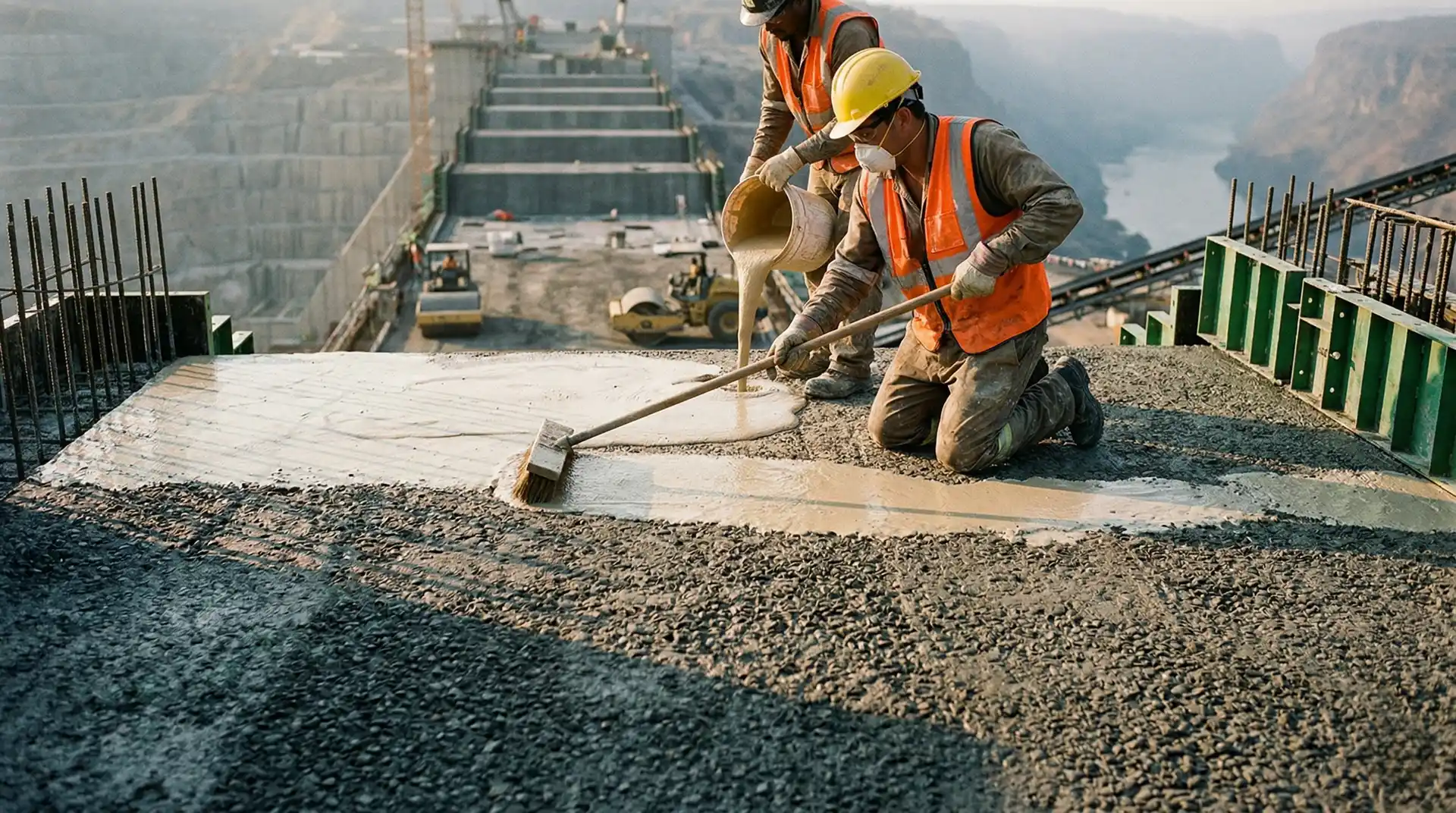
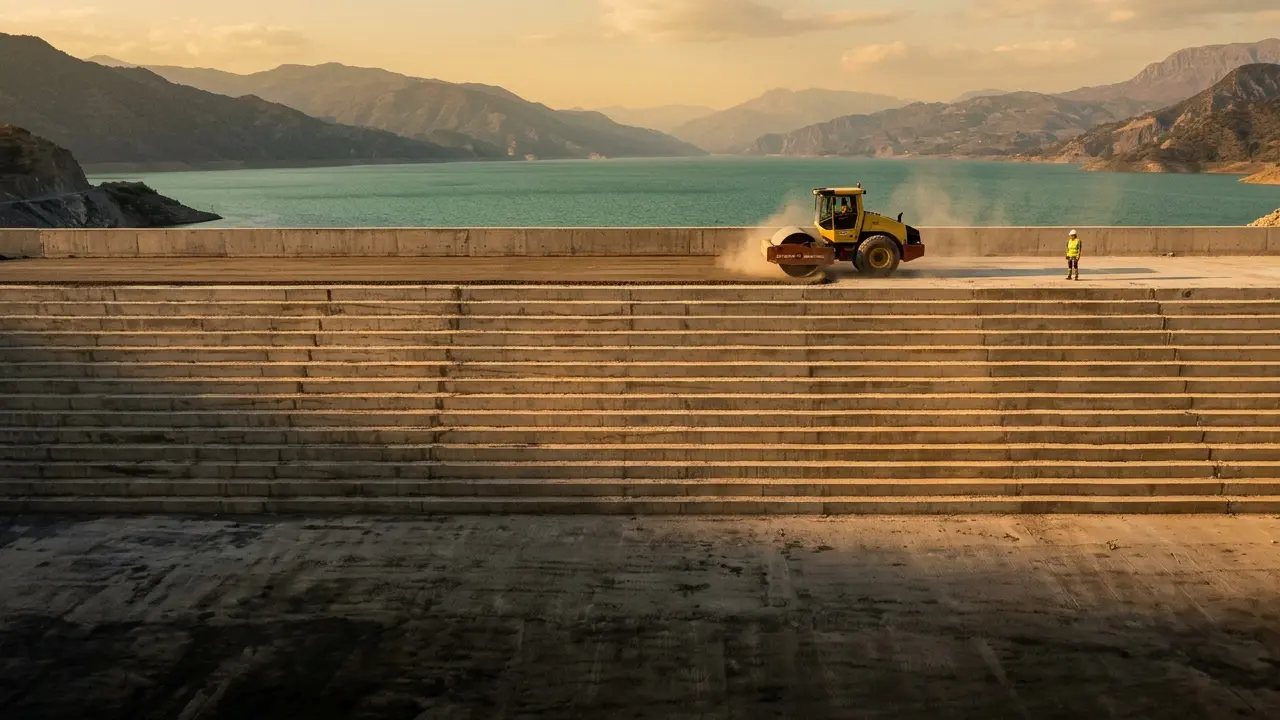
ICOLD Bulletin 177 (2020), Roller-Compacted Concrete Dams, is the international consensus reference for RCC dam design, construction, and quality control. Its nine chapters supersede Bulletin 126 (2003), and it is the document most modern Indian RCC tenders invoke alongside ACI PRC-207.5-11, because no Indian Standard covers RCC.
Roller-compacted concrete for dams sits in a regulatory gap that no Indian standard fills. IS 457 (1957) predates RCC by two decades. IS 456:2000 makes no provision for it. The standard that bridges global RCC practice into one reference is ICOLD Bulletin 177, published in 2020 as the successor to Bulletin 126 (2003). Most modern Indian RCC tenders invoke Bulletin 177 explicitly; LTAs reviewing those tenders need to know what is inside it and where it fits alongside ACI PRC-207.5-11 (formerly ACI 207.5R-11) and the basic IS concrete provisions.
This brief walks Bulletin 177 chapter by chapter, documents the delta from Bulletin 126, sets out the specification language for invoking it on Indian projects, and explains where it sits in a dual-standard concrete spec. For the broader survey of ICOLD bulletins relevant to dam concrete see the practitioner’s guide to ICOLD bulletins; this article goes one level deeper into Bulletin 177 alone.
What is ICOLD Bulletin 177?
Title: Roller-Compacted Concrete Dams. Publisher: ICOLD via Routledge / CRC Press under the ICOLD Bulletins Series. ISBN: 978-0367349493. Published 2020. Length: 426 pages, bilingual English/French. Structure: nine chapters plus an appendix.
The bulletin is the synthesis of 15+ years of RCC dam construction worldwide since Bulletin 126 (2003), the latest in an ICOLD RCC lineage that began with Bulletin 75 (1989). It draws on the experience of major operational RCC dams that did not exist or were under construction in 2003: Yeywa (Myanmar, 134 m, commissioned 2010), Longtan (China, 216.5 m, 2009), Gibe III (Ethiopia, 250 m, 2015), and India’s first major RCC structures including the Ghatghar Hydroelectric Pumped Storage Scheme (Maharashtra, 250 MW, three RCC dams) and Middle Vaitarna Dam (Maharashtra, 102.4 m, 2012). The bulletin is the international consensus document for any RCC dam project undertaken today.
The nine chapters at a glance
| Chapter | Title | What it governs |
|---|---|---|
| 1 | Introduction | RCC history, advantages, current design concepts, LCRCC / MCRCC / HCRCC classification |
| 2 | Design of RCC Dams | Early-age hydration, thermal considerations, galleries, spillways, instrumentation |
| 3 | Materials | Cementitious materials, SCMs, aggregates, admixtures |
| 4 | Mixture Proportions | High-paste vs lean-paste, Loaded VeBe, GERCC / GEVR / IVRCC compositions |
| 5 | Construction | Aggregate production, mixing, transport, placement methods, compaction, joints, facing systems |
| 6 | Quality Control | Materials testing, fresh and hardened RCC, full-scale trials, training |
| 7 | Performance of RCC Dams | Layer joint bond, tensile and shear strength, contraction joints, durability, seismic, case studies |
| 8 | Other Applications of RCC | Overtopping protection, dam stabilization, raising, erosion, cofferdams |
| 9 | RCC Arch Dams | Arch geometry, thermal stress, induced joints, Chinese practice, performance |
| App | Appendix | Reference data |
The bulletin is sequenced so that an engineer designing an RCC dam from scratch can move through the chapters in order. An engineer working as an Owner’s Engineer or LTA reviewing an existing design typically navigates directly to the chapter governing the contested clause.
Chapter 1: the LCRCC / MCRCC / HCRCC framework
Bulletin 177 formalises a three-tier classification of RCC by total cementitious content.
| Class | Total cementitious | Typical design approach | Typical use |
|---|---|---|---|
| LCRCC (Low-Cementitious RCC) | < 100 kg/m³ | Soil mechanics approach: Proctor density, moisture-density relationship | Low-to-medium dams in dry climates |
| MCRCC (Medium-Cementitious RCC) | 100-150 kg/m³ | Hybrid approach | Medium dams, balanced impermeability vs cost |
| HCRCC (High-Cementitious RCC) | > 150 kg/m³ | Concrete approach: w/cm ratio, Loaded VeBe, impermeability | High dams, exposure to water, demanding seismic |
The classification matters because it drives the proportioning method. LCRCC behaves more like a stabilised soil and is qualified through Proctor compaction tests. HCRCC behaves like concrete and is qualified through conventional cement-content and w/cm-based mix design with Loaded VeBe consistency control. The proportioning methods are not interchangeable; an engineer who applies the concrete approach to an LCRCC mix produces a wrong-density, wrong-fines mix that does not compact properly, and vice versa.
Chapter 2: design with thermal and structural integration
Chapter 2 governs the dam-level design framework. Early-age hydration heat and thermal stress get extended treatment because RCC dams typically place at high volume rates (10,000-50,000 m³ per week is routine for major projects) without embedded cooling pipes. The chapter documents the thin-lift placement approach that allows heat to dissipate from each layer before the next is placed.
The thermal section sits alongside thermal control for mass concrete under ACI 207, IS 7861, and IS 14591. What Bulletin 177 adds is RCC-specific: how lift thickness, placement rate, ambient temperature, and pre-cooling combine to keep peak temperatures below the cracking threshold without active cooling. For deeper detail on this approach see RCC thermal control without cooling pipes.
Galleries, spillways, and instrumentation get dedicated sections. Galleries inside an RCC dam are formed differently from CVC dams; spillway design must account for the different abrasion resistance of RCC vs CVC; instrumentation densities and placement schedules differ.
Chapter 3: materials selection for RCC
Chapter 3 sets the materials acceptance framework. Key points:
- Cementitious materials: ordinary Portland cement plus fly ash is the standard combination. High SCM replacement (50-80% by mass of cementitious) is common for low-heat performance.
- Coarse aggregate: up to 75 mm maximum size is typical; some dams have used up to 100 mm.
- Fine aggregate fines: LCRCC mixes typically incorporate 6-10 per cent fines below 75 microns in the aggregate, contributing to the paste fraction. HCRCC mixes use lower fines content with continuous grading.
- Admixtures: water-reducing, retarding, and air-entraining admixtures used selectively. Super-retarders extend setting time to support lift-on-lift joint integrity.
- Water quality: same requirements as conventional concrete.
The chapter’s materials acceptance framework runs in parallel with ICOLD Bulletin 165 (Selection of Materials for Concrete in Dams) but adapts the criteria for the specific demands of RCC.
Chapter 4: mixture proportions and the Loaded VeBe
The proportioning chapter is one of the most technical in the bulletin. The central method depends on whether the target is LCRCC, MCRCC, or HCRCC.
Lean-paste (LCRCC) proportioning
The mix is treated as a stabilised aggregate. Standard Proctor compaction is run on candidate gradations and water contents to identify the optimum moisture content for maximum dry density. The cementitious content is then layered on. Aggregate fines (around 8 per cent of total aggregate) act as part of the paste fraction. Total paste volume including aggregate fines is on the order of 200 L per cubic metre; excluding fines, the “free” paste is approximately 140 L per cubic metre.
High-paste (HCRCC) proportioning
The mix is designed as concrete. Water-cementitious ratio is the primary design lever. Continuous aggregate grading is used to achieve impermeability. Total paste volume is typically 100-125 L per cubic metre. The Loaded VeBe consistency test sets the workability target.
The Loaded VeBe consistency test
RCC is too dry to measure conventional slump. The Loaded VeBe test is the standard workability test: a surcharge weight (typically 12.5 kg) is placed on the concrete surface inside the VeBe apparatus, the apparatus is vibrated, and the time required for the concrete to fully consolidate around the surcharge is recorded in seconds. Typical placement-ready Loaded VeBe times are 15-30 seconds for traditional RCC, with high-workability super-retarded RCC potentially shorter (10-20 seconds). The target is established during full-scale trials and verified on every production batch.
GERCC, GEVR, and IVRCC compositions
Chapter 4 also documents the special mix variants used for facing systems:
- GERCC: Grout-Enriched RCC. Cement grout is added to the upstream RCC layer and immersion-vibrated to densify the matrix into an impermeable facing.
- GEVR: Grout-Enriched Vibratable RCC. A variant of GERCC with refined practice.
- IVRCC: Immersion-Vibrated RCC. The upstream RCC is treated by immersion vibration without separate grout, achieved by adjusting the mix workability.
Each method needs a separate mix design, separate workability targets, and separate production controls. Bulletin 177 documents the design considerations in detail.
Chapter 5: construction with thin lifts and modern facing
Construction is the longest chapter in the bulletin and covers the production-floor reality of building an RCC dam.
Aggregate production and stockpiling
Crusher selection, stockpile separation, moisture management, and segregation prevention are documented with operational guidance. RCC’s sensitivity to aggregate moisture variation drives much of the QC discipline.
Mixing, transportation, and placement
Twin-shaft mixers and continuous mixers are both documented. Transport from mixer to dam is typically by haul trucks, conveyor systems, or a combination. Placement methods include horizontal layers (most common), slope-layer placement (useful for managing exposure time), split-level placement, and block placement.
Compaction and lift thickness
Lift thickness is typically 300 mm uncompacted, compacting to about 250 mm. Compaction equipment includes vibratory rollers (single-drum, dual-drum, smooth-drum). Compaction passes are typically 4-6 per lift. Density is verified by nuclear gauge or specimen extraction. The verified density relative to the laboratory Proctor maximum is the acceptance criterion for LCRCC; HCRCC adds w/cm and air checks.
Construction joints
Lift-on-lift joints are classified by exposure time and treatment requirement:
- Hot joints: next lift placed within the time window where the previous lift is still chemically active (typically less than 4-6 hours). Treated by direct placement without bedding.
- Warm joints: placed within 6-24 hours. Require bedding mortar or grout.
- Cold joints: placed after 24 hours. Require bedding mortar treatment and surface preparation. Inadequate cold-joint treatment is a leading cause of RCC dam seepage.
The classification and treatment discipline these joints demand is the subject of RCC lift joint quality.
Facing systems
The chapter documents the six facing systems (CVC, GERCC, GEVR, IVRCC, formwork-finished, precast panels) with construction sequence diagrams, equipment selection, and quality control checkpoints. Selection depends on dam height, head, climate, and contractor experience.
Chapter 6: quality control with full-scale trials
The QC chapter formalises the testing protocol from materials through hardened concrete. Key features:
- Materials testing: cementitious materials per ASTM C150, C618, C1240 or IS 269, IS 3812-1, IS 15388.
- Aggregate testing: gradation, moisture, fines content per the relevant ASTM or IS methods.
- Fresh RCC testing: Loaded VeBe consistency on every batch; in-place density by nuclear gauge; temperature.
- Hardened RCC testing: cores extracted from completed lifts for compressive strength, tensile strength, density, and impermeability.
- Full-scale trial: a representative section of dam constructed under production conditions before full placement starts, with the same equipment, mix, and crew. The trial verifies that the proposed mix and method achieve the specification targets.
The full-scale trial requirement is non-negotiable for major RCC projects and is one of the most important provisions in Bulletin 177. The trial typically runs at least 30 m of dam length over multiple lifts and produces cores for every parameter the specification controls.
Chapter 7: performance data and case studies
Chapter 7 is the empirical evidence backbone of the bulletin. Performance data is presented from operational RCC dams worldwide, with parameters including layer-joint bond strength, direct tensile and shear strength, contraction-joint and waterstop performance, freeze-thaw durability, and seismic response.
Case-study dams referenced include Upper Stillwater (USA), Yeywa (Myanmar), Willow Creek (USA), Longtan (China), and many others. The bulletin’s case studies are the empirical basis for the acceptance criteria proposed in earlier chapters.
For Indian engineers, the bulletin’s performance data is particularly important. India has limited operational RCC dam experience (Ghatghar dams from ~2006 and Middle Vaitarna from 2012 are the main references), so Bulletin 177’s global database is the primary evidence base for design assumptions.
Chapter 8: other applications of RCC
Beyond gravity dams, Bulletin 177 covers RCC for:
- Overtopping protection of embankment dams
- Dam stabilization and buttressing
- Dam raising (adding RCC to existing dam crest)
- Erosion protection
- Cofferdam construction
These applications are increasingly relevant to dam rehabilitation under programmes like the Dam Rehabilitation and Improvement Project (DRIP) Phase II, where RCC overtopping protection and downstream stabilisation are tools available to the rehabilitation designer.
Chapter 9: RCC arch dams
The arch dams chapter is the most substantively expanded section relative to Bulletin 126 (2003), driven by Chinese construction in the 2003-2018 period. Key topics:
- Arch geometry and stress analysis
- Thermal stress in arch behaviour (compression-tension patterns differ from gravity dams)
- Induced joint systems and grouting (transverse contraction joints are deliberately induced at specified locations, then grouted to restore monolithic action)
- Construction sequencing for arch placement
- Performance data from operational RCC arch dams (mostly Chinese, including Shapai 132 m)
For Indian application this chapter is mostly informational. India has no operational RCC arch dam as of 2026 and project terrains generally favour gravity over arch geometry. The chapter remains relevant for engineers evaluating arch options or working as LTAs where a design consultant proposes RCC arch geometry.
What does Bulletin 177 mean for Indian RCC dam practice?
India’s operational RCC dam experience is limited but real. Three references anchor the domestic experience base:
Ghatghar Hydroelectric Pumped Storage Scheme (Maharashtra, 250 MW). Three RCC dams (saddle dam, upper dam 14.5 m, lower dam 86 m), commissioned approximately 2006. The first major RCC dams in India. The lower dam at 86 m height demonstrated that RCC could deliver a high gravity dam under Indian climatic and material conditions. Lessons learned from Ghatghar were carried into subsequent Indian RCC pursuits.
Middle Vaitarna Dam (Maharashtra, MCGM water supply). 102.4 m, completed 2012. India’s largest RCC dam at completion. Designed and constructed under a project-specific specification that invoked ICOLD Bulletin 126 (Bulletin 177 was not yet published) alongside ACI 207.5R. The project demonstrated that high RCC dams could be built within the Indian regulatory and contracting environment.
Kalu Dam (Maharashtra, proposed). RCC technology is among the design options being evaluated for the proposed Kalu water supply project. Not yet under construction.
Beyond these three, India has a growing pipeline of medium-height RCC dams under consideration for water supply, irrigation, and hydropower applications. The technology’s central advantage (rapid placement rates of 10,000-50,000 m³ per week with minimal embedded cooling, supporting tight construction schedules) makes it attractive for projects where schedule is binding.
For any Indian engineer, design consultant, contractor, or LTA entering an RCC dam project today, Bulletin 177 is the primary reference. Bulletin 126 is superseded. ACI PRC-207.5-11 is supplementary US-centric guidance. No Indian standard fills the RCC gap.
The strategic implication for the industry: PSUs, EPC contractors, and design consultancies that have built domestic RCC expertise on Bulletin 126 need to update their reference base, their specification templates, and their training material to Bulletin 177. Tenders that still cite Bulletin 126 as the governing reference are technically defensible but practically outdated; the 2003 to 2020 delta documents 15+ years of RCC practice evolution that the design and contracting communities cannot afford to leave on the shelf.
How does Bulletin 177 sit alongside ACI 207.5R and IS standards?
Indian RCC dam projects typically operate under three standards simultaneously. The reconciliation pattern:
| Topic | ICOLD Bulletin 177 | ACI PRC-207.5-11 | IS standards |
|---|---|---|---|
| RCC mix design philosophy | Chapter 4 | Section 3 | None |
| Mix proportioning method | LCRCC / HCRCC framework | High-paste / low-paste | IS 10262 general (not RCC-specific) |
| Materials specifications | Chapter 3 | Section 2 | IS 269, IS 12269, IS 3812, IS 16715, IS 383 |
| Loaded VeBe consistency | Chapter 4 | Section 3 | None |
| Lift thickness and compaction | Chapter 5 | Section 5 | None |
| Joint treatment | Chapter 5 | Section 5 | None |
| Quality control programme | Chapter 6 | Section 6 | IS 456 general |
| Acceptance criteria | Chapter 7 + project-specific | Section 6 | IS 456 limits where applicable |
The pattern: for RCC-specific provisions Bulletin 177 is the primary international reference, ACI PRC-207.5 provides parallel US-centric guidance, and IS standards apply only for general concrete provisions (cement, aggregate, fly ash, basic durability). An Indian RCC tender that names only one standard is incomplete.
For deeper code-comparison context see IS 457 vs ACI 207 mass concrete standards, which applies the same logic to conventional mass concrete.
Specification language for invoking Bulletin 177
Sample specification text PCCI uses on Indian RCC bid technical reviews:
“Roller-compacted concrete (RCC) for the dam shall be designed, proportioned, placed, and quality-controlled in accordance with ICOLD Bulletin 177 (2020), Roller-Compacted Concrete Dams. ACI PRC-207.5-11, Roller-Compacted Mass Concrete, shall be referenced for supplementary detail. IS 456:2000 applies for general concrete requirements not specifically addressed in RCC standards. IS 383 applies for aggregate quality. IS 3812 Part 1 applies for fly ash as a supplementary cementitious material. IS 12269 / IS 269 applies for Portland cement. In the event of conflict between standards on a parameter, the more stringent provision governs unless the Engineer determines otherwise in writing.”
The Indian engineer drafting or reviewing this specification must then map each contract clause to the governing Bulletin 177 chapter and verify that the project’s acceptance criteria are defensible against the bulletin’s performance benchmarks.
How PCCI uses Bulletin 177
For RCC project pursuits, advisory engagements, and LTA reviews, PCCI’s approach is to:
- Map every contract clause to the governing Bulletin 177 section and ACI PRC-207.5 cross-reference.
- Verify the project’s mix design submission against Chapter 4 with explicit LCRCC / MCRCC / HCRCC classification.
- Cross-check the full-scale trial protocol against Chapter 6 expectations.
- Benchmark proposed acceptance criteria against Chapter 7 performance data from comparable case-study dams.
- Flag where the Indian standard layer (IS 456, IS 383, IS 3812) imposes additional requirements that should be reconciled into the project QC plan.
The work is anchored in PCCI’s broader hydropower dam practice covering thermal control and placement engineering, mix design and performance concrete, QA/QC systems and lab programmes, and Owner’s Engineer / Independent Review.
Closing: read the bulletin, use the bulletin, defend with the bulletin
Bulletin 177 is the international consensus document that every modern RCC dam project rests on. For Indian projects where IS 457 is silent, ACI PRC-207.5 is US-centric, and bilateral or multilateral lender involvement adds documentation demands, Bulletin 177 is the reference that ties the technical specification together.
Read the bulletin. Use the bulletin. When a design or construction decision is contested, defend with the bulletin. That is the discipline that turns an RCC dam project from a technical curiosity into an internationally defensible piece of infrastructure.
For independent technical review of an RCC tender or in-flight RCC dam project, PCCI’s Owner’s Engineer / Independent Review service applies the Bulletin 177 framework to the specific contract documents and design submissions in front of the project.