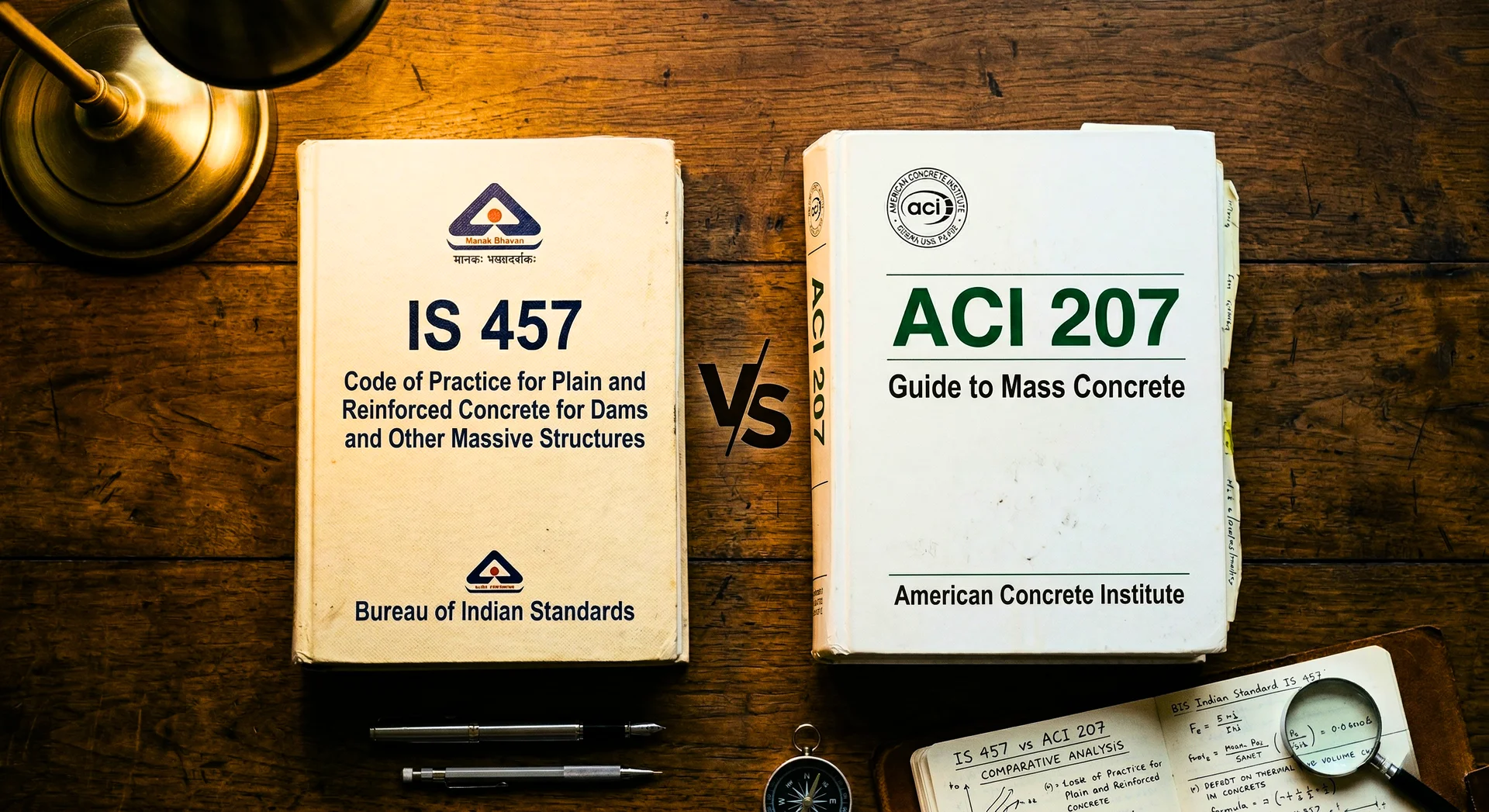

Every hydropower dam programme in India operates under three thermal control codes simultaneously. The ACI 207 series provides the engineering-mechanics framework for mass concrete worldwide. IS 14591:1999, Temperature Control of Mass Concrete for Dams: Guideline, is the Indian dam-specific operational guideline. IS 7861 Parts 1 and 2 cover hot-weather and cold-weather concreting for general construction. The three codes were written for different purposes, in different decades, and for different audiences. An owner’s engineer who relies on any single code will miss something the other two cover.
This reconciliation is not optional. It is what the contractor’s thermal control plan must navigate before a single cubic metre of mass concrete is placed, and what the owner’s engineer must verify before approving the plan. The reconciliation framework below draws on leadership experience across Tala HEP (1,020 MW), Mangdechhu HEP (720 MW), Punatsangchhu-1 HEP (1,200 MW), and other large hydroelectric programmes. It also reflects authorship of IS 14591 itself.
The three codes: scope, structure, and what each delivers
ACI 207 series (international engineering-mechanics framework)
ACI Committee 207 publishes the international reference set on mass concrete. The current series:
- ACI 207.1R-05 (Reapproved 2012), Guide to Mass Concrete: the foundational document defining mass concrete, materials, mixture proportioning, heat development, and cooling strategies. ACI PRC-207.1-21 is the newer revision that introduces the Performance-Based Temperature Difference Limit (PBTDL) approach and classifies mass concrete as either thermally controlled or traditional.
- ACI 207.2R-07, Report on Thermal and Volume Change Effects on Cracking of Mass Concrete: the engineering analysis of how thermal gradients produce tensile stress and cracking. Establishes the framework for the 19°C (35°F) traditional core-surface differential limit.
- ACI 207.4R-20, Report on Cooling and Insulating Systems for Mass Concrete: the current authoritative reference on pre-cooling and post-cooling system design, including pipe layouts, flow rates, water temperatures, and insulation requirements.
- ACI PRC-207.5-11, Report on Roller-Compacted Mass Concrete: RCC-specific thermal considerations.
Adjacent ACI codes that touch thermal control on dam projects:
- ACI 301-20, Specifications for Concrete Construction: sets the maximum internal mass concrete temperature at 71°C (160°F) to prevent delayed ettringite formation (DEF), and the maximum core-surface differential at 19°C (35°F).
- ACI 305R / ACI 305.1-14, Hot Weather Concreting: sets the general discharge temperature limit at 35°C (95°F), applicable to general construction, not mass concrete specifically.
- ACI 306R-16, Cold Weather Concreting: defines cold weather as ambient at or below 4°C (40°F), with minimum placement temperatures depending on section thickness.
- ACI 308R, Guide to External Curing of Concrete: addresses curing duration and temperature management.
IS 14591:1999 (Indian dam-specific operational guideline)
IS 14591:1999 (Reaffirmed 2020), Temperature Control of Mass Concrete for Dams: Guideline, is the Indian Standard published by the Bureau of Indian Standards under the Water Resources Division, Dams and Spillways section (WRD 9). The standard’s stated scope mainly covers pre-cooling methods adopted for temperature control of mass concrete in dams, and it also alludes to post-cooling as an overall temperature control measure.
The standard addresses the central thermal-control problem in mass concrete dams: a rapid rise in temperature occurs during the plastic stage as cement hydrates; after hardening, the concrete cools gradually to ambient, generating tensile stress that cracks the concrete when the stress exceeds the tensile strength. Temperature control is needed to minimise volumetric changes, control crack size and spacing, and enable continuous lift placement during the construction window.
IS 14591 was authored during my tenure at the Central Soil and Materials Research Station (CSMRS), New Delhi, drawing on field experience from major Indian dam projects of the time. The standard’s emphasis on operational practice (rather than only mechanics) reflects its purpose as a guideline for Indian dam constructors and supervisors.
IS 7861 Parts 1 and 2 (Indian extreme-weather general construction)
IS 7861 Part 1:1975 (Reaffirmed 1990), Code of Practice for Extreme Weather Concreting, Part 1: Recommended Practice for Hot Weather Concreting, governs general hot-weather concreting in India. Hot weather is defined as atmospheric temperature greater than 40°C or any operation where the concrete temperature at placement is expected to be greater than 40°C. The standard specifies that concrete temperature at the time of placing must be less than 40°C, and that the temperature of aggregates, water, and cement must be kept as low as possible to achieve this.
IS 7861 Part 2:1981 (Reaffirmed 1997), Code of Practice for Extreme Weather Concreting, Part 2: Recommended Practice for Cold Weather Concreting, governs general cold-weather concreting in India. Cold weather is defined as atmospheric temperature at or below 5°C.
IS 7861 was written for general construction, not mass concrete dams specifically. The 40°C and 5°C ambient thresholds invoke mandatory precautions across the Indian construction industry whether the structure is a building, a bridge, a pavement, or a dam.
What the three codes deliver, summarised
The three-code architecture
ACI 207 series delivers the engineering-mechanics framework: how heat develops, how stress arises, how to design cooling systems. IS 14591 delivers the dam-specific operational guideline: how to run pre-cooling and post-cooling on an Indian dam site. IS 7861 delivers the ambient-conditions overlay: what mandatory precautions kick in when ambient exceeds 40°C or falls below 5°C. All three apply simultaneously to mass concrete on a hydropower dam in India.
The five reconciliation questions
A thermal control plan for an Indian hydropower dam must explicitly answer five questions where the three codes overlap or have gaps.
Question 1: What is the maximum concrete placement temperature?
Where each code speaks:
- ACI 207 specifies project-specific placement temperatures derived backward from the peak-temperature constraint. Typical mass concrete placement temperatures on dam projects fall in the range 10 to 18°C.
- IS 14591 frames placement temperature as the controlling variable for peak temperature and post-cooling load, with pre-cooling methods (chilled water, ice, aggregate cooling, liquid nitrogen) detailed to achieve the project-specific limit.
- IS 7861 Part 1 sets the general construction ceiling at 40°C concrete temperature at placement.
- ACI 305.1-14 sets the general construction ceiling at 35°C (95°F) at discharge.
The reconciliation: For mass concrete on a dam, the binding placement temperature is the project-specific limit derived from the thermal control plan (typically 10 to 18°C), which is far below both IS 7861 (40°C) and ACI 305.1 (35°C). The 40°C and 35°C numbers are floor limits that even general construction may not exceed; mass concrete dams operate well inside the floor. The thermal control plan documents the project-specific limit and the pre-cooling capacity required to deliver it under design ambient conditions.
Where the plan fails review: If the thermal control plan cites IS 7861’s 40°C as the binding limit for mass concrete, the owner’s engineer rejects the plan. That is a misapplication of IS 7861 to a mass concrete pour.
Question 2: What is the maximum internal (peak) temperature?
Where each code speaks:
- ACI 301-20 sets the maximum internal mass concrete temperature at 71°C (160°F) to prevent delayed ettringite formation (DEF).
- ACI 207.1R and 207.2R provide the analytical framework to predict peak temperature from adiabatic rise, lift geometry, ambient conditions, and cooling system capacity.
- IS 14591 frames peak temperature in the context of post-hardening cooling and the resulting tensile stress, with project-specific limits established case by case.
- IS 7861 does not address peak temperature directly (it addresses placement temperature and ambient conditions).
The reconciliation: The 71°C ACI 301 limit is the DEF ceiling and applies regardless of dam-specific provisions. Project-specific peak temperatures are commonly set lower (typically 55 to 65°C) to provide margin and to limit the post-cooling load. The mix-design calorimetry must be performed on the actual cement-fly-ash combination, and the predicted peak temperature must be verified by embedded thermocouples during placement.
Where the plan fails review: If the thermal control plan cites a project-specific peak limit but does not document the calorimetry that supports it, the limit is unverified. The owner’s engineer requires the supporting calorimetry data.
Question 3: What is the maximum core-surface temperature differential?
Where each code speaks:
- ACI 207.2R / ACI 301 set the traditional limit at 19°C (35°F) between the centre and the exposed surface of a mass concrete placement during curing.
- ACI PRC-207.1-21 introduces the Performance-Based Temperature Difference Limit (PBTDL) approach, in which the allowable differential is derived from the concrete’s actual tensile strain capacity, modulus of elasticity, coefficient of thermal expansion, and the degree of restraint. PBTDL often allows higher differentials when justified by analysis.
- IS 14591 addresses temperature differential in the framework of cooling-induced tensile stress and cracking risk, with operational practice to monitor and control.
- IS 7861 does not address core-surface differential.
The reconciliation: The 19°C traditional limit remains the default for projects without project-specific tensile strain capacity analysis. PBTDL is invoked when the contract specification or the project’s tensile-strain testing supports a higher differential. The owner’s engineer verifies which approach the thermal control plan adopts and confirms the supporting analysis is current and complete.
Where the plan fails review: If the plan claims a 25 or 30°C differential without PBTDL analysis and tensile strain testing, the claim is unsupported. Defaulting to the traditional 19°C is conservative and code-compliant.
Question 4: What is the maximum cooling rate during post-cooling?
Where each code speaks:
- ACI 207 specifies that the concrete should not cool more than 11°C (20°F) in 12 hours during post-cooling to prevent thermal shock.
- ACI 207.4R-20 provides design guidance for cooling pipe spacing, flow rates, water temperatures, and cooling cycle duration.
- IS 14591 references post-cooling within its broader temperature control framework with operational practice for Indian dam sites.
- IS 7861 does not address post-cooling.
The reconciliation: The ACI 207 cooling rate limit of 11°C per 12 hours applies. Project-specific plans often set a tighter limit (5 to 8°C per 12 hours) for the early cooling phase when the concrete tensile strength is still developing, relaxing to the ACI 207 limit as the concrete matures. Post-cooling termination criteria are set in the thermal control plan, typically when the differential between the cooled concrete and ambient ground temperature is within a project-specific tolerance.
Where the plan fails review: If the plan does not specify a cooling rate limit (just that post-cooling will be performed), the operational discipline is undefined. The owner’s engineer requires a numerical rate limit and a monitoring protocol.
Question 5: How is curing temperature managed?
Where each code speaks:
- ACI 308R / 308.1 specifies curing duration (minimum 7 days when daily mean ambient temperature exceeds 5°C, or until 70 percent of specified strength) and surface temperature management.
- ACI 306R-16 addresses cold-weather curing protection.
- IS 14591 references curing temperature as part of the broader temperature control regime, with attention to the cooling rate at surface during early curing.
- IS 7861 Part 1 addresses curing under hot weather (extended curing periods, continuous moist curing).
- IS 7861 Part 2 addresses curing under cold weather (protection against freezing, accelerated curing under cover).
The reconciliation: Hot-weather curing on Indian dam sites is governed by IS 7861 Part 1 overlay on the IS 14591 / ACI 207 framework. When ambient exceeds 40°C and evaporation rate exceeds 1.0 kg/m²/hr (the ACI 305R threshold for plastic shrinkage precautions), additional protection (continuous wet curing, wind breaks, sun shades, evaporation reducers) is mandatory. Cold-weather curing at high-altitude Himalayan sites is governed by IS 7861 Part 2 and ACI 306R when ambient drops below 5°C. The thermal control plan addresses all three regimes that the project’s geographic and seasonal conditions may invoke.
Where the plan fails review: If the plan addresses only one regime (typically hot weather, since that dominates most Indian sites) and ignores monsoon humidity or high-altitude cold-weather, the plan is incomplete for sites where the other regime can occur.
Indian field conditions the codes did not fully anticipate
Three conditions are characteristic of Indian hydropower dam construction and are not fully addressed by any single code. The reconciled thermal control plan must address each.
Ambient placement temperatures above 45°C
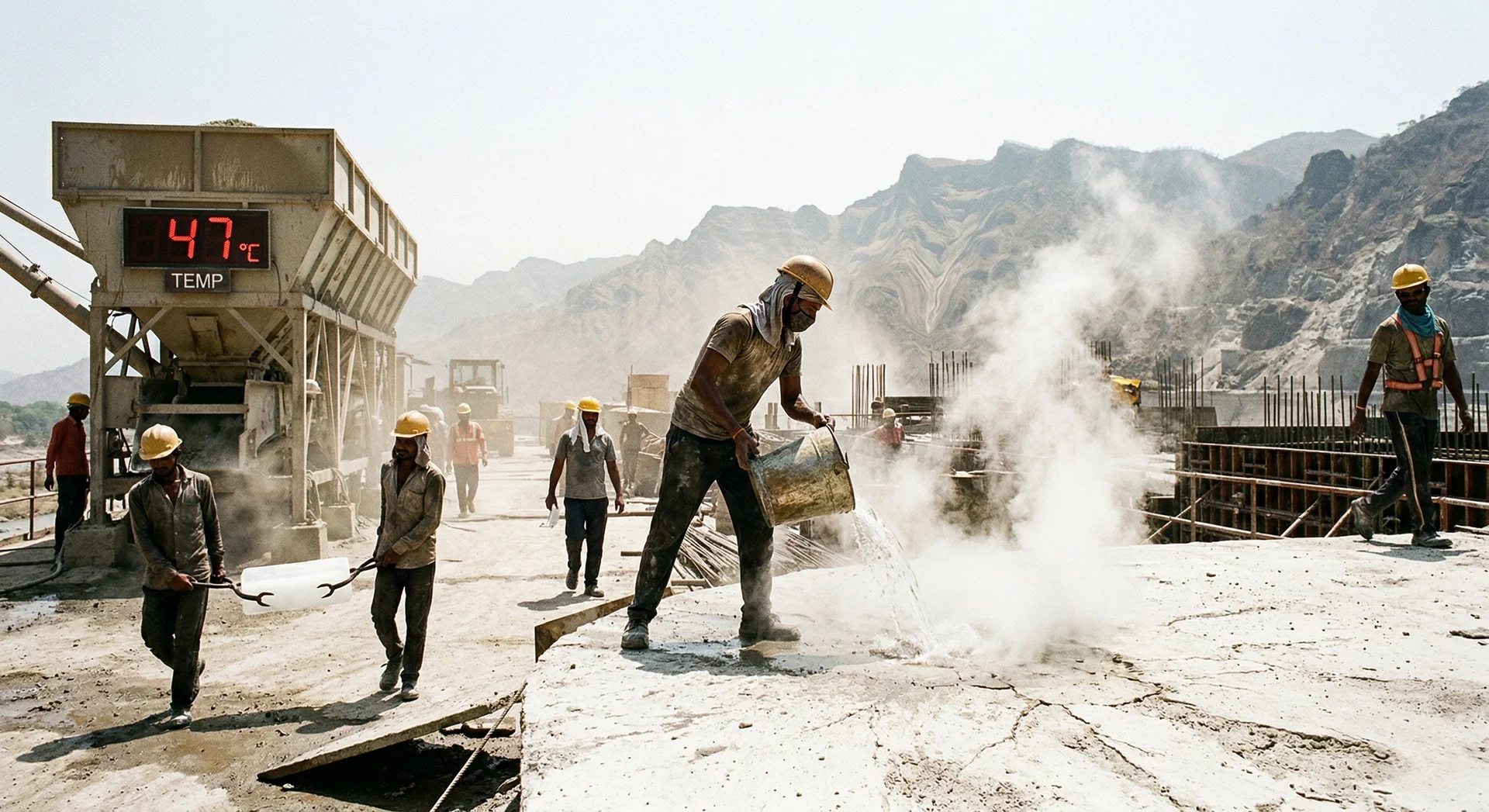
ACI 207 and ACI 305 were developed primarily for US construction conditions, where summer ambients above 40°C are uncommon. IS 7861 Part 1 covers ambient above 40°C but as a general threshold, not with dam-specific guidance. On Indian dam sites in pre-monsoon May and June, ambient placement-day temperatures regularly exceed 42°C, and on some northern Indian sites can exceed 45°C.
The reconciled thermal control plan addresses this by:
- Sizing the pre-cooling system for the design ambient, not the average ambient
- Restricting placements to night and early-morning hours when daily ambient exceeds a defined threshold (typically 38 to 40°C)
- Providing surge capacity in the chiller, ice plant, or aggregate cooling system for peak-week placements
- Establishing a rest-day protocol when ambient remains above the threshold for more than 36 consecutive hours
Fly-ash variability between supply lots
Most Indian hydropower mass concrete mix designs use 25 to 35 percent fly ash for hydration heat reduction and durability. The fly ash sourced from Indian thermal power stations varies in chemical composition, fineness, and reactivity from lot to lot, depending on the coal source, combustion conditions, and beneficiation practice at the station. ACI 207 calls for calorimetry on the actual cement-fly-ash combination, but does not anticipate the supply-side variability typical of Indian construction.
The reconciled thermal control plan addresses this by:
- Requiring calorimetry retesting whenever the fly-ash source changes
- Monitoring peak temperatures during placement against the calorimetry-predicted peak; flagging deviations
- Pre-qualifying two or three fly-ash sources at project start to provide flexibility without invalidating the thermal control plan
Monsoon-disrupted continuous placement
The southwest monsoon (June to September) and the northeast monsoon (October to December) disrupt continuous placement on Indian dam sites. ACI 207 assumes broadly continuous placement; IS 7861 addresses hot weather but not monsoon humidity; IS 14591 references the construction window but not monsoon-specific protocols.
The reconciled thermal control plan addresses this by:
- Identifying the placement-window calendar before construction starts
- Defining placement halt criteria (rainfall intensity, surface flooding, humidity affecting curing)
- Pre-positioning materials and forms to enable resumption when conditions normalise
- Treating monsoon-suspended lifts as construction joints rather than continuous placement, with explicit joint treatment provisions
The PCCI reconciliation framework: layered, not parallel
The practitioner approach across PCCI’s portfolio treats the three codes as layered, not parallel. Each code does what it does best; the others fill the gaps.
Layer 1: ACI 207 series as the engineering-mechanics framework. Thermal modelling, peak-temperature prediction, differential analysis, cooling system design, and PBTDL analysis when warranted. This layer answers the engineering questions: what heat will develop, what stresses will result, what cooling capacity is required.
Layer 2: IS 14591 as the operational and supervisory guideline. Pre-cooling methods, post-cooling protocols, monitoring cadence, supervisory framework, acceptance criteria in the Indian regulatory context. This layer answers the operational questions: how the engineering analysis from Layer 1 is executed on the site.
Layer 3: IS 7861 as the ambient-conditions overlay. Hot-weather precautions when ambient exceeds 40°C; cold-weather precautions when ambient is at or below 5°C. This layer answers the field-conditions questions: what mandatory adjustments are invoked when ambient crosses thresholds.
Layer 4: Practitioner judgment as the integrator. The three codes do not cover every field decision. The fly-ash supplier changes mid-construction. The monsoon arrives early. A cooling pipe leaks. The integrator uses 40+ years of field experience to make the call that the codes did not anticipate. This is what an owner’s engineer brings to the project.
A thermal control plan structured along these four layers is internally coherent. A plan that mixes codes without an explicit layering schema is internally inconsistent and produces conflicts under field pressure.
Common reconciliation errors the owner’s engineer should flag
Five errors recur in thermal control plan submissions across hydropower projects:
Error 1: Citing ACI 207 differential limit without checking PBTDL eligibility. If the contract specification allows PBTDL and the contractor’s tensile strain capacity testing supports it, the differential limit may be 25 to 30°C rather than the default 19°C. Citing 19°C without acknowledging PBTDL leaves construction efficiency on the table. Citing 25°C without supporting PBTDL analysis is non-compliant.
Error 2: Applying IS 7861 hot-weather provisions to mass concrete as the primary limit. IS 7861 is a general construction code. Its 40°C placement temperature limit is a floor, not a ceiling, for mass concrete. Mass concrete operates well inside that floor on a project-specific basis. A thermal control plan that cites IS 7861 as binding for mass concrete misunderstands the code’s scope.
Error 3: Treating IS 14591 as advisory. IS 14591 has specific operational requirements that are binding when invoked by the contract specification or by Indian regulatory authorities. Treating it as a general guideline that can be overridden by other codes is incorrect.
Error 4: Running hot-weather and mass-concrete provisions in parallel without integration. A summer placement on an Indian dam site invokes both IS 7861 Part 1 (hot-weather precautions) and IS 14591 / ACI 207 (mass concrete thermal control). The two regimes must be integrated, not run separately. A pour that meets IS 7861 placement temperature (40°C) but fails the project-specific mass-concrete limit (18°C) is non-compliant for mass concrete regardless of IS 7861.
Error 5: Not documenting the calorimetry that supports peak-temperature prediction. ACI 207 calls for calorimetry on the actual cement-fly-ash combination. IS 14591 frames calorimetry within the broader supervisory practice. Many thermal control plans cite a peak temperature limit without documenting the calorimetry that supports it. The owner’s engineer requires the supporting data and re-verifies it whenever supply sources change.
Each of these errors is correctable in the plan-review stage. Each becomes very expensive to correct in the placement stage. This is why thermal control plan review is the first hold point on the QA/QC plan and on the Owner’s Engineer scope.
The reconciliation summarised in one table
| Reconciliation question | ACI 207 contribution | IS 14591 contribution | IS 7861 contribution |
|---|---|---|---|
| Placement temperature | Project-specific limit derived from peak constraint | Pre-cooling methods to achieve limit | General 40°C ceiling |
| Peak temperature | Engineering-mechanics framework + 71°C DEF ceiling (ACI 301) | Dam-specific operational supervision | Not addressed |
| Core-surface differential | 19°C traditional or PBTDL | Operational monitoring | Not addressed |
| Cooling rate | 11°C / 12-hour limit + ACI 207.4R design guidance | Operational supervision | Not addressed |
| Curing temperature | ACI 308R framework | Curing within thermal regime | Hot/cold weather overlays |
The integrator’s role
A thermal control plan that reconciles the three codes upfront does what a code cannot: it produces a single, internally coherent operational framework for the specific project, written by engineers who understand which code governs which decision under which condition. The plan does not get rewritten mid-construction because the codes were misapplied. The owner’s engineer reviews it once at the project planning stage, approves it, and audits its execution.
PCCI’s Thermal Control and Placement Engineering service is structured to deliver this reconciliation. The framework draws on the authoring of IS 14591, decades of field application of ACI 207 series on Indian hydropower projects, and supervisory experience with IS 7861 invocations across summer placement windows on Tala, Mangdechhu, Punatsangchhu-1, and other landmark programmes.
The cheapest thermal control insurance for any hydropower dam project is to have the code reconciliation done before construction starts, not after the first thermal crack appears. The conversation begins with the contract specification, the contractor’s draft thermal control plan, and a walk through the batching plant and pre-cooling system.