The mix design submitted at the start of a hydropower project sets the trajectory of every cubic metre placed afterward. Proportion it to a single code in isolation and the project either pays for unnecessary cement or loses durability margin where it matters. Proportion it for the wrong code regime and the Lender’s Technical Advisor sends it back. Mass concrete for a 60 m-class gravity dam is unforgiving in both directions, and the practitioner has to navigate two parallel rule sets at the same time.
ACI 211.1-22 and IS 10262:2019 are the two methodologies a mass-concrete designer working in South Asia is most likely to invoke. They look similar at the level of the worked example. They are not the same code. Where, exactly, they diverge is the difference between a dam mix that clears acceptance and one that does not.
Why the comparison matters now
A change happened quietly in 2022 that most field practitioners have not yet absorbed. The American Concrete Institute issued ACI PRC-211.1-22 titled “Selecting Proportions for Normal-Density and High-Density Concrete: Guide.” The 1991 edition was titled “Standard Practice for Selecting Proportions for Normal, Heavyweight, and Mass Concrete.” Mass concrete was dropped from the title and from the formal scope of ACI 211.1. The proportioning engine remains. The mass-concrete-specific overlays moved to ACI PRC-207.1-21, the Mass Concrete Guide reissued in early 2022.
BIS did the opposite. The second revision of IS 10262 in 2019 expanded the standard from a single-section guideline into a five-section document with Section 5 dedicated to mass concrete and an illustrative annex providing a worked mass-concrete mix design. The revision also formalised supplementary cementitious materials in the absolute-volume calculation, refined the target mean strength formula with a grade-dependent X factor, and made compliance with IS 456:2000 durability provisions explicit, including the IS 456 Clause 8.2.4.2 ceiling of 450 kg per cubic metre cement (exclusive of fly ash and GGBS), beyond which special design consideration is required.
The practical consequence for a 2026 dam mix designer is this: anyone reading ACI 211.1 alone misses half the mass-concrete picture. Anyone reading IS 10262 alone misses the ACI/ASTM half that multilateral lenders require. The codes have to be read together, and the differences have to be understood at clause level.
The two codes at a glance
Before working through the steps, it helps to fix the structure of each.
| Element | ACI 211.1-22 (with ACI 207.1-21 for mass) | IS 10262:2019 |
|---|---|---|
| Scope statement | Normal-density and high-density concrete | Five sections including Section 5 mass concrete |
| Strength reference | Cylinder, f’c (per ASTM C39) | Cube, f_ck (per IS 516) |
| Target mean strength | f’cr = f’c plus statistical margin (ACI 301 / 318 Table 26.4.3.1) | f_target = max(f_ck + 1.65σ, f_ck + X) |
| Durability framework | ACI 318 Chapter 19, F/S/W/C exposure classes | IS 456:2000 Table 5, Mild to Extreme exposure |
| Maximum cement (OPC alone) | No hard cap | 450 kg per cubic metre (IS 456 Clause 8.2.4.2, invoked via IS 10262) |
| Trial mix testing | ASTM C39 (cylinders), C143 slump, C138 unit weight, C231 air | IS 516 (cubes), IS 1199 workability |
| Material specifications | ASTM C150 cement, C618 fly ash, C989 slag, C1240 silica fume | IS 12269 / IS 269 OPC, IS 3812-1 fly ash, IS 16715 GGBS, IS 15388 silica fume |
| Mass concrete companion | ACI 207.1-21 (Mass Concrete Guide), ACI 207.2R (thermal effects) | IS 457:1957 (mass concrete code), IS 14591 (thermal control) |
Both methods use absolute volume balance: the sum of the volumes of cement, water, supplementary cementitious materials, fine aggregate, coarse aggregate, and air equals one cubic metre. Both proceed through approximately nine sequential steps. The points of divergence are in the parameters at each step.
Step 1: Target mean strength
ACI 211.1 sets the required average strength f’cr by adding a statistical margin to the specified strength f’c. The current ACI 318 Chapter 26 approach uses Table 26.4.3.1, which adjusts the margin based on the known standard deviation from production records. With insufficient records the margin defaults to a conservative value tied to the f’c class.
IS 10262:2019 uses an explicit two-formula maximum: f_target equals the higher of f_ck + 1.65σ and f_ck + X, where σ is the assumed or known standard deviation and X is a grade-dependent factor tabulated in the standard. For M30 through M60 the X factor is 6.5 N/mm². For an M30 mass concrete mix with the assumed σ of 5 N/mm² the two candidate values are 38.25 N/mm² and 36.5 N/mm² respectively, and the designer adopts 38.25 N/mm². The 2019 revision introduced the X factor to ensure a minimum margin even when σ is low.
The practical consequence for a dam mix designer: the two codes give similar target strengths for the same f_ck once unit conversion is handled, but the IS 10262 formula is more explicit about the floor below which the margin must not drop. On a dual-regime project, calculate both and adopt the larger.
Cube vs cylinder: the 1.25 factor
IS 516 uses 150 mm cubes; ASTM C39 uses 100 by 200 mm or 150 by 300 mm cylinders. For the same mix the cube strength is approximately 1.25 times the cylinder strength. An IS M30 (30 N/mm² cube) corresponds approximately to an ACI 24 MPa (3500 psi) cylinder. The mix designer must keep this conversion in front of them on every dual-regime project.
Step 2: Slump and water content
ACI 211.1 selects slump from Table 6.3.1 based on the structural element type. For mass concrete in a dam interior the slump is typically 25 to 75 mm; for pumped or formed sections of the dam the slump may rise to 50 to 100 mm. Water content is then read from Table 6.3.3 as a function of slump, maximum aggregate size, and air entrainment. For 20 mm aggregate at 75 to 100 mm slump in non-air-entrained concrete the base water content is approximately 205 kg/m³.
IS 10262:2019 takes a similar path but with different table inputs. Table 4 gives the base water content for various maximum aggregate sizes at a reference 50 mm slump. For 20 mm aggregate the base water content is 186 kg/m³. Adjustments are then applied: approximately +6% per increment of slump increase, and a reduction for the use of plasticizers or superplasticizers (typically 5 to 30% depending on admixture class).
For mass concrete the practitioner approach is convergent: use the lowest workable slump consistent with placement method, use the largest practical maximum aggregate size (75 to 150 mm in dam practice where the placement geometry and equipment permit), and use water-reducing admixtures aggressively. Both codes acknowledge that water content drives heat of hydration through the cementitious total that follows; minimising water minimises heat.
Step 3: Water-cementitious materials ratio
This is where the codes start to diverge in earnest.
ACI 211.1-22 reads the strength-based w/cm from Table 6.3.4(a), which relates compressive strength to w/cm for normal-weight concrete with and without air entrainment. The designer then checks the resulting w/cm against the ACI 318 Chapter 19 durability ceilings for the applicable exposure class (F, S, W, or C category at its appropriate severity tier). The lower of the strength-derived and durability-derived w/cm governs.
For a dam upstream face exposed to freeze-thaw with deicing in temperate climates (F3), the ACI 318 w/cm ceiling is 0.40 and minimum f’c is 5000 psi (approximately 35 MPa). For a foundation contact zone subjected to moderate sulfate exposure (S1), the ceiling is 0.50. For a saturated dam interior with no chloride or freeze-thaw exposure (W0/W1, C0), the ceiling relaxes and strength governs.
IS 10262:2019 reads the strength-based w/c from a curve (Figure 1 in the 2009 edition, retained conceptually in 2019) and then checks against the IS 456:2000 Table 5 exposure-class ceilings. For Severe exposure (most dam interiors in seismic and snow-fed catchments) the IS 456 ceiling is 0.45 with minimum cement 320 kg/m³ and minimum grade M30. For Very Severe (high water table, marine spray, deicing salts) the ceiling is 0.45 with minimum cement 340 kg/m³ and minimum grade M35. For Extreme exposure the ceiling is 0.40 with minimum cement 360 kg/m³ and minimum grade M40.
The reconciliation rule on a dual-regime project: classify the same physical environment under both schemes, then adopt the lower of the two w/cm ceilings and the higher of the two minimum cement contents. A Himalayan spillway face that IS 456 calls Severe and ACI 318 calls F3 ends up at w/cm 0.40 with cement content at least 360 kg per cubic metre (IS minimum for Extreme governs the cement; ACI F3 governs the w/cm).
Step 4: Cementitious content and the 450 kg/m³ cap
Once water content and w/cm are fixed, total cementitious is arithmetic: C equals W divided by w/cm. For W of 150 kg/m³ at w/cm 0.45 the cementitious total is 333 kg/m³. For W of 130 kg/m³ at w/cm 0.40 the total is 325 kg/m³.
ACI 211.1 does not impose an upper cap on cementitious content. ACI 207.1-21 instead pushes mass concrete cementitious downward through SCM substitution: by replacing 30 to 50 per cent of Portland cement with fly ash or slag the OPC fraction is approximately half the total, which controls heat of hydration without sacrificing later-age strength or durability.
The Indian regime imposes a hard ceiling on cement content via IS 456:2000 Clause 8.2.4.2: cement content (exclusive of fly ash and GGBS) in excess of 450 kg per cubic metre is not to be used unless special design consideration is given to the elevated risk of drying shrinkage, early thermal cracking, and alkali-silica reaction. IS 10262:2019 invokes this IS 456 limit as part of its durability check. The clause exists because each of those failure mechanisms scales with Portland cement content. For mass concrete in dams the ceiling is rarely binding because mass concrete targets cementitious totals around 250 to 350 kg/m³ with high SCM replacement. The cap nevertheless disciplines structural elements adjacent to the dam (powerhouse, intake gantry, transition zones) where designers may otherwise specify cement-rich mixes for early-age strength.
Explore PCCI’s approach to cement-content optimization for the specific tactics that reduce cement without compromising acceptance criteria.
Step 5: Aggregate proportioning
Both codes use the same underlying volumetric logic for aggregate proportioning, with slight differences in tabulated values.
ACI 211.1 reads the dry-rodded coarse aggregate volume per unit volume of concrete from Table 6.3.6 as a function of maximum aggregate size and fineness modulus of the fine aggregate. For 19 mm MSA and FM of 2.70 the table value is approximately 0.63 (i.e., 63% of one cubic metre is coarse aggregate dry-rodded volume). The fineness modulus correction is ±0.01 per 0.10 FM increment. Fine aggregate is then back-calculated by absolute volume balance: V_fa = 1 minus the sum of V_cement, V_water, V_ca, and V_air.
IS 10262:2019 uses Table 5, which gives the coarse aggregate volume per unit volume of total aggregate (note: total aggregate, not total concrete) for various maximum aggregate sizes and fine aggregate zones (Zone I through Zone IV per IS 383). For 20 mm MSA and Zone III the table value is approximately 0.62. Adjustments include +0.01 per 0.05 decrease in w/c ratio and a 10 percent reduction for pumpable concrete. The total aggregate volume is then split between coarse and fine in the calculated ratio.
For mass concrete in dams both codes admit much larger maximum aggregate size, typically 75 mm or 150 mm depending on placement geometry. ACI 207.1-21 and IS 457:1957 (read alongside IS 10262 Section 5) both acknowledge that larger MSA reduces cement demand and reduces heat of hydration. The practitioner approach is to push MSA as large as the form geometry, reinforcement spacing, and placement equipment permit, and then to optimise the fine aggregate Zone selection so that the FA content does not exceed the minimum needed for workability.
Step 6: SCM accommodation
The framing of supplementary cementitious materials in proportioning is the single largest conceptual difference between the two codes.
ACI 211.1 treats SCMs via the “water/(cement + pozzolan)” ratio (w/cm rather than w/c), with the pozzolan added at full mass to the denominator. The strength-developing efficiency of fly ash, slag, and silica fume is different from Portland cement; ACI accommodates this through trial mixes that establish the actual strength response. ACI 207.1-21 documents 30 to 50 percent fly ash as the standard mass concrete range, with historical references to 50 to 75 per cent on landmark projects.
IS 10262:2019 absorbs SCMs into the absolute-volume calculation directly. The standard provides illustrative annexes for OPC with fly ash, OPC with GGBS, and mass concrete with mineral admixtures. The fly ash mass is added at full mass to the cementitious total; the volume contribution uses the specific gravity of fly ash (typically 2.20 to 2.40) rather than Portland cement (3.10 to 3.16). The standard does not prescribe a fixed maximum SCM percentage for mass concrete; the designer demonstrates strength, durability, and thermal performance through trial mixes.
The fly ash itself must conform to a specification: ASTM C618 Class F (preferred for mass concrete due to lower CaO content and pozzolanic stability) or IS 3812 Part 1: 2013 (which classifies fly ash as siliceous, reactive CaO below 10%, or calcareous; siliceous fly ash is the mass-concrete preferred specification). PCCI’s standard practice on multilateral projects is to qualify fly ash to both ASTM C618 and IS 3812 simultaneously, because the Lender’s Technical Advisor may invoke either at acceptance.
For slag the equivalent specifications are ASTM C989 (Grades 80, 100, and 120 by slag activity index, with Grade 80 being the lower-heat option typical for mass placements) and IS 16715. For silica fume the specifications are ASTM C1240 and IS 15388.
Read more on PCCI’s SCM strategy for dam concrete for the materials qualification protocol that supports dual-code compliance.
Step 7: Durability and the exposure framework
Durability is where IS and ACI most visibly differ in regulatory philosophy.
IS 456:2000 Table 5 uses a single-axis categorical scheme. Five tiers (Mild, Moderate, Severe, Very Severe, Extreme) each prescribe paired ceilings on w/c, minimum cement content, and minimum grade. The scheme captures Indian climatic and coastal conditions in one classification axis.
ACI 318-19 Chapter 19 uses four orthogonal axes. Each exposure category (F freeze-thaw, S sulfate, W water, C corrosion) has its own severity tiers (F0-F3, S0-S3, W0-W2, C0-C2) with independent ceilings on w/cm and minimum f’c. The same physical environment is classified under multiple axes simultaneously: a freeze-thaw spillway face in chloride-bearing snowmelt is F3 + C2 + W1, and each class’s ceiling applies.
The reconciliation method for dam concrete on a dual-regime project:
| Dam zone | Likely IS 456 class | Likely ACI 318 class | Governing w/cm | Governing min cement |
|---|---|---|---|---|
| Foundation contact (sulfate-bearing rock) | Severe | S1 to S2 | ACI 0.45-0.50 vs IS 0.45 | IS 320-340 kg/m³ |
| Interior mass | Moderate | F0, S0, W0, C0 | IS 0.50 | IS 300 kg/m³ |
| Upstream face (saturated, freeze-thaw) | Severe to Very Severe | F2 to F3, W1 | ACI 0.40-0.45 | IS 340-360 kg/m³ |
| Spillway face (freeze-thaw plus chloride) | Very Severe | F3, C2 | ACI 0.40 | IS 360 kg/m³ |
| Downstream face (atmospheric exposure) | Moderate to Severe | F1 to F2, W1 | IS 0.45-0.50 | IS 320 kg/m³ |
The mass concrete mix designer working both regimes adopts the more restrictive of each cell. On most South Asian dam projects the durability ceiling, not the strength ceiling, ends up governing the w/cm.
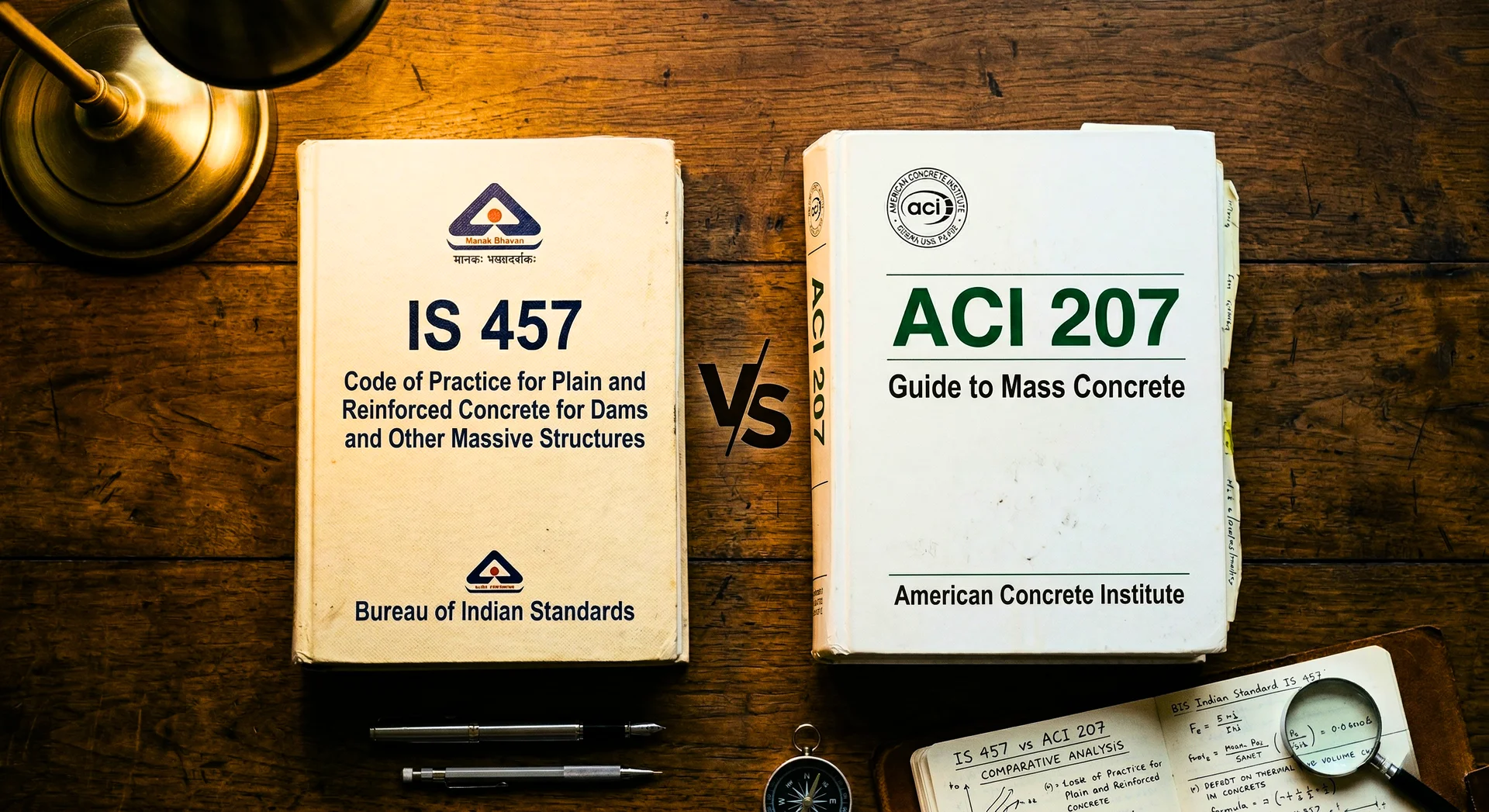
For deeper comparison of the mass-concrete code bodies themselves see IS 457 vs ACI 207 mass concrete standards.
Step 8: Trial mixes and acceptance
Trial mix programmes are where dual-code compliance generates the most field workload. The protocol is doubled but the underlying mix is one.
ACI 211.1-22 specifies a trial batch of minimum 0.028 cubic metre (1 cubic foot). Fresh tests cover slump (ASTM C143), unit weight (ASTM C138), air content (ASTM C231), and temperature. Hardened tests are 7-day and 28-day cylinder strength per ASTM C39. The trial is iterated by adjusting water content first, then coarse aggregate, then fine aggregate, until target strength and workability are both met.
IS 10262:2019 mandates trial batches tested at 28-day cube strength per IS 516. Workability is tested per IS 1199. Air content is tested per the relevant IS test methods. The standard implicitly assumes the designer iterates multiple trial mixes to establish the strength versus w/c relationship.
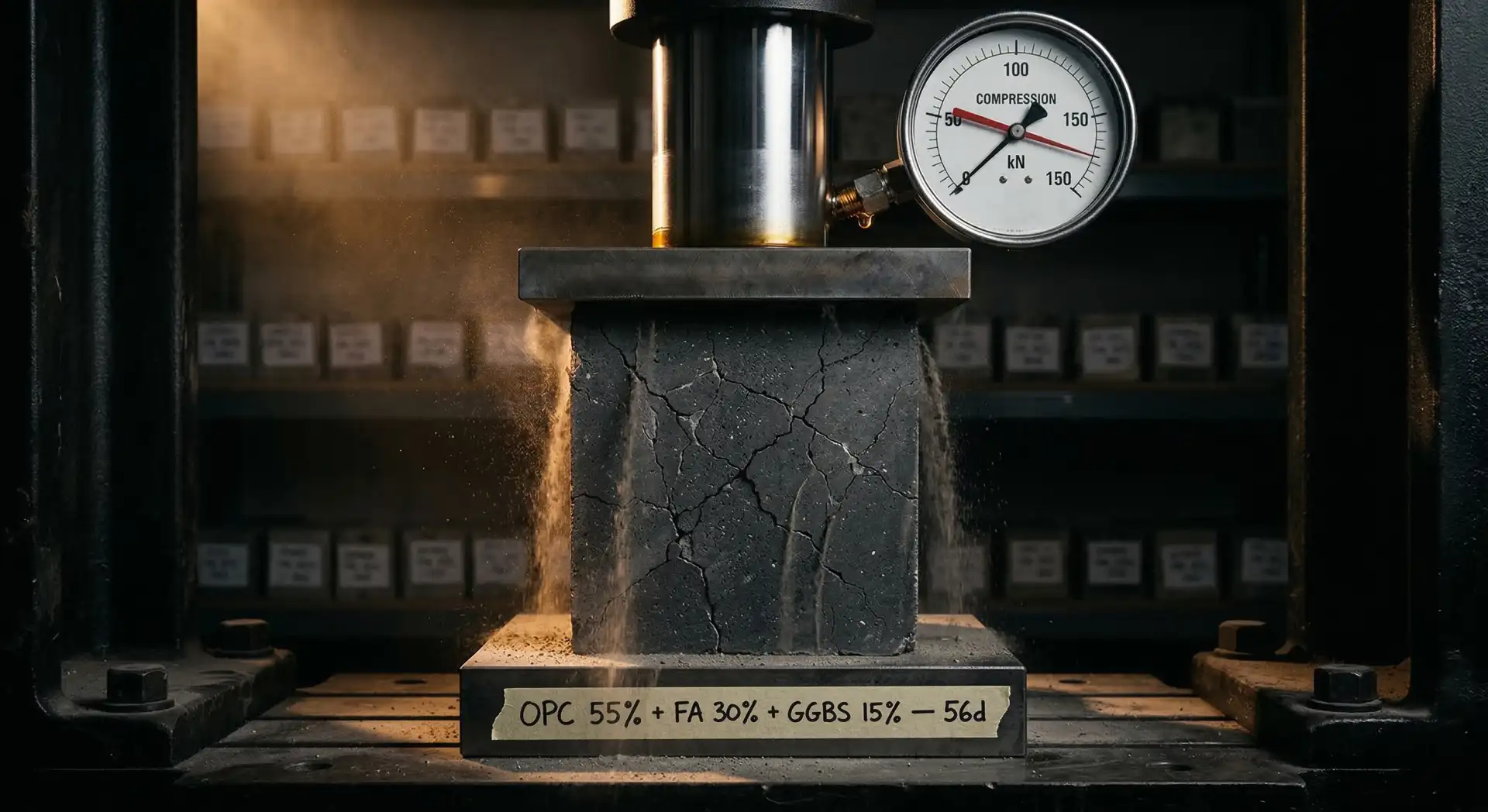
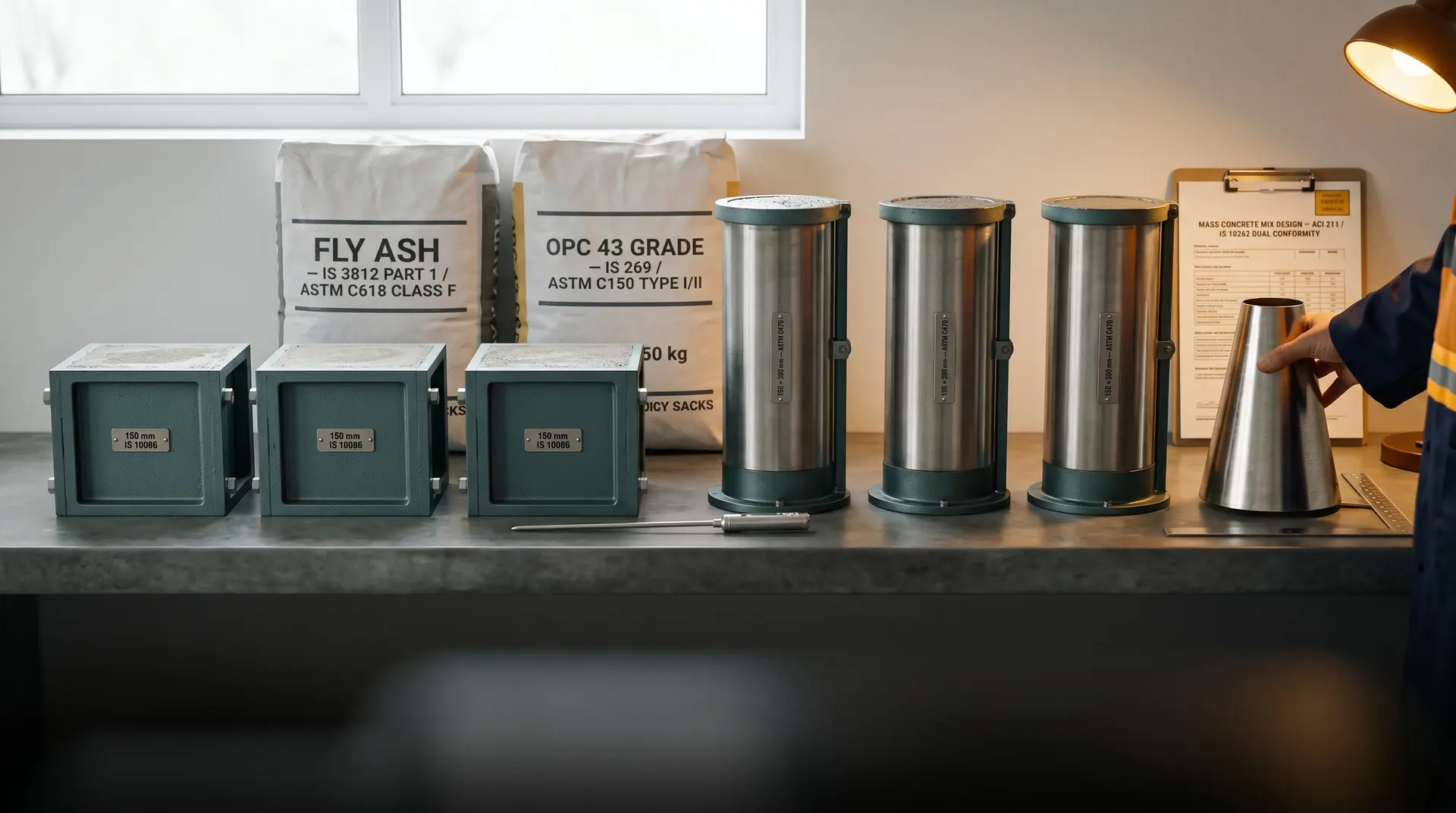
The practitioner approach on a dual-code project is to cast both cube and cylinder specimens from the same trial batch, run all fresh tests under both code frameworks, log results in a single trial-mix register that lists both cube and cylinder strengths against the same mix ID, and qualify the mix when it satisfies both the IS 516 cube target and the ASTM C39 cylinder target (allowing for the ~1.25× cube-to-cylinder conversion).
The trial-mix register becomes the artifact the Lender’s Technical Advisor reviews at the design-mix approval gate. A register that documents both code regimes preempts the back-and-forth that otherwise consumes weeks of pre-construction time.
For the dam-side acceptance protocol that follows trial mix approval see concrete acceptance criteria for dam QA/QC.
Reconciliation in practice: the Tanahu case generalized
The Tanahu Hydropower Project (140 MW, Nepal) is the natural anchor case for ACI/IS reconciliation. The project is multilaterally funded by the Asian Development Bank, JICA, and EIB, with project specifications drafted under the ACI/ASTM framework. PCCI delivered concrete technology consulting on the mass concrete mix design for the gravity dam, including high fly ash low cement formulation, alkali-aggregate reactivity testing, and thermal parameter qualification.
The reconciliation method PCCI applied generalises to any multilateral South Asian hydropower project:
- Read the project Specification carefully. Identify which ACI/ASTM standards are explicitly invoked and which IS standards are simultaneously required by the host country regulator (Central Water Commission in India, Department of Electricity Development in Nepal, Druk Green Power Corporation in Bhutan).
- Build the exposure-class map for every dam zone under both IS 456 and ACI 318 simultaneously. Adopt the more restrictive w/cm and the higher minimum cement in each cell.
- Select cement type and SCM mix that qualifies under both ASTM C150 / C618 and IS 269 / IS 3812-1 simultaneously. Most modern Indian and Nepali fly ash sources qualify under both with the same physical and chemical test data, but the certification must be presented in both formats.
- Apply the IS 456:2000 Clause 8.2.4.2 ceiling (cement excluding fly ash and GGBS ≤ 450 kg/m³, invoked by IS 10262:2019 via its durability check) as a discipline on all structural elements, even where ACI does not impose it. The clause is rarely binding on mass concrete (which targets 200 to 350 kg/m³ cementitious total) but matters for transition zones and powerhouse concrete.
- Cast trial mixes that produce both cube (IS 516) and cylinder (ASTM C39) specimens from the same batch. Keep the trial-mix register in a format that cross-tabulates both regimes against the same mix IDs.
- Build the acceptance criteria document in dual format: cube targets per IS 456, cylinder targets per ACI 301 / 318, with the conversion factor flagged. Both targets must be cleared at acceptance.
This was the discipline applied at Tanahu, and the same discipline carries to Punatsangchhu-1 (Bhutan, IS-led with ACI 207 references for thermal practice), Mangdechhu, and other Bhutan and India projects where multilateral lender involvement or international design consultancy brings ACI/ASTM into the specification stack.
What the next-generation dam mix looks like
The 2020s mass concrete mix that satisfies both ACI 211 / 207 and IS 10262 typically lands in this envelope:
| Parameter | Typical value (mass concrete interior) | Typical value (cover concrete) |
|---|---|---|
| Total cementitious | 200-280 kg/m³ | 320-400 kg/m³ |
| OPC alone | 100-150 kg/m³ | 180-280 kg/m³ |
| Fly ash (ASTM C618 Class F / IS 3812-1 siliceous) | 80-150 kg/m³ (35-50%) | 60-120 kg/m³ (20-30%) |
| Water | 120-150 kg/m³ | 140-170 kg/m³ |
| w/cm | 0.50-0.55 (interior) | 0.40-0.45 (cover) |
| Maximum aggregate size | 75-150 mm | 20-40 mm |
| Slump | 25-75 mm | 50-100 mm |
| Superplasticizer | 0.8-1.5% by cementitious mass | 0.8-1.5% by cementitious mass |
| Air entrainment | As required by ACI 318 F-class | As required by ACI 318 F-class |
| 28-day cube strength | M20-M25 (interior) | M30-M35 (cover) |
| Adiabatic temperature rise | Typically 25-35°C | Typically 35-45°C |
Values in this table are typical ranges for South Asian dam practice based on multiple project records. Project-specific values depend on cement type, fly ash quality, aggregate source, and exposure conditions.
The interior mass concrete mix uses the IS 10262 Section 5 absolute-volume calculation, the ACI 207.1-21 SCM strategy, the lower of IS 456 and ACI 318 durability ceilings, and trial mixes qualified to both ASTM C39 and IS 516. The result is a mix that places without thermal cracking, satisfies the durability envelope of both codes, and passes acceptance under whichever LTA invokes whichever code.
For the thermal control system that supports this mix design see mass concrete thermal control under ACI 207, IS 7861, and IS 14591.
How PCCI applies this on multilateral projects
The dual-code mix proportioning method described in this brief is the working framework PCCI applies on every project where multilateral funding or international design consultancy brings ACI/ASTM into the specification stack alongside IS conformity.
The work product on a typical engagement covers:
- Pre-bid mix proportioning study under both ACI 211 / 207 and IS 10262, with reconciliation analysis and cost implications.
- Materials qualification programme for cement, fly ash, slag, aggregates, and admixtures under both ASTM and IS specifications simultaneously.
- Trial mix programme management: design, witness, log, and approval submission under both regimes.
- LTA-defensible mix design submission documenting all dual-code reconciliation decisions, exposure-class mapping, durability ceilings adopted, and trial mix results.
- Continuing technical advisory during construction for mix adjustments, NCR resolution, and acceptance documentation.
The framework draws on USACE EM 1110-2-2000 for practical mass-concrete-for-civil-works guidance, ICOLD bulletins for international consensus on dam concrete materials, and the on-site lab discipline that PCCI installs and runs.
The result is a mass concrete mix that does not have to be reproportioned mid-construction because the durability ceiling was missed, the SCM specification was misapplied, or the trial-mix register did not satisfy the LTA’s protocol.
Closing: the practitioner’s three-line rule
Three lines summarise the dual-code mix proportioning method for mass concrete in dams.
First, read both codes together. Anyone reading ACI 211.1 alone misses ACI 207.1-21; anyone reading IS 10262 alone misses the ACI/ASTM reality of multilateral funding.
Second, adopt the more restrictive of each parameter. Lower of the two w/cm ceilings, higher of the two minimum cement contents, lower of the two maximum SCM percentages where the designer needs early strength, the IS 456:2000 Clause 8.2.4.2 cap of 450 kg/m³ cement (exclusive of fly ash and GGBS) applied to every element on the project.
Third, qualify the trial mixes under both regimes simultaneously. One batch, two specimen geometries, one register, two acceptance gates.
PCCI’s mix design and performance concrete service delivers exactly this reconciliation for dam concrete on multilaterally-funded hydropower projects. For project advisory or independent review on a mix design submission already in flight, the Owner’s Engineer / Independent Review service provides a second opinion on whether the mix as proportioned will clear both code regimes at acceptance.
The mix that is right at the start does not have to be re-proportioned later. Get the dual-code reconciliation right at the trial mix stage and the rest of the project flows.