Sulfate attack on dam concrete operates through four distinct mechanisms (external sulfate attack, internal sulfate attack, delayed ettringite formation, and thaumasite sulfate attack), each requiring a different mitigation strategy bounded by ACI 318-19 Chapter 19 and the IS 12330 / IS 456 framework.
Sulfate attack consumes dam concrete from four directions at once. Groundwater carrying dissolved sulfate ions diffuses into the foundation contact zone and reacts with the cement paste. Gypsum-contaminated aggregate carries sulfate inside the concrete from the day it is placed. Early-age temperatures above 70°C in mass concrete pours set up delayed ettringite formation that takes months to manifest. And in cold-climate dam sites where temperatures stay below 15°C with carbonate and sulfate present, thaumasite sulfate attack reduces the binder to a white mush with no warning.
Sulfate attack does not have one mechanism. It has four. Each one demands a different defence. The cement type matters, the w/cm matters, the supplementary cementitious materials matter, and on mass concrete dams the early-age temperature ceiling matters as much as any of them.
This brief walks the four mechanisms, sets out the diagnostic signs and test methods, maps the ACI 318 Building Code Requirements for Structural Concrete and Indian-standards framework that governs the mitigation, and shows how PCCI integrates the disciplines on dam concrete projects with documented or suspected sulfate exposure.
Why does sulfate attack matter for dam concrete?
Sulfate attack is rarely the headline durability concern in dam concrete the way alkali-aggregate reaction or thermal cracking is. It does not produce the dramatic crack-pattern signatures that AAR (see alkali-aggregate reaction in dam concrete) generates. It does not threaten lift joints the way thermal stress does. It works slowly, through chemistries that may take five to thirty years to produce visible damage, against concrete that is in continuous contact with the source of attack.
The four operating conditions that make dam concrete a higher-risk target than typical structural concrete:
- Foundation contact: dam concrete sits on rock that may contain gypsum (Rajasthan, parts of Gujarat, Saurashtra) or sulfate-bearing groundwater. The contact zone is in continuous wet exposure.
- Mass concrete temperatures: peak temperatures in mass pours routinely reach 60-75°C without cooling. Above 70°C the delayed ettringite formation pathway opens.
- 100-year design life: dams are designed for a century of service. Slow sulfate-attack chemistries that would be irrelevant on a 30-year structure are first-order concerns on a 100-year dam.
- Limited rehabilitation access: foundation-contact sulfate damage is difficult to inspect and even harder to repair on an operational dam.
The mitigation strategy must therefore be specified at design stage. Sulfate attack on dam concrete is not a problem you fix later. It is a problem you prevent during mix design and placement.
Mechanism 1: External sulfate attack (ESA)
External sulfate attack is the classical and historically dominant mechanism in the sulfate-attack literature. Sulfate ions in groundwater, soil moisture, or surface water diffuse into the hardened concrete and react with two cement-paste phases:
- Calcium hydroxide (Ca(OH)₂) reacts with sulfate to form gypsum (CaSO₄·2H₂O). The reaction is not strongly expansive but the gypsum has lower mechanical properties than the parent calcium hydroxide and softens the concrete.
- Tricalcium aluminate (C₃A) reacts with sulfate and water to form ettringite (Ca₆Al₂(SO₄)₃(OH)₁₂·26H₂O). Ettringite formed in the hardened paste occupies substantially greater volume than the precursor C₃A and calcium aluminate hydrate phases, producing internal expansion. The expansion mechanism is discussed in detail in Mehta and Monteiro, Concrete: Microstructure, Properties, and Materials.
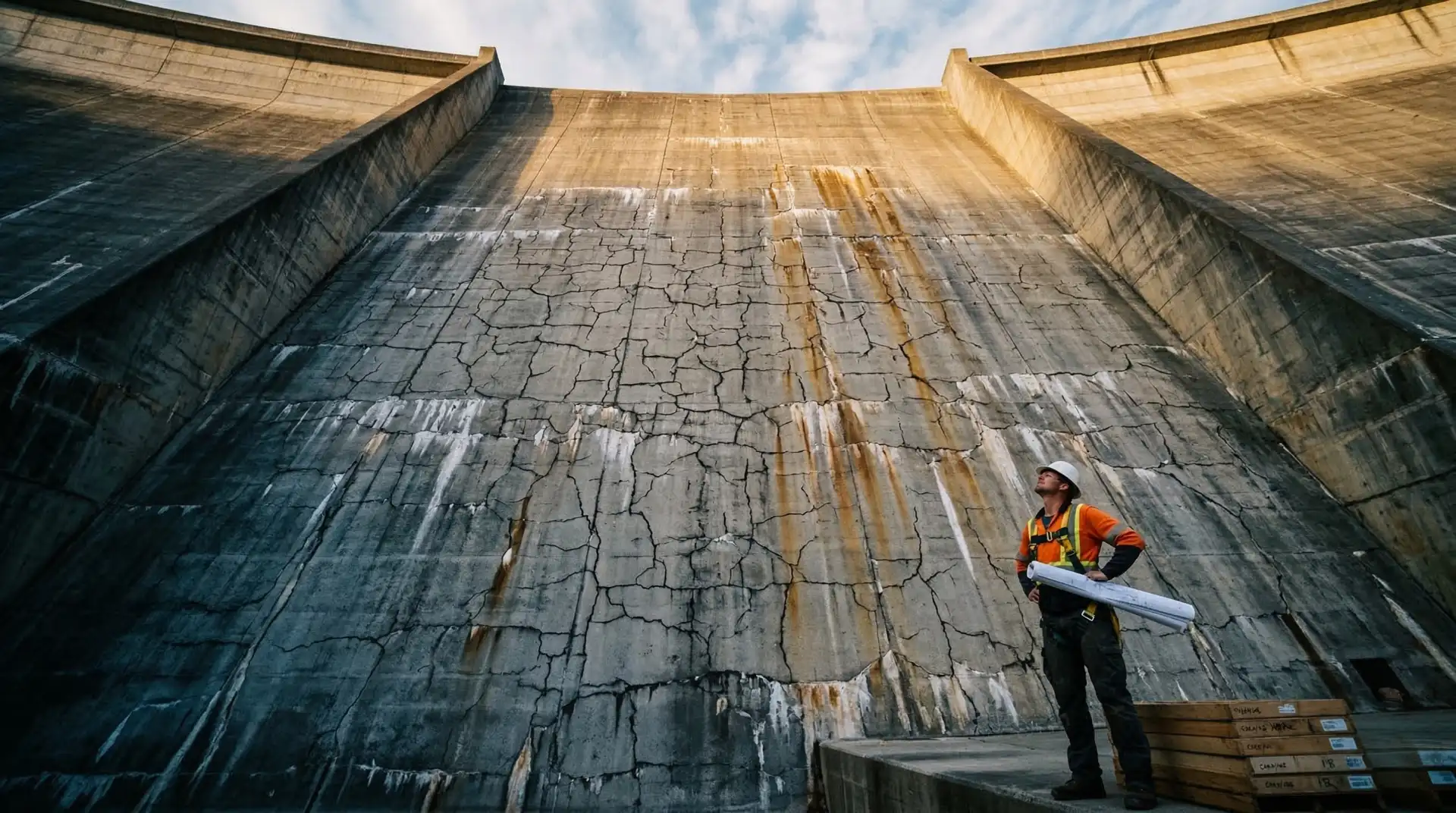
The combined damage: surface softening from gypsum formation, internal expansion from ettringite formation, micro-cracking that propagates from the exposed surface inward, progressive loss of section, and ultimately structural failure of the affected concrete.
Visual signs
- White or pale efflorescence at the wet-line and at surfaces in contact with sulfate-bearing water.
- Surface scaling and softening; the surface concrete can be removed by light scraping.
- Edge spalling at corners and exposed projections.
- Pattern cracking that may resemble alkali-aggregate reaction but typically progresses from the surface inward.
- In severe cases, complete loss of section in the most exposed zones.
Where it shows up on dams
The foundation contact zone in dams sited on sulfate-bearing rock or with sulfate-bearing groundwater. Spillway floors where sulfate-laden seepage emerges. Drainage gallery concrete. Intake structures in some hydrochemical settings.
Mechanism 2: Internal sulfate attack (ISA)
Internal sulfate attack uses the same chemistry as ESA but the sulfate source is inside the concrete itself from the day of placement. Two common sources:
- Gypsum-contaminated aggregate: aggregates from gypsum-bearing sedimentary formations carry sulfate into the concrete. Particularly an issue in parts of Rajasthan, Gujarat (Saurashtra), and other regions where gypsiferous formations are mined for construction aggregate.
- Excess gypsum in cement: cement specifications limit gypsum addition to a maximum SO₃ level (typically 2.5-3.5 per cent for OPC). Cement that exceeds the specification provides additional sulfate to the pore solution.
The damage progresses similarly to ESA but typically from the interior outward rather than from the surface inward. Surface scaling appears later than for ESA; pattern cracking may dominate the early presentation.
Prevention
- Aggregate qualification: ASTM C295 petrographic examination must screen for gypsum, anhydrite, and other sulfate-bearing minerals. The contract specification must specify aggregate sulfate limits.
- Cement qualification: every cement source must be qualified against the SO₃ limit (IS 269 / IS 12269 / IS 12330 specifications). Excess-SO₃ cement must be rejected.
- Mix design conservatism: when there is any uncertainty about aggregate or cement sulfate content, the design moves toward lower w/cm and higher SCM substitution to slow internal ion mobility.
Mechanism 3: Delayed ettringite formation (DEF)
Delayed ettringite formation is sulfate attack that requires no external sulfate source. It is induced by early-age high temperature in mass concrete pours.
The mechanism
During the first hours and days of cement hydration, ettringite normally forms as a stable phase and is incorporated into the developing microstructure. If concrete temperature exceeds approximately 70°C (158°F) during this early-age period, the normal ettringite formation pathway is disrupted: ettringite either does not form or decomposes back to calcium aluminate phases plus sulfate. The sulfate ions become locked in calcium silicate hydrate (CSH) and pore solution.
Once the concrete cools to normal service temperatures and moisture is available, the sulfate is released and ettringite reforms within the hardened paste. The newly-formed ettringite occupies greater volume than the precursor phases. The expansion is constrained by the now-rigid concrete matrix; the result is internal stress that cracks the concrete from within over months to years.
Why it is a mass-concrete problem
Mass concrete placements routinely reach internal temperatures of 60-75°C from the heat of hydration alone, especially in:
- Large lifts placed in summer.
- High-cement-content mixes.
- Insufficient pre-cooling or post-cooling.
- Inadequate placement temperature management.
DEF is therefore directly linked to the thermal control discipline. The 70°C threshold is the same threshold that ACI 207 / IS 14591 thermal control practice already uses for thermal cracking prevention. A thermal control plan that keeps peak temperature below 70°C eliminates DEF risk; a plan that exceeds this threshold without compensating measures (low-C₃A cement, high SCM substitution) opens DEF risk.
Prevention
- Temperature ceiling: hold peak in-place concrete temperature below 70°C. This is the most direct prevention.
- Low-C₃A cement (controls the aluminate available for re-ettringite formation): ASTM C150 Type V or IS 12330 SRPC (C₃A ≤ 5%). ASTM C150 Type II also limits C₃A to ≤ 8% and is commonly specified where Type V is unavailable.
- Low-heat cement (controls the peak temperature itself, the primary DEF trigger): ASTM C150 Type IV, ASTM C150 Type II (MH option per ASTM C150 Table 4), or IS 12600 low-heat Portland cement. Note: sulfate resistance (Type V) and heat-of-hydration control (Type IV / Type II-MH) are distinct C150 designations. DEF prevention strategy should address both, not assume one covers the other.
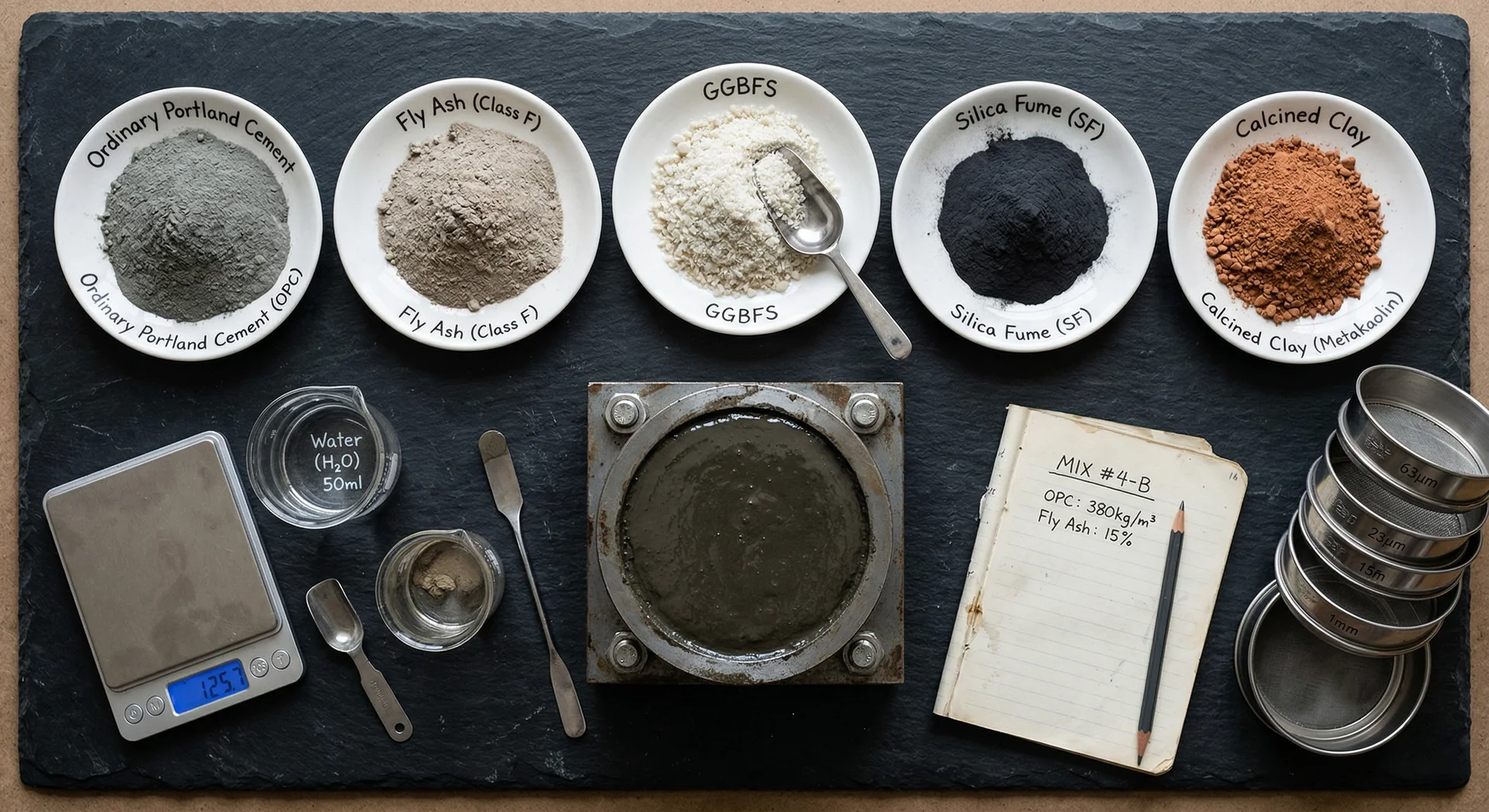
- SCM substitution: Class F fly ash 30 per cent or higher, slag 50 per cent or higher. Reduces both the total available C₃A and the hydration heat.
For the testing methodology that quantifies the heat-generation signature of the project mix see adiabatic temperature rise testing for mass concrete in dams.
Mechanism 4: Thaumasite sulfate attack (TSA)
Thaumasite sulfate attack is the cold-weather sulfate-attack mechanism and is the most destructive of the four when its conditions are met.
The chemistry
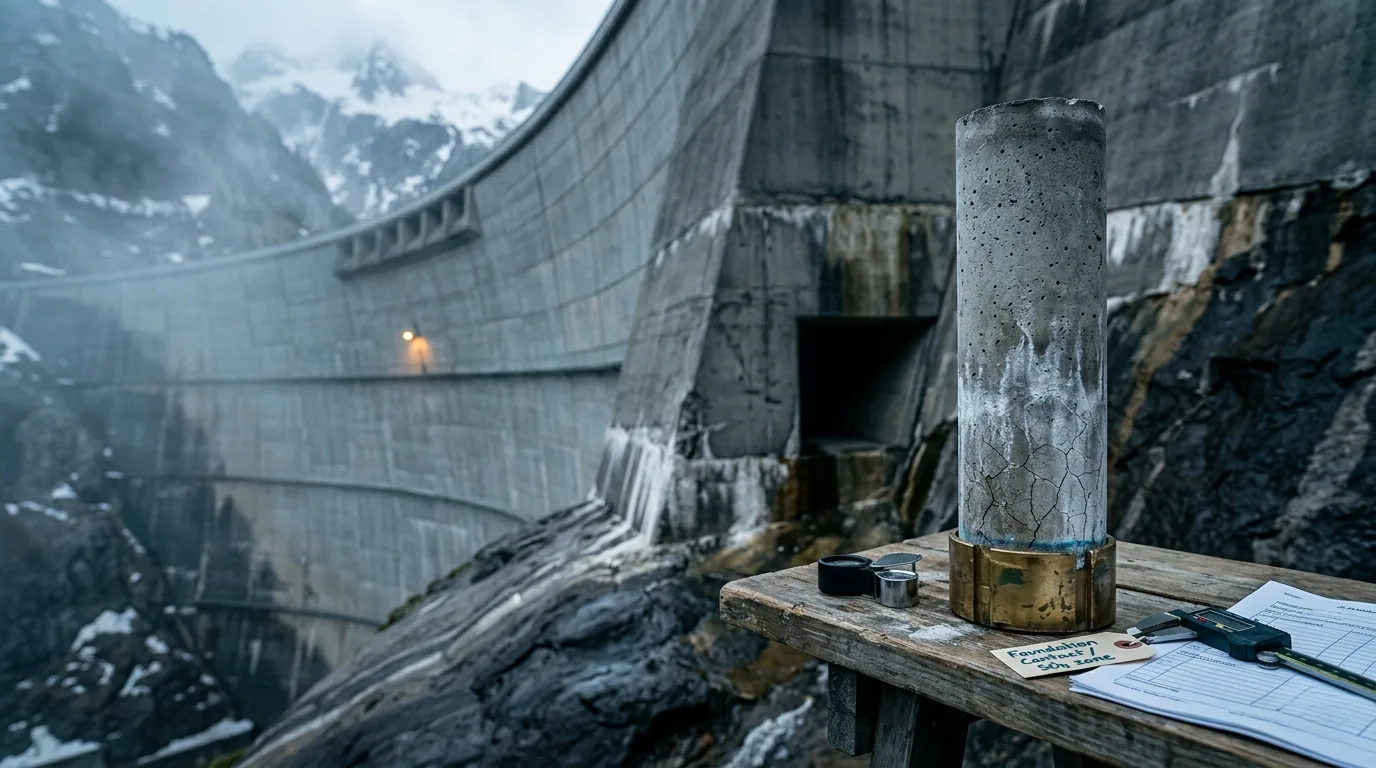
At temperatures below approximately 15°C, in the simultaneous presence of sulfate ions, carbonate or bicarbonate ions, and moisture, calcium silicate hydrate (CSH) converts to thaumasite (Ca₃Si(OH)₆(CO₃)(SO₄)·12H₂O). Thaumasite is a calcium silicate carbonate sulfate hydrate. Critically, thaumasite is non-cementitious: the CSH binding phase that holds cement paste together is consumed and replaced by a crystalline product with no binding capacity.
The damage progression: CSH (the primary binder of cement paste) reduces to thaumasite from the exposed surface inward; the concrete loses cohesion; in late-stage attack the concrete reduces to a white mush that can be removed by hand. Documented Chinese hydroelectric case studies, including Yongan Dam, report TSA-driven degradation in dam-concrete elements exposed to sulfate-bearing groundwater, confirmed by petrographic and microanalytical investigation.
When it threatens dam concrete
TSA requires four conditions met simultaneously:
- Temperature below ~15°C for substantial periods.
- Sulfate ions in groundwater or soil contact.
- Carbonate or bicarbonate in the concrete or environment.
- Sustained moisture.
Indian and South Asian sites at risk: Himalayan and high-altitude dams where ambient temperatures stay below 15°C for months, foundation contact zones with sulfate-bearing rock, and concrete containing limestone filler or limestone-derived aggregate.
Prevention
- Avoid limestone-rich cements and limestone-derived aggregate in cold-climate dam concrete with sulfate exposure. The carbonate ions required for thaumasite formation come from limestone constituents; Portland-limestone-type cements and limestone aggregate both elevate TSA susceptibility. Indian Standards permit up to 5 per cent limestone as a performance improver in IS 269 OPC and IS 1489 Part 1 PPC; on TSA-risk projects this allowance should be specifically disallowed. IS 12330 SRPC, by contrast, does not list limestone as a co-grinding constituent in the same explicit way that IS 269 OPC and IS 1489 PPC do, providing additional carbonate-source control on TSA-risk projects beyond the C₃A constraint.
- Verify foundation chemistry: rock and groundwater sulfate testing during the geotechnical investigation. Sulfate-bearing foundation rock requires explicit TSA-mitigation strategy.
- Low-permeability concrete: w/cm ≤ 0.40 with high SCM substitution (Class F fly ash 30%+, slag 50%+).
- Surface protection: epoxy coating or polyurethane membrane on foundation-contact surfaces in known TSA-risk sites.
How is sulfate attack diagnosed on a deteriorating dam?
Identifying which of the four sulfate-attack mechanisms is operating on a deteriorating dam is essential to selecting the correct repair strategy.
Visual diagnosis
| Symptom | Likely mechanism |
|---|---|
| White efflorescence at wet-line, surface scaling | ESA |
| Surface softening with no visible cracking, gypsum-rich aggregate visible | ISA |
| Pattern cracking in mass concrete, no external sulfate source, peak temp records >70°C | DEF |
| White mush surface, low ambient temperature, foundation-contact zone | TSA |
Laboratory tests
- Petrographic examination (ASTM C856 Standard Practice for Petrographic Examination of Hardened Concrete): identifies ettringite, thaumasite, gypsum in extracted cores. The diagnostic gold standard.
- SEM-EDS analysis: scanning electron microscopy with energy-dispersive X-ray spectroscopy provides chemical microanalysis at micron resolution. Distinguishes ettringite from thaumasite which look similar under optical petrography.
- XRD analysis: X-ray diffraction confirms presence of crystalline ettringite, thaumasite, gypsum, and brucite. Quantitative XRD (Rietveld refinement) can estimate phase concentrations.
- ASTM C1012 Length Change of Hydraulic-Cement Mortars Exposed to a Sulfate Solution: mortar bar length-change test for sulfate resistance of candidate cement-SCM combinations. Used for prevention qualification rather than damage diagnosis. 6 to 18 month test duration.
- Sulfate ion penetration depth: measured on cores via chemical extraction. Quantifies the affected zone for repair-strategy decisions.
- Acid-soluble and water-soluble sulfate determination: ASTM C114 sections on sulfate analysis of hydraulic cement (binder powder), ASTM C1580 for sulfate content of soil at the foundation contact, and BS 1377 Part 3 procedures on concrete extract together supplement the petrographic and microanalytical suite. Note: ASTM C265, the legacy water-extractable-sulfate test for hardened mortar, was withdrawn in 2017 and should not be specified on current projects.
- Pore solution expression and ion chromatography: research-grade test that quantifies sulfate, hydroxide, and other ion concentrations in the pore solution; informs the chemistry of attack in active cases.
The diagnostic test sequence on an actively-deteriorating dam typically starts with petrographic examination of extracted cores, escalates to SEM-EDS and XRD when the phase identification is ambiguous, and concludes with sulfate-penetration-depth mapping that informs the repair-zone delineation.
For the broader concrete-defect diagnostic framework see twelve concrete defects an Owner’s Engineer catches.
The ACI 318 sulfate exposure framework
ACI 318-19 Chapter 19 classifies sulfate exposure into four severity tiers based on sulfate concentration in soil or water in contact with the concrete:
| Class | SO₄ in soil (%) | SO₄ in water (ppm) | Min f’c | Max w/cm | Cement type |
|---|---|---|---|---|---|
| S0 | < 0.10 | < 150 | 17 MPa (2,500 psi) | n/a | Any |
| S1 | 0.10 to < 0.20 | 150 to < 1,500 | 28 MPa (4,000 psi) | 0.50 | Type II or MS blended |
| S2 | 0.20 to ≤ 2.00 | 1,500 to ≤ 10,000 | 31 MPa (4,500 psi) | 0.45 | Type V or HS blended |
| S3 (Option 1) | > 2.00 | > 10,000 | 31 MPa (4,500 psi) | 0.45 | Type V or HS plus pozzolan or slag |
| S3 (Option 2) | > 2.00 | > 10,000 | 35 MPa (5,000 psi) | 0.40 | Type V or HS (pozzolan/slag not required) |
ACI 318-19 Table 19.3.2.1 added Option 2 for Class S3, allowing designers to trade higher f’c and lower w/cm for the SCM requirement.
The classification is regulatory and binding for projects under ACI 318 jurisdiction. For Indian projects under multilateral lender frameworks the ACI 318 classification typically applies in parallel with IS 456 exposure provisions; the more restrictive provision governs.
For the broader durability framework see IS 456 vs ACI 318 exposure class reconciliation in the ACI 211 vs IS 10262 mix-proportioning article.
The Indian framework: IS 12330 and IS 456
The Indian standards framework for sulfate exposure operates on two levels.
IS 12330:1988 Sulphate Resisting Portland Cement
The cement specification that defines what qualifies as Sulphate Resisting Portland Cement (SRPC). Key provisions:
- Maximum C₃A: 5 per cent. This is the binding chemistry constraint that distinguishes SRPC from ordinary OPC.
- Minimum Blaine fineness: 225 m²/kg.
- Manufacturing controls: gypsum addition limited by SO₃ ceiling; air-entraining and performance-improver additives permitted only to specified maximums per IS 12330 clauses.
- Certification: BIS Scheme-I licence is mandatory; ISI mark required on packaging.
SRPC under IS 12330 is approximately equivalent to ASTM C150 Type V for sulfate resistance purposes.
IS 456:2000 exposure framework
IS 456 Table 4 classifies aggressive soil and groundwater based on SO₃ content. The classification triggers exposure class designation (Moderate, Severe, Very Severe, Extreme) with paired ceilings on w/cm and minimum cement content. For severe-or-worse sulfate exposure the specification typically invokes SRPC (IS 12330) or blended cement (IS 1489 PPC or IS 455 PSC) with SCM substitution.
Combined IS 12330 + SCM substitution
For dam concrete with documented sulfate exposure the typical Indian specification combines:
- IS 12330 SRPC (or IS 269 OPC with limited C₃A)
- IS 3812 Part 1 Class F fly ash at 25-30 per cent replacement
- w/cm ≤ 0.45 (Severe) or ≤ 0.40 (Very Severe/Extreme)
- Minimum cement content per IS 456 Table 5
SCM strategy for sulfate-resistant dam concrete
Supplementary cementitious materials are the most cost-effective sulfate-resistance strategy beyond cement-type selection. The mechanisms by which SCMs improve sulfate resistance:
- Dilution of cement and C₃A: reduces the aluminate available for ettringite formation.
- Consumption of Ca(OH)₂: pozzolanic reaction consumes calcium hydroxide, reducing the gypsum-formation reservoir.
- Permeability reduction: pore structure refinement slows sulfate ion ingress.
- Pore-solution modification: changes the chemistry that drives reactivity.
| SCM type | Typical replacement | Sulfate resistance | Notes |
|---|---|---|---|
| Class F fly ash (ASTM C618 / IS 3812-1) | 25-40% | Good | Most common dam-concrete SCM |
| Class C fly ash (ASTM C618 Class C) | 15-25% | Variable | Higher CaO can worsen resistance |
| Slag cement (ASTM C989 / IS 16714) | 50-70% | Excellent | Strong sulfate resistance |
| Silica fume (ASTM C1240 / IS 15388) | 5-10% | Synergistic | Used with fly ash or slag |
The combination of low-C₃A cement plus Class F fly ash at 25-30 per cent replacement is the standard PCCI specification for dam concrete with documented sulfate exposure, qualified through ASTM C1012 mortar bar testing.
For deeper context on SCM strategy see SCM strategies for dam concrete.
Indian context: where sulfate exposure shows up
The Indian dam pipeline has documented or suspected sulfate exposure in several geological settings.
Gypsum-bearing formations
Parts of Rajasthan (Bikaner, Jaisalmer regions), Gujarat (Saurashtra gypsiferous shale), and other regions with sedimentary gypsum or anhydrite present sulfate-bearing aggregate and groundwater risk. Project foundation rock and groundwater chemistry must be characterised at the geotechnical investigation stage.
Coastal regions
Coastal and tidal-zone concrete faces combined sulfate-and-chloride attack (seawater contains both, with seawater sulfate around 2,700 ppm). ACI 318 classifies marine exposure under chloride class C2 (which requires w/cm ≤ 0.40 for corrosion protection). Although seawater’s ~2,700 ppm SO₄ falls numerically inside the S2 sulfate range (1,500-10,000 ppm), ACI 318-19 Chapter 19 explicitly assigns seawater members to Class S1, not S2, on the basis that chloride-sulfate interaction suppresses ettringite expansion in seawater service. Type II (moderate sulfate-resisting) cement is therefore acceptable for the sulfate dimension, while the C2 chloride limits drive the w/cm.
Cold-climate Himalayan sites
The TSA risk profile applies to Himalayan dams where ambient temperatures stay below 15°C for substantial periods. Foundation rock sulfate content must be specifically tested.
Summer construction in mass concrete
DEF risk concentrates on mass concrete placements made in Indian summer (April to June) where placement temperatures can exceed 35°C and peak in-place temperatures can exceed 75°C. Thermal control discipline per IS 14591 keeps the peak below 70°C and eliminates DEF risk.
How does PCCI approach sulfate-attack mitigation on dam projects?
PCCI applies the cement-qualification, mix-design-control, SCM-strategy, and thermal-control disciplines that govern durable dam concrete directly to sulfate-exposure assessment and mitigation.
For project engagements involving documented or suspected sulfate exposure, the workflow:
- Geotechnical investigation review: foundation rock SO₄ testing, groundwater chemistry analysis, mapping of sulfate-bearing zones across the dam footprint.
- Material qualification: cement source qualification under IS 12330 / ASTM Type V; SCM source qualification under ASTM C618 / IS 3812-1; ASTM C1012 mortar bar testing on the project’s actual cement-SCM combination.
- Mix design: w/cm and cementitious content per the more restrictive of ACI 318 (S1/S2/S3) and IS 456 (Severe/Very Severe/Extreme); SCM substitution at 25-30 per cent Class F fly ash or 50-70 per cent slag.
- Thermal control integration: peak in-place temperature ceiling at 70°C to eliminate DEF risk; cooling-system design that delivers the ceiling reliably.
- Construction-phase QC: aggregate sulfate verification on every quarry batch, cement SO₃ verification on every cement consignment, ASTM C1012 verification on production-batch SCM combinations.
- Long-term monitoring: petrographic examination of test cores at scheduled intervals on operational dams to detect early sulfate attack before structural impact.
The framework draws on durability and service-life design, mix design and performance concrete, thermal control and placement engineering, and Owner’s Engineer / Independent Review.
Closing: four mechanisms, one prevention discipline
Sulfate attack on dam concrete is not one problem. It is four. ESA from groundwater diffusion, ISA from contaminated materials, DEF from early-age high temperature, and TSA from cold-climate carbonate-sulfate combinations. Each one demands a different defence.
The unifying prevention discipline: characterise the sulfate exposure at design stage (geotechnical investigation, materials qualification, aggregate petrography), specify the mix to the more restrictive of ACI 318 / IS 456 exposure ceilings, use Class F fly ash or slag at appropriate replacement, hold the peak in-place temperature below 70°C, and verify through ASTM C1012 testing.
Get the prevention discipline right at design stage and a 100-year dam life is achievable in geologies that would otherwise consume the concrete within 30 years. Get it wrong and the cost of rehabilitation, particularly on foundation-contact concrete, will dominate the operating budget of the dam.
PCCI’s durability and service-life design service applies the four-mechanism sulfate-attack framework to dam concrete projects in pursuit, design, or construction phase. For independent review of a project’s sulfate-mitigation strategy on a tender submission already in flight, the Owner’s Engineer / Independent Review service provides a senior-practitioner assessment of whether the cement specification, mix design, SCM strategy, and thermal control plan together address the project’s sulfate exposure across all four mechanisms.
Four mechanisms. One discipline. A century of dam concrete service ahead.