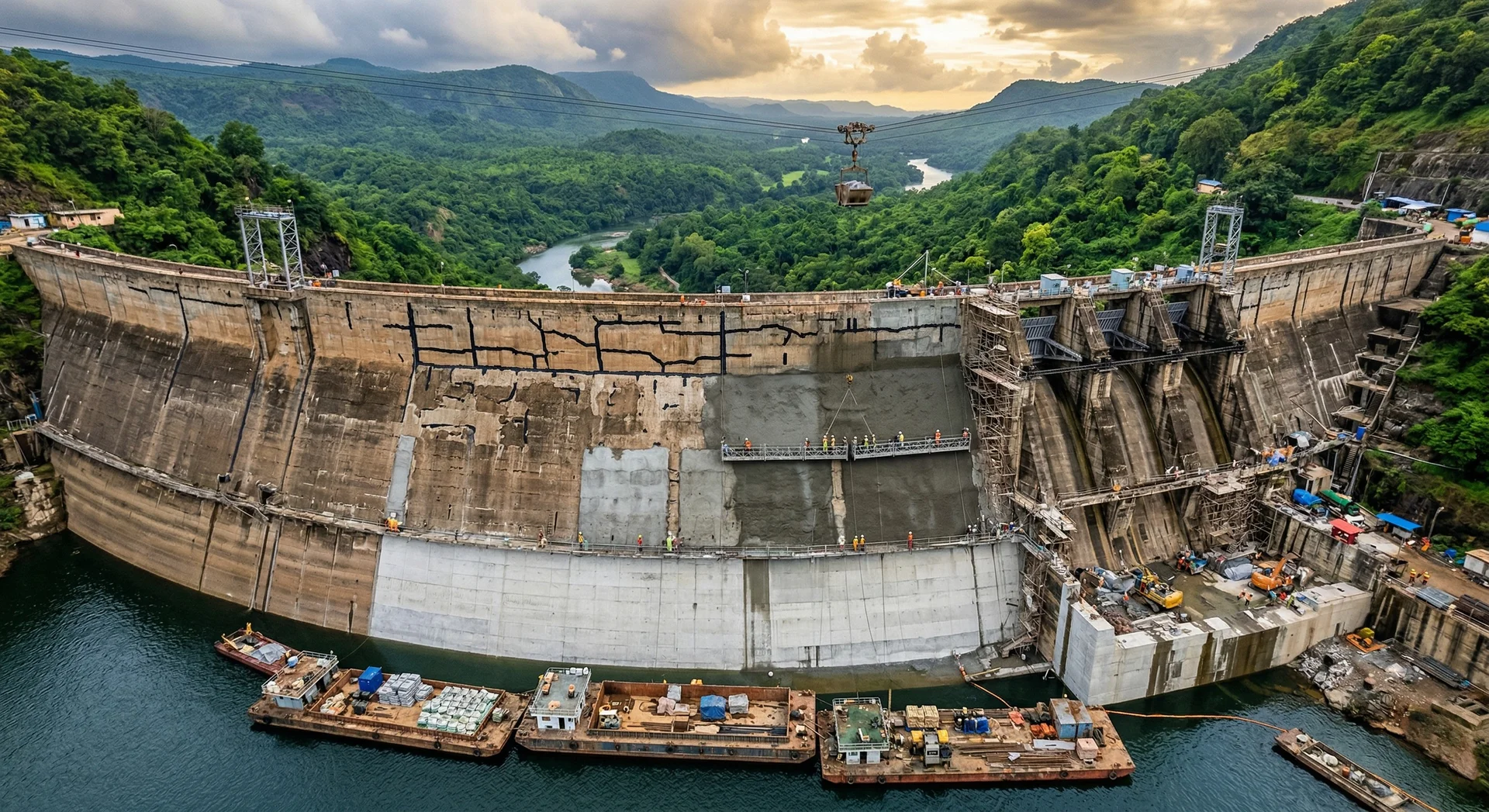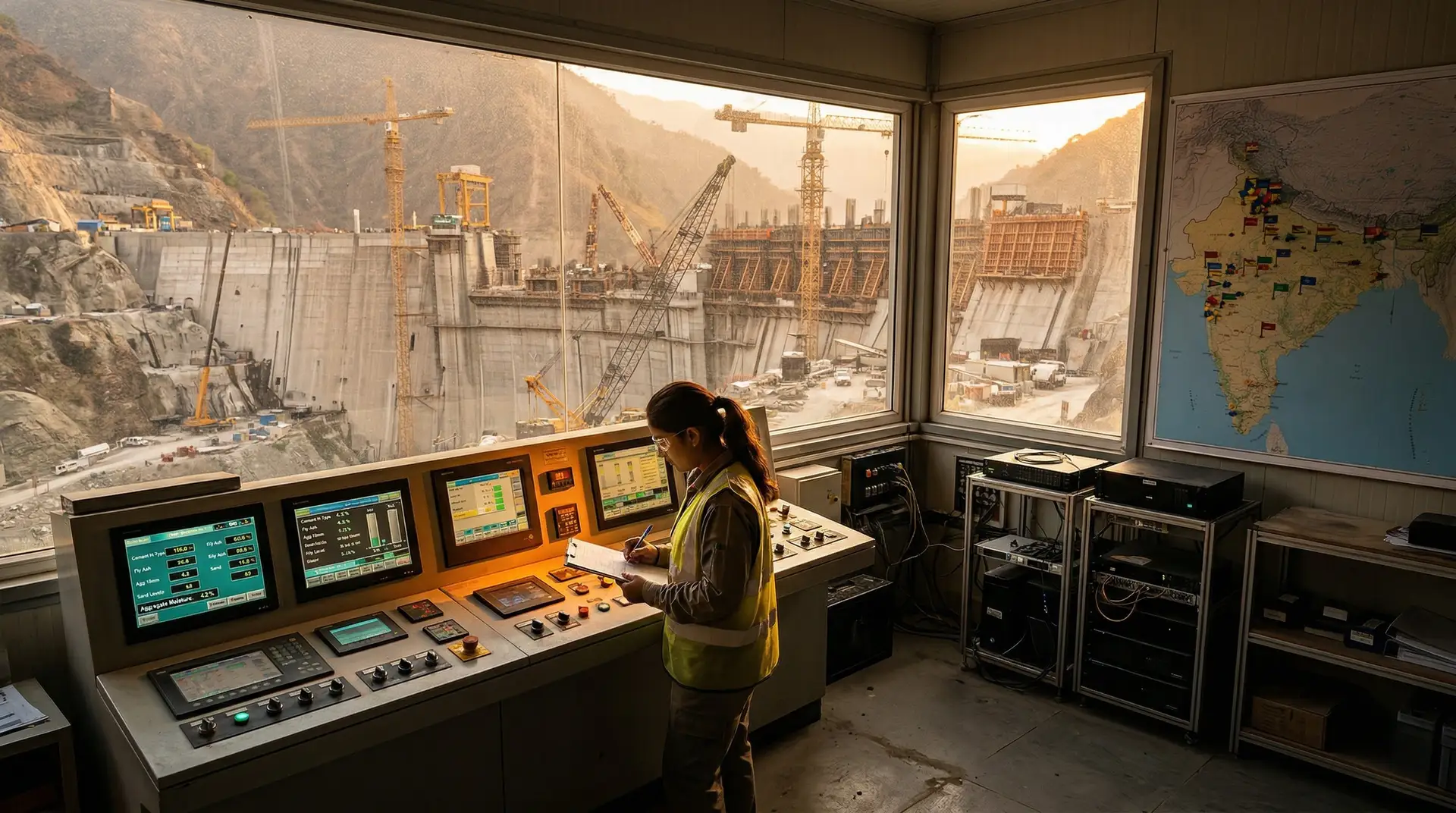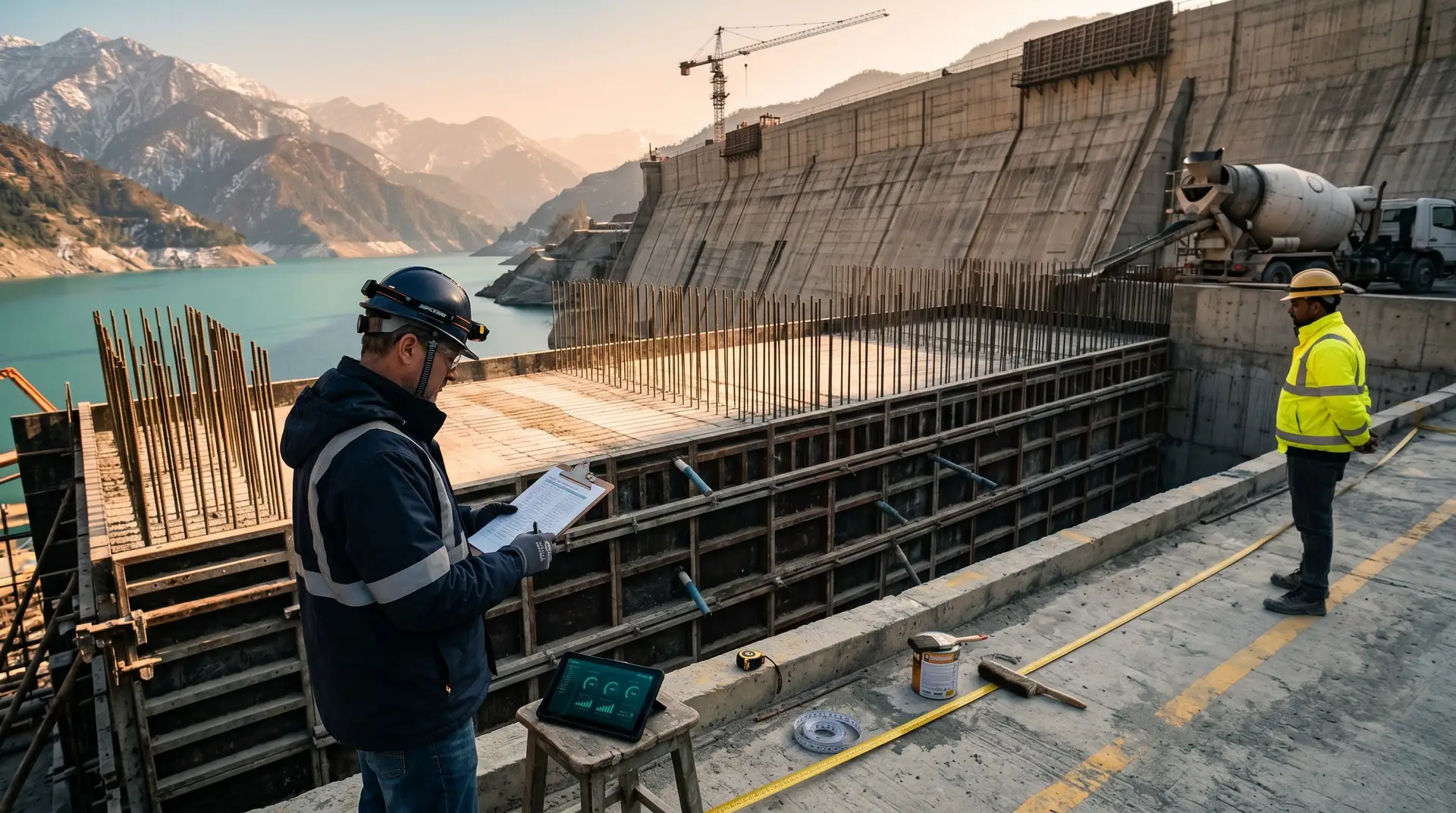
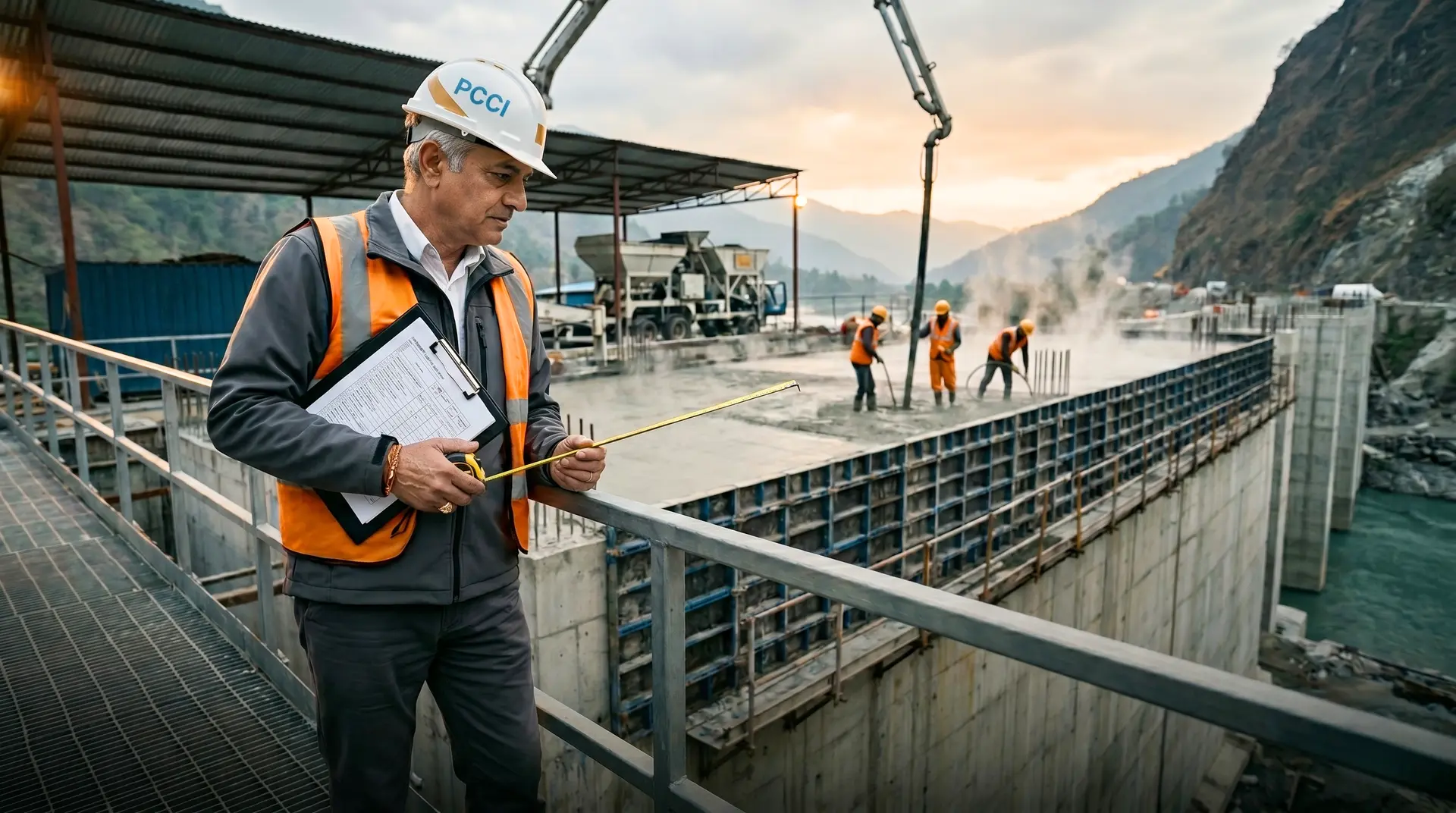
Every multilaterally funded hydropower dam project has three engineering teams around the construction table. The contractor’s engineer represents the EPC builder. The owner’s engineer represents the project owner. The Lender’s Technical Advisor represents the financiers. The three roles look similar from the outside. They are technically competent, they review designs and specifications, they walk the site, they write reports. They are different in one critical respect: the LTA’s reporting line determines what they actually deliver, and what they actually flag, and when they sign or refuse to sign.
The LTA reports to the lender. Its reviews trigger disbursements at construction milestones. Its red-flag reports give the lender’s loan officer the technical basis to slow payment, demand action, or invoke remedies. When the LTA’s signature is missing, money does not move.
For concrete technology on a hydropower dam, this matters more than it appears. The structural concrete is 30 to 50 percent of total construction cost and the single largest determinant of project schedule, structural integrity, and 100-year service-life performance. The LTA’s review of concrete-related decisions, from mix design through thermal control through dam-body QC, is one of the lender’s primary risk-management mechanisms. This article describes what that review actually involves, how each major multilateral lender frames it, and why getting it right matters for the borrower as much as for the lender.
What a Lender’s Technical Advisor does on a hydropower dam project
The LTA’s mandate is risk identification on behalf of the lender. The standard scope on a hydropower dam project spans the full project lifecycle:
Pre-loan due diligence. Before the lender approves the loan, the LTA reviews the project for technical adequacy. Is the technology appropriate? Is the contractor capable? Is the schedule realistic? Is the cost estimate adequate? Are the risks identified and bounded? Concrete-specific elements at this stage include mass concrete strategy (conventional vs RCC vs hybrid), thermal control approach, and durability provisions for the design life.
Design and specification review. During design development, the LTA reviews design documents, specifications, and the contractor’s proposed methodologies. For concrete-intensive elements (dam body, intake, spillway, powerhouse foundation), this includes mix design submissions, the thermal control plan, the QA/QC plan, and the construction methodology.
Construction supervision oversight. During construction, the LTA reviews the owner’s supervision team’s reports, walks the site at scheduled intervals, samples observations from independent inspection, and issues monthly or quarterly progress reports to the lender. The LTA does not replace the owner’s supervision team; it provides independent verification that the supervision is being performed and that the construction is progressing as represented.
Payment certification. Before the lender disburses against a construction milestone, the LTA reviews the engineer’s recommended payment certificate. The review confirms the work has been performed, the quality is acceptable, and the payment amount is consistent with the contract. This is the disbursement-linked function.
Variation order and claims review. When the contractor proposes a change order or files a claim, the LTA reviews the technical justification on behalf of the lender. This is one of the highest-stakes LTA functions because claims can rapidly escalate construction cost beyond the lender’s loan ceiling.
Environmental and social safeguards compliance. The LTA reviews the project’s compliance with the lender’s environmental and social safeguards policy, including any impacts arising from concrete operations (cement plant emissions, aggregate quarry impacts, river-water diversion for cooling and curing, fly-ash sourcing and handling).
Completion and commissioning review. At project completion, the LTA reviews the completion certification and the operations and maintenance documentation. For concrete elements, this includes the as-built records of concrete quality, the crack and defect register, the NCR closeout file, and the operations manual provisions for concrete inspection and rehabilitation over the design life.
How the LTA differs from Owner’s Engineer and Construction Supervision Consultant
The three roles are commonly confused because each involves an engineer reviewing the contractor’s work. They are not the same.
| Role | Reports to | Primary incentive | Authority on site |
|---|---|---|---|
| Owner’s Engineer (OE) | Project owner | Project completion within scope, schedule, budget | Approves contractor submittals, instructs contractor on owner’s behalf |
| Construction Supervision Consultant (CSC) | Project owner (or owner’s program manager) | Construction quality and schedule compliance | Day-to-day site supervision; issues NCRs; approves daily site decisions |
| Lender’s Technical Advisor (LTA) | Lender(s) | Lender protection: technology adequacy, risk identification, loan repayment certainty | Issues reports to lender; reviews payment certifications; cannot instruct contractor directly |
The Owner’s Engineer is responsible to the owner. PCCI’s Independent Review / Owner’s Engineer service operates in this lane. The OE represents the owner in technical decisions, approves submittals on the owner’s behalf, and protects the owner’s contract interests.
The Construction Supervision Consultant is also responsible to the owner, but operates at the day-to-day level. CSCs often run the site engineering team, issue NCRs for non-conformance, manage the inspection-and-test plan, and produce daily and weekly progress reports.
The LTA is responsible to the lender. The LTA’s reports inform lender decisions about disbursement, covenant compliance, and any need to escalate technical concerns to the borrower or to other lenders in a consortium.
On large hydropower projects, all three roles typically coexist. They are not redundant. They serve different incentive structures, and their independent perspectives produce different risk identification.
The five major multilateral lenders and their requirements
The World Bank
The World Bank is the most influential multilateral lender for hydropower in South Asia, with significant exposure to both new hydropower construction and dam safety rehabilitation. Key frameworks:
Procurement Framework, effective 1 July 2016. The current Procurement Framework replaced the previous Procurement Guidelines for projects with concept notes after 1 July 2016. Standard Procurement Documents (SPDs) for Works are mandatory, with 28 SPDs published as of March 2018. Hydropower projects fall under the highly specialised category requiring design, manufacture, supply, and installation of plant. (World Bank: Procurement Framework for IPF Projects).
Operational Policy 4.37 and Bank Procedure 4.37 on Safety of Dams. For large dams financed by the World Bank, the borrower must retain an Independent Panel of Experts. The Panel consists of three or more experts appointed by the borrower and acceptable to the Bank. The Panel reviews investigation, design, construction, and start of operations. OP 4.37 was extended in October 2001 to cover tailings and ash dams beyond water-storage dams. (World Bank: OP 4.37 Safety of Dams).
Environmental and Social Framework (ESF). Replacing the earlier Safeguard Policies for projects after October 2018. The ESF includes provisions on community health and safety, biodiversity, and indigenous peoples that may interact with concrete operations (cement plant emissions, aggregate quarrying, river diversion).
For concrete-intensive World Bank projects, the LTA’s reviews include verification that the contractor’s mix design submissions meet specification, that thermal control plans are adequate, that QA/QC programmes are operational, and that any Panel-of-Experts recommendations on concrete are implemented.
Asian Development Bank (ADB)
ADB is heavily active in South Asian hydropower, including significant Nepalese, Indian, and Bhutanese projects.
Procurement Policy and Standard Bidding Documents (SBDs). ADB’s procurement framework requires use of ADB SBDs for ADB-financed works, with category-specific documents for plant, large works, and consultancy services.
Safeguards Policy Statement (SPS, 2009). Covers environmental, involuntary resettlement, and indigenous peoples safeguards. Concrete operations affecting any of these are reviewable.
The Tanahu Hydropower Project (140 MW, Nepal) is a representative ADB-financed concrete-intensive project, where ADB committed $150 million of the $505 million total cost. (Tanahu Hydropower Limited).
Japan International Cooperation Agency (JICA)
JICA is Japan’s bilateral ODA agency and has been a major financier of South Asian hydropower, particularly in Nepal, Bhutan, and India.
Guidelines for Procurement under Japanese ODA Loans. JICA’s procurement framework is distinct from the multilateral development banks’ frameworks but interoperable on co-financed projects.
JICA committed $183 million to the Tanahu Hydropower Project, the largest single tranche of the three multilateral commitments. JICA has a strong technical interest in storage-type dams given Japan’s domestic experience with hydropower storage technology; Tanahu is Nepal’s third storage-type project.
European Investment Bank (EIB)
EIB is the European Union’s lending arm and active in selective hydropower projects, including Tanahu (initial $70 million, later increased to $85 million). EIB’s Guide to Procurement governs the contractor selection process on EIB-financed works.
Asian Infrastructure Investment Bank (AIIB)
AIIB is a relatively newer multilateral lender (established 2016) with growing exposure to Indian dam safety rehabilitation. AIIB co-finances DRIP Phase II with the World Bank at $250 million each. (Cabinet approves DRIP Phase II and Phase III, PIB India).
Concrete-specific reviews the LTA performs
The LTA’s concrete-specific scope on a hydropower dam project typically includes:
Mix design strategy and submissions. The LTA reviews the contractor’s mix design submissions for compliance with the project specification and the applicable codes (IS 456, IS 457, IS 10262, ACI 211.1, ACI 318, BIS). The review focuses on cement content, supplementary cementitious materials (fly ash, GGBS, silica fume), water-cement ratio, durability provisions for the design life, and the trial-mix qualification data. Where the project uses both Indian and international codes, the LTA verifies the code-reconciliation approach as covered in PCCI’s article on mass concrete thermal control reconciling ACI 207, IS 7861, and IS 14591.
Thermal control plan. For mass concrete dam bodies, the LTA reviews the thermal control plan against ACI 207 series, IS 14591, and the project-specific thermal modelling. Reviews the placement-temperature limit, peak-temperature prediction, core-surface differential limit, cooling pipe design, and post-cooling protocol. On a 140 m high concrete gravity dam such as Tanahu, this is one of the highest-risk technical elements.
RCC method statement. Where the project uses roller-compacted concrete, the LTA reviews the method statement against ACI 207.5R-11 (Roller-Compacted Mass Concrete) and USACE EM 1110-2-2006 (Roller-Compacted Concrete). Lift schedule, bedding mortar specification, GERCC at faces, and lift-joint maturity classification are typical review points.
QA/QC plan and laboratory accreditation. The LTA reviews the contractor’s QA/QC plan against the project specification, ICOLD Bulletin 136, and lender-specific requirements. The plan must address material qualification, batching plant calibration, sampling frequency, acceptance criteria, NCR workflow, and hold/witness points. (Covered in detail in PCCI’s article on the QA/QC plan section-by-section.)
Dam safety panel coordination. Under World Bank OP 4.37 and equivalent provisions in other lender policies, the LTA coordinates with the Panel of Experts on concrete-related dam safety reviews. The Panel is appointed by the borrower; the LTA is appointed by the lender; both review the same concrete decisions from different vantage points.
Construction quality verification. During construction, the LTA samples observations from independent site walks. Reviews the owner’s engineer’s NCRs and the contractor’s closeout responses. Cross-checks concrete test results against trend charts. Verifies that the Panel of Experts’ recommendations on concrete are being implemented.
Variation order review. When the contractor proposes a concrete-related change order (e.g., changing the mix design, adjusting the lift schedule, modifying the cooling pipe layout), the LTA reviews the technical justification and the cost impact for the lender.
The dam safety panel and the LTA
The Panel of Experts (POE) required by World Bank OP 4.37 is sometimes confused with the LTA. They are distinct:
| Role | Appointed by | Reports to | Primary scope |
|---|---|---|---|
| Panel of Experts (POE) | Borrower (acceptable to lender) | Borrower; review reports circulated to lender | Dam safety: investigation, design, construction, start of operations |
| Lender’s Technical Advisor (LTA) | Lender | Lender | Project technology and risk advisory; disbursement-linked review |
The POE is a dam safety review function. The LTA is a project advisory function. Both exist because the lender needs different kinds of assurance. The POE provides expert technical review of dam safety specifically. The LTA provides ongoing operational and risk monitoring on behalf of the lender across the project’s full scope.
For concrete decisions on a dam project, the POE’s reviews and the LTA’s reviews are complementary. The POE may flag a concrete-related dam safety concern; the LTA verifies that the concern is being addressed in the construction quality system. The POE reviews the design and construction at scheduled intervals; the LTA reviews continuously through monthly or quarterly site visits and report cycles.
Disbursement-linked review
The LTA’s most consequential function is disbursement review. Multilateral lenders disburse against milestones, and the LTA’s certification is typically a precondition. For concrete-intensive projects, the relevant milestones include:
- Pre-construction: loan signing, mobilisation, design approval, contractor selection
- Construction commencement: first concrete pour, dam-body lift 1, foundation acceptance
- Construction milestones: dam body to specified elevation, intake structure completion, powerhouse foundation, spillway concrete
- Commissioning: structural completion, first reservoir filling, hydraulic testing, power generation start
- Completion: final acceptance, defect liability period closeout
At each milestone, the LTA reviews the engineer’s recommended payment certificate, verifies the work has been performed and tested, and recommends disbursement to the lender. If the LTA identifies a technical issue that warrants action (e.g., persistent strength shortfall in a critical lift, unresolved thermal cracking, NCRs not closed out), the LTA can recommend that the disbursement be withheld until the issue is resolved.
This authority makes the LTA’s reviews materially important to the contractor and the owner. A delayed disbursement triggers cash-flow strain on the contractor and may trigger contractor claims against the owner. Avoiding LTA-triggered disbursement delays requires that the contractor’s quality system actually be operational, not just documented on paper. This is the discipline that the LTA’s role creates.
Tanahu Hydropower as a case anchor
The Tanahu Hydropower Project (140 MW, Nepal) is a representative multilaterally funded hydropower project where PCCI leadership has delivered concrete technology consulting. Key facts:
- 140 m high concrete gravity dam on the Seti River near Damauli, Tanahun district, 150 km west of Kathmandu
- 175 m crest length, 7.26 km² reservoir surface area, 295 million m³ gross storage capacity
- Total project cost approximately $505 million
- Three multilateral co-lenders: ADB ($150 million, signed Feb 2013), JICA ($183 million, signed Mar 2013), EIB ($70 million signed May 2013, later increased to $85 million)
- Nepal Government contribution: $86 million
- Physical progress 63% as of December 2024; target completion May 2026
For an LTA on a project structured like Tanahu, the concrete-related review scope is substantial. The 140 m high gravity dam requires extensive mass concrete; the thermal control plan must address Himalayan ambient conditions, monsoon-disrupted continuous placement, and the multi-year construction window. The project’s reliance on local Nepalese aggregates requires careful AAR screening, mix qualification, and durability provisions. Operating under ACI/ASTM frameworks (typical on multilaterally funded South Asian projects) creates a code-reconciliation requirement with local Indian-Standards-trained engineering teams.
The cross-cutting LTA role is to verify that all three multilateral lenders’ technical expectations are being met, that the borrower (Tanahu Hydropower Limited) and the owner’s supervision are managing the concrete operations effectively, and that the disbursement schedule is being supported by actual construction progress and quality.
DRIP Phase II as a different model
The Dam Rehabilitation and Improvement Project Phase II in India is structured differently from a single-project hydropower investment. DRIP Phase II is a programmatic rehabilitation effort:
- Co-financed by World Bank and AIIB at US$ 250 million each (US$ 500 million total external assistance)
- Total budget outlay across Phases II and III: ₹10,211 crore (Ph II: ₹5,107 Cr; Ph III: ₹5,104 Cr)
- 736 dams to be rehabilitated across 19 states and 3 central agencies
- 10-year duration in two 6-year phases with 2 years’ overlap
- Operational since October 2021
- As of March 2025: rehabilitation proposals worth over ₹5,053 crore for 191 dams approved; major physical rehabilitation completed at 43 dams
(Press Information Bureau: DRIP Phase II / III Cabinet approval)
For an LTA on a programme like DRIP, the scope is fundamentally different from single-project work:
- Programmatic review framework rather than per-project deep dive
- Concrete decisions are rehabilitation-focused (epoxy injection, joint treatment, dam body grouting, surface restoration, AAR mitigation in existing dams), as covered in PCCI’s DRIP Phase II opportunities article
- Indian National Dam Safety Authority (NDSA) and the Dam Safety Act 2021 add a regulatory layer beyond the lender’s policies
- State-level implementation variation: 19 different state implementing agencies, each with different procurement and quality systems
The LTA’s value on DRIP-type programmes is in normalising review standards across many sites and in providing the lender with portfolio-level risk visibility. The concrete-specific review focuses on the consistency and adequacy of rehabilitation specifications across state implementing agencies and the integration of NDSA regulatory requirements with the lender’s policies.
Common errors and missteps
Five errors recur when LTAs are engaged on hydropower dam projects with significant concrete scope:
Error 1: Confusing LTA with Owner’s Engineer. Borrowers sometimes try to use a single firm in both roles. This compromises independence: the same firm cannot represent both the project owner’s interests and the lender’s interests on the same decisions. Some lenders explicitly prohibit it. The two roles must be filled by independent organisations.
Error 2: Underscoping the concrete review. Lender procurement teams sometimes scope the LTA for general project advisory without explicit concrete technology depth. On a concrete-intensive dam, this is a structural under-scope. The LTA needs an experienced concrete technology specialist on the team, not just generalist engineering review.
Error 3: Missing the Panel of Experts coordination. On World Bank-financed projects, the Panel of Experts under OP 4.37 reviews concrete-related dam safety. The LTA must coordinate with the Panel rather than duplicate or conflict with its reviews. The Panel’s recommendations on concrete are inputs to the LTA’s reviews, not separate streams.
Error 4: Disbursement review without site verification. An LTA that reviews payment certificates from documentation alone misses what site walks reveal. Concrete quality is field-verified, not paper-verified. The LTA’s reviews must include independent site observations, not just review of the owner’s supervision team’s reports.
Error 5: Code-reconciliation neglect on multi-code projects. On projects funded by multiple lenders, the technical codes invoked by the contract may include both Indian Standards and international standards (ACI, ASTM, ICOLD). The LTA must verify that the contractor’s submissions reconcile across the codes consistently, not pick the most permissive code for each decision.
How an LTA engagement supports project success
The LTA’s role is not adversarial to the borrower. Done well, the LTA’s reviews make the project more bankable and more deliverable. Concrete-related disputes between borrower and contractor surface earlier, when they are cheaper to resolve. Concrete-related quality issues are identified before they propagate into structural concerns. Concrete-related disbursement delays are minimised because the LTA’s monthly reviews flag issues before they become disbursement triggers.
The discipline of operating under continuous independent technical review is, for many borrowers, the single most useful project-management feature of multilateral lending. The LTA’s reports become an external check on the owner’s own supervision system, the contractor’s quality system, and the broader construction programme.
For multilateral lenders, the LTA’s value is straightforward: independent assurance that the project they financed is being built as represented. The lender does not have the technical capacity in-house to evaluate every construction-phase decision; the LTA provides that capacity.
Closing
A Lender’s Technical Advisor on a multilaterally funded hydropower dam project is one of the most consequential engineering roles in the project. The LTA’s reviews directly affect disbursement, dispute escalation, and the lender’s risk position. For concrete technology specifically, the LTA’s review scope spans mix design, thermal control, RCC method, QA/QC, dam safety panel coordination, and ongoing construction quality verification.
PCCI’s Independent Review / Owner’s Engineer service is structured to deliver this independent-review function across project owner-side, lender-side, and dam-safety-panel contexts. Leadership experience includes the multilaterally funded Tanahu Hydropower Project (140 MW, Nepal), and broader portfolio engagement on projects following ACI, ASTM, and Indian Standards frameworks.
If your hydropower dam project is multilaterally funded, or is heading into a financing round where multilateral lenders are evaluating participation, the conversation about LTA engagement should begin early. The concrete technology scope is one of the technically demanding pieces; getting the right LTA capacity in place at loan negotiation rather than after construction starts produces a measurably better outcome for both the lender and the borrower.