India’s Dam Rehabilitation and Improvement Project Phase II is now operational across 19 states and 3 central agencies, with 736 dams scheduled for rehabilitation under Phases II and III at a combined budget outlay of ₹10,211 crore, of which ₹7,000 crore is external loan from the World Bank and the Asian Infrastructure Investment Bank. The construction work has begun. The tenders are flowing. The contractors bidding on the work need to know what concrete specifications the DRIP Phase II tenders actually contain, and what the technical complexity behind those specifications looks like.
This article is a practitioner’s walkthrough of typical DRIP Phase II concrete rehabilitation specifications. It identifies seven major work categories that recur across DRIP tenders, what the typical specification clauses cover for each, what materials and methods the specifications usually call for, where the technical complexity lies, and what the common bidder mistakes are. The article does not reproduce specific project tender numerical values (which are project-specific and protected). It describes the standards backbone, the practical workflow, and the practitioner judgment that DRIP rehabilitation work in the Indian hydropower-dam sector demands.
The framework draws on the CWC Manual for Rehabilitation of Large Dams (referenced in the Government of India approval of DRIP Phase II and III), the ACI PRC-546 Concrete Repair Guide, the ACI 506R Guide to Shotcrete, ACI 562 Code Requirements for Assessment, Repair, and Rehabilitation of Existing Concrete Structures, International Concrete Repair Institute (ICRI) guidelines, and decades of practitioner experience on Indian and South Asian mass-concrete dams.
The DRIP Phase II framework
DRIP Phase II is the second phase of India’s Dam Rehabilitation and Improvement Project, administered by the Central Water Commission (CWC) under the Ministry of Jal Shakti, Department of Water Resources, with 736 dams identified for physical rehabilitation under Phases II and III. Key facts:
- External financing: Phase II is co-financed by the World Bank and the Asian Infrastructure Investment Bank (AIIB) at US$ 250 million each, totalling US$ 500 million in external assistance. Phase III is financed by the World Bank at US$ 500 million. The combined external loan across Phases II and III is approximately ₹7,000 crore.
- Total budget outlay (Phases II + III): ₹10,211 crore; Phase II ₹5,107 Cr, Phase III ₹5,104 Cr; balance of ₹3,211 crore borne by participating States and the three central agencies.
- Programme duration: 10 years (two 6-year phases with 2 years overlap), April 2021 to March 2031.
- Coverage: 736 dams across 19 states and 3 central agencies (Central Water Commission, Bhakra Beas Management Board, and Damodar Valley Corporation).
- Operational since: 12 October 2021.
DRIP Phase I, which preceded Phase II, covered 223 dams across 7 states (Jharkhand, Karnataka, Kerala, Madhya Pradesh, Odisha, Tamil Nadu, Uttarakhand) at a cost of approximately ₹2,567 crore, implemented from April 2012 to March 2021. The DRIP Phase II + III scope is over three times larger and spans more states with greater technical diversity. Most rehabilitated dams under DRIP are composite structures: masonry or concrete gravity dam sections combined with earthen embankment sections. The majority are more than 25 years old.
The implementing agencies are the state water resources departments or state dam safety organisations. CWC provides central coordination, technical concurrence, and lender liaison. The lenders provide funding plus oversight through their respective procurement and technical-adviser frameworks. The Dam Safety Act 2021 and the National Dam Safety Authority frame the regulatory context. For the upstream framing of the commercial opportunity that this specifications guide sits within, see the companion piece on DRIP Phase II dam rehabilitation opportunities.
How DRIP specifications differ from new-build dam specifications
A bidder coming to DRIP from new-construction work must recognise that rehabilitation work is technically different. Three differences dominate:
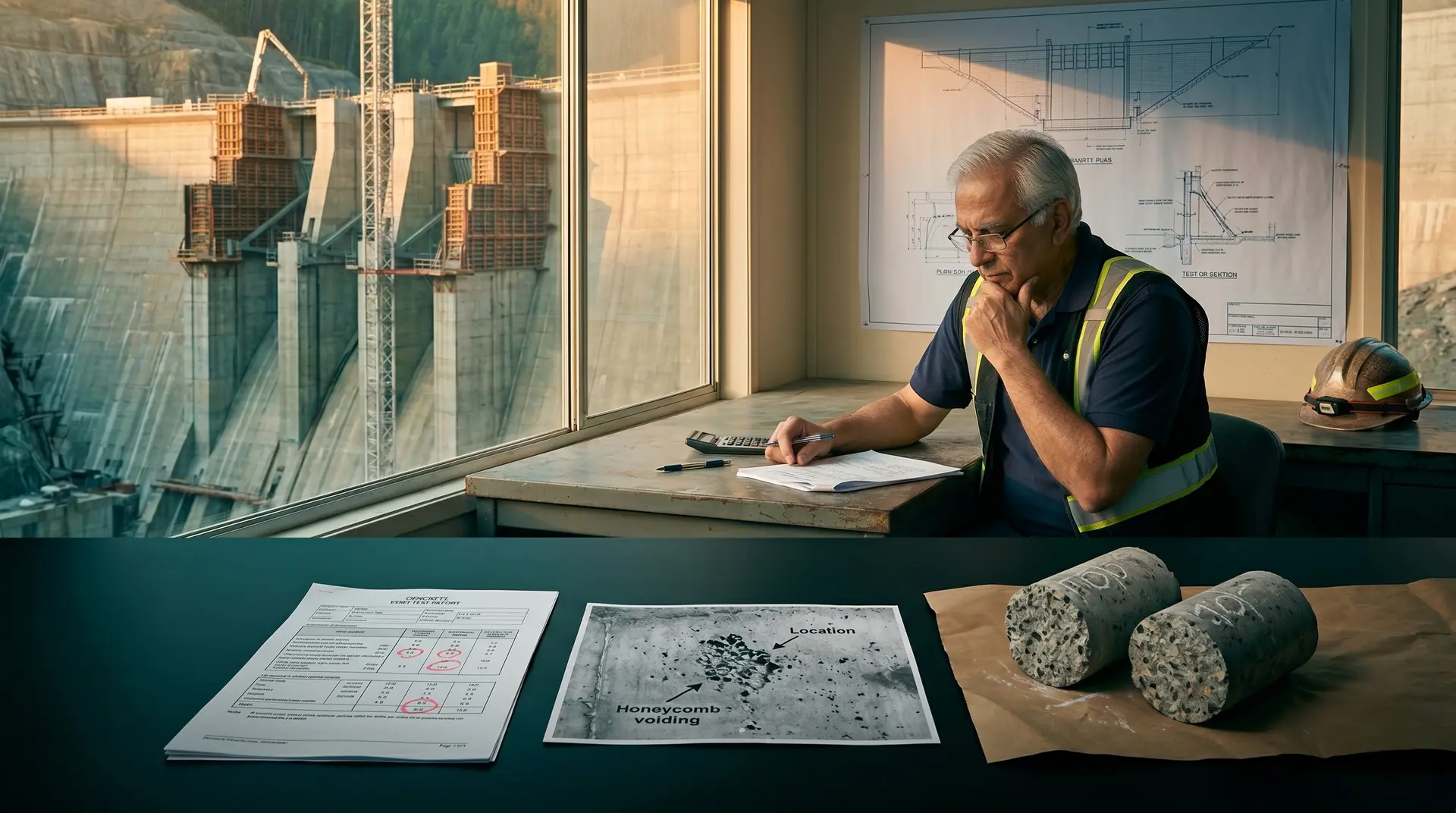
The substrate is existing concrete. A new-build specification assumes the contractor will place fresh concrete that meets the specified strength, durability, and dimensional requirements. A rehabilitation specification assumes existing concrete is already in place, with its own composition, durability state, and condition profile. The repair material must bond to the existing substrate, behave compatibly under load and thermal cycling, and produce a composite structure that performs over the design life of the repair. Specifications therefore cover surface preparation, bond requirements, compatibility testing, and acceptance criteria that have no direct equivalent in new-build work.
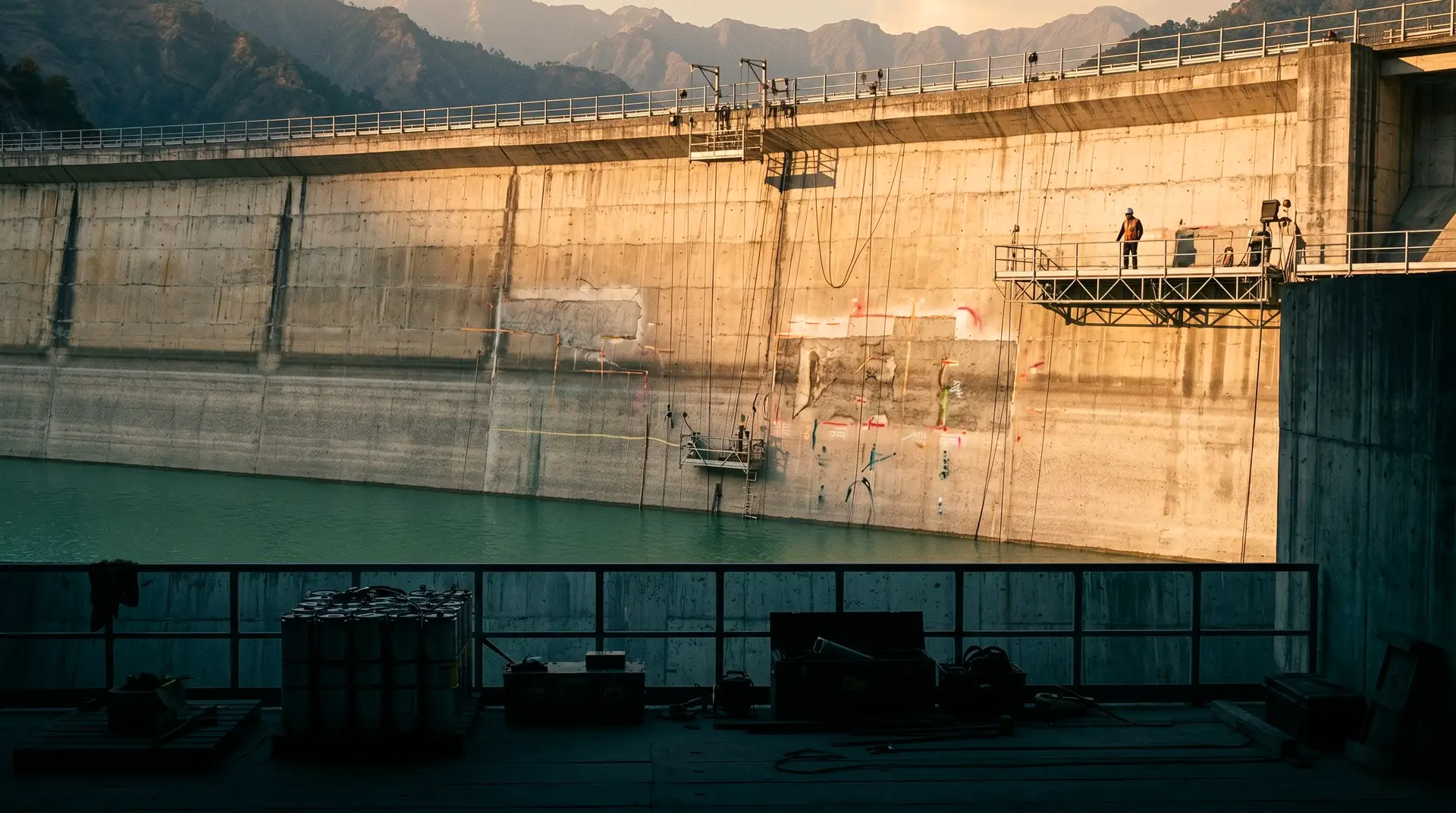
The work is performed in service. New-build construction is performed before the dam impounds water. Rehabilitation is performed with the dam either in service or with reservoir partially drawn down by agreement with the host utility. Underwater repair, monsoon-period work, and reservoir-level dependent operations are standard considerations. Specifications cover the timing constraints, the coordination with the host utility, and the contingencies if reservoir level cannot be drawn down as planned.
The design life of the repair is shorter than the original construction. New-build dam concrete is designed for a 100-year service life. A typical concrete repair is designed for 30 to 50 years. The repair must integrate with the host structure’s residual service life and with the lender’s risk profile. Specifications therefore include performance-based provisions, periodic inspection requirements, and warranty provisions that are different from new-build practice.
These differences are not minor. They affect material selection, workmanship requirements, equipment, supervisory capacity, and bid pricing. A bidder approaching DRIP with new-construction experience but no rehabilitation experience often misprices the work and underperforms in execution.
The seven major concrete rehabilitation work categories
DRIP tenders specify rehabilitation work in seven recurring categories. The mix of work on any given dam depends on the condition assessment and the rehabilitation plan. Most rehabilitation contracts involve at least four of the seven categories.
1. Crack repair (injection, sealing, structural restoration)
Crack repair is the most common category in DRIP work. Typical specification content:
- Crack survey and classification: mapping all cracks above a specified width threshold (often 0.3 mm), measuring depth, classifying as active or dormant, structural or non-structural, leaking or dry.
- Injection material selection: epoxy resin (two-component, structural) per ACI 503.7 Specification for Crack Repair by Epoxy Injection and BS EN 1504-5 for dry cracks needing structural restoration; polyurethane (flexible foam, sealant) for active or wet cracks requiring leakage stoppage.
- Injection procedure: port spacing, drilling pattern, injection pressure (typically 20-30 psi plus hydrostatic head), sequence (bottom to top for vertical cracks).
- Acceptance criteria: at least 90 percent penetration of the prepared crack length; bond strength tested via ICRI 210.3R Guide for Using In-Situ Tensile Pulloff Tests to demonstrate failure in substrate rather than at interface; for structurally significant cores, failure at 90 percent of host concrete compressive strength or 6,500 psi, whichever is lower.
Common bidder mistakes: under-pricing surface preparation (30-50 percent of repair cost); using epoxy on wet cracks (it will not bond); skipping the maturity-based dryness check before epoxy application. For a deeper treatment of repair-material families and how they are matched to defect type, see concrete repair materials for dam rehabilitation.
2. Surface concrete repair (spalling, deterioration, abrasion)
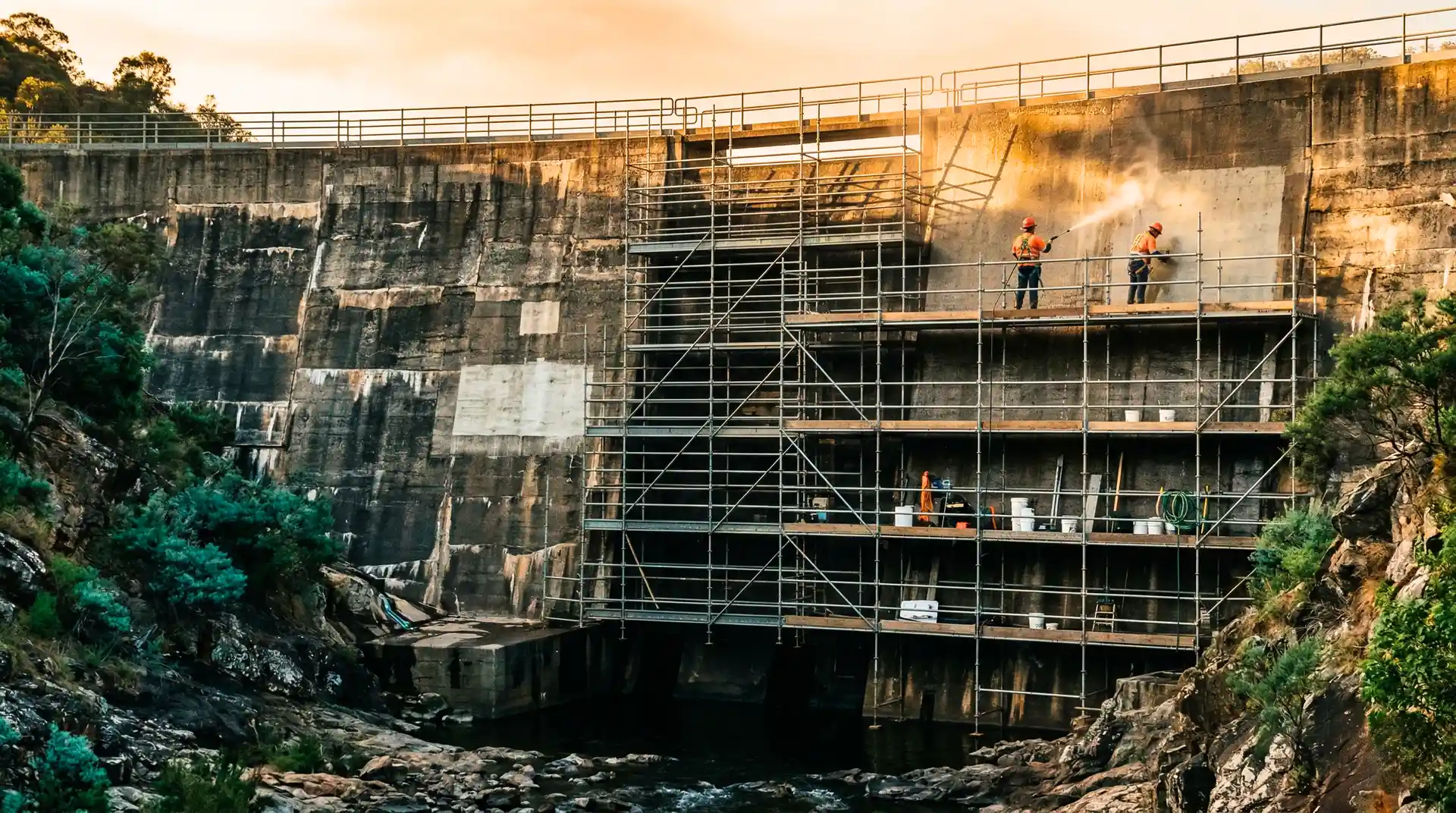
Surface repair addresses concrete that has spalled, scaled, abraded, or deteriorated, exposing reinforcement or reducing the effective section. Typical specification content:
- Surface preparation: removal of unsound concrete to sound substrate, per ICRI 310.1R-2008 Guideline for Surface Preparation, with surface profile measurement.
- Reinforcement treatment: cleaning of exposed reinforcement, application of corrosion-inhibitor or bonding agent, supplementary reinforcement where original bar section is reduced.
- Repair mortar selection: polymer-modified mortar (PMM) or shrinkage-compensated mortar; for thicker repairs, microconcrete or shotcrete per ACI 506R-16 Guide to Shotcrete.
- Shotcrete specifics: wet-mix or dry-mix application, layer thickness, curing requirements, finishing tolerances.
- Acceptance criteria: bond strength, compressive strength, surface profile, no visible defects post-cure.
Common bidder mistakes: Inadequate surface preparation (most repair failures originate here); selecting low-cost mortar without verifying compatibility with substrate; skipping the shotcrete nozzle operator certification per ACI 506.
3. Dam body grouting (cementitious, polyurethane, epoxy grouting)
Dam body grouting addresses internal seepage paths through the dam body or at the foundation interface. Typical specification content:
- Grouting type selection: cementitious grout (for larger voids, foundation contact, curtain extension), polyurethane chemical grout (for active leaks, fine cracks, water-bearing zones), epoxy grout (for structural restoration of voided zones).
- Drill hole pattern: primary, secondary, tertiary holes; spacing 1.5 to 3 metres typically; depth based on dam profile.
- Grouting pressure: project-specific; typically a fraction of overlying pressure to avoid hydraulic fracturing.
- Grout mix design: water-cement ratio, admixture dosing, viscosity targets per Lugeon-test correlation.
- Acceptance criteria: post-grouting Lugeon test demonstrating reduced permeability; cessation of visible seepage; reduction in instrumentation readings (piezometers, weirs).
Common bidder mistakes: Excessive grouting pressure causing hydraulic fracturing or jacking; inadequate grouting sequence (skipping the primary-secondary-tertiary discipline); not performing pre-grouting permeability testing to baseline the work.
4. Upstream face protection (geomembrane, sealing, surface treatment)
Upstream face protection prevents reservoir water from penetrating the dam body through surface cracks, joints, and surface deterioration. Typical specification content:
- Geomembrane systems: PVC or HDPE membrane installation, anchorage detailing, drainage layer behind membrane, top and bottom anchorage zones.
- Surface sealing: epoxy-modified cement-based sealers, silicone-based water repellents, methacrylate sealants for crack-mouth treatment.
- Surface preparation: removal of unsound concrete, joint cleaning, surface profile to receive sealant or membrane.
- Acceptance criteria: pull-off testing of bonded systems, leak testing of installed membrane, durability testing under simulated UV and water exposure.
Common bidder mistakes: Selecting a sealer not compatible with the substrate’s moisture state; failing to address joints adequately before membrane installation; inadequate anchorage detailing at boundaries.
5. Alkali-aggregate reaction (AAR) mitigation
Where the existing dam has confirmed or suspected AAR, the rehabilitation plan may include AAR mitigation. Typical specification content:
- AAR confirmation: petrographic analysis of core samples to confirm AAR (alkali-silica reaction or alkali-carbonate reaction); expansion testing to characterise rate.
- Mitigation method: lithium nitrate impregnation (which disrupts ASR gel formation and alters pore-solution chemistry so that any gel that does form is non-expansive), surface barriers (preventing further moisture ingress), structural strengthening if expansion is structurally significant, monitoring instrumentation.
- Application specifications: lithium concentration, application rate, multiple applications over time, post-application monitoring.
- Acceptance criteria: measurable reduction in expansion rate (compared to pre-mitigation baseline), demonstrated through long-term monitoring.
Common bidder mistakes: Treating AAR as a surface defect rather than a body-wide deterioration mechanism; specifying single-application mitigation for what requires multi-year protocol; not budgeting for the long-term monitoring requirement.
6. Underwater concrete repair
For outlet works, gate slots, spillway intake bays, and submerged dam-face zones, underwater concrete repair is often required. Typical specification content:
- Method selection: tremie concrete placement (for larger volumes), preplaced aggregate concrete (for confined zones), anti-washout admixtures for moderate volumes.
- Diver and equipment requirements: commercial diver certification, underwater concrete pumping equipment, visibility-aided work.
- Mix design specifics: anti-washout admixtures per IS 9103 framework; high cohesion mix; high flow characteristics; reduced bleeding. (For the broader mix design considerations that govern rehabilitation concrete production, see PCCI’s mix design consulting framework.)
- Quality control underwater: sampling at depth, in-situ strength testing where feasible, post-placement core extraction.
- Acceptance criteria: compressive strength, density, in-place quality verified by NDT and cores.
Common bidder mistakes: Using surface-cast mix designs underwater (washout and segregation); inadequate diver communication and supervision; not coordinating reservoir level with the host utility.
7. Contraction joint treatment and waterstop replacement
Contraction joints in older dams often suffer from waterstop failure, debris infiltration, and water passage. Typical specification content:
- Joint preparation: removal of existing damaged waterstop, cleaning of joint surfaces, drying.
- Replacement waterstop: PVC, rubber, or stainless-steel waterstops per IS 12200:2001 (Code of Practice for provision of water-stops at transverse contraction joints in masonry and concrete dams) and IS 15058:2001 (PVC water-stops specification); installation continuous and protected during concrete placement.
- Adjacent concrete: removal and replacement of locally deteriorated concrete around joint; bonding of new concrete to existing.
- Acceptance criteria: waterstop integrity verified by visual inspection and pressure testing; joint sealing demonstrated by post-rehabilitation leakage measurement.
Common bidder mistakes: Selecting a waterstop type incompatible with the joint movement; inadequate concrete placement around the replacement waterstop; not field-testing the joint after rehabilitation.
The standards backbone of DRIP specifications
DRIP specifications draw on a layered set of standards. Understanding which standard governs which decision is essential to bidding and execution.
| Standard | Coverage | Layer |
|---|---|---|
| CWC Manual for Rehabilitation of Large Dams | Indian framework for dam rehabilitation; concrete-specific provisions | Programmatic / Indian regulatory |
| CWC Manual for Assessing Structural Safety of Existing Dams | Condition assessment methodology, basis for rehabilitation planning | Programmatic / Indian regulatory |
| ACI PRC-546-23 (Concrete Repair Guide) | International concrete repair practice | International technical |
| ACI 506R-16 (Guide to Shotcrete) | Shotcrete application methodology | International technical |
| ACI 503.7 (Crack Repair by Epoxy Injection) | Specification for epoxy injection | International technical |
| ACI 562-25 (Assessment, Repair, Rehabilitation) | Code framework for assessment and repair | International technical |
| ICRI 210.3R (Pull-Off Tests) | Bond strength field testing | International field practice |
| ICRI 310.1R (Surface Preparation) | Surface preparation for repair | International field practice |
| BS EN 1504-5 | Resin injection product standard | European product standard |
| IS 456 / IS 457 / IS 14591 | Plain and reinforced concrete, concrete for dams and massive structures, temperature control of mass concrete for dams | Indian regulatory |
| IS 12200 / IS 15058 | Provision of water-stops at transverse contraction joints; PVC water-stops specification | Indian product standard |
| IS 9103 | Concrete admixtures specification | Indian product standard |
| World Bank SPDs / AIIB Procurement Policy | Procurement framework for tenders | Lender framework |
A typical DRIP specification will invoke 8 to 12 of these standards explicitly. The owner’s engineer’s role is to ensure the specification is internally consistent: where two standards give different guidance, the specification must say which governs.
The owner’s engineer’s role on DRIP rehabilitation tenders
DRIP tenders benefit substantially from independent technical review. The owner’s engineer, acting on behalf of the state implementing agency or the project owner, brings:
Pre-tender review. Verifying that the tender specification is internally consistent, addresses the actual condition of the specific dam, and is biddable. Identifying gaps where the tender’s silence will produce disputes during construction.
Bid evaluation support. Reviewing bidder qualifications against rehabilitation experience (not just new-construction experience), evaluating proposed methods, scrutinising material and equipment proposals.
Construction-phase oversight. Site walks, NCR review, acceptance test verification, coordination with the contractor’s QC and with the lender’s technical adviser where present.
Acceptance decisions. Applying the accept-repair-reject-investigate decision framework on non-conforming work during the rehabilitation campaign.
Closeout. Ensuring the as-built record is complete, the NCRs are closed, and the rehabilitation documentation is integrated into the dam’s operations and maintenance manual for the residual service life.
Many DRIP projects under Phase I have shown that the difference between a successful rehabilitation campaign and an unsuccessful one is not the construction itself; it is the pre-tender preparation, the bidder selection, the construction-phase discipline, and the closeout documentation. The Owner’s Engineer service at PCCI is structured to deliver this discipline on rehabilitation programmes, drawing on leadership experience across new-build mass-concrete dam construction and on the concrete technology framework that maps directly onto rehabilitation work.
Common bidder mistakes
Five mistakes recur across DRIP bidder responses:
Mistake 1: Bidding against new-construction experience rather than rehabilitation experience. The two require different skills, equipment, and supervisory approach. A bidder strong on new-construction concrete may be weak on surface preparation, repair material selection, and substrate-compatibility testing.
Mistake 2: Under-pricing surface preparation. Surface preparation is typically 30-50 percent of repair cost. Bidders who under-budget this will either skip preparation (invalidating the repair) or absorb the cost mid-construction (losing margin or triggering claims).
Mistake 3: Checklist thinking on specifications. Each dam has its own condition profile. The specification calls for the standard procedures, but the actual work requires understanding what condition applies on this specific dam. Bidders who treat the specification as a generic procedure miss the dam-specific complexity.
Mistake 4: Ignoring seasonal and reservoir-level constraints. Monsoon timing, reservoir drawdown coordination with the host utility, and access constraints all materially affect schedule and cost. Bidders who assume continuous year-round work miss these.
Mistake 5: Missing the lender procurement framework requirements. World Bank SPDs and AIIB Procurement Policy govern the tender process. Bidders who do not understand the lender’s requirements risk procedural disqualification.
What makes DRIP work technically distinct
Three characteristics define DRIP work technically:
Multi-discipline integration. Most DRIP contracts combine concrete repair with embankment work, electromechanical refurbishment, instrumentation upgrades, and operational improvements. The concrete-specific scope is one piece of a larger rehabilitation campaign. Coordination with other disciplines is integral.
Programmatic scale at variable site complexity. With 736 dams across 19 states, DRIP is programmatic in funding and oversight but variable in site complexity. A small earthen embankment dam with minor concrete spillway work is very different from a 60-year-old masonry-and-concrete gravity dam needing AAR mitigation, body grouting, and upstream face protection. The lender frameworks and the CWC manuals provide the constant; the project-specific complexity provides the variable.
Long programme duration. DRIP Phase II + III runs 10 years across two 6-year phases. Bidders thinking about a single rehabilitation contract should also think about the programmatic relationship that successful execution builds with CWC and the state implementing agencies. The next tender pipeline is downstream of the current execution quality.
Closing
DRIP Phases II and III together form the largest dam rehabilitation programme in India’s history, structured by CWC, with Phase II co-financed by the World Bank and AIIB and Phase III financed by the World Bank, executed across 19 states and three central agencies. The concrete rehabilitation work at the heart of the programme spans seven major categories, draws on a layered set of Indian and international standards, and requires technical capacity that bidders without rehabilitation experience often underestimate.
For state implementing agencies, the conversation about concrete specifications should begin at the pre-tender stage with an independent technical review. For bidders, the conversation should begin with an honest assessment of rehabilitation experience and capacity. For lenders, the conversation involves the technical adviser framework and the integration with the CWC’s programmatic oversight.
PCCI’s Independent Review and Owner’s Engineer service and QA/QC consulting support DRIP-context rehabilitation work, drawing on leadership experience across more than 4,000 MW of mass-concrete dam construction in India, Bhutan, and Nepal. The technical capabilities that delivered mass-concrete programmes such as Tala HEP (1,020 MW), Karchham Wangtoo HEP (1,000 MW), and Punatsangchhu-1 HEP (1,200 MW) apply directly to the rehabilitation specifications, supervision discipline, and construction troubleshooting frameworks that DRIP Phase II demands.
If your firm is preparing to bid on DRIP work, or is a state implementing agency preparing tenders, the conversation begins with the dam condition assessment, the proposed rehabilitation plan, and the CWC Manual for Rehabilitation of Large Dams as the operational backbone.