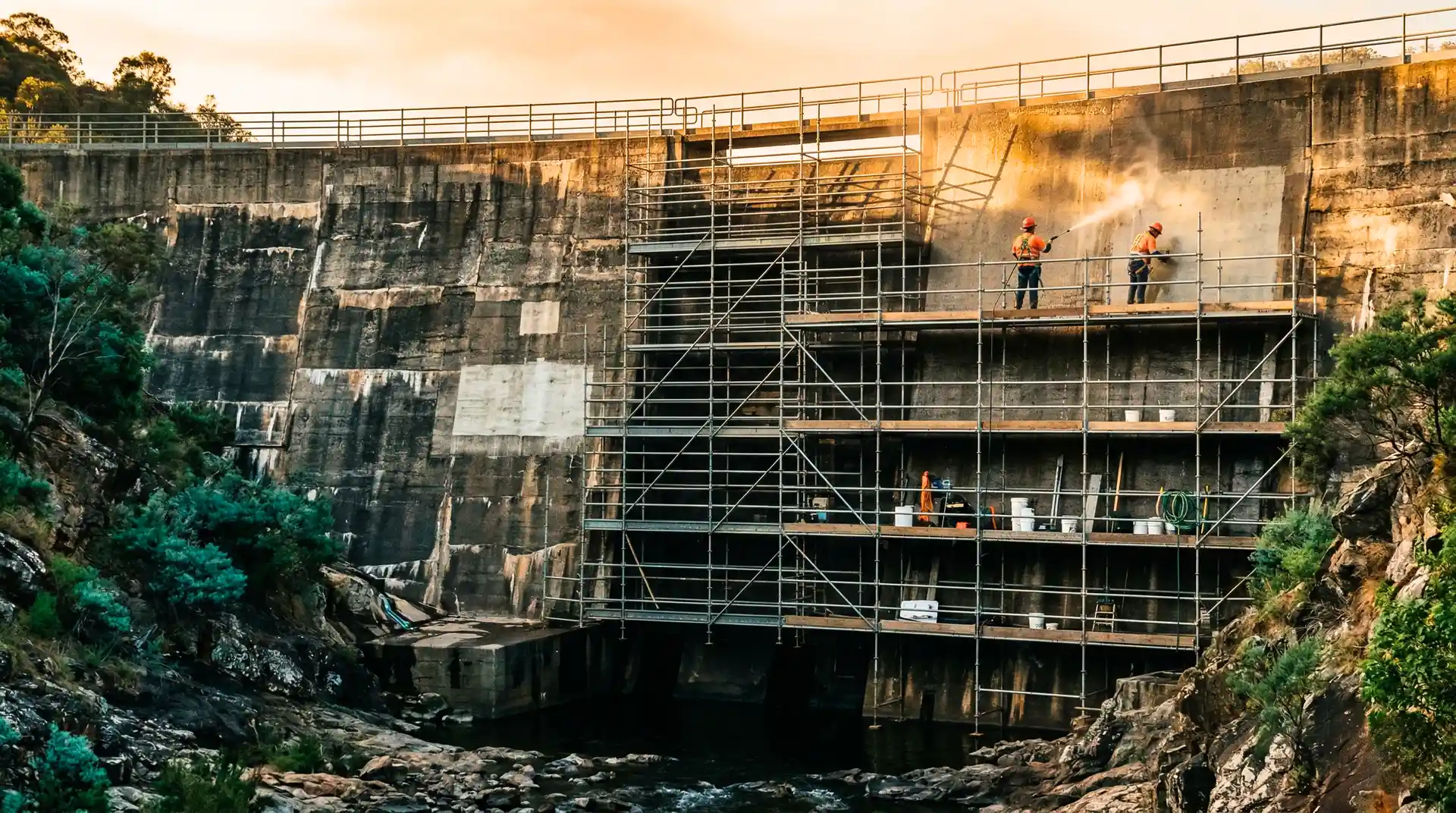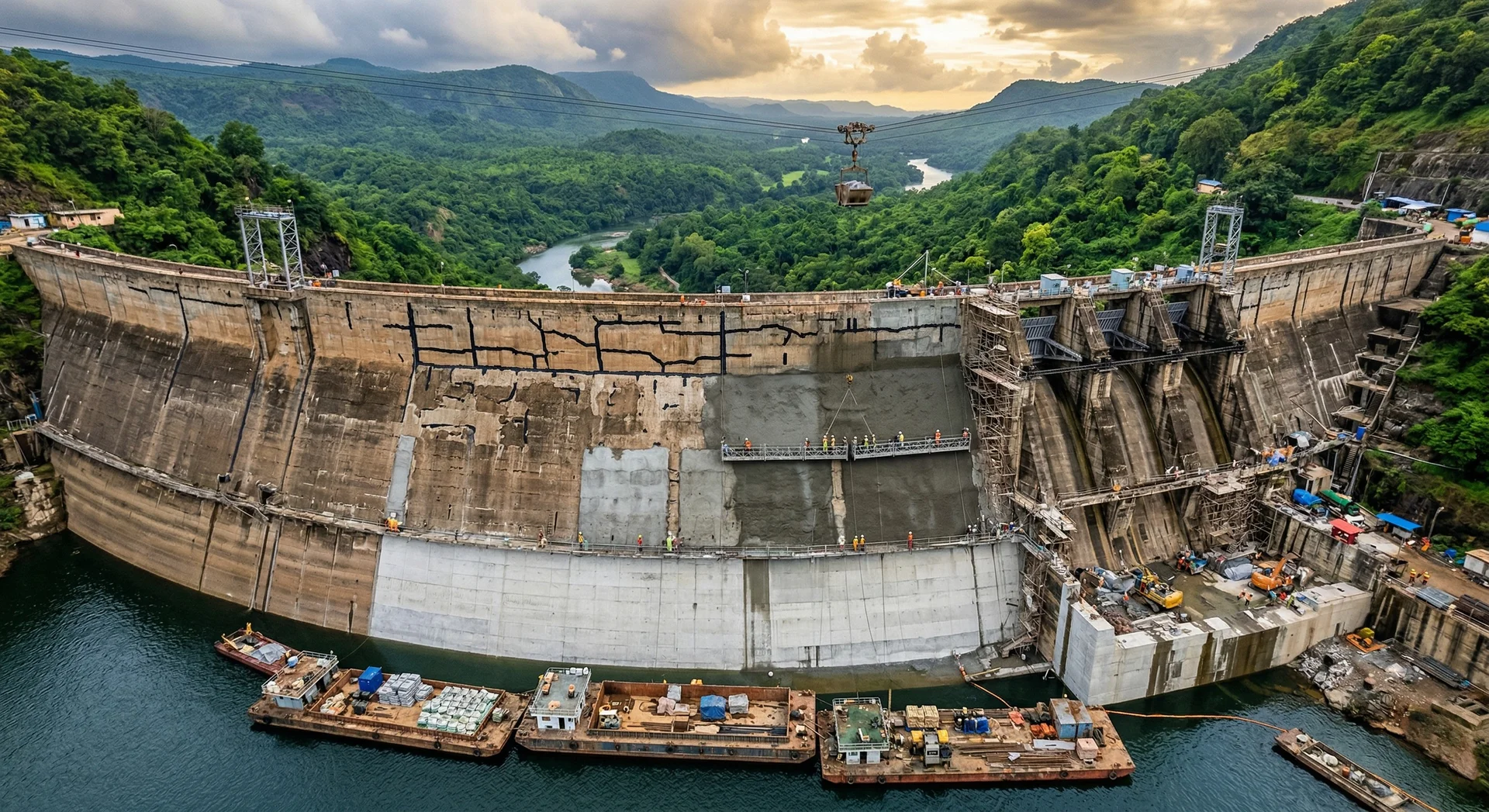
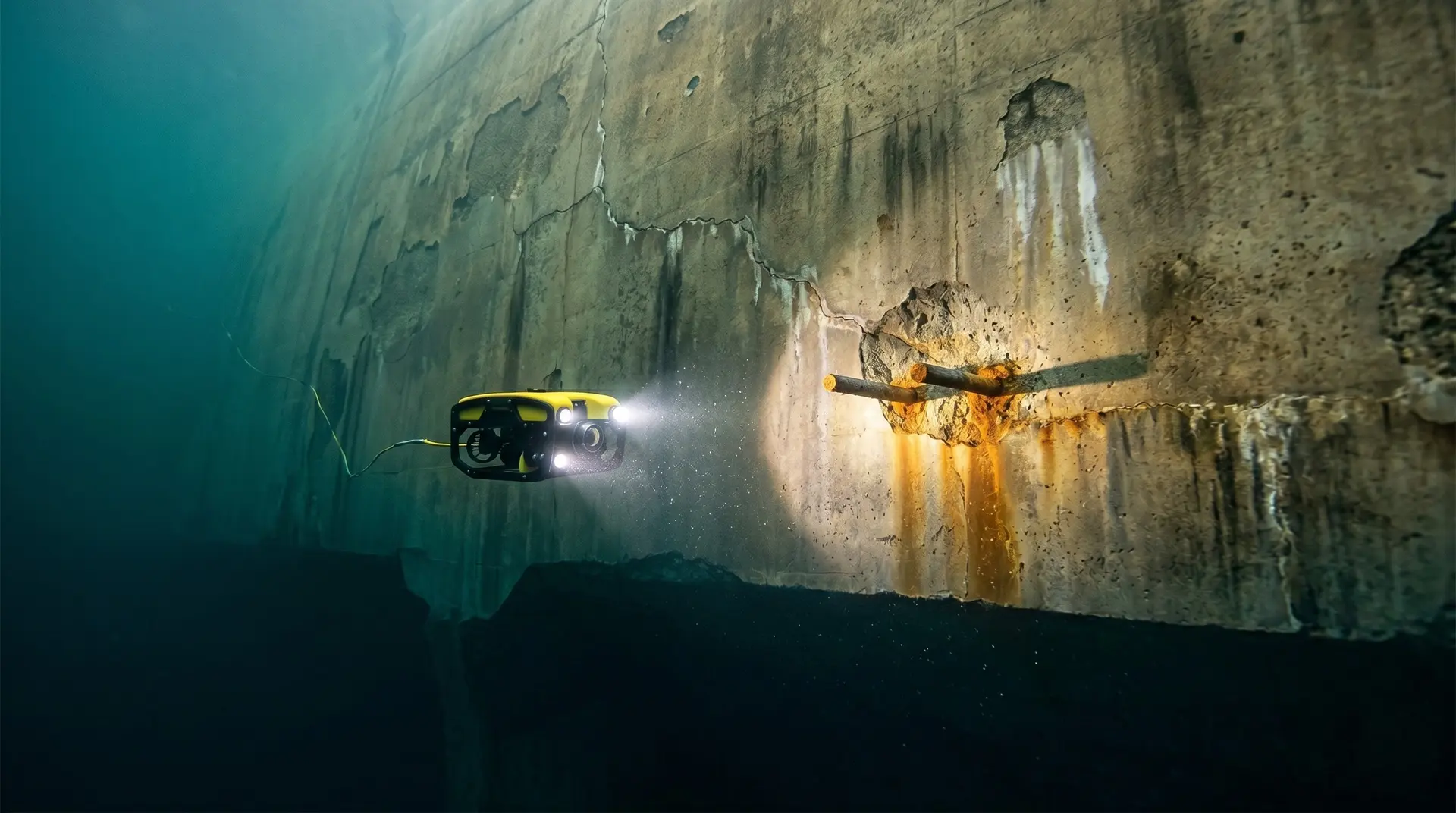
Most concrete deterioration on dams happens where you can see it: the downstream face, the spillway chute, the stilling basin floor during dewatered inspections. But some of the most consequential damage occurs below the waterline, on surfaces that remain permanently submerged and can only be assessed through ROV inspection or diver survey. Repairing these zones is fundamentally different from conventional above-water concrete repair. The substrate is saturated. The formwork must resist hydrostatic pressure. The repair material must resist washout during placement. And quality verification is limited to what cameras, cores, and acoustic methods can tell you after the fact.
ACI PRC-546.2-20 (also catalogued as ACI 546.2R-20), titled Guide to Underwater Repair of Concrete, is the primary reference document, providing comprehensive guidance on materials, methods, formwork, and inspection for submerged concrete repair. For Indian dam projects, IS 456 and IS 457 provide the structural framework, but project-specific underwater repair specifications typically reference ACI 546.2R because the Bureau of Indian Standards has not published a dedicated equivalent standard. The United States Bureau of Reclamation (USBR) also maintains decades of technical references on underwater repair of hydraulic structures, particularly spillway tunnels and stilling basins.
With DRIP Phase II and Phase III covering 736 aging dams across 19 Indian states and two central agencies, and with most of these structures being composite dams more than 25 years old, the demand for competent underwater concrete repair is growing faster than the available expertise to deliver it.
Key Facts at a Glance
- Primary standard: ACI PRC-546.2-20 / ACI 546.2R-20, Guide to Underwater Repair of Concrete. Indian framework: IS 456 and IS 457 for structural design; no BIS standard dedicated to underwater concrete repair.
- Five principal methods: tremie concrete, preplaced aggregate concrete (PAC), anti-washout concrete, epoxy injection, and pumped concrete.
- Strength achieved underwater: typically 70 to 90 percent of equivalent dry-placed concrete compressive strength, depending on method and execution quality.
- DRIP Phase I (2012-2021): 223 dams rehabilitated across seven states (Jharkhand, Karnataka, Kerala, Madhya Pradesh, Odisha, Tamil Nadu, Uttarakhand) at Rs 2,567 crore, financed by the World Bank.
- DRIP Phase II and III (2021-2031): 736 dams across 19 states and two central agencies (Bhakra Beas Management Board and Damodar Valley Corporation), Rs 10,211 crore combined outlay, co-financed by the World Bank and the Asian Infrastructure Investment Bank.
- Earliest large-scale dam application of PAC: Hoover Dam Arizona spillway tunnel, repair started shortly after the October 1941 erosion event; original cavity approximately 35 m long by 9 m wide and up to 14 m deep (USBR).
Five Principal Methods
1. Tremie Concrete
Tremie concrete is placed underwater through a pipe (the tremie) that maintains a seal below the concrete surface throughout placement. The pipe is initially charged with concrete, lowered to the repair area, and then slowly raised as fresh concrete flows from the bottom up, displacing water without mixing with it.
The method is best suited for large-volume repairs where the tremie can be positioned without frequent relocation. Tarbela Dam in Pakistan remains the most-cited historical example: after the 1974 cavitation event destroyed the 2-metre-thick reinforced concrete lining of one of its irrigation tunnels, the remediation campaign deployed large volumes of tremie-placed and steel-fibre-reinforced concrete in the tunnels, stilling basins, and spillway plunge pools, in one of the largest underwater concrete repair operations in dam engineering history.
Advantages:
- High placement rates for large volumes
- Uses conventional concrete batching equipment
- Well-established methodology with extensive precedent
Limitations:
- Requires maintaining tremie seal continuously; loss of seal causes washout and contamination
- Not practical for thin or geometrically complex repairs
- Substrate preparation is limited to what divers or ROVs can achieve
Mix design considerations: Tremie concrete requires high workability (typically 150 to 200 mm slump) with cohesion sufficient to resist washout. This is achieved through higher cementitious content than conventional concrete, fine aggregate enrichment, and sometimes anti-washout admixtures. The mix must flow freely through the tremie pipe without segregation while maintaining sufficient paste volume to displace water at the placement front.
2. Preplaced Aggregate Concrete (PAC)
Preplaced aggregate concrete separates the placement process into two stages. First, clean, graded coarse aggregate is placed into formwork, either dry (if the area can be temporarily dewatered) or submerged. The aggregate packs densely under its own weight, forming a structural skeleton. Second, a highly fluid cement-sand grout is pumped from the bottom up through embedded grout pipes, filling all void spaces and displacing water as it rises. Pumping continues until grout appears at all vent pipes, confirming complete void filling.
The technique has a distinguished history in dam repair. The Hoover Dam Arizona spillway tunnel was repaired starting in 1941, immediately after a maximum flow of 38,000 cubic feet per second eroded a cavity approximately 35 metres long, 9 metres wide, and up to 14 metres deep (115 ft × 30 ft × 45 ft, totalling about 818 m³ of removed material) using the Prepack and Intrusion process, a preplaced-aggregate technique developed at the time (USBR). Barker Dam in Colorado (built 1909-1910, approximately 53 m / 175 ft high) was repaired in 1946 using preplaced aggregate concrete, with grout intrusion completed after about ten days.
Advantages:
- Minimal segregation because the aggregate is stationary during grouting
- Excellent bond to existing concrete and to reinforcement
- High density and low porosity in the finished product
- Effective in submerged conditions; grout displaces water upward through the aggregate voids
Limitations:
- Requires formwork and grout pipe installation, which is labour-intensive underwater
- Aggregate gradation is critical: too fine blocks grout flow; too coarse leaves unfilled voids
- Not suited for thin repairs (minimum practical thickness approximately 150 mm)
Best applications on dams: Stilling basin floor repair, pier and abutment restoration, filling large erosion cavities, and upstream face resurfacing. The technique excels when the repair volume exceeds approximately 1 m3 and the geometry permits formwork installation.
3. Anti-Washout Concrete
Anti-washout admixtures (AWAs) modify the rheology of fresh concrete to resist segregation and washout when placed underwater without a tremie seal. The concrete can be placed by pump, skip, or even free-fall through water while retaining its cementitious paste. AWAs are typically cellulose-based or welan gum-based polymers that increase the viscosity and cohesion of the mix. ASTM C1621 provides the standard test method for evaluating the passing ability of self-consolidating concrete, which is relevant to assessing AWA-modified mix performance.
Research has shown that incorporating ground granulated blast-furnace slag (GGBS) enhances anti-washout properties through latent hydraulic reactions, with underwater concrete typically using slag with Blaine fineness in the 4,000 to 6,000 cm²/g range (450 to 600 m²/kg).
Advantages:
- Eliminates the need to maintain a tremie seal, simplifying placement logistics
- Effective for medium-volume repairs in locations where tremie positioning is difficult
- Compatible with pumping, reducing the need for direct diver involvement during placement
Limitations:
- AWA-modified concrete typically achieves 70 to 85% of the strength of equivalent dry-placed concrete
- Higher admixture cost increases material price per cubic metre
- Requires careful mix proportioning; excessive AWA dosage can reduce strength and increase setting time
4. Epoxy Injection and Epoxy Grout
Epoxy systems are the standard for structural crack repair underwater. The epoxy resin is formulated to cure in the presence of water and is injected into cracks under pressure, bonding the crack faces and restoring structural continuity. When mixed with graded silica sand, epoxy forms a mortar suitable for patching and filling voids.
Advantages:
- Bond strength can exceed the tensile strength of the parent concrete
- Waterproof once cured, sealing the crack against further water ingress
- Applicable to cracks as narrow as 0.05 mm (per ACI 224.1R guidance) that are too fine for cementitious repair
Limitations:
- Expensive relative to cementitious materials; not practical for large-volume repairs
- Requires clean, stable crack surfaces; poorly prepared substrates yield poor bond
- Limited pot life and sensitivity to water temperature; cold dam environments slow cure
Best applications on dams: Structural crack repair in dam faces, gallery walls, and gate piers where water tightness and structural bond are essential. Also used for anchoring bolts and reinforcing steel into existing concrete underwater.
5. Pumped Concrete
Pumped concrete is batched above water and delivered underwater through a pipeline, relying on pump pressure and sometimes gravity flow to reach the repair location. It is simpler than tremie placement but offers less control over the placement front.
Advantages:
- Fast placement rates for accessible locations
- Uses standard pump equipment available on most dam sites
Limitations:
- Higher risk of washout compared to tremie or PAC
- Requires anti-washout admixtures for effective performance in open-water conditions
- Limited to applications where the pump line can reach the repair area without excessive pressure loss
Decision Framework: Selecting the Right Method
The choice of underwater repair method depends on four primary factors:
| Factor | Tremie | PAC | Anti-Washout | Epoxy | Pumped |
|---|---|---|---|---|---|
| Repair volume > 5 m3 | ✅ Best | ✅ Good | ⚠️ Possible | ❌ Not suited | ✅ Good |
| Repair volume < 1 m3 | ❌ Impractical | ❌ Impractical | ✅ Good | ✅ Best | ⚠️ Possible |
| Structural crack repair | ❌ | ❌ | ❌ | ✅ Best | ❌ |
| Deep erosion cavity | ✅ Good | ✅ Best | ⚠️ Possible | ❌ | ⚠️ Possible |
| Complex geometry | ❌ Difficult | ⚠️ Possible | ✅ Good | ✅ Good | ⚠️ Possible |
| Minimal diver access | ✅ Good | ❌ Needs divers | ✅ Good | ⚠️ Needs divers | ✅ Good |
| Structural strength critical | ✅ Good | ✅ Best | ⚠️ Moderate | ✅ Best (bond) | ⚠️ Moderate |
For most stilling basin repairs, where large volumes of eroded concrete must be replaced in a submerged environment, PAC or tremie concrete are the preferred methods. For crack treatment in dam faces and gate structures, epoxy injection is the standard. For medium-volume repairs in geometrically complex locations (gate slots, transition zones), anti-washout concrete offers the best flexibility.
Quality Assurance for Underwater Repairs
Quality control for underwater concrete repair is inherently more challenging than for above-water work. The engineer cannot observe the placement directly, cannot vibrate the concrete conventionally, and cannot readily assess bond quality after placement.
Pre-Repair Requirements
- Condition survey: ROV or diver inspection to map the full extent of deterioration, including crack patterns, erosion depth, joint separation, and any exposed reinforcement.
- Substrate preparation: Removal of loose, deteriorated, or contaminated concrete to sound substrate. Underwater, this typically uses hydro-demolition (high-pressure water jetting) rather than mechanical chipping, because the water environment facilitates debris removal.
- Trial placement: For large repairs, a trial placement at a representative depth and orientation confirms that the selected method and mix achieve acceptable results before committing to the full repair.
During Placement
- Maintain continuous monitoring of tremie seal (for tremie concrete) or grout pressure and flow rate (for PAC)
- Monitor concrete temperature if large volumes are placed in confined formwork
- Record placement rate, material quantities, and any interruptions
Post-Repair Verification
- ROV survey of completed repair surface to verify coverage and surface quality
- Core extraction from accessible portions of the repair to verify compressive strength, density, and bond
- Acoustic testing (ultrasonic pulse velocity) across the repair-substrate interface to check for voids or debonding
- Seepage monitoring if the repair is intended to reduce water ingress through the dam body
Implications for Indian Dam Owners
The Dam Safety Act 2021, supported by the Central Water Commission’s institutional framework, places clear obligations on dam owners to maintain their structures in safe operating condition. For the 736 dams targeted under DRIP Phase II and Phase III across 19 states and two central agencies, many have concrete components that have deteriorated below the full supply level and require underwater intervention. Durability and service-life considerations sit at the centre of every repair specification.
The challenges are practical. Most state dam safety organisations have limited experience specifying and supervising underwater concrete repair. The contractor base in India with proven underwater concrete repair capability on dams is small. And the materials (AWA admixtures, underwater-curable epoxies, specialty grouts) are available but require correct specification and application.
This is where consulting expertise matters. Specifying the right repair method, selecting appropriate materials, designing the QA/QC programme, and supervising execution underwater requires a combination of materials science knowledge, hydraulic engineering understanding, and field experience that goes beyond standard civil construction practice.
PCCI’s troubleshooting and rehabilitation practice draws on leadership experience across South Asia’s most demanding hydroelectric projects, where concrete performance in severe hydraulic environments is not optional. For dam owners facing underwater repair decisions under DRIP or any other rehabilitation programme, the starting point is always the same: understand exactly what has deteriorated, why it has deteriorated, and then select the repair approach that addresses the root cause rather than just the symptoms.
For expert guidance on underwater concrete repair specification and supervision for your dam rehabilitation project, contact PCCI’s consulting team.