Cement batch variability is the routine, within-specification drift in a cement’s strength, fineness, alkali and blend from one delivery to the next. It has six common causes, it is invisible on the bag, and on dam projects it is managed by testing every consignment against IS 269 (OPC) and IS 1489 (PPC), not by trusting the label.
The story every senior concrete engineer has told
Talk to any senior concrete engineer who has run a long mass concrete pour in India, and the story is similar. Same project, same supplier, same brand, same grade. Week one, everything within design margin. Week three, cube results are coming in lower. The cement looks the same in the bag. The chemical analysis from week three is within IS 269 or IS 1489 specification. But the concrete is behaving differently.
Two days of investigation reveals what changed. The supplier had a kiln maintenance shutdown in week two and restarted with a slightly different clinker chemistry. The new clinker has a slightly higher C3S content. The result: faster early hydration, more heat, slightly lower 28-day strength. All within spec. All causing problems.
Cement batch variability is a structural feature of the cement industry, in India and elsewhere. The IS specifications define ranges, not points. Suppliers can vary within those ranges, day by day, batch by batch, kiln by kiln, and remain compliant. For dam projects that place mass concrete continuously over weeks or months, that variability shows up in the concrete.
This article is for QC engineers, project supervisors, and contractors who have been frustrated by cement-related strength variability and want to understand what is actually happening upstream.
Why does cement vary from batch to batch?
The cement that arrives at site today is not necessarily the cement that arrived yesterday. Six common reasons:
1. Clinker source. A cement plant may have multiple kiln lines, or may import clinker from sister plants under the same brand. The chemistry of clinker depends on the raw materials (limestone, clay, iron ore, additives) and the kiln conditions. Different kilns produce different clinker. The bag does not say which kiln.
2. Blending ratio for PPC. IS 1489 (Part 1) allows fly ash content in Portland Pozzolana Cement from 15 to 35 percent of total cement mass. Plants vary the blending ratio depending on fly ash availability, market demand, and clinker cost. A 25 percent fly ash PPC and a 35 percent fly ash PPC both meet IS 1489 specifications but behave significantly differently in concrete.
3. Fineness. The grinding mill produces cement at a target fineness, but the actual fineness varies with mill operation, ball charge, separator efficiency, and feed rate. Differences of 20 to 50 m2/kg in Blaine fineness are common between batches and affect early strength and heat of hydration.
4. Storage and ageing. Cement that has been stored at the plant or distribution centre for several weeks behaves differently from freshly produced cement. Moisture exposure, even minimal, causes pre-hydration that reduces strength. Older cement is also less reactive because the exposed surface pre-hydrates and carbonates.
5. Climate effects on the kiln. Monsoon humidity affects raw meal moisture, which affects clinker chemistry. Plants in tropical climates show seasonal variation in clinker chemistry that propagates into cement variability.
6. Plant maintenance cycles. Kiln shutdowns for maintenance, restarts, and operational adjustments produce transitional cement quality. Cement produced in the first 24 to 48 hours after a kiln restart is often slightly different from steady-state production.
The bag tells you almost nothing
The information on a cement bag (brand, grade, manufacture date, packing date) is the regulatory minimum, not a quality specification. The actual chemical composition, fineness, soundness, and strength of any specific batch varies within the IS specification and is not labelled. The QC engineer who relies on the bag information alone is operating with very partial information.
How much can cement vary and still meet the standard?
The IS strength grades are minimums, not target values. A supplier delivers above the minimum, and the amount of headroom drifts from batch to batch.
For OPC 43 grade under IS 269, the unified OPC standard whose current edition is IS 269:2015:
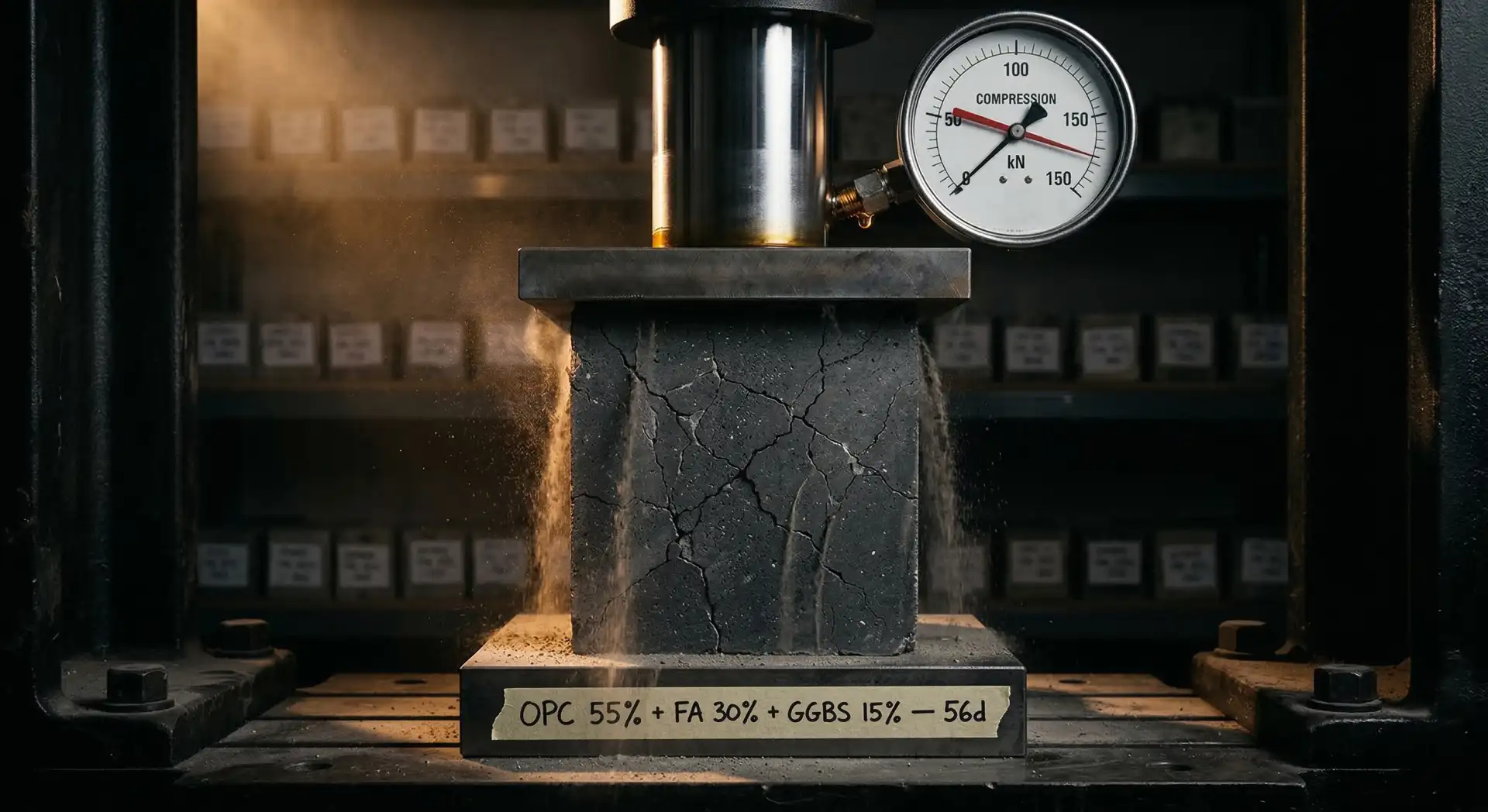
- 28-day compressive strength: 43 MPa minimum, with a single plant’s deliveries typically swinging 4 to 6 MPa above that from one month to the next
- Fineness: 225 m2/kg Blaine minimum, with typical batch-to-batch variation of 20 to 50 m2/kg
For OPC 53 grade:
- 28-day compressive strength: 53 MPa minimum, with typical batch-to-batch swing of 5 to 8 MPa
For PPC under IS 1489 (Part 1):
- 28-day compressive strength: 33 MPa minimum, with typical batch-to-batch swing of 3 to 5 MPa
- Fly ash content: 15 to 35 percent allowed, with typical variation of 5 to 10 percent within a single supplier
These variations are routine and within specification. The implication for mix design: the design strength must accommodate not just statistical mix variation but also cement variability that the project cannot directly control, which is why proportioning to IS 10262 builds a margin over the characteristic strength rather than designing to the grade itself.
What it means for mass concrete
Mass concrete is more sensitive to cement variability than general construction concrete for three reasons.
Long pour duration. Mass concrete pours often run for weeks. Cement supply changes over that time accumulate. A pour that starts with one cement chemistry may finish with another.
Optimised cement content. Mass concrete mixes are optimised for low cement content to control heat of hydration. The mix margin between design strength and minimum acceptable strength is tight. Cement variability uses up that margin.
Large pour volumes. A single off-batch of cement can affect 50 to 200 cubic metres of placed concrete before the QC system detects it. The bad concrete is buried inside the structure by the time the 28-day cube results come in.
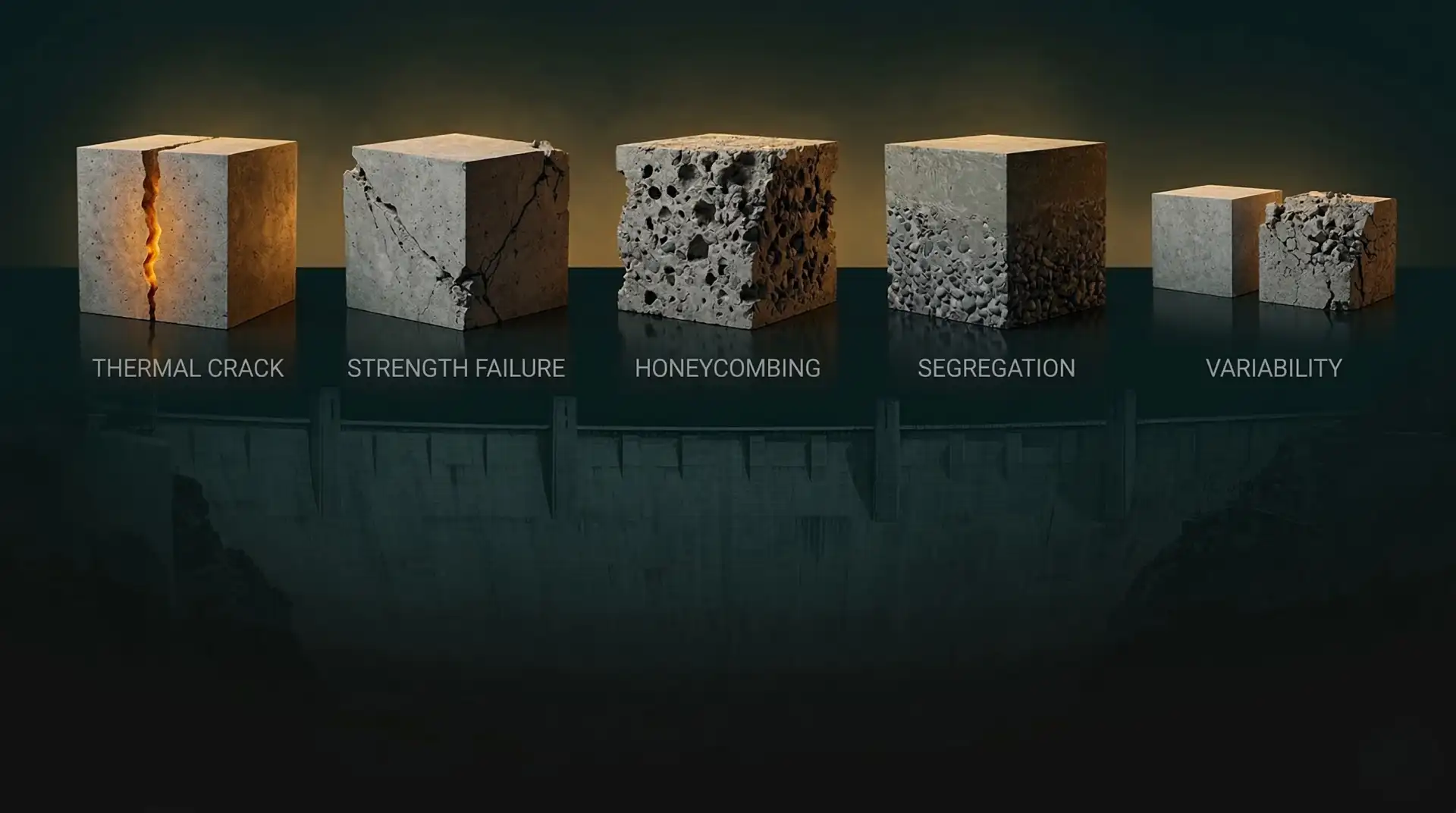
The combination is that cement variability is a more serious problem on dam projects than on general construction projects, even though the cement itself meets the same specification. It sits alongside the other recurring concrete quality problems a dam QC programme has to stay ahead of.
Five practices that manage the risk
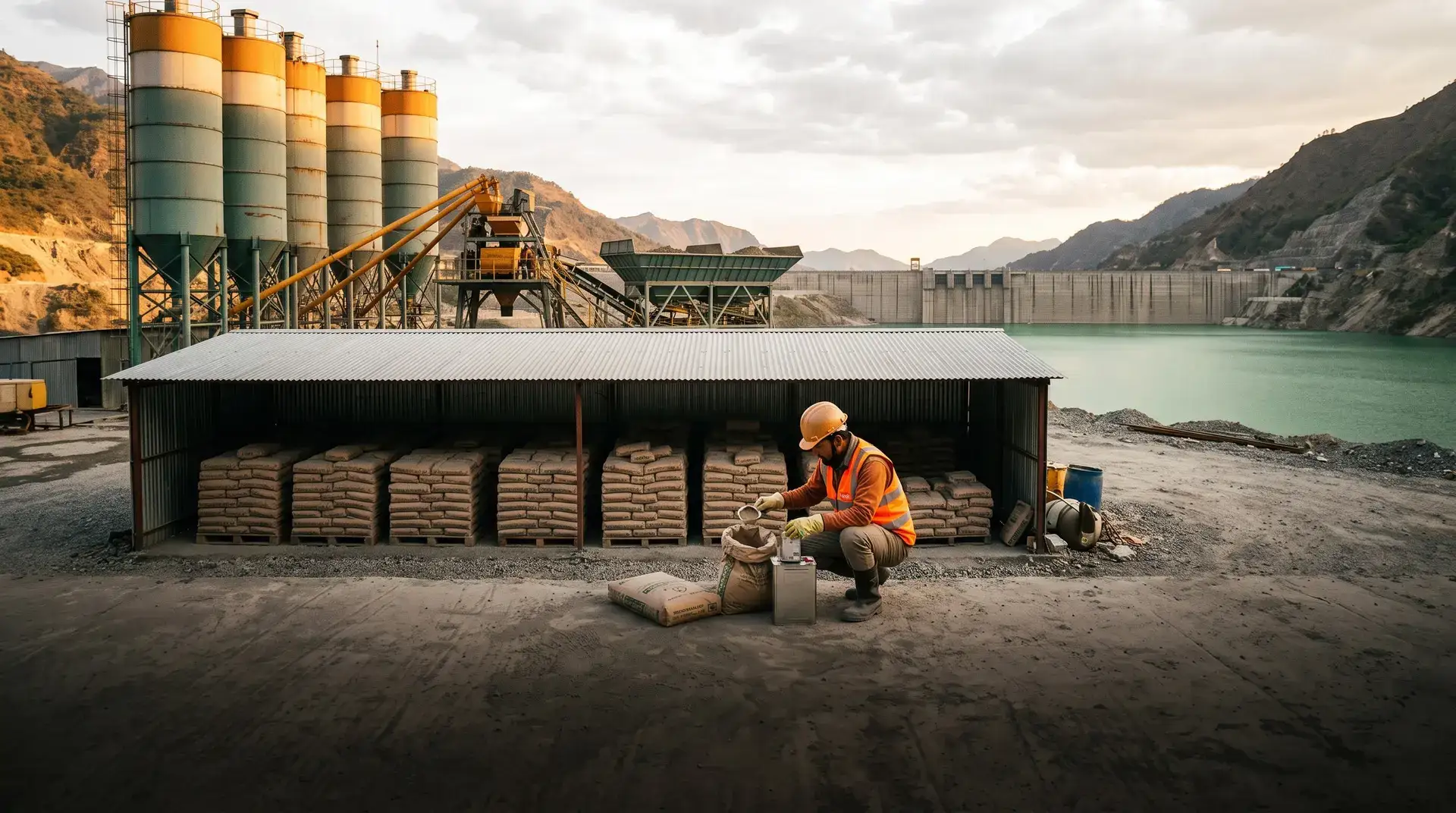
1. Routine batch testing. Every cement delivery is tested for at least: compressive strength at 1, 3, 7, and 28 days; fineness; setting time. For mass concrete projects: heat of hydration on a sample basis, soluble alkali content if AAR is a concern.
2. Cement storage and rotation. Older cement is mixed with newer cement in the storage silos to dampen variability. Storage capacity is sized for at least 7 to 14 days of consumption, allowing this rotation.
3. Mix design margin. The mix design sets a target strength above the specification minimum, with margin for cement variability. Shrinking that margin without losing reliability is the aim of cement optimization: a tighter, better-characterised supply lets a project carry less binder for the same characteristic strength.
4. 3-day cube monitoring. As described in our 3-day cube article, early-age cube testing detects cement supply changes 25 days earlier than 28-day testing. Combined with routine batch testing of cement, this gives a leading indicator of placed-concrete strength outcomes.
5. Alternative supplier qualification. At project start, an alternative cement supplier is tested and approved. If the primary supplier drifts unacceptably, the alternative can be brought in within days rather than weeks.
Cement variability is unavoidable; lack of detection is unforgivable
No QC programme can prevent cement suppliers from varying their product within specification. What a competent QC programme can do is detect the variation early, document it, and adjust the mix or the supplier as needed. Projects that monitor cement variability do not eliminate the problem; they manage it before it becomes a placed-concrete problem.
How PCCI approaches cement variability
Cement variability is a constant across the hydropower dam work behind PCCI’s leadership, whose 40+ years and 4,000+ MW of delivered concrete span the Indian and Bhutanese hydropower programmes, Tala (1,020 MW) and Karchham Wangtoo (1,000 MW) among them. On that work, cement supply-chain management was a continuous part of the concrete quality effort, not a first-delivery formality. PCCI brings the same discipline to a project’s QA/QC: routine testing of every consignment, storage rotation, mix-design margin, and an alternative supplier qualified before it is needed, run as a system.
Book a Technical Call → to discuss your project’s cement supply and variability management.